


How VCFO Helps Tech Industry Startups Control Burn and Extend Runway?
One thing a lot of tech founders learn too late is this: revenue can look fine while cash quietly slips away. A startup may have new customers, a busy team, and a better product, but the bank balance can still feel tighter every month. This is when the stress normally starts. A few extra hires, rising cloud bills, software tools nobody is using, and a bigger marketing spend can slowly push burn higher without anyone noticing in time.
This is where a VCFO helps tech industry businesses. A Virtual CFO looks at the numbers before they become a problem. They help founders see where money is going, cut waste, and make better calls on hiring, spending, and growth.
In this blog, we will look at how that support can reduce burn, improve runway, and keep growth under control.
Expert Insight from MSNA: For most tech founders we work with, it’s not a cash problem, it’s a visibility problem. They don’t know what their real burn is until it is urgent. A VCFO helps the tech industry present that number weekly, not quarterly.
Understanding Burn Rate and Runway in Tech Companies
Before discussing solutions, let’s understand why burn rate and runway are such important numbers in growing startups.
What Is Burn Rate?
Burn rate is simply the amount of cash a company spends over a given period, usually each month. For technology companies, burn can increase surprisingly fast.
- A startup hires engineers.
- Then adds salespeople.
- Invests in marketing.
- Upgrades infrastructure
- Buys new tools.
None of those decisions seems dangerous at first. The challenge is that spending rarely arrives all at once. It accumulates quietly.
Many founders don’t notice how much their monthly costs have changed until they compare today’s numbers with where they were six or twelve months ago.
There are two common methods to measure burn:
- Gross Burn Rate refers to total monthly spending.
- The Net Burn Rate is the amount of cash the company is bleeding after revenues.
Example: So let’s say a SaaS company has a recurring income of ₹ 5 lakh and monthly expenses of ₹ 15 lakh. This means the net burn rate is ₹ 10 lakh.
What Is Startup Runway?
Runway answers a simple question: How long can the company continue operating before it runs out of cash? The formula is this:
Available Cash ÷ Monthly Net Burn = Runway (in months)
If a startup has ₹1 crore in the bank and burns ₹10 lakh each month, it has roughly ten months of runway.
That figure affects nearly every big choice.
- Hiring.
- Fundraising.
- Expansion.
- Product investments.
- New initiatives.
When founders know exactly how much time they have, decisions become easier to evaluate.
Why Tech Startups Often Run Into Cash Challenges?
Most startups don’t get into trouble because they’re spending irresponsibly. They get into trouble because growth rarely follows the plan.
- Revenue arrives later than expected.
- Customer acquisition becomes more expensive.
- Enterprise agreements are harder to get done.
- Fundraising deadlines drag on.
- Markets evolve.
If founders fail to plan and check their money on a regular basis, they may find themselves responding to cash troubles rather than preventing them. That’s one reason VC-backed startup runway management has become a major focus for investors and leadership teams alike.
How VCFO Helps Tech Industry Businesses Reduce Burn Rate?
Reducing burn isn’t about cutting costs everywhere. A VCFO for the tech industry understands which costs are helping the business grow and which costs are simply accumulating.
Identifying Unnecessary Operational Costs
Most startups collect expenses the same way garages collect old boxes. Months later, the company is paying for things that no longer create meaningful value.
A Virtual CFO reviews spending with fresh eyes. They look for:
- Unused software licenses.
- Duplicate tools.
- Excess cloud spending.
- Inefficient vendor contracts.
- Marketing channels with weak returns.
Expert Tip from MSNA: In our experience, the first cloud audit we perform for a SaaS client typically uncovers 15-25% in recoverable spend within 60 days. These aren’t dramatic cuts; these are tools that auto-renewed and campaigns that nobody looked at after the first quarter.
Individually, these costs may seem small. Together, they can quietly drain the runway.
Improving Unit Economics
A startup can grow rapidly and still create financial pressure if customer acquisition costs are too high or retention is too low.
For that reason, smart finance directors keep an eye on key SaaS financial metrics, including:
- Customer Acquisition Costs (CaC)
- Customer lifetime value LTV.
- Gross profits
- Retention ratio.
These measurements tell us whether expansion is adding value or just eating cash. A Virtual CFO helps founders understand where those numbers are improving and where they need attention.
Aligning Spending With Growth Goals
One of the easiest mistakes to make during periods of momentum is assuming growth will continue indefinitely.
- Founders hire ahead of demand.
- Marketing budgets expand aggressively.
- New initiatives launch simultaneously.
- Everything feels justified because growth is happening.
A Virtual CFO introduces discipline into these decisions. Not by slowing the company down. By making sure spending is tied to measurable outcomes and realistic assumptions.
Navigating Tax and Compliance Without Losing The Cash
Many tech businesses focus on product and growth, but ignore modest tax and compliance issues that quietly drain revenue.
- GST Compliance: Filing GST returns and renewing LUT for their global customers on a regular basis allows SaaS companies to improve the availability of working capital and avoid delays in refunds.
- Section 80-IAC of The Income-tax Act, 1961 – Startup Tax Holiday: The VCFO helps the eligible companies to obtain the exemption they are entitled for in law. DPIIT’s Startup India scheme allows eligible startups to claim a 100% deduction of profits and gains derived from eligible business activities for any three consecutive assessment years out of ten years from incorporation
Important requirements to qualify:
- Incorporated on or after April 1, 2016 and before March 31, 2030 (deadline extended).
- LLP or Registered as a Private Limited Company.
- Revenue of a year not exceeding ₹100 crore.
- Must include new products, services or scalable processes.
Expert Tip from MSNA: We meet many founders who have never applied for 80-IAC. They think they are not eligible or that it is a complicated process. In reality, if you are DPIIT recognised and have reported profits in any year in your first decade, this exemption can save crores in tax. It is the most under-leveraged financial benefit in the Indian startup ecosystem.
- Managing Software Costs Globally: Most of the tech organizations use tools like AWS, GitHub, and Salesforce. A VCFO may help ensure TDS and other compliance are done correctly, therefore decreasing the chance of penalties and unexpected fees down the road.
How VCFO Helps The Tech Industry Manage Runway More Effectively?
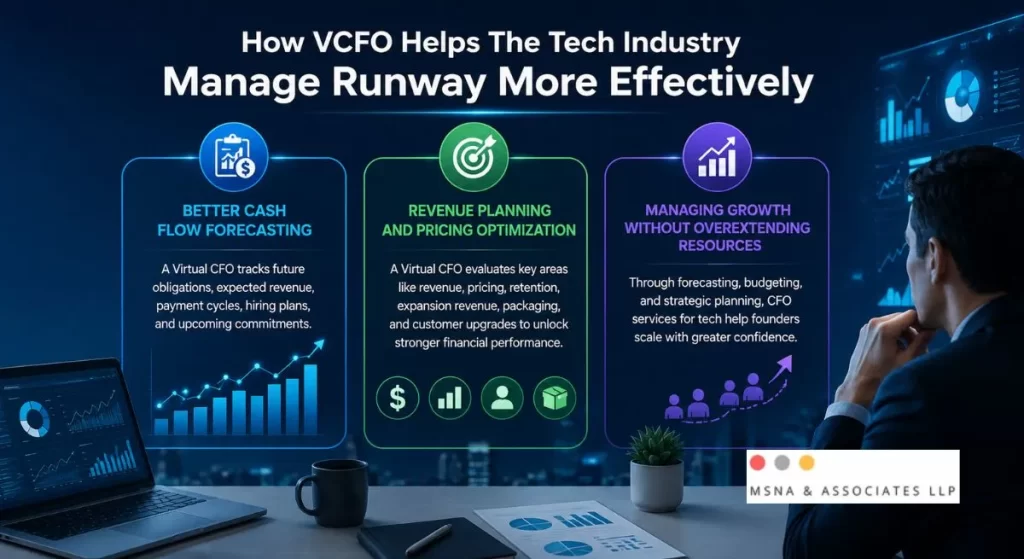
Reducing burn is only part of the equation. Improving the runway requires a broader financial strategy. A VCFO helps the tech industry in:
Better Cash Flow Forecasting
The difficulty is that entrepreneurs are usually too busy running the business to realize cash problems early on.
A Virtual CFO tracks future obligations, expected revenue, payment cycles, hiring plans, and upcoming commitments.
Revenue Planning and Pricing Optimization
Many startups immediately look for expenses to cut when the runway becomes a concern. Sometimes the bigger opportunity sits elsewhere.
- Revenue.
- Pricing.
- Retention.
- Expansion revenue.
- Packaging.
- Customer upgrades.
A Virtual CFO evaluates these areas to identify opportunities that strengthen financial performance.
Managing Growth Without Overextending Resources
Growth should make a company stronger. Not more fragile. Through forecasting, budgeting, and strategic planning, CFO services for tech help founders scale with greater confidence.
Key Financial Metrics VCFO Helps Tech Industry Businesses Track
| Metric | Why It Matters | 2026 Benchmark |
|---|---|---|
| Burn Multiple | Revenue is growing, but is it costing too much to get there? This metric helps answer that. | Below 1.5x at Series A |
| CAC (Customer Acquisition Cost) | Bringing in customers costs money. CAC shows how much you’re spending to win each one. | Varies by segment |
| LTV:CAC Ratio | Not every customer stays. LTV shows how much value a customer brings before they leave. | Above 3:1 |
| Gross Margin | Sales can look great on paper. Gross margin shows how much money actually stays in the business. | 70%+ for SaaS |
| Runway | This is the number founders check when cash starts feeling tight. It shows how long the business can keep going with available funds. | 24–30 months |
| MRR/ARR | One good month means little. Consistent recurring revenue tells a much bigger story. | Month-on-month growth |
| Churn Rate | Customers leaving quietly can hurt growth. Churn helps you spot that problem early. | Below 5% monthly |
What Does a VCFO Do for Tech Industry Businesses?
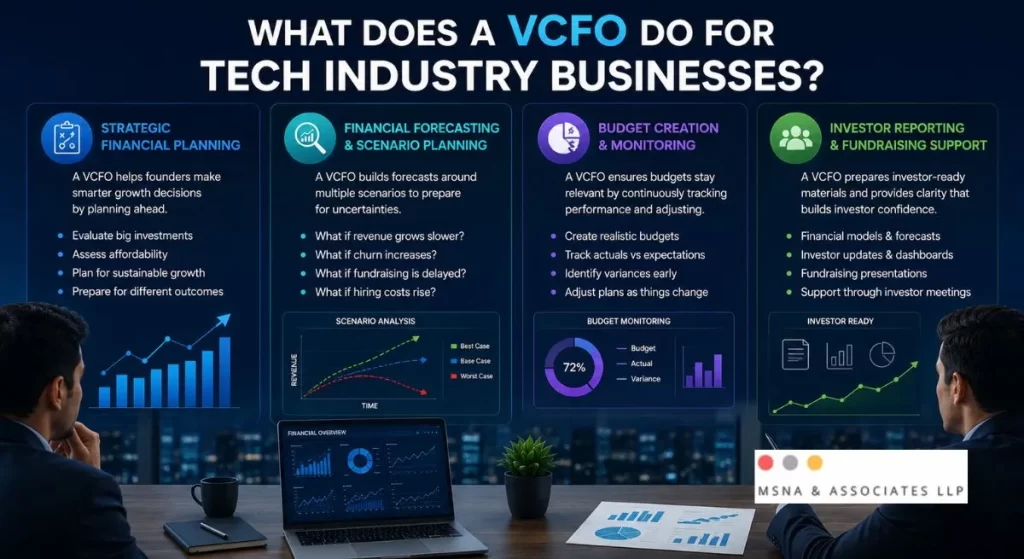
A Virtual CFO operates much closer to strategic decision-making. Their job isn’t just to report numbers. Their job is to help founders understand what those numbers mean.
Strategic Financial Planning
Every startup eventually reaches a point where growth decisions become expensive. Hiring plans become larger. Marketing budgets increase. Product investments require bigger commitments.
At that stage, the question isn’t simply: “Can we afford this?”
The better question is: “What happens if our assumptions are wrong?”
A Virtual CFO helps founders think through those scenarios before money gets committed.
Financial Forecasting and Scenario Planning
One of the biggest advantages of financial planning for SaaS companies is visibility. Founders rarely struggle because they lack ambition. They struggle because of uncertainty.
A Virtual CFO builds forecasts around multiple outcomes rather than relying on a single optimistic projection.
Questions often include:
- What happens if revenue grows more slowly than expected?
- What happens if churn increases?
- What happens if fundraising takes six months longer?
- What happens if hiring costs rise?
Budget Creation and Monitoring
Most startup budgets are accurate for about five minutes. Then reality shows up.
- Priorities change.
- Markets change.
- Customers change.
- The business changes.
That’s why budgeting isn’t a once-a-year thing. A virtual CFO regularly reviews spending vs expectations and helps leadership teams to make adjustments as things change.
Investor Reporting and Fundraising Support
Fundraising becomes much easier when founders understand their numbers. A Virtual CFO helps the tech industry helps prepare financial models, investor updates, forecasts, and fundraising materials that support those conversations.
More importantly, they help founders walk into investor meetings knowing exactly where the company stands.
8 Warning Signs It's Time to Hire a Virtual CFO for Tech Startups
Most founders don’t bring on a strategic finance partner until there’s a problem. These are the red flags that action needs to be taken:
- You don’t know what your actual net burn rate is right now, without looking at a spreadsheet.
- Your runway calculation is almost 4 weeks old.
- You employed 3+ individuals in the last quarter without a clear headcount model.
- Your cloud or SaaS tool spend is up over 20% YoY and revenue has not kept pace.
- You’re walking into investors with less than 9 months of runway left.
- You are eligible for DPIIT recognition and 80-IAC tax exemption but have not applied.
- At your previous board meeting, there was no cash flow forecast, only P&L.
- You’ve never done a formal scenario analysis (best case/ base case/ survival mode).
From MSNA: A founder with confidence and speed can answer all these questions, indicating a solid financial base. Most Series A entrepreneurs can only answer three of these without pausing. VCFO helps the tech industry fill that gap.
Benefits of Hiring a Virtual CFO Instead of a Full-Time CFO
For many startups, a full-time CFO isn’t the right move yet. The need for strategic financial guidance exists. The budget often doesn’t. That’s why many growing companies choose fractional CFO services.
A Virtual CFO provides founder-level leadership and experience without the need to recruit a full-time CFO.
The company receives strategic support when needed while maintaining flexibility as it grows.
How VCFO Helps Tech Industry Build Smarter Growth with MSNA?
In the end, growth only works when the numbers hold up too. Virtual CFO Services in India help tech industry companies keep burn under control, monitor runway closely, and make steadier decisions as the business scales. It is not about cutting every cost. It is about spending more care and seeing problems early.
For founders who want that kind of financial clarity without building a full in-house finance team, professional firms like MSNA can be a practical support partner in the background.
Need Better Financial Visibility for Your Tech Startup?
Related
Discover more from MSNA & Associates LLP
Subscribe to get the latest posts sent to your email.