


Two founders at a networking event in Dubai were both wrestling with the same problem: month-end reporting. One had books closed and reports out within a week; the other was still chasing invoices weeks later.
The difference was an outsourced accounting team in India versus an in-house function stretched thin.
It’s a familiar bind for founder-led and NRI-led businesses in the Gulf. More transactions, more payroll, more reporting, and at some point a small internal team just can’t keep up. That’s the gap accounting outsourcing to India is filling: a way to grow the finance function without growing headcount at the same rate.
In this guide, we explain how accounting outsourcing from the UAE to India works, covering the process, cost, technology, reporting structure, implementation timeline, and benefits.
What Do Accounting Outsourcing Services to India Actually Include?
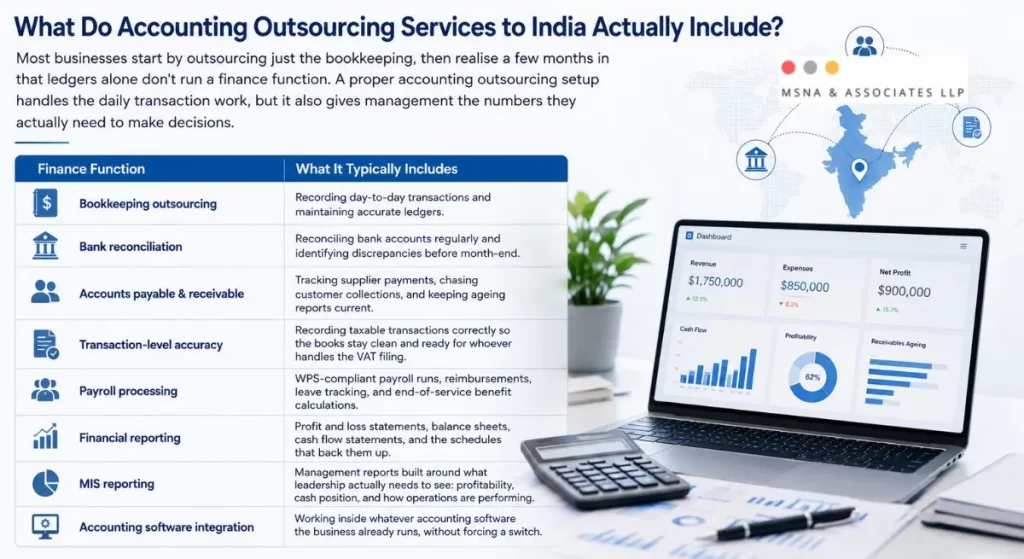
Most businesses start by outsourcing just the bookkeeping, then realise a few months in that ledgers alone don’t run a finance function. A proper accounting outsourcing setup handles the daily transaction work, but it also gives management the numbers they actually need to make decisions.
| Finance Function | What It Typically Includes |
|---|---|
| Bookkeeping outsourcing | Recording day-to-day transactions and maintaining accurate ledgers. |
| Bank reconciliation | Reconciling bank accounts regularly and identifying discrepancies before month-end. |
| Accounts payable & receivable | Tracking supplier payments, chasing customer collections, and keeping ageing reports current. |
| Transaction-level accuracy | Recording taxable transactions correctly so the books stay clean and ready for whoever handles the VAT filing. |
| Payroll processing | WPS-compliant payroll runs, reimbursements, leave tracking, and end-of-service benefit calculations. |
| Financial reporting | Preparing profit and loss statements, balance sheets, cash flow statements, and supporting schedules. |
| MIS reporting | Delivering management reports focused on profitability, cash position, and operational performance. |
| Accounting software integration | Working within the business’s existing accounting software without requiring a platform switch |
If the scope only covers bookkeeping but management is expecting analytical reports and decision-ready insights, that mismatch shows up fast, and usually at the worst time. Getting the scope written down clearly at the start saves both sides from that conversation later.
How the Process Works: Step by Step
A successful accounting outsourcing India engagement follows a structured finance workflow rather than simply transferring bookkeeping work between two teams. Businesses that Outsource Accounting & Bookkeeping Services to India for UAE Businesses typically establish standardised processes from the beginning, ensuring consistent reporting, stronger financial controls, and clear accountability across both locations. This is where the provider looks past the accounting software itself, at transaction volumes, reporting requirements, payroll cycles, and however month-end close is currently being handled. Scope, reporting frequency, and who signs off on what all get decided here, before anyone touches the books.
2. Secure Document Collection and System Access
Invoices, bank statements, receipts, and payroll records move through a shared cloud folder, or get pulled straight in through software integrations and bank feeds where those are set up. Both teams end up looking at the same information instead of chasing attachments back and forth.
3. Transaction Processing and Reconciliation
Transactions get recorded, banks get reconciled, journal entries get posted, payroll runs, and supporting schedules stay current through the month rather than piling up. If something doesn’t add up or a document’s missing, it gets logged and sent back to the UAE finance contact right away, so it’s sorted well before month-end instead of holding up the reports later. Because reconciliation happens continuously rather than only at month-end, finance teams spend less time correcting prior-period issues and more time reviewing current performance.
4. Internal Review and Quality Control
A senior accountant reviews the numbers before reports are issued. Reconciliations get checked, anything unusual gets pulled aside and looked at properly, and reporting standards get applied the same way every month rather than varying by who did the work.
5. Monthly Reporting and Management Review
Once the books close, the reporting package comes together: financial statements, reconciliation summaries, ageing schedules, MIS reports, and commentary on whatever moved significantly that month. Most UAE businesses pair this with a monthly call where the finance head or controller can ask questions, push back on anything unclear, and sign off before the numbers go anywhere else.
Building a Reporting Calendar That Works Across the Time Difference
One aspect that many founders overlook is how reporting calendars are coordinated between UAE businesses and their outsourced accounting teams in India. An outsourced team works on IST, just 1.5 hours ahead of Gulf Standard Time – a gap small enough that the working day overlaps almost entirely if the close calendar is built around it deliberately.
In practice, this means setting the internal book-close date several working days before any reporting deadline, scheduling reconciliation cut-offs within the shared working window (roughly 9 AM to 3 PM GST), and treating day-to-day entries as a running task through the month rather than a backlog cleared at the last minute.
Most delays in an outsourced accounting engagement trace back to a close calendar that was never explicitly agreed, not to the accounting work itself.
How Much Do Accounting Outsourcing Services to India Cost?
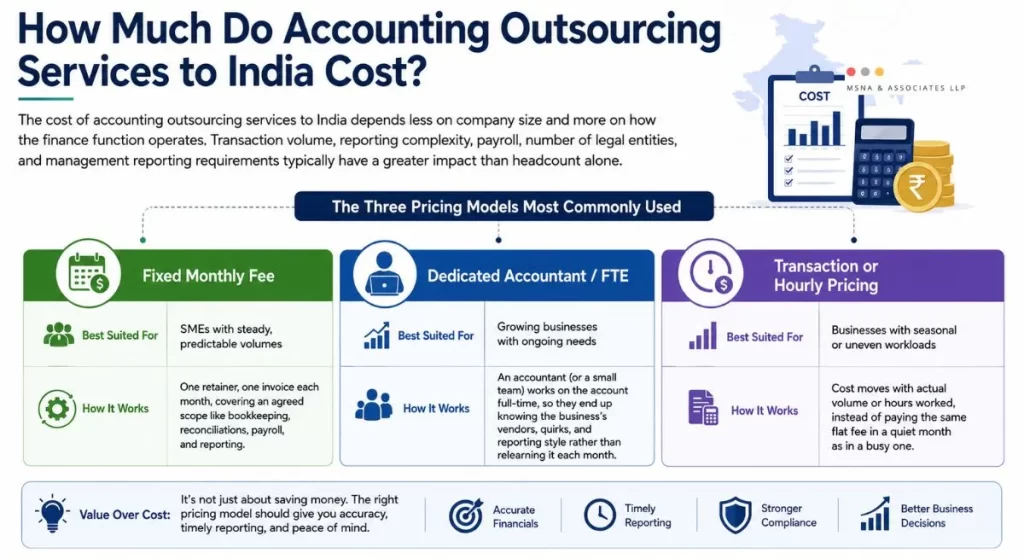
The cost of accounting outsourcing services to India depends less on company size and more on how the finance function operates. Transaction volume, reporting complexity, payroll, number of legal entities, and management reporting requirements typically have a greater impact than headcount alone.
The three pricing models below are the most commonly used.
| Pricing Model | Best Suited For | How It Works |
|---|---|---|
| Fixed Monthly Fee | SMEs with steady, predictable transaction volumes | A fixed monthly retainer covers an agreed scope of services, such as bookkeeping, bank reconciliations, payroll processing, and financial reporting. |
| Dedicated Accountant / FTE | Growing businesses with ongoing accounting needs | A dedicated accountant or finance team works exclusively on your account, gaining familiarity with your business, vendors, processes, and reporting requirements. |
| Transaction or Hourly Pricing | Businesses with seasonal or fluctuating workloads | Fees are based on the number of transactions processed or hours worked, allowing costs to vary with business activity instead of paying a fixed monthly amount. |
Regardless of the pricing model, it’s worth asking for a detailed proposal upfront, one that lays out the scope of work, how often reporting will happen, and who’s accountable for reviewing the numbers before they reach you. Turnaround times should be spelled out too. This keeps expectations aligned from the start and makes it far easier to weigh one provider against another.
How Accounting Outsourcing Services to India Ensure Secure Technology Integration?
One common misconception is that outsourcing accounting requires businesses to migrate to a new accounting platform. In practice, most outsourcing providers work within the software the business already uses , commonly Zoho Books, QuickBooks Online, Tally, or Xero, connected through:
- Cloud access with role-based permissions, so the outsourced team has exactly the access level needed and nothing more.
- Bank feed integration, where supported, to reduce manual statement uploads.
- Document management tools for invoice and receipt storage, tagged against the relevant ledger entries.
- Shared dashboards for real-time visibility into cash position and outstanding items, rather than waiting for month-end to see where things stand.
Data security is a legitimate concern raised by most UAE finance heads at the diligence stage, and it is worth confirming directly with any provider: where data is hosted, who has access, and what the data retention and deletion policy looks like once the engagement ends. Providers hosting client data on ISO/IEC 27001-certified infrastructure offer a useful baseline to check against during due diligence.
Establishing Communication and Reporting for Accounting Outsourcing Services to India
The reporting cadence should be set explicitly at the start of the engagement, not left to default to “whenever it’s ready.” A typical structure looks like:
| Frequency | Typical Deliverables |
|---|---|
| Daily / Weekly | Bank reconciliation updates, transaction status reports, and resolution of outstanding accounting queries. |
| Monthly | Profit & Loss Statement, Balance Sheet, Cash Flow Statement, MIS reports, ageing reports, and management review meetings. |
| Quarterly | Detailed reconciliation reviews, financial performance analysis, and strategic finance discussions. |
| Annually | Year-end financial close, audit support, financial statement preparation, and compliance-related assistance. |
A single point of contact on the Indian side, rather than a rotating pool of accountants, makes this cadence easier to hold to and reduces the number of times context has to be re-explained.
Why Do UAE Businesses Outsource Accounting to India?
Lower operating costs often start the conversation, but businesses usually continue with accounting outsourcing because month-end becomes more predictable, reporting improves, and finance teams spend less time fixing accounting records after the fact. Many of these advantages are equally relevant for global businesses, as explained in our guide on Benefits of Outsourcing Accounting to India for US Businesses.
- Reporting gets more reliable. Consistent reconciliation and a proper review process before anything goes out catches errors that would otherwise slip through.
- Month-end stops being a scramble. When transactions are processed throughout the month instead of piling up, closing the books stops being a last-minute push.
- Access to accountants who’ve done this before. Payroll, financial reporting, management reporting, the kind of work that benefits from someone who’s handled it for other UAE businesses, not just learning it on the job.
- The team scales without a hiring cycle. As volume grows, more support gets added to the engagement instead of triggering a recruitment process.
- Internal teams get their time back. Less of it goes into routine processing, more into actually looking at the numbers and what they mean for the business.
- Performance becomes easier to see. Reporting that shows up consistently, month after month, makes it much easier to spot trends instead of reacting to surprises.
How to Choose the Right Accounting Outsourcing Partner in India?
The quality of an outsourced accounting engagement depends less on the size of the provider and more on the structure of its review process, reporting discipline, and familiarity with UAE compliance requirements. Worth checking before signing anything:
- Have they actually worked with UAE businesses before, or is this new territory for them?
- Is there a dedicated accountant or team on the engagement, or does it rotate?
- What does their review process look like before a report reaches you?
- Do they work in the software and ERP platforms you’re already using?
- How often will reports actually land, and in what format?
- If something’s unclear in a transaction, how does that query get raised and resolved?
A partner who understands both Indian accounting practices and how UAE businesses operate day to day can support more than basic bookkeeping. At MSNA & Associates, this is the structure we build with UAE clients: a defined accounting workflow, a reporting calendar that holds up, and records that stay audit-ready throughout the year.
When Outsourced Accounting Isn't Right Fit ?
Outsourcing works best when transaction volume is high enough to justify a structured handoff. A very early-stage business with a handful of monthly transactions may find a part-time in-house bookkeeper simpler until volume grows. Businesses needing same-day, in-person access to their finance team for board meetings or investor due diligence may also prefer to keep at least a lean function in-house, using outsourcing to support rather than replace it
Accounting Outsourcing Services to India: Implementation Timeline and What to Expect
Although every business is different, most accounting outsourcing engagements follow a similar implementation timeline.
| Timeline | What Typically Happens |
|---|---|
| Weeks 1–2 | Access is set up, the chart of accounts and existing finance processes are reviewed, and reporting requirements are finalised before day-to-day accounting activities begin. |
| Weeks 3–4 | Historical reconciliations are completed, outstanding backlogs are cleared, and work is carried out alongside the existing finance team to ensure a smooth transition without disruptions. |
| Month 2 | Regular accounting operations are fully underway, and the first complete monthly financial reporting package is prepared and delivered. |
| Month 3 Onwards | Reporting processes are refined, management dashboards are customised, and accounting workflows become fully integrated with the business’s ongoing operations. |
By this stage, finance teams usually spend considerably less time following up on missing documents because responsibilities and reporting timelines have become routine.
What Changes After Choosing Accounting Outsourcing Services to India?
Once the engagement stabilises, the shift a UAE finance head typically notices is less about cost and more about predictability. Books close on a fixed date each month instead of drifting. And the controller or CFO gets a consistent MIS reporting package that supports decisions, instead of raw ledger data that needs to be interpreted before it’s useful.
Why Accounting Outsourcing Services to India Are a Smart Long-Term Investment?
For UAE businesses, accounting outsourcing services to India have evolved beyond a cost-saving measure. Get the workflows, reporting schedule, technology, and team right, and outsourcing turns into a genuinely more efficient and predictable finance function, not just a cheaper version of what was already there.
The real value lies less in transaction processing itself and more in what it enables: timely financial reporting, accurate books that hold up to scrutiny, and information management that can actually act on. Businesses that outline their expectations clearly and choose a partner with the right technical depth tend to build a finance function that scales with them rather than one they outgrow.
If you’re evaluating outsourced accounting support for your UAE operations, you can reach the MSNA team at contact@msna.co.in to walk through how this would work for your reporting volume and existing software setup
Need Reliable Accounting Outsourcing Support for Your UAE Business?
FAQs Related To Accounting Outsourcing Services to India
Is accounting outsourcing to India suitable for a UAE free zone company?
Yes, the day-to-day accounting workflow, bookkeeping, reconciliation, and reporting, is broadly the same for free zone and mainland entities.
Does outsourcing accounting to India mean losing control over financial data?
No, if the access and hosting terms are settled before the engagement starts. The UAE entity still owns the software and the data sitting in it. The outsourced team gets a role-based login into that same system, so they’re working inside the business’s own environment rather than pulling records out into a separate one.
Can a dedicated accounting team in India also support UAE payroll processing?
Yes , Payroll is usually handled within the same engagement as bookkeeping and reporting, since both draw on the same records. This covers WPS-compliant payroll runs and end-of-service benefit calculations.
How long does it take to see clean, audit-ready books after outsourcing?
Most businesses clear the backlog within the first month. Monthly reporting then settles into a steady rhythm from the second month onward.
Related
Discover more from MSNA & Associates LLP
Subscribe to get the latest posts sent to your email.