

If you’re a US founder registering a private limited company in India, one requirement trips up almost everyone: you need a director who spent 182 days in India last year, even if you own 100% of the company.
Under the Companies Act, 2013, a private limited company lets a US citizen or US-based entity hold up to 100% ownership in most sectors, open a real Indian bank account, sign contracts locally, and hire employees on Indian payroll. LLPs and branch offices carry more friction on foreign ownership and investor access, which is why most founders default to this structure the moment they plan to raise capital or hire a team.
American firms are projected to anchor around 350 new Global Capability Centres in India by 2030, as companies move beyond cost arbitrage toward engineering, product, and finance functions built locally. For a US business India setup, the entity you register on day one shapes how easily that operation scales.
Here’s exactly how the SPICe+ process works, what it costs, how long it takes, and what to file after incorporation so a funding round doesn’t stall on paperwork later.
What Is a Private Limited Company Under Indian Law?
A private limited company is a distinct legal person under the Companies Act, 2013, separate from the people who own or run it. It exists as its own legal entity, separate from you as founder. That’s what protects your personal assets if the business runs into trouble, you’re only on the hook for what you put in as share capital. And it doesn’t dissolve just because a director resigns or a shareholder sells out.
It needs a minimum of two directors and two shareholders (up to 200 shareholders), at least one director resident in India, and current law sets no mandatory minimum paid-up capital.
Which India Entity Actually Fits a US Founder?
US founders weighing foreign founder company registration India options usually compare three routes:
| Business Structure | Foreign Ownership | Best Suited For | Key Limitation |
|---|---|---|---|
| Private Limited Company | Up to 100% foreign ownership under the automatic route in most sectors | Startups, SMEs, subsidiaries of US companies, and venture-backed businesses planning to hire employees or raise investment | Requires at least one director who qualifies as an India-resident director under the Companies Act, 2013 |
| Limited Liability Partnership (LLP) | Foreign investment is permitted, but FDI may require the government approval route depending on the sector and conditions | Consulting firms, professional services businesses, and companies not seeking institutional funding | Less preferred by venture capital and private equity investors, making fundraising more difficult |
| Branch Office / Liaison Office (FEMA Route) | Not a separate legal entity; operates as an extension of the foreign parent company | Companies establishing a representative presence, market research, or liaison activities without local commercial operations | Requires RBI approval, is subject to FEMA regulations, and has restricted business activities with no independent legal identity |
A private limited company is the only structure of the three that Indian and global investors are actually set up to invest in cleanly, and it caps shareholder liability at unpaid share capital. For an India subsidiary registration with employees and future funding rounds, this is the practical default.
What Is the Cost and Timeline for Private Limited Company Registration in India?
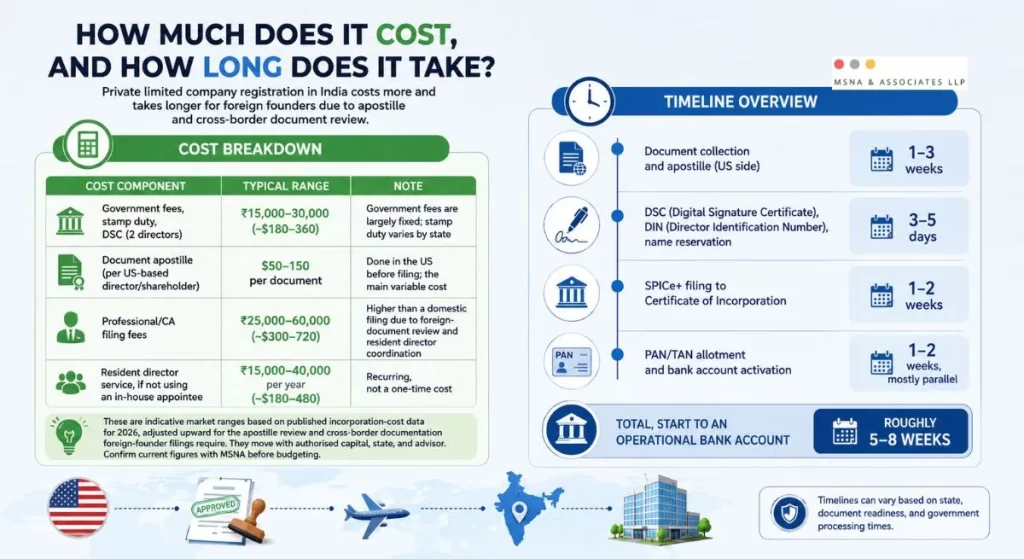
This is the question every reader wants answered before they commit. Private limited company registration in India costs run higher than a domestic filing because of apostille and cross-border document review, and the timeline runs longer for the same reason.
| Cost Component | Typical Cost Range | Notes |
|---|---|---|
| Government Fees, Stamp Duty & DSC (2 Directors) | ₹15,000–30,000 (≈ US$180–360) | Government fees are largely fixed, while stamp duty varies based on the state of incorporation. |
| Document Apostille (Per US-Based Director/Shareholder) | US$50–150 per document | Documents must be apostilled in the United States before filing. This is the primary variable cost for foreign founders. |
| Professional/CA Filing Fees | ₹25,000–60,000 (≈ US$300–720) | Higher than domestic incorporation due to foreign document verification, regulatory compliance, and resident director coordination. |
| Resident Director Service (If Required) | ₹15,000–40,000 per year (≈ US$180–480) | An annual recurring cost if the company appoints a professional resident director instead of an in-house appointee. |
These are indicative market ranges based on published incorporation-cost data for 2026, adjusted upward for the apostille review and cross-border documentation foreign-founder filings require. They move with authorised capital, state, and advisor. Confirm current figures with MSNA before budgeting.
| Phase | Typical Duration |
|---|---|
| Document Collection & Apostille (US Side) | 1–3 weeks |
| Digital Signature Certificate (DSC), Director Identification Number (DIN) & Company Name Reservation | 3–5 business days |
| SPICe+ Filing to Certificate of Incorporation (COI) | 1–2 weeks |
| PAN/TAN Allotment & Bank Account Activation | 1–2 weeks (largely completed in parallel) |
| Total Timeline (From Start to Operational Bank Account) | Approximately 5–8 weeks |
Before this stage begins, ensure all director documents are ready and properly authenticated. If you’re unfamiliar with these requirements, read our detailed guide on ,NRI Company Registration in India: DIN, DSC & Documents Explained
The apostille step in the US, not the MCA review in India, is usually the longest single item on this timeline. Starting document collection before anything else is filed is the biggest lever founders have over their own schedule
Can a US Citizen Own 100% of an Indian Company?
Yes, in most sectors. Company registration in India for US citizens doesn’t require an Indian partner or minimum local shareholding.
US individuals and US parent companies can hold full equity through the automatic route; no prior RBI approval needed. That covers most sectors a founder is likely to be in. A handful don’t: defense tops out at 74% automatic, above that you need government approval, and print media and multi-brand retail have their own caps and clearance requirements. Worth checking where your sector actually falls before you file, not after.
During private limited company registration in India, this requirement applies regardless of ownership percentage:
- Section 149(3), Companies Act, 2013 requires every Indian company to have at least one director who stayed in India for 182 days or more in the prior financial year.
- A 100% US-owned company still needs this resident director on the board.
- Founders typically meet this through a resident director service or a trusted India-based colleague, while keeping control through shareholding and board composition.
Understanding the SPICe+ Process for Private Limited Company Registration in India
SPICe+ (Simplified Proforma for Incorporating Company Electronically Plus) is the Ministry of Corporate Affairs’ single integrated form for foreign company incorporation in India. It now bundles most new-company registrations into one filing through the linked AGILE-PRO-S workflow.
| Step | What Happens | Who It Involves |
|---|---|---|
| 1. Digital Signature Certificate (DSC) | Apostille-backed identity verification is completed, and a Digital Signature Certificate is issued for each director. | All directors, including US-based directors |
| 2. Director Identification Number (DIN) | A Director Identification Number (DIN) is applied for directly through the SPICe+ form for most first-time directors. | Every proposed director |
| 3. Company Name Reservation | SPICe+ Part A is filed to reserve the proposed company name with the Ministry of Corporate Affairs (MCA). | Applicant or authorised agent |
| 4. SPICe+ Part B Filing | Details of directors, shareholders, registered office, authorised share capital, e-MOA, and e-AOA are submitted through SPICe+ Part B. | Company secretary, chartered accountant, or incorporation advisor |
| 5. Certificate of Incorporation (COI) | The Registrar of Companies (RoC) issues the Certificate of Incorporation, while PAN and TAN are allotted automatically as part of the incorporation process. | Registrar of Companies (RoC) |
Each of these five steps can be filed remotely. No US founder or director needs to travel to India to complete incorporation, provided documents are apostilled correctly ahead of time.
What Documents Do US Founders Need to Prepare For Private Limited Company Registration in India?

For individual directors and foreign shareholders:
- Passport copy, apostilled under the Hague Convention (the US is a signatory)
- Proof of address, apostilled
If the shareholder is a US company:
- Certificate of incorporation of the US entity, apostilled
- MOA (Memorandum of Association )/AOA (Articles of Association ) or bylaws of the US entity, apostilled
- Board resolution authorising the India investment, apostilled
For the registered office in India:
- Lease or ownership document
- No-objection letter from the property owner
The most frequent cause of delay isn’t missing documents, it’s improperly authenticated ones. Indian authorities apply the apostille requirement strictly, and a notarized-only copy isn’t treated as equivalent.
How Do US Founders Open a Bank Account for the Indian Subsidiary?
You can’t open the bank account until the Certificate of Incorporation is issued and PAN is allotted. Banks in India won’t activate a current account without both in hand. Most banks expect the resident director or an authorised signatory to complete in-person verification at a branch, though several private banks now support video KYC for non-resident directors and shareholders.
Treat this as a scheduling item, not an afterthought. A subsidiary with no operating bank account cannot receive FDI inflows, pay vendors, or run local payroll, which stalls everything downstream of incorporation.
What Registrations Follow Right After Incorporation?
| Registration | When It Applies | Filed Through |
|---|---|---|
| PAN and TAN | Automatically allotted as part of the company incorporation process | SPICe+ |
| GST Registration | Mandatory when turnover exceeds the prescribed threshold or immediately for inter-state supplies, e-commerce, or SaaS-based businesses requiring GST registration | AGILE-PRO-S / GST Portal |
| EPFO and ESIC Registration | Applicable once the business reaches the statutory employee threshold prescribed under each scheme | AGILE-PRO-S |
| Professional Tax Registration | Applicable depending on the state in which the registered office or business operates | Respective State Government Portal |
| FDI Reporting (Form FC-GPR) | Must be filed within 30 days of share allotment after receiving foreign direct investment (FDI) | Reserve Bank of India (RBI) through an Authorised Dealer (AD) Bank |
FEMA compliance is the piece US founders miss most often, usually assuming the wire transfer itself completes RBI reporting when FC-GPR is a separate filing. Missing it doesn’t stop daily operations, but it builds compounding FEMA penalty exposure and can surface as a red flag in a later funding round’s due diligence.
What Annual Compliance Applies After the First Year?
| Compliance Filing | Applicable Form / Requirement | Frequency |
|---|---|---|
| Financial Statements | Form AOC-4 | Annual |
| Annual Return | Form MGT-7 / MGT-7A (as applicable) | Annual |
| Statutory Audit | Audit conducted by a practicing Chartered Accountant | Annual |
| Annual General Meeting (AGM) | Board and shareholder meeting with statutory records maintained | Annual |
| Income Tax Return | Form ITR-6 | Annual |
| Foreign Liabilities and Assets (FLA) Return (Applicable if the company has received FDI) | RBI Foreign Liabilities and Assets (FLA) Return | Annual (Filed separately from Form FC-GPR) |
None of these filings are individually burdensome. Late filings carry per-day penalties, not per-cycle ones. So a small delay in year one can become an expensive cleanup by year three. Building this into the operating calendar from incorporation avoids that.
Does the US Parent Need to Worry About Transfer Pricing During Private Limited Company Registration in India?
Yes, the moment money starts moving between the subsidiary and the US parent, whether that’s management fees, cost allocations, or royalties, India’s transfer pricing rules kick in. You can’t just set a number that’s convenient for the group. It has to reflect what an unrelated party would actually pay, and you need paperwork proving it. This is separate from incorporation compliance. Founders planning intercompany billing early are better placed than those retrofitting documentation once tax filings come due. MSNA & Associates advises clients to establish this documentation alongside the incorporation timeline, rather than waiting until the first tax filing forces the issue.
Can the Indian Subsidiary Issue ESOPs to Its Employees?
Yes, the subsidiary can run its own ESOP (Employee Stock Ownership Plan)under the Companies Act, or employees can be granted options in the US parent instead, subject to FEMA rules on Indian residents holding foreign securities. Which fits better depends on the group’s cap table strategy, and it’s worth resolving before the first hire since retrofitting later is harder than designing it in early.
Common Mistakes US Founders Make During India Entry
- Delaying the resident director appointment until after filing starts, which stalls SPICe+ before it can be submitted
- Under-authorising share capital at incorporation, then needing a separate amendment before a funding round
- Assuming the bank handles FDI reporting automatically, when FC-GPR is a filing the company must make itself
- Treating annual compliance as a year-end task instead of a standing calendar item
Where This Fits in Your India Entry?
Private limited company registration in India is the foundation, not the finish line. The operating questions start after: who manages the resident director role, how books satisfy both Indian audit and US reporting needs, and how FDI reporting and annual filings stay current without pulling founder attention away from the business. Consulting a professional before you Setup New Company in India from the USA can help you assess how the incorporation process, compliance requirements, and funding structure apply to your specific business, sector, and expansion timeline.
For US founders evaluating India subsidiary registration, MSNA & Associates can be reached at +91 9036727740 or contact@msna.co.in.
Need Guidance on Registering Your Company in India?
Related
Discover more from MSNA & Associates LLP
Subscribe to get the latest posts sent to your email.