


Most growing companies in India don’t lose money in one bad month. They lose it in small decisions nobody flagged in time: a late invoice, an unreviewed vendor contract, a missed compliance deadline.
For an India subsidiary of a US or UAE parent, there’s a second layer on top of this. The numbers also have to satisfy someone outside the country, on a calendar and in a format they didn’t set.
A Virtual CFO builds that discipline in without the cost of a full-time hire, through four levers: budgeting and forecasting that catch cash gaps early, cost and revenue optimization that protects margin, data-driven decisions that replace guesswork, and compliance and risk systems built around India’s regulatory calendar plus whatever reporting a foreign parent adds on top.
The core discipline is the same for every business. What changes for a subsidiary is who else needs to see the numbers, and in what format, and that’s where most of the practical ROI actually shows up.
Who This Is For?
This is written for two audiences with the same underlying need: Indian businesses that have outgrown ad hoc bookkeeping, and Indian subsidiaries of US or UAE parent companies whose finance function has to answer to two sides at once.
If you’re a founder wondering whether it’s time for CFO-level input, or a subsidiary finance lead tired of reformatting reports for head office every quarter, the same four levers apply. We’ll flag where the subsidiary case adds a layer.
For the fuller picture of what a Virtual CFO does day-to-day, see our dedicated article on VCFO services.
How Virtual CFOs Maximize ROI: The Four Core Levers ?
Every Virtual CFO engagement runs on the same four levers, whether the client is a single-entity Indian business or a subsidiary reporting into a US or UAE parent. Here’s what each one covers, and how it changes when a foreign parent is in the picture.
1. Budgeting and Forecasting
A Virtual CFO builds budgets around current expenses and future growth, using historical data, seasonal patterns, and industry benchmarks to set realistic targets rather than optimistic ones.
- Financial planning: budgets that account for both current expenses and future growth
- Statistical forecasting: revenue targets grounded in historical data and seasonal trends, not guesswork
- Cash flow management: making sure invoices are collected, and bills are paid on schedule, not late and not too early
Cash flow discipline matters more than most owners assume. A U.S. Bank study, cited widely by SBA-affiliated resources, found that poor cash flow management was a contributing factor in roughly 82% of small business failures.
For a subsidiary: the forecast also has to translate cleanly into the parent’s reporting currency and fiscal calendar for consolidation, not tracked only in INR and converted after the fact. A US parent running a January to December year against India’s mandatory April to March year is a mismatch a Virtual CFO plans for from month one, not one the finance team discovers at quarter close.
2. Cost and Revenue Optimization
This lever starts with an honest audit of where money is actually going, then turns that audit into action on both sides of the ledger.
- Expense auditing: reviewing vendor contracts and operational processes to find where money leaks out through inefficiency
- Strategic savings: renegotiating weak deals and redirecting freed-up cash into higher-return areas of the business
- Revenue enhancement: benchmarking competitor pricing and studying underserved segments to find product or service gaps worth filling
For a subsidiary: this lever carries an added layer. Intercompany pricing and vendor contracts need to hold up under transfer-pricing scrutiny, not just look efficient on an India-only P&L. A cost cut that improves the India entity’s margin but creates a transfer-pricing mismatch with the parent isn’t actually a saving. It’s a compliance risk wearing a saving’s clothes.
3. Data-Driven Decisions
Real-time visibility is what separates a Virtual CFO’s approach from a once-a-quarter review.
- Monitoring analytics: real-time dashboards and KPI tracking on sales, expenses, and trends, not a month later in a static report
- Operational optimization: flagging underperforming areas early enough to act, instead of after the quarter closes
- Capital and investment allocation: evaluating projects for risk versus return
- Capital structure: recommending the funding mix that balances interest cost against equity dilution, and reviewing existing debt for refinancing opportunities
For a subsidiary: capital structure often needs to be presented in more than one currency framework. A foreign lender or investor and an India-based one won’t evaluate the same numbers the same way without that translation done for them.
4. Compliance and Risk Systems
This lever is about catching problems before they surface, not reacting after.
- Risk mitigation: internal controls and compliance systems that keep pace with changing regulations
- Tax planning: structuring the India entity’s transactions in a tax-efficient way, working alongside the company’s CA or tax advisor for the actual filings
- Digital infrastructure: cloud-based accounting systems so every stakeholder sees the same real-time numbers, wherever they’re based
- Partnerships and scale: adjusting the finance function’s structure as complexity increases, and brokering partnerships that bring in expertise the company doesn’t have in-house yet
For a subsidiary: stakeholder management becomes its own discipline. Keeping reporting formats consistent means a US investor or a UAE bank sees the India entity’s numbers presented the way they expect, not just the way the local books happen to be kept.
What this looks like in practice:
An India subsidiary of a US-headquartered SaaS company came to us with a familiar problem. Their India MIS was accurate, but the US finance team was reformatting it by hand every month before their board could use it. We rebuilt the reporting structure to match the format the US team already worked in, so the same pack that satisfied India’s GST and ROC requirements also dropped straight into head office’s consolidation without a manual rework. The compliance side didn’t change. The seam between the two sides did.
Virtual CFO vs. Traditional CFO: Which Is Right for a Growing Indian Business?
On paper, the two roles look similar. The gap shows up in the invoice, and in how fast you get an answer.
Feature | Virtual CFO (VCFO) | Traditional CFO |
Employment Type | Part-time / Outsourced | Full-time / In-house |
Cost | Cost-effective (pay per service or project) | High salary with benefits and overhead costs |
Flexibility | Highly flexible; scalable as per business needs | Fixed role and hours; limited flexibility |
Expertise Access | Access to diverse industry experts & specialized skills | Expertise limited to one professional’s experience |
Technology Use | Relies on cloud-based, data-driven tools | May use traditional accounting systems |
Scalability | Ideal for startups and MSMEs, including subsidiaries, aiming to grow | Suited for large, stable enterprises |
Engagement Model | On-demand, remote, or hybrid support | On-site and continuous presence |
Implementation Speed | Quick setup with minimal onboarding | Time-consuming recruitment and integration |
Focus Areas | ROI optimisation, cost-cutting, funding readiness, compliance | Strategic planning, investor relations, internal operations |
Multi-entity / group reporting | Coordinated from the India side for group consolidation | Depends on the individual hire’s cross-border background |
Risk Management | Automated monitoring and digital compliance tools | Relies on manual oversight and traditional methods |
Best For | Startups, MSMEs, and India subsidiaries of foreign parents | Large corporations and listed companies |
Decision Agility | Data-driven, fast decisions through digital dashboards | Slower due to traditional approval hierarchies |
How VCFOs Maximize ROI for Indian Subsidiaries of US and UAE Parent Companies ?
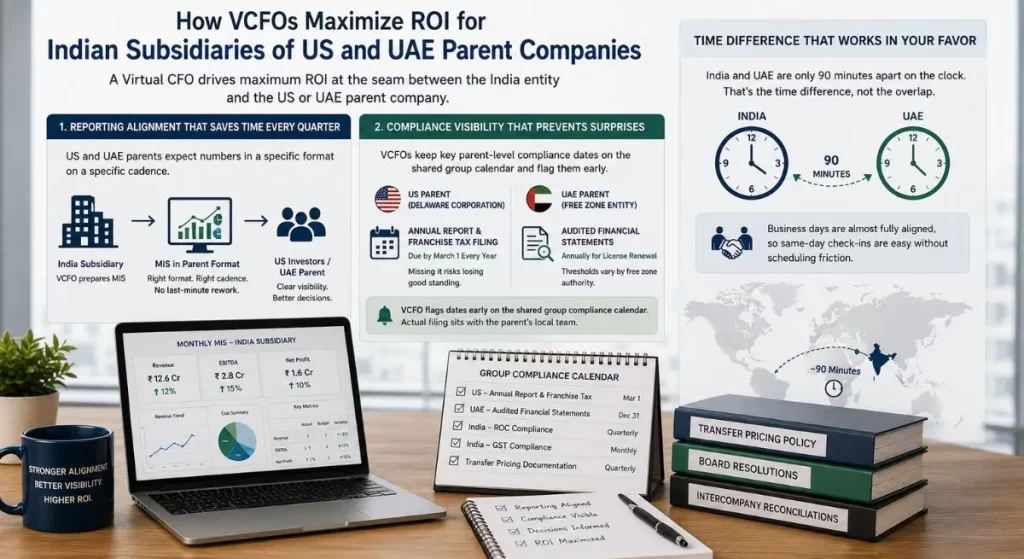
A Virtual CFO’s work happens on the India side of the entity: the subsidiary’s books, compliance calendar, and reporting. It isn’t a substitute for finance or filing support in the US or UAE itself.
For a subsidiary board, most of the practical ROI shows up exactly at the seam between the two sides.
Reporting is one piece of that seam. A US investor or UAE parent expects numbers in a specific format on a specific cadence. A Virtual CFO builds the India entity’s MIS to match that expectation from the start, instead of reformatting it every quarter under deadline pressure.
Compliance visibility is the other piece. If the parent is a Delaware corporation, that entity owes an annual report and franchise tax filing by March 1 each year. Missing it risks losing good standing. If the parent operates through a UAE free zone, most free zones now require audited financial statements annually as part of license renewal, with the exact threshold depending on the free zone authority. A Virtual CFO working on the India entity typically keeps dates like these on the shared group compliance calendar and flags them early, even though the actual filing sits with the parent’s own local team.
India and the UAE are only 90 minutes apart on the clock. That’s the time difference, not the overlap. In practice it leaves the two countries’ business days almost fully aligned, so a same-day check-in between the India finance team and the UAE side is usually possible without the scheduling friction a wider gap would create.
Beyond ROI: What Else a Structured Finance Function Buys You
The cost savings are structural: no fixed salary, benefits, or overhead, and an engagement that scales up or down as the business changes.
For a subsidiary specifically, that same flexibility extends to how costs get allocated back to the parent and in what currency, one more thing that doesn’t need solving manually every reporting cycle.
A Virtual CFO’s network also tends to open doors: banking relationships, fundraising support, and specialized financial services that become especially valuable once the roadmap is precise enough to put those connections to use. For the tax side of that roadmap, see how a Virtual CFO approaches strategic tax planning in India. For the cash side, see our breakdown of cash flow and working capital management.
When a Virtual CFO Might Not Be the Right Fit ?
A Virtual CFO isn’t the right call for every stage or every problem. It helps to know where the model stops adding value.
- Very early-stage businesses with no revenue yet. If there’s nothing to forecast against and no compliance calendar to speak of, a Virtual CFO’s monthly cadence has little to work with. A bookkeeper or part-time accountant is usually enough until there’s real transaction volume.
- Businesses that need a full-time strategic partner in the room daily. Some growth stages genuinely call for someone embedded in leadership meetings every day, not on a scheduled monthly or weekly cadence. That’s a full-time CFO’s job, not a Virtual CFO’s.
- Filing needs outside India. A Virtual CFO based in India can coordinate the group compliance calendar, but can’t file a Delaware franchise tax return or a UAE free zone audit submission. Those need locally licensed advisors in that jurisdiction.
If none of these describe your situation, the four levers above are where the ROI conversation usually starts.
How VCFOs Maximize ROI: Getting the ROI Case Right
How VCFOs maximise ROI comes down to replacing reactive financial management with a structured system: forecasting that catches gaps early, cost and revenue discipline that survives group-level scrutiny, data-driven decisions, and compliance that’s tracked before deadlines become emergencies. None of it requires a full-time hire to get right.
At MSNA & Associates, our team brings 15+ years of experience across CIA, US CPA advisory, and UAE accounting, applied through Virtual CFO services in India for growing Indian companies, including Indian subsidiaries of US and UAE parent companies, structured around exactly these four levers. If you’d like to see what this would look like for your business specifically, our team is happy to walk through it.
Build a Finance Function Focused on ROI
Frequently Asked Questions About How Virtual CFOs Maximize ROI
Can a Virtual CFO in India support an Indian subsidiary of a US or UAE company?
Yes, The Virtual CFO manages the India entity’s finances: forecasting, cost control, and compliance, and builds reporting to match what the parent, its investors, or its bank expect to see.
How much can a business save with a Virtual CFO compared to a full-time CFO?
Costs vary by scope and engagement model, but the core saving is structural: no fixed salary, benefits, or overhead, and the ability to scale the engagement up or down as the business’s needs change.
Does a Virtual CFO handle tax filing for a subsidiary's US or UAE parent?
Yes, A practicing CA can take on Virtual CFO engagements alongside their regular practice, which is common in India.
What are the four phases of a CFO's role?
Strategist, Catalyst, Steward, and Operator, broadly moving from long-term financial direction to day-to-day financial control.
Related
Discover more from MSNA & Associates LLP
Subscribe to get the latest posts sent to your email.