

An NRI founder based in Dubai had already secured his first client in India before he started the registration process. He assumed incorporating a company would take a couple of weeks. Instead, he spent the next month figuring out whether his documents needed an apostille or embassy attestation, who could be his resident director, and why every consultant seemed to give him a different answer.
That’s a story we hear often.
If you’re an NRI reading yet another checklist on company registration, here’s the honest starting point: the paperwork isn’t the hard part. Filling forms is mechanical. The real challenge is understanding the sequence. Knowing which document comes first, what authentication your country requires, and so on.
We’ve seen NRI founders lose four to six weeks because documents were authenticated incorrectly or the resident director requirement was treated as a formality instead of the critical governance requirement it is.
If you’re planning an NRI company registration in India, this guide walks you through the complete process: which documents to authenticate first, how the resident director requirement actually works, and what DIN and DSC involve, so you don’t lose the same four to six weeks he did.
Who Actually Qualifies as an NRI, and Why the Definition Matters?
For NRI company registration in India, two different laws define “NRI” differently and the definition that applies can affect your incorporation and future compliance.
Under the Income Tax Act, residency is determined largely by the number of days you spend in India during a financial year. Under FEMA, what really matters is why you’re staying outside India and what your intent is. When it comes to registering a company and staying compliant afterward, it’s this FEMA definition, not any other, that decides how your investment and shareholding actually get classified.
Why does this matter?
Because an incorrect investor classification can create avoidable complications in later FEMA reporting, including filings such as FC-GPR.
Our advice:
If there’s any uncertainty about your residency status under FEMA, clarify it before incorporation. It’s far easier to structure the investment correctly at the beginning than to rectify regulatory filings after shares have already been allotted.
Before You Choose a Business Structure for NRI Company Registration in India, Ask These Three Questions
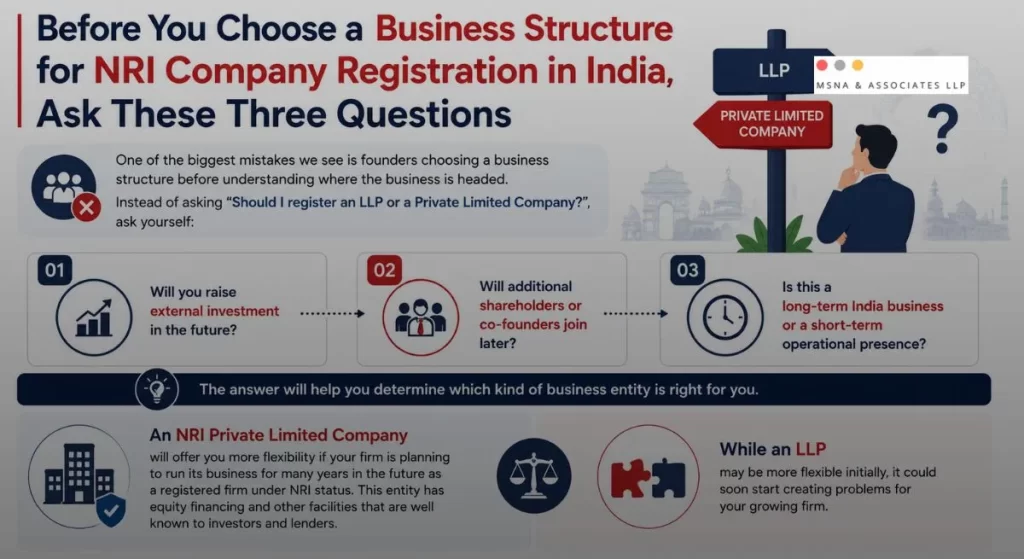
One of the biggest mistakes we see is founders choosing a business structure before understanding where the business is headed.
Instead of asking “Should I register an LLP or a Private Limited Company?“, ask yourself:
- Will you raise external investment in the future?
- Will additional shareholders or co-founders join later?
- Is this a long-term India business or a short-term operational presence?
The answer will help you determine which kind of business entity is right for you.
An NRI Private Limited Company will offer you more flexibility if your firm is planning to run its business for many years in the future as a registered firm under NRI status. This entity has equity financing and other facilities that are well known to investors and lenders.
While an LLP may be more flexible initially, it could soon start creating problems for your growing firm.
Can NRIs Own 100% of an Indian Company?
In many cases, yes.
Good news for a lot of founders considering company registration for NRI entrepreneurs: sectors like IT services, consulting, manufacturing, and most professional services allow 100% foreign investment under the automatic route. So there’s no need to wait around for government approval before you begin.
That said, not every sector is fully open, some industries still have specific restrictions or need prior approval. If you’re operating in a regulated space, make sure you check the applicable FDI rules before you get to incorporation.
NRIs who are Indian citizens can now incorporate an OPC, but most founders planning to raise investment or add co-founders still outgrow it fast. A Private Limited Company saves that conversion later.
The Resident Director Requirement Is More Important Than Most Founders Think
One requirement surprises many overseas founders planning NRI company registration in India.
Section 149(3) of the Companies Act, 2013 requires that at least one director on the board of every Indian private limited company be a person who has stayed in India for a total period of not less than 182 days during the preceding financial year. This is not negotiable and it is not satisfied by an NRI who visits India occasionally. It has to be an actual Indian resident individual.
A resident director becomes part of the company’s governance structure. They’re the ones signing statutory documents, sitting in on board decisions, and staying involved in day-to-day compliance. So picking a relative or friend just because they happen to be around often ends up causing problems down the line.
If you don’t already have a suitable resident director, it’s worth discussing your options before beginning the incorporation process. It’s one of the most common conversations we have with overseas founders, and our incorporation team is always happy to guide you before you commit to a board structure. You can reach us on +91 9036727740 for a preliminary discussion.
Documents Required for NRI Company Registration for NRI Founders
The required documents don’t only depend on whether you’re an NRI. They also depend on where you currently live.
| Document | Purpose |
|---|---|
| Passport | Identity proof of the NRI director/shareholder |
| Overseas Address Proof | Verification of the director’s overseas residential address |
| Passport-size Photograph | Director identification and company records |
| PAN (Permanent Account Number) | Tax identification for the director/shareholder (where applicable) |
| Registered Office Proof | Proof of the company’s registered office address in India |
| No Objection Certificate (NOC) (if applicable) | Consent from the property owner to use the premises as the registered office |
| MOA (Memorandum of Association) & AOA (Articles of Association) | Legal documents defining the company’s objectives, scope, and internal governance |
| DSC (Digital Signature Certificate) | Enables directors to electronically sign MCA incorporation and compliance filings |
| DIN (Director Identification Number) | Unique identification number allotted to every company director by the Ministry of Corporate Affairs (MCA) |
Standard documents typically required
The real difference lies in how these documents are authenticated.
If you live in the UAE or another non-Hague country
Your documents generally require:
- Local notarisation
- Attestation by the Indian Embassy or Consulate
If you live in the USA, UK, Singapore or most European countries
Documents generally require an Apostille under the Hague Convention.
DIN and DSC: What They Are and Why the Order Matters
A Director Identification Number is the unique identifier the Ministry of Corporate Affairs assigns to every company director, and a Digital Signature Certificate is the credential that lets a director sign MCA filings electronically. For NRIs and foreign nationals, both are foundational, and neither can be skipped regardless of your role in the company.
The DSC has to be a Class 3 certificate issued by an MCA-authorised Certifying Authority, and it has to exist before the SPICe+ form can be filed, because the form itself requires director signatures to submit.
NRIs and foreign nationals do not need to travel to India for this. Class 3 DSCs are available through video-based identity verification or the paper-based Officially Valid Document route using passport verification. This typically takes one to two business days once your documents are ready. We would treat DSC procurement as the very first action item on your incorporation timeline, because every downstream filing, including your Director Identification Number, depends on it.
The DIN itself no longer requires a standalone application in most cases. For up to three first directors, DIN is applied for and allotted automatically within Part B of the SPICe+ form itself. If you already hold a DIN from an earlier directorship, confirm your DIR-3 KYC filing is current before you begin, because a deactivated DIN due to lapsed KYC will block the entire incorporation, and this is an easy thing to overlook if your last directorship was several years ago.
How Long Does NRI Company Registration Usually Take?
Assuming your documents are ready, the process generally follows this timeline:
| Stage | Typical Timeline |
|---|---|
| Document Authentication | 3–10 business days |
| DSC Issuance | 1–2 business days |
| Company Name Approval | 2–3 business days |
| SPICe+ Incorporation Filing | 2–5 business days |
| Certificate of Incorporation | 3–7 business days |
The NRI Business Registration India Process: What Actually Happens?
A typical NRI business registration in India follows these steps:
- Secure your structure and shareholding initially.
- Get your documents attested, Apostille or Embassy, whichever applies to you.
- Sort out your Digital Signature Certificate (DSC).
- Reserve your company name on SPICe+.
- File for incorporation, MOA and AOA included.
- You’ll get your Certificate of Incorporation, PAN, and TAN.
- Open the company’s bank account.
- Bring in investment and complete the applicable FEMA reporting.
Each step builds on the previous one. Trying to fast-track the process before the documentation is ready usually creates more delays than it saves.
The Incorporation Filing Itself: MOA, AOA, and What SPICe+ Actually Bundles
SPICe+ is the single integrated web form on the MCA21 Version 3 portal that has replaced the older, more fragmented incorporation process. It has two parts.
Part A: Name reservation
- Propose your company name and, if it’s rejected, you get one resubmission
- Run a name search on both the MCA portal and the IP India trademark database before you file, rather than finding out about a conflict after a rejection costs you a filing cycle
Part B: Incorporation details
- Registered office address
- Director, subscriber and foreign shareholder information
- DIN application for new directors
What gets bundled into the same filing
SPICe+ is linked to AGILE-PRO-S, which registers the company for GST, EPFO, and ESIC in the same filing, and, through partner banks, opens the company’s first bank account.
Your Memorandum of Association and Articles of Association, the documents that define what your company is legally permitted to do and how it governs itself internally, are executed electronically as INC-33 and INC-34 within the same portal, each signed by the subscribing directors using their DSC.
One exception worth planning for: an NRI subscriber without an Indian DSC at the point of subscription needs a notarised and apostilled physical declaration instead. This is worth arranging well in advance rather than discovering it mid-filing.
What you get, and how long it actually takes
Once the Registrar of Companies is satisfied with the filing, the Certificate of Incorporation is issued along with your Company Identification Number, PAN, and TAN, all bundled into the same certificate.
| Stage | Typical Timeline |
|---|---|
| DSC Procurement | 1–2 working days |
| Name Reservation (Part A) | 1–3 working days |
| SPICe+ Part B Filing to Certificate of Incorporation | 2–3 weeks (for companies with foreign or NRI directors) |
That window widens considerably if any document needs to go back for re-notarisation or re-apostille, which is precisely why we push clients to front-load the authentication work rather than treat it as a parallel track item.
Incorporation Is Not the Finish Line: FEMA Reporting Starts the Clock
This is the part of the process that’s easy to overlook, because FEMA reporting has its own separate timeline that starts only after incorporation is complete. Getting FEMA reporting right from day one is what keeps an NRI incorporation clean through its first year, rather than surfacing as a compliance gap later.
Two filings you cannot afford to miss:
- Form FC-GPR, filed on the RBI’s FIRMS portal within 30 days of share allotment, not from the date funds were received. Founders often count the clock from the wrong event. A late filing triggers a Late Submission Fee and, in more serious cases, an RBI compounding proceeding that can take months and surfaces as a red flag in any future funding round or exit due diligence.
- The Foreign Liabilities and Assets (FLA) return, filed annually by 15 July by every company with outstanding foreign shareholding, even a single NRI shareholder, regardless of whether any new investment came in that year. This is the one we see missed most often, precisely because there’s no transaction to prompt a reminder.
There’s also a beneficial ownership angle worth knowing if your structure has any layering through holding entities. Under Press Note 3 (2020), an investment where the beneficial owner sits in or is a citizen of a country sharing a land border with India requires prior government approval, not the automatic route. A March 2026 amendment now allows non-controlling stakes of up to 10% to proceed automatically, subject to DPIIT reporting. But anything above that threshold, or carrying control rights, still needs approval.
Our recommendation to NRI clients is to map beneficial ownership honestly at the structuring stage, because retrofitting a clean ownership disclosure after the RBI or an investor asks for one is a far more expensive exercise than getting it right before the first filing.
Five Mistakes That Delay NRI Company Registration in India
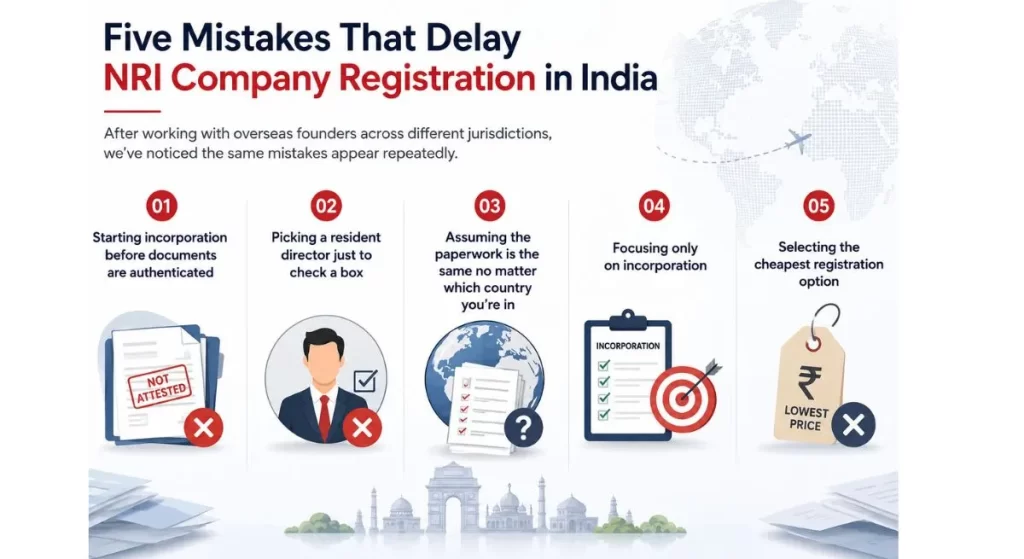
After working with overseas founders across different jurisdictions, we’ve noticed the same mistakes appear repeatedly.
1. Starting incorporation before documents are authenticated
2. Picking a resident director just to check a box
3. Assuming the paperwork is the same no matter which country you’re in
4. Focusing only on incorporation
5. Selecting the cheapest registration option
Don’t optimise for the fastest incorporation. Optimise for the cleanest one.A company incorporated two weeks later, with the correct ownership structure, properly authenticated documents and a well-planned compliance strategy, is far easier to operate than one that requires corrections after registration.
The Actual Decision in Front of You
By now, the decision is rarely whether to incorporate. It’s how to do it efficiently. Managing documentation, cross-border compliance, and post-incorporation FEMA filings can quickly become complex for NRIs if the process isn’t planned correctly. MSNA supports NRI company registration in India, company registration for NRI entrepreneurs, Setup of a New Company in India from the UAE, resident director arrangements, Set up new company in India from the USA and post-incorporation FEMA reporting. If you’re planning your entry into India, reach out to contact@msna.co.in.
Planning NRI Company Registration in India?
Can an NRI own 100% of a private limited company in India?
In most sectors, yes. The automatic route covers IT services, consulting, and most professional services without needing government approval.
Does an NRI director need to travel to India to get a DSC?
No, A Class 3 DSC can be done remotely through video verification or notarised passport copies, usually within a day or two.
Is the FLA return required even if there's no new investment during the year?
Yes. It’s due every 15 July as long as there’s outstanding foreign shareholding on the books, whether or not any money moved that year.
Related
Discover more from MSNA & Associates LLP
Subscribe to get the latest posts sent to your email.