


Every quarter, your Indian subsidiary sends over a set of financial statements that are fully compliant with Indian rules and still do not fit your group’s reporting format. Someone on your team spends a day or two adjusting them by hand, makes a note to fix this before the next close, and then does the same adjustment again next quarter.
That is not a bookkeeping problem. It is a financial control problem: getting numbers from India into a shape your CFO can actually trust for consolidation, before audit season exposes the gaps.
MSNA works with GCC groups on exactly this problem. Financial accounting outsourcing, done properly, brings together Indian financial reporting, the accounting between your parent company and its Indian arm, and Indian statutory compliance into one structure, so established GCC groups can close this gap without running a full finance team on the ground.
Here is what that structure needs to cover, in plain terms, and where most arrangements fall short.
Why an Indian Subsidiary Is a Different Accounting Problem for a GCC Parent?
A branch office and a fully owned Indian company are not the same from an accounting standpoint. Once a GCC parent sets up a private limited company in India, that company becomes its own legal entity under the Companies Act, 2013, with its own books, its own annual audit, and its own filing deadlines, separate from the parent’s.
It does not automatically report on your timetable, and it will not use your group’s chart of accounts (the standard categories a company uses to record income, expenses, assets, and liabilities) unless someone deliberately builds that connection.
For a Regional Finance Director sitting in Dubai or Riyadh, this creates two jobs at once: staying compliant with Indian law, and feeding clean numbers into the group’s consolidated accounts.
- Get Indian compliance right but the reporting format wrong, and someone ends up reconciling everything by hand, every quarter. Let compliance slide while chasing reporting polish, and the group picks up regulatory risk it never budgeted for, since Indian penalties apply to the local entity regardless of what the parent knew.
- These are two different problems: how the numbers are organised, and who is keeping India’s filings on track. An arrangement built only to meet India’s minimum filing requirements typically covers compliance but not group-reporting format. The two need to be solved together.
How Financial Accounting Outsourcing Services Simplify Consolidation Between a GCC Parent and an Indian Subsidiary?
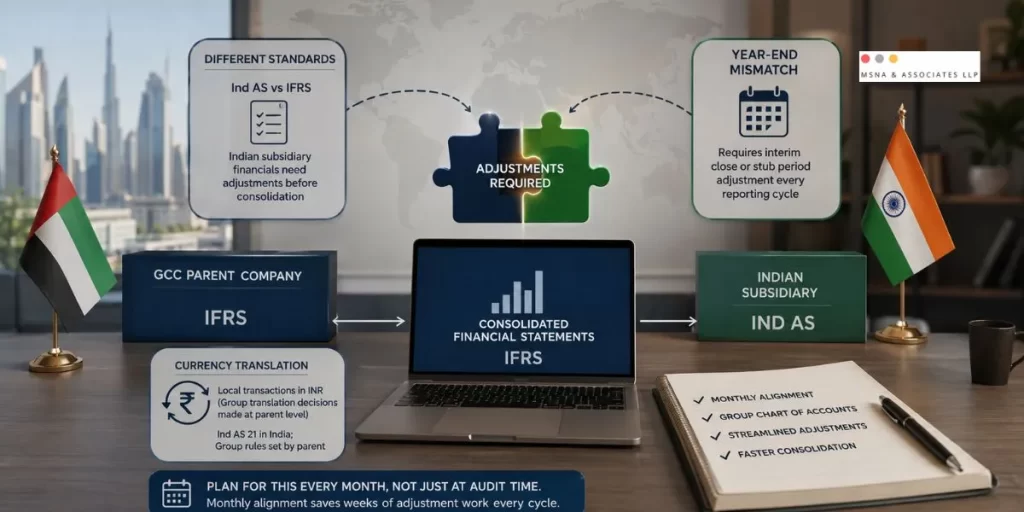
Most GCC parent companies report under IFRS, the international standard used across most of the world. Indian subsidiaries report under Ind AS, India’s own version. Ind AS lined up closely with IFRS after 2015, but still differs in areas like financial instruments, revenue, and certain valuations, so an Indian subsidiary’s financials are not ready to drop straight into an IFRS group set. They need an adjustment step first.
On top of that, the two calendars do not match: Indian companies must close their financial year on 31 March by law, while most GCC parents close on 31 December.
| What’s Different | What It Means for You | Why It Happens |
|---|---|---|
| Ind AS vs IFRS | The Indian subsidiary’s financial statements require adjustments before they can be included in your IFRS group financial statements. | Although Ind AS is largely converged with IFRS, it still contains differences in areas such as financial instruments, revenue recognition, and certain valuation principles. |
| Year-end mismatch | You need an interim close or a stub period adjustment during every reporting cycle to align the subsidiary’s financials with the group’s reporting period. | Indian companies are legally required to follow a 31 March financial year, while most GCC parent companies report on a 31 December year-end. |
| Currency translation | The subsidiary records transactions in Indian Rupees (INR), but the group must translate those balances into its reporting currency during consolidation. | Indian accounting follows Ind AS 21 for local currency reporting, while the parent company determines the group-level translation policy based on its reporting framework. |
Plan for this every month, not once a year at audit time. A subsidiary whose monthly reporting already lines up with the group’s chart of accounts saves the consolidation team weeks of adjustment work every cycle.
How Financial Accounting Outsourcing Services Manage Accounting Between the Parent and the Indian Subsidiary?
This is the accounting for transactions between the parent and the Indian subsidiary, often called intercompany accounting. It is where financial control most often breaks down, since these transactions look routine until an audit or tax authority asks for the paperwork.
Businesses that Outsource Accounting & Bookkeeping Services to India for UAE Businesses often implement standardized intercompany accounting processes from the outset, reducing reconciliation issues, improving documentation, and ensuring both entities maintain consistent financial records.
The transactions that most commonly need matching entries on both sides, backed by an actual written agreement rather than a journal entry, include:
- Management fees the parent charges the Indian subsidiary
- Shared costs split between the parent and the subsidiary
- Loans between the two companies, and any interest on them
- Royalty or licence payments
Balances that do not match between parent and subsidiary are the first thing we see auditors flag when reviewing consolidated accounts, usually because the two companies record the same transaction at different times or in different ways. A well-run process closes both sides in the same period and checks balances monthly, not once a year, and shows the board the group actually knows what it owes and is owed.
What Transfer Pricing Rules Apply, and Why Groups Often Miss the UAE Side?
Transfer pricing rules exist to stop group companies from shifting profit between countries by charging each other unrealistic prices for services, loans, or goods. Most people only covers the Indian side of the rule. That is a gap, because the same obligation applies on the UAE side too, under a completely separate law and a separate authority.
| Aspect | India | UAE |
|---|---|---|
| Which law applies | Section 92E of the Income Tax Act, 1961 | Article 34 of the UAE Corporate Tax Law |
| What has to be filed | Form 3CEB, a report certified by a Chartered Accountant | Related Party Transaction Disclosure Form, filed along with the UAE Corporate Tax Return |
| When filing is required | Applies to every international transaction with an associated enterprise in India, regardless of transaction value. | Required when related-party transactions exceed AED 40 million in a financial year, with any single transaction category above AED 4 million disclosed separately. A lower threshold of AED 500,000 applies to transactions with connected persons, as per the UAE Corporate Tax Law’s Transfer Pricing Guide. |
| When detailed documentation is required | Transfer pricing documentation becomes mandatory when the aggregate value of international transactions exceeds ₹1 crore (approximately AED 385,000, subject to exchange rate fluctuations) in a financial year. | Transactions must comply with the arm’s length principle (fair market value) irrespective of whether they cross the disclosure thresholds. |
| Who signs off | A Chartered Accountant certifies and signs Form 3CEB. | The company is responsible for preparing and supporting its transfer pricing position based on its own pricing analysis. |
A single annual management fee or one intercompany loan can push you past the Indian ₹1 crore threshold on its own, so most Indian subsidiaries already need this documentation, whether or not it’s currently in place. On the UAE side, fair pricing applies regardless of size and audit lookback periods just extended under Federal Decree-Law No. 17 of 2025, effective 1 January 2026. So only the disclosure paperwork itself has a threshold.
The point is simple: the same transaction must be priced fairly on both ends, under two different laws. A management fee defensible in Dubai but undocumented in India is only half-compliant, and that gap tends to surface during a tax audit, not during planning.
Most Indian tax treaties let India withhold tax on management fees paid abroad. The India-UAE treaty is a rare exception, upheld repeatedly by Indian tribunals in rulings on India-UAE FTS treatment. A management fee your Indian subsidiary pays the UAE parent may escape withholding tax under Section 195 entirely, but only with no permanent establishment in India and a valid Tax Residency Certificate and Form 10F on file.
What Compliance Does the Indian Subsidiary Have to Manage on Its Own?
The Indian subsidiary has its own compliance calendar, separate from anything the parent company reports. None of this is unusual. It is standard practice for any Indian company. What makes it hard to manage from outside India is that none of these deadlines line up with the parent’s own reporting calendar.
| What’s Required | What It Involves | Which Law Covers It |
|---|---|---|
| Statutory Audit | Every private limited company in India must undergo a statutory audit each financial year, regardless of its size or turnover. | Companies Act, 2013 |
| Subsidiary’s Own Consolidation | If the Indian entity has one or more subsidiaries, it must prepare consolidated financial statements covering those entities. | Section 129(3), Companies Act, 2013 |
| GST Accounting | Goods and Services Tax (GST) must be correctly accounted for and reported, particularly when the Indian subsidiary provides services to the GCC parent or other overseas group entities. | Central Goods and Services Tax (CGST) Act, 2017 |
| TDS Compliance | The Indian subsidiary must deduct and deposit Tax Deducted at Source (TDS) on applicable payments, including certain payments made to the parent company. Delays or non-compliance may result in interest, penalties, and possible disallowance of expenses for tax purposes. | Income Tax Act, 1961 |
A finance team that is only focused on serving the parent’s group reporting will often miss these, simply because nobody has been given clear ownership of the Indian filing calendar.
How Financial Accounting Outsourcing Services Strengthen Financial Control for GCC Groups?
Financial control is different from bookkeeping. It means the GCC parent can answer these questions at any point in the year, not only at year end:
- What does the Indian subsidiary currently owe the rest of the group, or what is it owed?
- Does its trial balance map cleanly onto the group’s own chart of accounts?
- Is every filing (audit, GST, TDS) actually up to date right now?
- If either tax authority asked to see the transfer pricing position today, would it hold up?
A financial accounting outsourcing arrangement built around these questions answers all four at any time, through a defined monthly close, a management report in a format your group actually uses, and a compliance calendar with someone clearly accountable for it. Mapping your current setup against these four questions is a useful first step before your next audit cycle.
When Should a GCC Group Move From an In-House India Team to Outsourcing?

There is no single trigger, but a few situations recur across GCC groups with Indian subsidiaries.
- The size does not quite fit. Enough activity to need proper accounting discipline, but not enough for a full in-house team with a controller and dedicated compliance staff.
- Investors or the board want more from the reporting. Consolidation-ready numbers monthly, not a scramble at year-end.
- A compliance gap has already shown up. Usually an audit finding or a transfer pricing question, showing the setup was never properly documented.
- The group structure changes. A funding round, an acquisition, or a shift in how the parent reports can mean the Indian numbers need to hold up to closer scrutiny.
In any of these situations, outsourcing is not simply cheaper than hiring locally. It gives you chartered-accountant-level oversight on consolidation, transfer pricing, and compliance, without building that capability from scratch. If your group is evaluating how the transition works in practice, including timelines, costs, and operational considerations, read our guide on Outsourcing Accounting from the UAE to India: Process, Cost & Benefits.
How MSNA Delivers Financial Accounting Outsourcing Services for GCC Groups with Indian Subsidiaries?
MSNA & Associates works with GCC-based groups on the accounting side of their Indian subsidiary, covering:
- Monthly close and management reporting, built to match the parent’s chart of accounts
- Accounting and reconciliation between the parent and the Indian subsidiary
- Preparation of Ind AS financial statements
- Coordinating the statutory audit
- GST and TDS compliance
- Transfer pricing documentation and Form 3CEB filing, coordinated with your UAE tax advisor so the pricing position is consistent on both sides, rather than assessed separately by two teams that never compare notes.
A useful starting point is checking whether your Indian subsidiary’s trial balance currently maps to your group’s chart of accounts, and whether its last transfer pricing filing has been reviewed against both India’s and the UAE’s rules. Where either answer is unclear, that’s the gap to close first.
Need Better Financial Control for Your Indian Subsidiary?
FAQ's Related To Financial Accounting Outsourcing Services
Does an Indian subsidiary need its own statutory audit even if the group audits at a consolidated level?
Yes, Every private limited company in India needs its own annual audit under the Companies Act, 2013, no matter how the parent group is audited.
Is transfer pricing documentation needed even for a single annual management fee?
Yes, in most cases. Filing Form 3CEB is required for any cross-border transaction with your Indian subsidiary, and a single management fee is often enough on its own to cross the ₹1 crore documentation threshold.
Does UAE transfer pricing law apply to transactions with an Indian subsidiary, or only within the UAE?
It applies to both. Article 34 of the UAE Corporate Tax Law requires fair pricing on related-party transactions regardless of where the other party is based, so your Indian subsidiary is covered too.
What is the difference between outsourced bookkeeping and financial accounting outsourcing?
Bookkeeping just records transactions. Financial accounting outsourcing also covers consolidation, transfer pricing documentation, and Indian statutory compliance, built around what your group needs, not just India’s minimum requirements.
Related
Discover more from MSNA & Associates LLP
Subscribe to get the latest posts sent to your email.