
If your board has signed off on India as the next market, a wholly owned subsidiary (WOS) is usually the most practical route for long-term operations. Getting the structure right from the start goes a long way toward avoiding incorporation delays, RBI penalties, and compliance gaps down the road.
A wholly owned subsidiary in India is the entity most US corporations land on: it gives the parent 100% ownership and a locally recognized legal identity. The subsidiary can hire staff and invoice customers directly, and it can hold assets in India, all without a local partner.
The full lifecycle runs under the Companies Act, 2013, and the RBI’s FEMA framework, from structuring and incorporation through capital infusion, statutory reporting, and the operational responsibilities a US parent carries for as long as the subsidiary exists.
What Counts as a Wholly Owned Subsidiary in India?
A WOS is an Indian private limited company incorporated under the Companies Act, 2013, in which the foreign parent holds the entire share capital. It is a separate Indian legal person, and that separateness is what protects the parent:
- Signs contracts and opens bank accounts in its own name
- Can be sued in its own name, keeping the parent’s exposure limited to the capital it has subscribed
- Insulates the parent’s balance sheet from the subsidiary’s day-to-day liabilities, something a branch or liaison structure does not do
Which Entry Structure Should a US Company Choose?
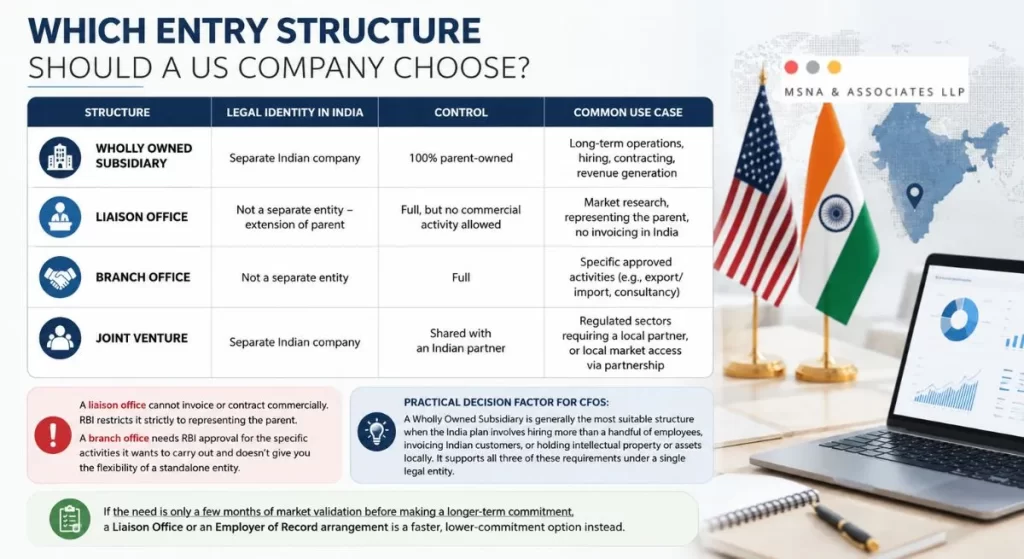
| Structure | Legal Identity in India | Control | Common Use Case |
|---|---|---|---|
| Wholly Owned Subsidiary (WOS) | Separate Indian private limited company | 100% owned by the foreign parent | Long-term operations, hiring employees, contracting with customers, invoicing, and revenue generation in India |
| Liaison Office (LO) | Not a separate legal entity; extension of the foreign parent | Full control by the parent | Market research, brand promotion, and representing the parent company without carrying out commercial or revenue-generating activities |
| Branch Office (BO) | Not a separate legal entity; extension of the foreign parent | Full control by the parent | Conducting RBI-approved activities such as export/import, consultancy, technical support, and professional services |
| Joint Venture (JV) | Separate Indian company | Shared ownership and control with an Indian partner | Businesses operating in regulated sectors requiring local participation or seeking market access through a strategic Indian partner |
A liaison office cannot invoice or contract commercially. RBI restricts it strictly to representing the parent. A branch office needs RBI approval for the specific activities it wants to carry out and doesn’t give you the flexibility of a standalone entity. In practice, we rarely see growth-stage US companies choose a branch or liaison office once they plan to hire employees or generate revenue in India. A WOS generally offers more operational flexibility and more fundraising routes than a branch or liaison structure, since it can raise equity, contract, and hold assets in its own name
Practical decision factor for CFOs: A Wholly Owned Subsidiary is generally the most suitable structure when the India plan involves hiring more than a handful of employees, invoicing Indian customers, or holding intellectual property or assets locally. It supports all three of these requirements under a single legal entity.
If the need is only a few months of market validation before making a longer-term commitment, a Liaison Office or an Employer of Record arrangement is a faster, lower-commitment option instead.
How Does the SPICe+ Process Work for Foreign Company Registration in India?
Setting up a wholly owned subsidiary in India means going through the Ministry of Corporate Affairs’ (MCA) SPICe+ (Simplified Proforma for Incorporating Company Electronically Plus) portal. Here’s what that sequence actually involves for a WOS:
1. Name Reservation
Start by filing Part A of SPICe+ with two name options. MCA runs these against its database of existing companies and trademarks, so it’s worth having a backup in mind. And if either name touches on a regulated space like banking or insurance, it’ll get pulled into an extra round of sectoral review.
2. Digital Signature Certificates (DSC) and Director Identification Numbers (DIN).
Every proposed director needs a DSC to sign electronic filings and a DIN, MCA’s unique director ID. For directors based in the US, this means a notarised and apostilled identity document; budget extra time here; it’s the step that most often stalls US-led foreign company registration in India.
3. Resident director appointment.
Section 149(3) of the Companies Act, 2013 requires at least one director who has stayed in India for a total of not less than 182 days during the financial year (1 April–31 March). For a newly incorporated company, this applies proportionately at the end of the financial year of incorporation.
Most US parents fill this with a local hire, an Indian national already on the global team, or a professional nominee director arrangement, not a US-based director who happens to visit occasionally. This requirement is frequently underestimated in planning timelines because sourcing a compliant resident director can take longer than the incorporation filing itself.
Non-compliance attracts a penalty under Section 172 and is flagged at the MGT-7 filing, where the residential status of directors is declared.
4. Drafting the MOA and AOA.
The Memorandum of Association defines what the company is permitted to do; the Articles of Association govern how it’s run internally. For a 100% foreign-owned subsidiary, these should be drafted to anticipate the parent’s actual operating model (services vs. product sales vs. R&D) rather than using a generic template, since amending them later requires a fresh shareholder resolution and an MCA filing.
5. Filing SPICe+ Part B, AGILE-PRO, and linked forms.
This one filing takes care of incorporation, PAN and TAN allotment, GST registration if you want it at this stage, EPFO and ESIC registration, and the bank account application, all submitted together to the Registrar of Companies.
6. Certificate of Incorporation
Once the ROC signs off, the company gets its Certificate of Incorporation, and with it, a Corporate Identification Number (CIN). The company legally exists from this point.
Realistic timeline: 4–6 weeks is standard when documentation from the US parent (board resolutions, apostilled documents, KYC) is ready upfront. The single biggest driver of delay isn’t the ROC. It’s document authentication on the US side, since apostille turnaround varies by state and adds a step most first-time filers don’t budget for.
Before starting the SPICe+ filing, it’s helpful to understand the overall incorporation process, expected costs, timelines, and compliance requirements. Our guide on Private Limited Company Registration in India for US Founders explains these aspects in detail.
How Do You Fund the Subsidiary and Report It to RBI?
Most sectors relevant to US market entry- IT services, consulting, e-commerce, R&D- sit under the FDI automatic route, meaning 100% foreign ownership needs no prior RBI or government approval. (e-commerce marketplace activity sits under the automatic route; inventory-based e-commerce with FDI does not).
A smaller set, such as defence and telecom, carry caps, so confirm which bucket your activity falls into before the structure is locked in.
Once capital is infused into your wholly owned subsidiary in India, the reporting sequence is fixed:
- The parent wires the subscription amount to the subsidiary’s Indian bank account.
- The bank issues a Foreign Inward Remittance Certificate confirming the funds entered as foreign investment.
- The subsidiary allots shares to the parent.
- The subsidiary reports the allotment to the RBI on Form FC-GPR, through its Authorised Dealer bank on the FIRMS portal, per the RBI’s Master Direction on Reporting under FEMA, 1999, within 30 days of allotment.
Missing that window does not void the investment, but it converts a routine filing into a compounding application, essentially asking RBI for retroactive permission, with a processing fee attached. It is the single most preventable compliance failure we see in first-time India entries, and it almost always traces back to nobody owning the 30-day clock once the wire clears. MSNA’s FEMA compliance services can help build that calendar alongside your incorporation filing.
What Wholly Owned Subsidiary India Compliance Steps Do Most Companies Miss?
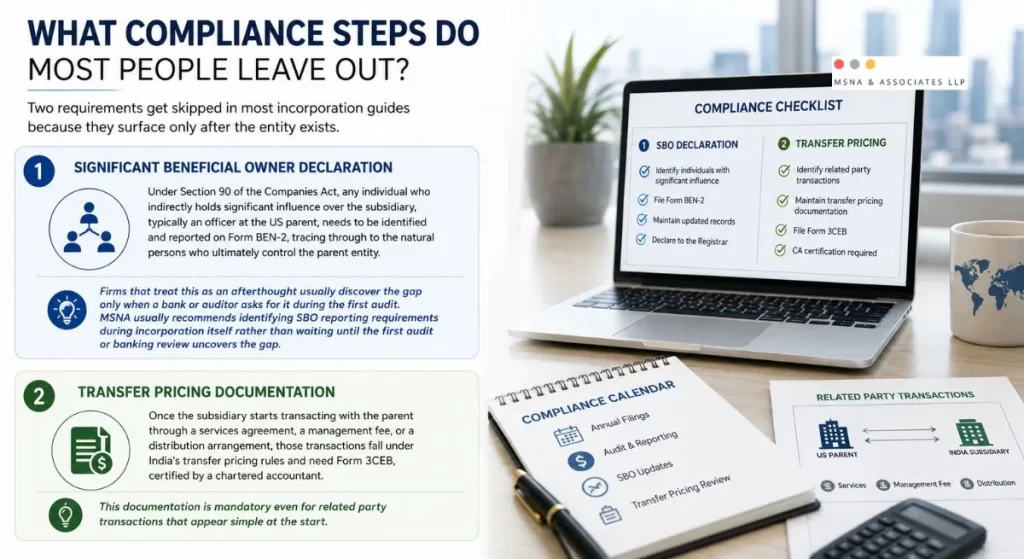
Two requirements get skipped in most incorporation guides because they surface only after the entity exists.
1. Significant Beneficial Owner declaration. Under Section 90 of the Companies Act, any individual who indirectly holds significant influence over the subsidiary, typically an officer at the US parent, needs to be identified and reported on Form BEN-2, tracing through to the natural persons who ultimately control the parent entity. Firms that treat this as an afterthought usually discover the gap only when a bank or auditor asks for it during the first audit. MSNA usually recommends identifying SBO reporting requirements during incorporation itself rather than waiting until the first audit or banking review uncovers the gap.
2. Transfer pricing documentation. Once the subsidiary starts transacting with the parent through a services agreement, a management fee, or a distribution arrangement, those transactions fall under India’s transfer pricing rules and need Form 3CEB, certified by a chartered accountant.
What Post-Incorporation Compliance Is Required for a Wholly Owned Subsidiary in India?
There are a few things that need to be in place before a WOS can operate.
- Bank account activation. Runs on the bank’s own KYC of the parent entity and can outlast the incorporation itself if documents are not pre-staged.
- Registered office and statutory records. A registered office, statutory registers, and books of account are all required from the date of incorporation, not from the date operations begin.
- First board meeting and auditor appointment. Both must happen within 30 days of incorporation.
From there, the compliance calendar runs on its own rhythm every year:
| Obligation | Frequency | Typical Deadline |
|---|---|---|
| Board Meetings | Ongoing | Minimum 4 meetings per year, with a gap of not more than 120 days between two meetings |
| Statutory Audit | Annual | Before the Annual General Meeting (AGM) |
| Form AOC-4 (Financial Statements Filing) | Annual | Within 30 days of the AGM |
| Form MGT-7 (Annual Return Filing) | Annual | Within 60 days of the AGM |
| FLA Return (RBI) | Annual | 15 July of every year |
| Form 3CEB (Transfer Pricing Report) | Annual | Alongside the tax audit due date, if intercompany transactions exist |
The FLA return is worth flagging separately because it runs on its own calendar regardless of whether the statutory audit is finished, which is why it is one of the most frequently missed deadlines among foreign-owned subsidiaries.
Does the State of Incorporation Matter for a Wholly Owned Subsidiary in India?
Most people treat a wholly owned subsidiary in India as purely a central-government process, but registered-office location drives a second layer of state-specific registrations that a US company subsidiary in India rarely budgets for:
- Professional tax registration
- Shops and Establishment registration
- Labour welfare fund enrollment, where applicable
Confirming these against the registered-office state before incorporation avoids a second scramble once the CIN is issued.
How Do You Repatriate Funds, and Does the Parent Risk Permanent Establishment?
Dividend repatriation runs through RBI’s FEMA framework and needs:
- A board resolution based on audited financials showing distributable profits, since a company cannot declare a dividend out of capital
- Remittance through an Authorized Dealer bank, which will require both the resolution and the audited numbers before releasing funds
Building that sequence into the annual calendar avoids a scramble every time the parent wants a distribution.
A related question comes up with nearly every US parent: could the parent’s own activities in India, sending employees, managing the subsidiary closely, create a permanent establishment exposure for the parent itself? That depends on how the two entities actually operate day to day, not just the structure on paper, and it needs a cross-border tax specialist looking at the operating model before patterns are locked in.
What Happens When You Close a Wholly Owned Subsidiary in India?
Exit planning rarely gets discussed at setup, but it shapes decisions made on day one. Closing a WOS, through Fast Track Exit or formal winding-up under the Companies Act, requires:
- Clean statutory registers and settled liabilities
- RBI’s confirmation that no FC-GPR or FLA filings are pending
A subsidiary that kept its books current closes in months; one carrying a backlog on ROC or FLA filings takes considerably longer, since those gaps must clear first. The discipline that makes exit smooth is the same one that makes the annual calendar smooth.
Common Mistakes to Avoid When Setting Up a Wholly Owned Subsidiary in India
- Treating incorporation as the finish line. The recurring calendar (FC-GPR, FLA, AOC-4, MGT-7, board cadence, Form 3CEB) is where penalties actually originate.
- Underestimating the resident director search timeline. Sourcing someone genuinely compliant takes longer than most teams plan for.
- Skipping a documented nominee shareholder declaration. This creates ownership ambiguity, which is more expensive to fix later than to set up correctly.
- Building the chart of accounts without the parent’s consolidation needs in mind. This means retrofitting Indian statutory books to US group reporting later, which mapping it at setup avoids.
Setting up a wholly owned subsidiary is as much an accounting and compliance commitment as it is a legal filing. Planning your India entry correctly from day one helps avoid costly compliance issues later. If you’re ready to Setup New Company in India from the USA, MSNA can assist with company incorporation, FEMA compliance, RBI reporting, accounting, and ongoing statutory compliance
Need Guidance on Setting Up a Wholly Owned Subsidiary in India?
Related
Discover more from MSNA & Associates LLP
Subscribe to get the latest posts sent to your email.