

How a Virtual CFO for MIS Improves Business Insights and Financial Control ?
A founder I spoke to recently said something during a review meeting that honestly stayed with me. “We are growing every month, so why does it still feel like the business is financially messy?”
That confusion is exactly why many companies now hire a Virtual CFO for MIS.
In his case, sales were increasing, new clients were coming in, and the business looked healthy from the outside. But internally, things were all over the place. Reports came late. Cash flow kept becoming unpredictable. Some months looked profitable, yet there was constant pressure around expenses and payments.
The issue wasn’t a lack of effort. The issue was a lack of financial visibility.
The accountant handled compliance and bookkeeping properly, but nobody was actually analysing the numbers deeply enough to guide business decisions. That is where a Virtual CFO changed things. Instead of just preparing reports, the business finally started understanding what the reports were trying to say.
In this blog, we will look at how a Virtual CFO improves MIS reporting, business insights, cash flow visibility, and overall financial control for growing businesses.
What Is a Virtual CFO for MIS?
A Virtual CFO is simply an outsourced finance professional who helps companies in handling financial planning, reporting, analysis, forecasting, and strategy without the need to employ a full-time CFO internally.
Now add MIS into that. MIS stands for Management Information System. In finance, it simply means organising financial data in a way that helps management understand what is happening inside the business.
MIS reporting explains:
- Why something happened
- Where problems are building
- What needs attention
- What decisions should be taken next
A Virtual CFO for MIS helps turn financial data into business direction. Instead of looking at reports like formal paperwork, management starts using them as decision-making tools.
Expert Insight: At some point in scaling your firm, you need to move away from just looking at totals to asking smarter questions. Most founders see growth as an instant fix, but revenue without a granular strategy is very volatile. A real Virtual CFO doesn’t only create templates; they provide strong Internal Control over Financial Reporting (ICFR) frameworks and exact Risk Control Matrices (RCM). This ensures your operational data is in sync with your financial reality in real time.
The Role of Strategic MIS Reporting in Modern Corporate Finance
Most growing businesses eventually reach a stage where basic accounting is not enough. At first, spreadsheets feel manageable. Reports are simple. Teams are smaller. But once operations grow, financial visibility usually starts getting messy.
Different departments begin tracking different numbers. Reports arrive late. Management meetings become filled with confusion because nobody is fully confident about which figures are correct.
This is exactly why businesses are investing heavily in MIS services now.
Modern MIS systems help businesses track:
- Revenue patterns.
- Cash flow movement.
- Operating costs.
- Performance of the department.
- Costs of inventory.
- Late payments from customers.
- Profitability trends
Before, companies waited till the end of the month to see what went wrong. That delay might really damage growth in 2026. Companies now expect real-time financial reporting because decisions cannot wait for thirty-day-old reports anymore. For example, if expenses suddenly spike this week, management wants visibility immediately, not after the month closes.
Difference Between Accounting and MIS Reporting
A lot of people still treat accounting and MIS reporting services like the same thing. They are not.
Accounting focuses on recording and maintaining the financial transactions correctly. MIS reporting goes one step further. It looks at those figures and says what they mean for the business.
For example, the books can reflect that marketing costs went up 25%. MIS reporting asks:
- Did it boost sales?
- Was the investment a good idea?
- Which campaign did the best?
- Is the cost of client acquisition increasing?
Without proper MIS systems, businesses often make decisions based on assumptions, pressure, or instinct. Sometimes those decisions work. Many times, they quietly create bigger financial problems later.
Common Financial Challenges Businesses Face Without MIS Expertise
Most businesses do not suddenly collapse because of one huge mistake. Usually, small financial problems keep building quietly in the background.
- Reports get delayed.
- Costs are not being properly tracked.
- Cash flow becomes unpredictable.
Cash flow is a major issue here. According to the Economic Survey, an estimated ₹8.1 Lakh Crore is stuck across India in delayed payments owed to MSMEs, restricting operating capital across the private sector. In fact, official Ministry of MSME data from the Samadhaan Portal shows that over 2.56 Lakh delayed payment cases have been filed by stressed companies, with billions of rupees still waiting for formal adjudication.
How Compliance Works Today:
Managing cash flow is no longer simply a matter of operational survival; it is very much about tax compliance. Under Section 43B(h) of the Income-tax Act, you are required to maintain a record of your payment timeframes. If you have a business and you do not clear dues to registered Micro and Small Enterprises within 45 days (subject to a written agreement), you will lose tax deductions on that expenditure. A virtual CFO makes sure your MIS is tracking these vital payment periods automatically so you don’t have to ever suffer any surprise tax fines.
And then there is the visibility problem. Many founders honestly do not know:
- Which service actually makes money
- Which clients are the least profitable
- Where operational waste exists
- Why revenue growth is not improving margins
That lack of clarity affects decision-making badly over time. This is where CFO advisory services become extremely valuable because a Virtual CFO brings structure to financial management instead of leaving management to guess on its own.
How a Virtual CFO for MIS Visualizes Deep Business Insights?

One of the biggest changes businesses notice after working with a Virtual CFO is visibility. Instead of looking at confusing spreadsheets, management begins seeing how different parts of the business affect each other financially.
Real-Time Financial Dashboards Reporting
Businesses today move too fast for static reports. By the time traditional reports are prepared, the situation may have already changed completely. Modern MIS dashboard reporting gives management live visibility into:
- Daily or weekly sales performance
- Real-time operating run rates
- Dynamic cash flow runways
- Pending collections and aging receivables
KPI-Based Performance Monitoring
Most businesses track revenue. Only a few businesses can track performance properly. A Virtual CFO monitors KPIs that actually show financial health, such as:
- Gross Profit Margins per SKU or service contract.
- Inventory Turnover Ratio (how quickly stock converts to cash).
- Cash Burn Rate and Net Runway Months.
- Customer Acquisition Cost (CAC) relative to Customer Lifetime Value (LTV).
- Department-wise contribution margins.
These numbers usually reveal problems much earlier than regular reports do.
For example, a company may celebrate rising sales while completely missing the fact that margins are shrinking because operational costs have increased too aggressively.
Predictive Forecasting and Scenario Planning
Forecasting has become a big importance in 2026 since companies work in unpredictable situations presently. According to the current survey of more than 200 CFOs by Gartner, enhancing financial forecast accuracy and quality is among the top five goals for 51% of CFOs for 2026.
For example, Virtual CFO services help businesses prepare before problems happen by answering questions like:
- Can our cash flow securely fund an expansion into a new geography this year?
- What if next quarter we see a 15% jump in our core raw material costs?
- Can we afford to grow our internal staff by 20%? Or would that severely squeeze our runway?
How a Virtual CFO for MIS Drives Strict Financial Control?
A business may grow in revenue while slowly becoming financially unstable underneath. That is why stronger financial control for SMEs has become such an important focus area recently.
A Virtual CFO improves financial discipline in many practical ways. Budgets are monitored more closely. Unnecessary spending becomes easier to identify. Reporting accuracy improves. Financial leakages get noticed early. Many businesses also lose money by things like:
- Duplicate software subscriptions.
- Uncontrolled operational spending.
- Poor approval systems.
- Weak inventory tracking.
- Delayed receivables.
A Virtual CFO helps businesses build tighter financial systems so these problems stop piling up unnoticed.
Key MIS Reports Managed by a Virtual CFO
Different reports help management understand different parts of the business more clearly. Some of the most important ones include:
| MIS Report | Business Benefit |
|---|---|
| Cash Flow Report | Better liquidity planning |
| Profitability Report | Clearer margin visibility |
| Budget Variance Report | Better expense control |
| KPI Dashboard | Faster business decisions |
| Receivables Report | Improved payment tracking |
| Department-Wise Reports | Better operational visibility |
Industries That Benefit Most From Virtual CFO for MIS
Almost every growing business benefits from stronger MIS systems.
But some industries depend on them more heavily because their operations move faster, and financial tracking becomes more complicated.
- Startups require reporting for investors and monitoring of burn rates.
- E-commerce companies are always looking at margins, refunds, and logistics costs.
- Manufacturing companies need an in-depth investigation into inventory and production cost analysis.
- SaaS companies are very focused on recurring revenue and client acquisition costs.
Without strong reporting systems, managing growth becomes extremely difficult in these industries.
Questions to Ask Before Onboarding a Virtual CFO for MIS
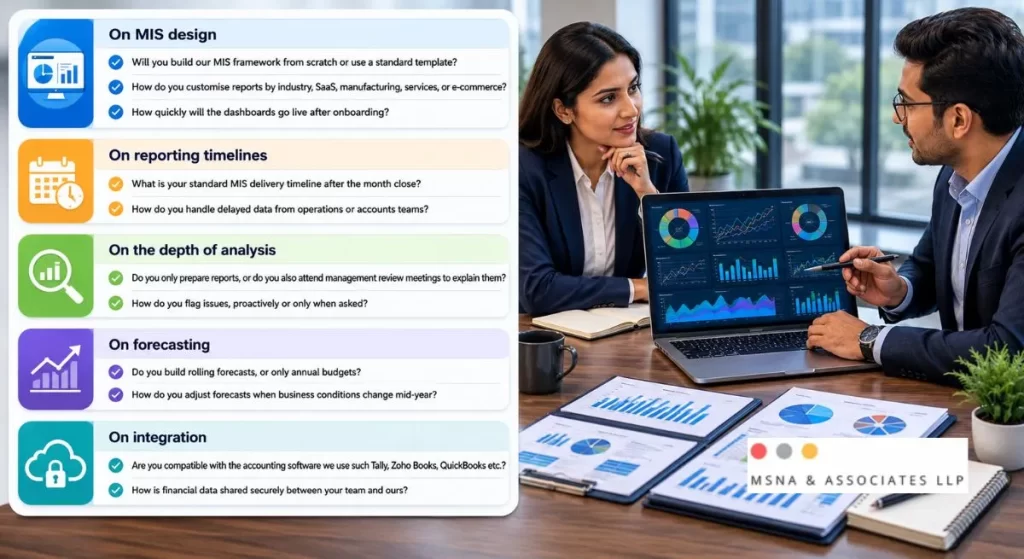
These are the questions worth asking before you hire one.
On MIS design
Ask them this first:
- Will you build our MIS framework from scratch or use a standard template?
- How do you customise reports by industry, SaaS, manufacturing, services, or e-commerce?
- How quickly will the dashboards go live after onboarding?
This matters because every business is different. A proper Virtual CFO for MIS should not force the same format on every client.
On reporting timelines
Timing is a big deal in MIS. A report that comes too late usually loses its value.
Ask:
- What is your standard MIS delivery timeline after the month close?
- How do you handle delayed data from operations or accounts teams?
On the depth of analysis
Ask:
- Do you only prepare reports, or do you also attend management review meetings to explain them?
- How do you flag issues, proactively or only when asked?
This helps you understand whether they are just compiling numbers or actually thinking like a finance partner.
On forecasting
MIS is not only about reporting the past. It should also help you plan the future.
Ask:
- Do you build rolling forecasts, or only annual budgets?
- How do you adjust forecasts when business conditions change mid-year?
On integration
Your finance setup should work with the tools you already use.
Ask:
- Are you compatible with the accounting software we use, such as Tally, Zoho Books, QuickBooks, etc.?
- How is financial data shared securely between your team and ours?
Why do these questions matter?
Asking these things upfront helps you separate firms that genuinely deliver strategic MIS from those that only rearrange accounting data into a different format.
Why a Virtual CFO for MIS Is Becoming Important for Businesses Today ?
Many businesses assume MIS is a reporting exercise, but its real value lies in reducing decision-making time. An effective MIS framework enables management to identify deviations early, take corrective action faster, and respond to market changes before they impact profitability.
In our experience, businesses rarely face financial stress because of a lack of revenue alone. More often, the warning signs appear first in receivable ageing, inventory build-up, or working capital cycles. A well-designed MIS dashboard helps management identify these trends before they become cash flow challenges.
The most effective MIS systems do not operate in isolation. They connect operational metrics such as sales volumes, customer acquisition, inventory movement, and project delivery with financial outcomes, allowing management to understand the true drivers of profitability.
This is why many growing companies are now choosing Virtual CFO Services in India for MIS instead of depending only on accounting. Better MIS reporting helps businesses understand what is actually happening behind the numbers, where money is getting stuck, and what needs attention before small problems become bigger ones. Professional firms like MSNA & Associates are helping businesses build that kind of clarity through stronger reporting, planning, and financial control systems that actually support growth.
Turn Financial Data Into Smarter Business Decisions
Related
Discover more from MSNA & Associates LLP
Subscribe to get the latest posts sent to your email.