
If your board just approved a Global Capability Center in India, you’re not alone. Hundreds of US companies have made the same call this year, and India remains the default choice for building an offshore hub with real ownership and control.
But approval is the easy part. GCC setup in India for US companies involves real decisions on legal structure, hiring, and compliance, and getting them wrong is expensive to fix later. Every one of those decisions carries a compliance thread attached to it, from the day the entity is incorporated through the first year of operations.
This guide walks US CFOs, global expansion teams, and HR leaders through the entity options, the hiring models, the compliance load, and a step-by-step roadmap for building an India GCC hub the right way.
What Exactly Is a GCC, and Why Does India Keep Winning This Race?
A Global Capability Center is an offshore unit that a company sets up to run functions like engineering, finance operations, data analytics, or customer support directly, instead of outsourcing them to a third party. It’s a captive center setup. The parent company owns it, controls it, and builds long-term capability inside it.
India remains the top destination for this model. The talent pool is deep. Costs are lower than in the US without sacrificing skill quality. Time zones support round-the-clock coverage for US operations. And India’s regulatory system, while detailed, is predictable once you understand it
GCC Setup in India for US Companies: Choosing the Right Legal Entity
This is the first fork in the road, and it shapes everything downstream. Under Indian law, a US company setting up in India has three realistic entity options, out of the six structures generally available to foreign businesses.
Entity Type | Governing Framework | Best Fit | Key Limitation |
Wholly Owned Subsidiary (Private Limited Company) | Companies Act, 2013 | Most GCCs; full operational control, own hiring, own IP | Requires local directors and full compliance calendar |
Branch Office | FEMA, RBI regulations | Short-term feasibility studies or liaison-style presence | Cannot carry out full-scale commercial GCC activity easily |
LLP (Limited Liability Partnership) | Smaller advisory or project-based teams | Less common for large-scale GCC operations; funding structure is different |
For most GCCs, a Wholly Owned Subsidiary structured as a Private Limited Company is the standard route. It gives the US parent 100% ownership under India’s automatic FDI route for most sectors, clean separation of liability, and a structure banks and clients recognise.
A few entity-structure basics US teams often miss:
- A minimum of two directors are required, and at least one must be a resident of India.
- The subsidiary needs its own PAN, TAN, and GST registration in place before it starts hiring employees or raising invoices.
- Foreign investments need to be reported to the RBI on time – this isn’t something to delay.
- Board resolutions and statutory registers should be maintained from day one, not put together later when someone asks for them.
Hiring Talent for GCC Setup in India for US Companies
After the organizational structure for the GCC is established, then comes the process of recruitment. There’s no single right answer here. It depends on speed, headcount, and how much operational control you want on day one.
1. Direct hiring under your own entity
This is the standard model once the Private Limited Company is incorporated. You hire employees directly, run your own payroll, and build a culture that matches the parent company. It takes longer to set up but gives you full control long term.
2. Employer of Record (EOR)
An EOR lets you hire people in India before your own entity is fully operational. It’s fast, often a matter of weeks. But it’s meant as a bridge, not a permanent solution, since costs per employee run higher over time.
3. Staffing or BOT (Build-Operate-Transfer) partners
A local partner builds the team and runs operations for an agreed period, then transfers the entity and staff to the US parent. This suits companies that want India expertise on the ground before taking full ownership.
Here’s a quick way HR and talent leaders can think about it:
- Need people in India within a month? Start with an EOR.
- Building a 100+ person function over 12 to 18 months? Go direct, under your own entity.
- Want someone else to de-risk the first year? Consider a BOT partner.
Compliance for Foreign GCC Entities: What US Parent Companies Must Track
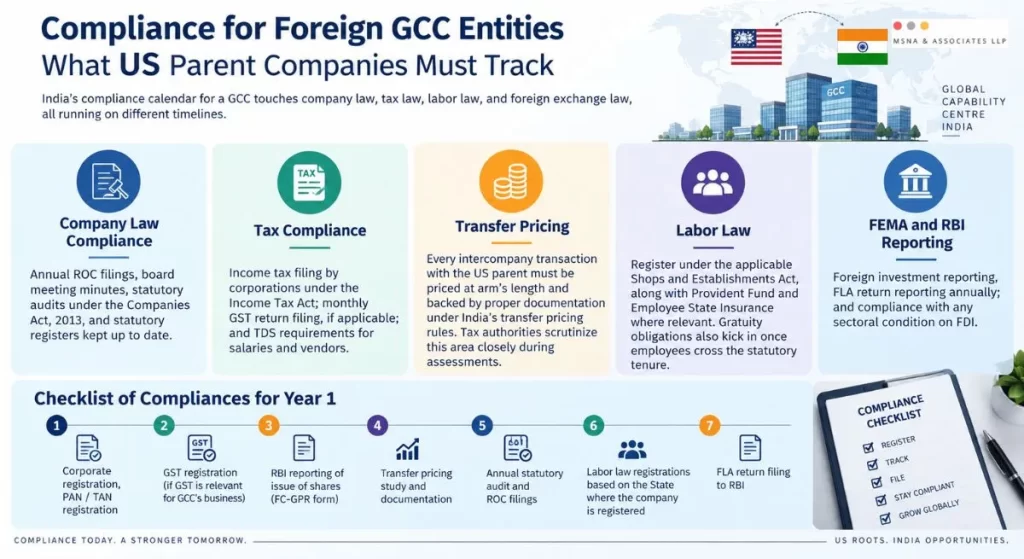
This is where most US finance teams underestimate the workload. India’s compliance calendar for a GCC touches company law, tax law, labor law, and foreign exchange law, all running on different timelines.
1. Company law compliance
Annual ROC filings, board meeting minutes, statutory audits under the Companies Act, 2013, and statutory registers kept up to date.
2. Tax compliance
Income tax filing by corporations under the Income Tax Act; monthly GST return filing, if applicable; and TDS requirements for salaries and vendors.
3. Transfer pricing
This is where things get genuinely tricky. Since the India GCC delivers services to its US parent, every intercompany transaction has to be priced at arm’s length and backed by proper documentation under India’s transfer pricing rules for US Subsidiaries. Tax authorities scrutinize this area closely during assessments, so it needs real attention from the outset, not something bolted on after the fact. We cover the filing requirements and penalties in detail in Transfer Pricing in India for US Subsidiaries.
4. Labor law
On the employment front, GCCs need to register under the applicable Shops and Establishments Act, along with Provident Fund and Employee State Insurance where relevant. Gratuity obligations also kick in once employees cross the statutory tenure, so that’s worth tracking from day one.
5. FEMA and RBI reporting
Foreign investment reporting, FLA return reporting annually; and compliance with any sectoral condition on FDI.
Checklist of compliances for Year 1:
- Corporate registration, PAN / TAN registration
- GST registration (if GST is relevant for GCC’s business)
- RBI reporting of issue of shares (FC-GPR form)
- Transfer pricing study and documentation
- Annual statutory audit and ROC filings
- Labor law registrations based on the State where the company is registered
- FLA return filing to RBI
Where India GCC Setups Usually Go Wrong?
US companies often incorporate the entity first and figure out transfer pricing later, sometimes a full year later, after the GCC has already been invoicing the parent informally. By then, the pricing pattern is already set, and correcting it retroactively invites scrutiny.
The fix is simple: build the transfer pricing policy and intercompany agreement before the GCC starts operating, not after. Decide the cost-plus markup, document the functional and risk profile of the India entity, and get the intercompany services agreement signed before the first invoice goes out. It costs a few weeks upfront. It saves a lot of pain during the first tax assessment.
Cost Considerations: What an India GCC Hub Costs
Cost is the reason the board approved this in the first place, so it’s worth being direct about where the money goes.
1. Entity setup:
Legal, registration, and professional fees typically run a modest one-time cost, small relative to overall GCC investment once you break down actual registration costs.
2. Talent cost:
Salaries in India for engineering, finance, and analytics roles run significantly lower than equivalent US roles, though senior India GCC leadership talent is increasingly competitive.
3. Real estate and infrastructure:
Office space in tech hubs like Bengaluru, Hyderabad, or Pune varies widely by city and grade of building.
4. Compliance and professional services:
Accounting, audit, taxation, and secretarial expenses that recur continuously need to be budgeted in a fixed monthly figure, not as a one-time expense.
5. Hidden cost to plan for:
Transfer pricing documentation and annual TP audits. This gets more expensive to fix later than to build correctly at the start.
How to Set Up a GCC in India From the USA: Step-by-Step Roadmap
Here’s roughly how this plays out, from the planning stage to having a fully running entity on the ground.
- Start by defining scope. Which functions are moving to India first, engineering, finance ops, analytics, and roughly how many people you’ll need in year one.
- Pick the entity structure. Most US companies go with a wholly owned subsidiary, set up as a private limited company under the Companies Act, 2013.
- Registering with tax and regulatory bodies comes next: PAN, TAN, GST where it applies, and letting the RBI know about the foreign investment.
- Don’t leave transfer pricing for later. Get the intercompany services agreement and TP policy drafted before operations actually start.
- Then there’s the hiring model to settle on. Some companies hire directly, others go through an EOR or a BOT partner, and the right call really depends on your timeline and appetite for risk.
- Payroll and statutory registrations need sorting too, PF, ESI, gratuity, plus whatever labour registrations apply in your state.
- Review after the first year. Revisit the entity structure, hiring model, and TP policy once the GCC has real operating data. Once the finance function needs ongoing oversight rather than one-time setup, this is often where a Virtual CFO for your India subsidiary comes into the picture.
GCC Setup in India for US Companies: What US CFOs Need to Know
GCC setup in India for US companies is a legal, tax, and operational decision rolled into one.
MSNA & Associates LLP works with the India-side entity structuring, tax registrations, transfer pricing documentation, and ongoing statutory compliance that a US parent company needs on the ground. Consulting a professional early, before the entity is incorporated, is what keeps the compliance calendar manageable and the transfer pricing defensible from day one.
Need Help With Your India GCC Setup?
Frequently Asked Questions About GCC setup in India for US companies
Can a US company own 100% of its India GCC?
Yes, under India’s automatic FDI route, most sectors allow full foreign ownership of a Private Limited Company without prior government approval.
Does a GCC need a separate transfer pricing study every year?
Generally, yes. Since the GCC transacts with its US parent, annual TP documentation is required to support the pricing of intercompany services.
How long does it take to incorporate the entity?
The process of incorporation itself may take a few weeks from the moment when documentation becomes available, but reaching the stage of operational preparedness will require additional time.
Is a Branch Office a good alternative to a subsidiary for a GCC?
Not usually.There are additional limitations placed on the extent of operations of branch offices, which are more fit for the role of facilitators rather than GCC operators.
Related
Discover more from MSNA & Associates LLP
Subscribe to get the latest posts sent to your email.