

If you’re a US founder pricing out company registration in India, the quotes you get back rarely match. One provider says ₹50,000, another says ₹2,00,000, and the SPICe+ government fee page shows almost nothing at all. So it’s hard to tell which number, if any, reflects what you’ll actually pay.
Company registration cost in India for US companies runs around $700–$1,900 (₹70,000–₹1,80,000) upfront, and $450–$1,100/year (₹40,000–₹1,00,000+) on compliance after that.
The government fee itself is close to zero. The real cost drivers are apostille, a mandatory share valuation report, RBI filings, and a resident director arrangement, none of which appear on a standard MCA fee schedule.
This breakdown covers what’s specific to a US company: a US-incorporated parent as shareholder, apostille (not embassy attestation), FEMA/RBI reporting, and transfer pricing exposure from the parent-subsidiary relationship.
What Is The Total company Registration Cost In India For US Companies ?
The table below covers the standard route for a US company: incorporating a wholly owned subsidiary (WOS) with 100% foreign shareholding under the automatic FDI route.
Cost Component | INR Range | USD Equivalent* | Notes |
MCA/SPICe+ government fee | ₹0 | $0 | Waived for authorised capital up to ₹15 lakh |
Name reservation | ₹1,000 | ~$10 | Refiling costs the same again if rejected |
₹3,000–5,000 | $30–55 | Covers the resident director plus one authorised signatory | |
Stamp duty | ₹500–10,000+ | $5–105+ | Set by the state where the registered office sits |
PAN and TAN | ₹131 | ~$1.5 | Bundled through AGILE-PRO-S |
Apostille (US parent documents) | ₹9,500–19,000 | $100–200 per document | Certificate of Incorporation, board resolution, POA typically need 2–4 documents |
Share valuation report | ₹15,000–40,000 | $160–420 | Mandatory for any FDI share subscription; |
Resident director arrangement | ₹15,000–30,000/year | $160–315 | Only if no director already meets the 182-day residency rule |
FC-GPR filing (professional fee) | ₹5,000–15,000 | $55–160 | RBI reporting within 30 days of share allotment |
Incorporation and drafting fees | ₹20,000–50,000 | $210–525 | MoA/AoA, coordination across filings |
*USD figures are approximate, based on a reference rate of ~₹95/$1 as of August 2026, and will move with the exchange rate on the day funds are actually converted.
For a single-shareholder structure with one resident co-director, this lands most US founders around ₹75,000 to ₹1,50,000 ($790–$1,580) all-in.
How Much Does a Wholly Owned Subsidiary Cost vs. a Branch or Liaison Office?
Most US founders default to a Private Limited WOS without checking whether a branch or liaison office fits the actual business plan better. The three routes carry very different cost and approval profiles.
Structure | Setup Cost (USD)* | RBI/AD Bank Approval Needed | Best Fit |
Wholly Owned Subsidiary (Pvt Ltd) | $700–$1,900 | No (automatic route, most sectors) | Product/service companies planning to bill Indian customers or hire locally |
Branch Office | $1,500–$3,500+ | Yes, plus a 5-year profitable track record and USD 100,000 net worth for the parent | Consulting, IT services, or export/import tied directly to the parent’s business |
Liaison Office | $1,200–$2,800 | Yes, plus USD 50,000 minimum net worth and a 3-year profit track record for the parent | Market research and vendor coordination only; cannot invoice in India |
LLP with foreign contribution | $650–$1,600 | No, if the sector allows 100% automatic-route FDI with no performance conditions | Professional services with two or more working partners, no plans to raise equity funding |
A branch or liaison office costs more because RBI approval, not SPICe+ registration, is the gating step, and that route involves a longer document trail. A WOS stays the more cost-efficient, flexible route for US companies that intend to actually operate and bill in India.
What Government Fees Apply To US Company Registration In India?
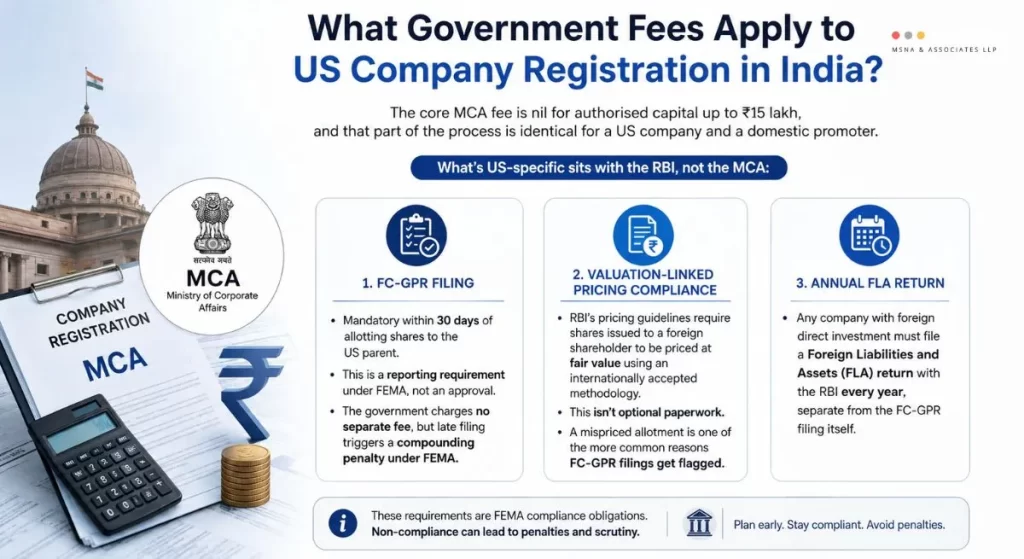
The core MCA fee is nil for authorised capital up to ₹15 lakh, and that part of the process is identical for a US company and a domestic promoter. What’s US-specific sits with the RBI, not the MCA:
FC-GPR filing:
Mandatory within 30 days of allotting shares to the US parent. This is a reporting requirement under FEMA, not an approval; the government charges no separate fee, but late filing triggers a compounding penalty under FEMA.
Valuation-linked pricing compliance:
RBI’s pricing guidelines require shares issued to a foreign shareholder to be priced at fair value using an internationally accepted methodology. This isn’t optional paperwork. A mispriced allotment is one of the more common reasons FC-GPR filings get flagged.
Annual FLA return:
Any company with foreign direct investment must file a Foreign Liabilities and Assets return with the RBI every year, separate from the FC-GPR filing itself.
What Do Consultants And Registered Agents Charge For US-to-India Setup?
Professional fees vary more than government fees, since they reflect the provider’s process.
Service | Typical Fee Range (USD)* |
End-to-end incorporation (SPICe+, MoA/AoA, name filing) | $210–$525 |
Registered agent / registered office service (if not using a physical office) | $100–$300/year |
Share valuation report (CA or merchant banker) | $160–$420 |
FC-GPR filing support | $55–$160 |
Resident director arrangement | $160–$315/year |
First-year compliance retainer (ROC, audit coordination, GST if applicable) | $475–$1,050/year |
The fee difference between provider quotes rarely comes from the SPICe+ filing itself, since that part is close to standardized. It comes from whether the valuation and FC-GPR filing are priced properly upfront, or bundled into a vague “compliance package” that shows up separately on the invoice.
Why Does A US Parent Company Need Valuation Report And Transfer Pricing Study?
This is the part most US founders skip entirely, and it’s specific to a corporate parent-subsidiary structure rather than an individual investor.
The valuation report exists because RBI requires shares issued to a foreign shareholder to be priced fairly, not arbitrarily. A Chartered Accountant or SEBI-registered merchant banker prepares this using an internationally accepted methodology, commonly discounted cash flow for an early-stage subsidiary. It’s a one-time cost per funding round, and it needs redoing at each subsequent capital infusion.
Transfer pricing is an ongoing obligation. Once the US parent and Indian subsidiary start transacting, whether that’s a services agreement, cost allocation, or intercompany loan, those dealings fall under Section 92 of the Income Tax Act as transactions between “associated enterprises.” A Chartered Accountant issues a certified report (Form 3CEB) confirming the pricing is at arm’s length. There’s no minimum transaction size that exempts a company from this once related-party dealings exist.
Founders who skip the transfer pricing conversation at incorporation usually pay more for it later, once a tax audit is already underway and the pricing has to be reconstructed after the fact.
What Hidden US-Side Costs Do American Founders Overlook?
A US parent has its own compliance calendar running in parallel, and missing it costs more than anything on the India side.
Form 5471 or Form 5472.
A US person or company with a controlling stake in a foreign corporation has to file one of these information returns with the IRS. Form 5471 penalties start at $10,000 per form per year; Form 5472 penalties start at $25,000 per form, with no cap on continuation penalties if the failure isn’t resolved. Either way, exposure applies regardless of whether the Indian subsidiary owes any tax.
GILTI and Subpart F exposure.
Depending on how the subsidiary’s income is structured, US shareholders may have added reporting obligations even without any cash coming back to the US.
The India-US DTAA.
This tax treaty can reduce withholding on dividends, royalties, and technical fees between the two entities, but only if treaty benefits are claimed correctly on both sides.
None of this shows up on an India-side incorporation invoice. It shows up on the US tax return the following spring, which is exactly why it gets missed.
What Is the Annual Compliance Cost After Registering a US Subsidiary in India?
Incorporation is one-time. Compliance runs every year the company exists, whether or not it’s actively trading.
Annual Item | Typical Cost (USD)* |
ROC annual filing (AOC-4 + MGT-7), government fee | $2–$6 per form |
ROC annual filing, professional fees | $55–$160 |
Statutory audit (mandatory regardless of turnover) | $105–$315+ |
Transfer pricing certification (Form 3CEB), if applicable | $160–$420 |
Income tax return filing | $55–$160 |
Annual FLA return to RBI | $105–$260 |
DIR-3 KYC per director | $5–$16 if filed on time |
GST return filing, if registered | $125–$380/year |
A straightforward Private Limited WOS lands between $450 and $1,100+ a year. The auditor fee line and the transfer pricing certification are the two items a resident-only startup budget genuinely doesn’t have, and skipping either one isn’t an option once the parent-subsidiary relationship exists on paper.
Where Should US Founders Invest First When Registering a Company in India?
Here’s the pattern worth noting
The instinct is to shop the incorporation filing itself, since that’s the line item every provider quotes first. That’s not where the risk sits. The valuation report and the resident director are.
A weak valuation report gets flagged during FC-GPR filing or, worse, during a later tax assessment, costing more in professional time to fix than it would have cost to do right. A disengaged resident director stalls every signature-dependent filing downstream, long after the incorporation fee is already paid.
If a founder spends more than the cheapest quote anywhere, spend it there. The incorporation filing is close to commoditized. The valuation and the resident director relationship are not.
How to Reduce Company Registration Costs in India Without Cutting Corners?
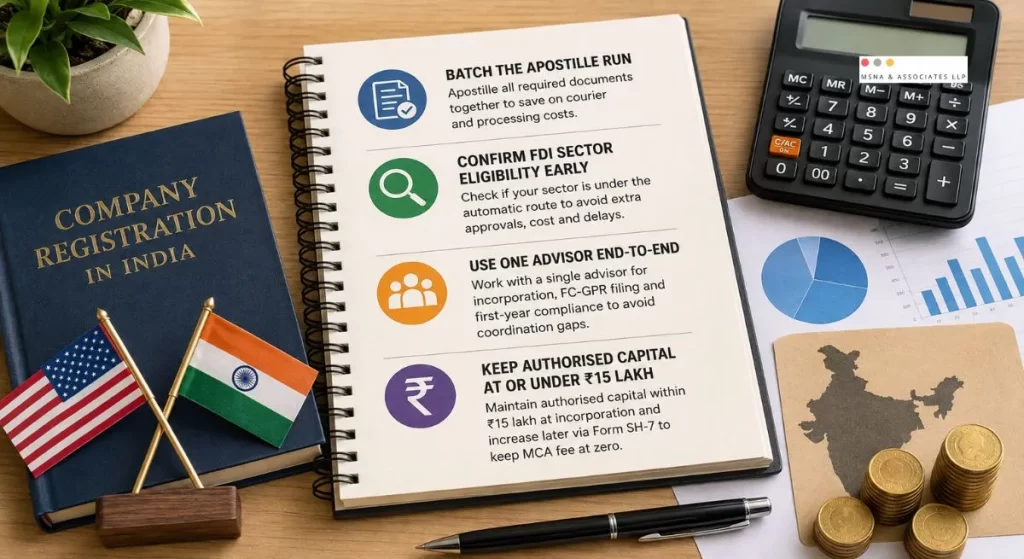
There are some measures that can be undertaken in order to reduce the costs associated with incorporation of an entity in India:
- Batch the apostille run: Apostille the Certificate of Incorporation, board resolution, and POA together in one submission instead of separately. Also pay courier and processing costs once instead of three times.
- Confirm FDI sector eligibility before drafting documents: A sector needing government-route approval instead of the automatic route changes the entire cost and timeline.
- Use one advisor across incorporation, FC-GPR, and first-year compliance: Coordination gaps between a US-side accountant and an India-side CA firm are a common, avoidable source of delay.
- Keep authorised capital at or under ₹15 lakh at incorporation, then raise it later via Form SH-7. This keeps the MCA fee at zero for as long as possible.
Company Registration Cost In India For US companies: Planning The Budget Right
The real cost of registering a company in India from the US isn’t the SPICe+ filing fee. It’s the combination of apostille, a properly done valuation report, RBI reporting, and the ongoing transfer pricing obligation that comes with any US parent-Indian subsidiary structure. Founders who plan for all four upfront spend more at incorporation and considerably less over the following two years than founders who don’t.
If you’re planning to set up a new company in India from the US, an itemised estimate based on your sector, funding structure, and parent company’s FDI eligibility will tell you a lot more than a flat quoted number.
Understand Your India Registration Cost
Frequently Asked Questions About Company Registration Cost in India for US companies
What is the minimum cost to register a company in India from the US?
For a straightforward wholly owned subsidiary with modest authorised capital, the minimum realistically sits around $700, once apostille, the valuation report, and FC-GPR filing are included.
Is the government fee for company registration in India really free for US companies?
The core MCA/SPICe+ fee is waived for authorised capital up to ₹15 lakh for foreign and domestic shareholders alike. Stamp duty, apostille, valuation, and professional fees still apply on top.
Does incorporation cost more for a corporate US parent than for an individual NRI investor?
Generally yes, A corporate parent needs a share valuation report and ongoing transfer pricing documentation that an individual investor typically doesn’t need at the same scale, since these requirements are tied to the parent-subsidiary relationship itself.
How long does it take to register a company in India from the US?
Once documents are apostilled, SPICe+ incorporation typically takes 10–15 working days. Apostille through the Hague Convention adds roughly 1–2 weeks on the US side, faster than the embassy attestation route that non-Hague countries need.
Related
Discover more from MSNA & Associates LLP
Subscribe to get the latest posts sent to your email.