


Six structures exist for a US company entering India: a Private Limited Company, an LLP, a Branch Office, a Liaison Office, a Project Office, and a Joint Venture. Only two of them let you actually own equity in an Indian entity. The other four range from full commercial operations under RBI approval to a presence that legally can’t earn a rupee of income.
Picking the wrong one doesn’t just cost money to fix later. Some structures can’t convert into others without closing down and starting over. A liaison office set up to “test the market” can’t become a subsidiary once the business is ready to sell; it has to be closed and rebuilt from scratch.
The right company type in India for a US subsidiary depends on one question most founders skip: what does this entity actually need to do, sell, hire, hold IP, or simply observe the market?
That answer, not cost or timeline, is what should drive the decision.
Key Takeaways
- Only two structures, a wholly owned subsidiary and an LLP, let a US company hold equity directly in an Indian entity.
- A wholly owned subsidiary (private limited company) is the default choice for most US founders planning to hire, sell, or raise funding in India.
- Branch and liaison offices currently require a five-year and three-year profit track record, respectively, though the RBI’s October 2025 Draft FEMA (Establishment in India of a Branch or Office) Regulations propose removing this requirement entirely.
- A liaison office can never earn income in India. It’s a listening post, not a business.
What Does This Entity Actually Need to Do?
Cost differences across these six structures top out around a few thousand dollars. That’s rarely the number that should decide anything here. The number that matters is what gets lost or gained by picking a structure that doesn’t match the business’s actual activity.
Start with this question: does the entity need to sign contracts, hire employees, and invoice customers in India? Or does it just need to observe the market, liaise with vendors, or execute one specific, time-bound project?
The answer splits the six options roughly in half before anything else gets weighed.
- A US founder planning to sell software to Indian customers within the year needs an entity that can invoice and collect payment. That rules out a liaison office immediately, no matter how much cheaper it looks on a fee schedule.
- A founder who genuinely just wants boots on the ground to understand pricing and competitors before committing capital doesn’t need the compliance weight of a full subsidiary yet.
- Getting this sequencing backwards, choosing the lighter structure now and assuming an upgrade later, is where founders lose months, not choosing the “wrong” one on a comparison chart.
What Company Types in India Can a US Company Set Up?
US companies entering India generally choose from six structures, governed by the Companies Act, 2013, the LLP Act, 2008, and FEMA, with Branch, Liaison, and Project Offices additionally regulated under the RBI Master Direction on Establishment of BO/LO/PO.
Each structure solves a different problem. Some are built for full operations, others exist only to observe, coordinate, or execute a single project.
Note: costs, timelines, and tax status below are indicative as of 2026. Government fees vary by state; confirm current figures before budgeting.
Entity Type | Typical Cost | Typical Timeline | Can Earn Income in India? | Best For |
Wholly owned subsidiary (Pvt Ltd) | $2,000-$5,000+ | 3-5 weeks | Yes | Full commercial operations, hiring, fundraising |
LLP | $1,500-$4,000 | 3-4 weeks | Yes, in eligible sectors only | Service businesses not seeking equity funding |
Branch office | $3,000-$8,000+ | 8-12 weeks | Yes, within parent’s approved activities | Established companies extending existing operations |
Liaison office | $2,500-$6,000+ | 8-12 weeks | No | Market research before committing capital |
Project office | $2,500-$7,000+ | 6-10 weeks | Yes, for the specific project only | Executing one defined contract |
Joint venture | Varies with partner terms | 4-8 weeks | Yes | Entering with a local partner’s market access |
Private Limited Company (WOS): The Default Choice
A Private Limited Company is the structure most US founders land on when evaluating the best entity type in India for a US company. It’s the only entity type built for full-scale operations, hiring, fundraising, and revenue generation under one roof. The US parent can hold up to 100% ownership under the automatic FDI route, which is what makes it a Wholly Owned Subsidiary. It’s taxed as a domestic company. And because it’s a separate legal entity, liability stays contained to the India entity, not the parent.
Example: A US SaaS company opening a delivery center in India usually goes this route. So does a DTC brand setting up local sales and warehousing.
Factor | Detail |
Minimum directors/shareholders | 2 directors (1 India-resident), 2 shareholders |
Minimum capital | No statutory minimum |
Government + professional fees | Roughly ₹8,000–₹15,000 govt fees, ₹40,000–₹90,000 professional fees |
Timeline | 3–5 weeks to Certificate of Incorporation |
Ongoing compliance | Annual ROC filings, statutory audit, board meetings |
Who should pick this: Founders who plan to hire, sign local contracts, generate India revenue, or raise India-specific capital.
LLP: The Lean Option for Services Businesses
An LLP suits founders running consulting, design, or tech-services models where the business doesn’t need share capital or investor-style equity.
Profit share isn’t taxed the way company dividends are, which keeps things simple for founder-only or partner-only teams.
Factor | Detail |
Minimum partners | 2 designated partners (1 India-resident) |
Government + professional fees | Roughly ₹5,000–₹10,000 govt fees, ₹30,000–₹60,000 professional fees |
Timeline | 3–4 weeks |
Ongoing compliance | Annual ROC filing; audit only above prescribed turnover/contribution thresholds |
Trade-off: LLPs cannot issue equity shares. This is a poor fit if you’ll raise venture capital later. Converting to a Private Limited Company mid-way is possible but adds cost and time.
Joint Venture: When You Need a Local Partner
A Joint Venture pairs the US company with an Indian partner, through a new entity or an equity stake in an existing one. This is less about preference and more about sector rules. Some regulated sectors cap foreign ownership or require government-route approval.
Factor | Detail |
Structure | New Pvt Ltd/LLP with a local partner, or equity investment in an existing company |
Ownership cap | Sector-dependent. Automatic route or capped, depending on sector |
Timeline | 4–8 weeks, longer under government route |
Key documents | Shareholders’ agreement, JV agreement defining control, exit, dispute terms |
Who should pick this: Founders entering ownership-capped sectors, or wanting a partner’s market access and regulatory relationships.
What Are The Company Types In India For Foreign Businesses?
These three structures don’t create a separate Indian legal entity. The US parent carries the liability directly, and all three route through RBI approval via an Authorised Dealer bank.
Factor | Branch Office | Liaison Office | Project Office |
Purpose | Revenue-generating activity (export/import, consultancy, IT/R&D) | Market research, relationship-building only | Executing one awarded India contract |
Eligibility | Parent profitable over preceding 5 years, net worth ≥ USD 100,000 | Parent profitable over preceding 3 years, net worth ≥ USD 50,000 | Secured India contract, defined funding source |
Revenue allowed | Yes, within defined activities | No. Cannot invoice or contract | Contract-linked only |
Tax status | Taxed as a foreign company, at the foreign-company rate | None. No income generated | Taxed as a foreign company on project income |
Timeline | 8–12 weeks | 8–12 weeks | 6–10 weeks |
Who should pick which: Branch Office fits established companies testing India revenue without full incorporation. Liaison Office fits founders scoping the market before committing capital. Project Office fits a defined, contract-bound engagement.
Which Company Type in India Is Best for Foreign Founders?
Most US founders reach for Private Limited before evaluating anything else, since it’s the entity type that comes up first in search results. In our experience advising US-to-India entries at MSNA, that instinct is right more often than not, but the cases where it’s wrong are expensive to undo.
The pattern we see most: a services founder incorporates Private Limited anticipating a funding round that never happens, then carries audit and board compliance an LLP would have avoided. The reverse also happens; a founder picks LLP for simplicity, then converts to Private Limited eighteen months later to raise capital, absorbing costs that upfront planning would have skipped.
The real driver isn’t “which entity is most common.”
It’s one question: will this entity ever need to issue equity? If yes, even a “maybe eventually,” Private Limited is worth the extra compliance from day one. If it’s a confident no, LLP is the leaner path.
The Track-Record Trap in Branch and Liaison Applications
Founders researching Branch and Liaison Offices usually think the decision comes down to activity type: revenue versus non-revenue. That’s true, but it misses a harder constraint: RBI’s profitability track-record requirement.
We regularly see recently profitable US companies apply for a Branch Office assuming approval is a formality. RBI scrutinizes historical financials closely, and a thin profitability history can push approval well past the typical 8-12 week window. Founders plan around activity scope and skip this eligibility check entirely, and it’s the most underestimated variable in the decision.
Before filing, we map the parent’s financials against RBI’s track-record expectations. If the numbers are borderline, a WOS is usually the faster, lower-risk path to the same India presence. It carries no profitability prerequisite and is taxed domestically rather than at foreign-company rates.
How to Choose the Right Company Type in India: A Founder's Decision Framework
Work through these questions in order. They’ll point you to one structure faster than reading every section above.
- Will you generate revenue in India? No → Liaison Office.
- Do you have a signed India contract with a defined end date? Yes → Project Office
- Will you eventually raise equity through the India entity? Yes → Private Limited.
- Does the parent meet RBI’s profitability track record for a Branch Office? Yes → Branch Office is viable. No → Private Limited or LLP.
- Does your sector require a local partner or cap foreign ownership? Yes → Joint Venture. No → Private Limited or LLP based on the equity question above.
- Does tax treatment matter to your structure? Domestic-rate taxation favors WOS or LLP over Branch/Project Office, which are taxed at foreign-company rates.
What Are The Common Mistakes US Founders Make Choosing an Entity Type
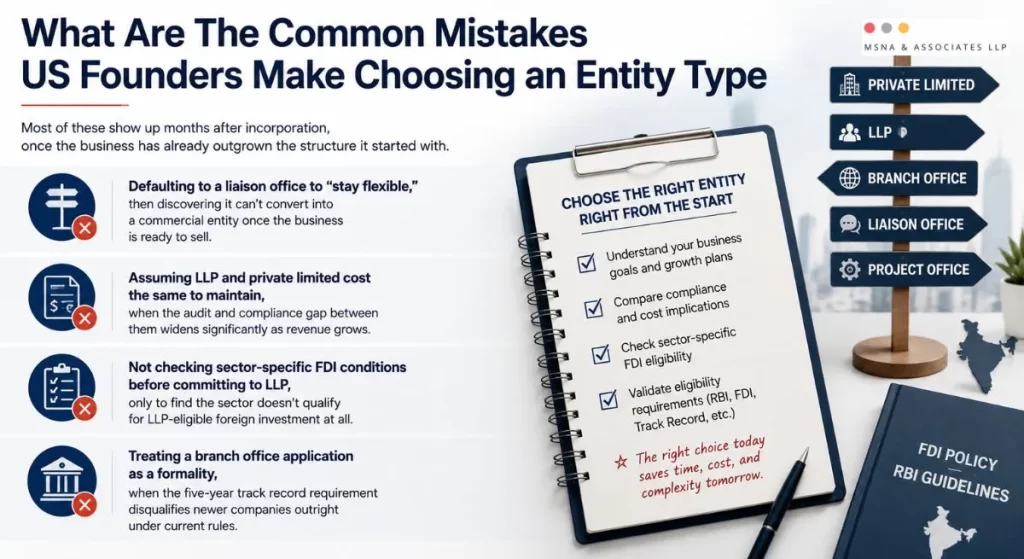
Most of these show up months after incorporation, once the business has already outgrown the structure it started with.
- Defaulting to a liaison office to stay flexible, then discovering it can’t convert into a commercial entity once the business is ready to sell.
- Assuming LLP and private limited cost the same to maintain, when the audit and compliance gap between them widens significantly as revenue grows.
- Not checking sector-specific FDI conditions before committing to LLP, only to find the sector doesn’t qualify for LLP-eligible foreign investment at all.
- Treating a branch office application as a formality, when the five-year track record requirement disqualifies newer companies outright under current rules.
Choosing the Right Company Type in India With Confidence
Cost and timeline differences across these six structures are real, but they’re rarely what should decide this. What the entity actually needs to do, sell, hire, hold IP, or simply observe, narrows the list faster than any comparison table can.
MSNA’s India entry team works through this decision with US founders before a single filing goes in, since unwinding the wrong structure typically costs far more than getting the structure right upfront.
Consulting a professional who can assist in setting up a new company in India from the USA can help you map your specific plans against the structure that actually fits them, rather than the one that looked simplest on paper.
Evaluate The Right India Entry Structure
Frequently Asked Questions About Company Types In India
Can a US company own 100% of an Indian Private Limited Company?
Yes, in most sectors, under the automatic FDI route, without prior government approval.
Which India entity type is fastest to set up?
LLP and Private Limited, at 3–5 weeks, since neither requires RBI approval.
Does a Liaison Office need RBI approval?
Yes, through an Authorised Dealer bank, along with a demonstrated parent profitability track record.
Is a Branch Office taxed differently from a Private Limited subsidiary?
Yes, A Branch Office is taxed as a foreign company at the foreign-company rate, while a WOS is taxed as a domestic company.
Related
Discover more from MSNA & Associates LLP
Subscribe to get the latest posts sent to your email.