


Growth rarely happens in isolation. At some point, most companies face a choice: build capacity internally or combine with another business to get there faster. This is where types of combination in business become relevant.
A merger, an acquisition, an amalgamation, a consolidation, or a joint venture each changes ownership, control, and financial reporting differently. Picking the wrong structure can slow down growth, trigger tax exposure, or dilute control more than intended.
This guide breaks down each type of business combination, how they differ under Indian corporate law, and how a Virtual CFO helps founders and strategy teams match the structure to the growth goal.
What Is a Business Combination?
A business combination arises whenever a company acquires control over another company or whenever multiple companies join together to form a new company. Ownership percentage alone does not decide this under Ind AS 103. Control does, and control can be established through a share purchase, an asset purchase, or a court-approved scheme, even without acquiring a full majority stake in some cases.
Why a company chooses one route over another usually comes down to what it needs at that stage of growth. A company chasing market share leans toward horizontal combinations. One trying to cut supply chain costs looks at vertical deals. One wanting to enter a completely different industry considers a conglomerate merger instead. The structure picked also carries downstream effects that founders rarely think about upfront, from shareholder voting rights to how long regulatory clearance takes to how heavy the post-deal integration turns out to be.
What Are the Types of Business Combinations?
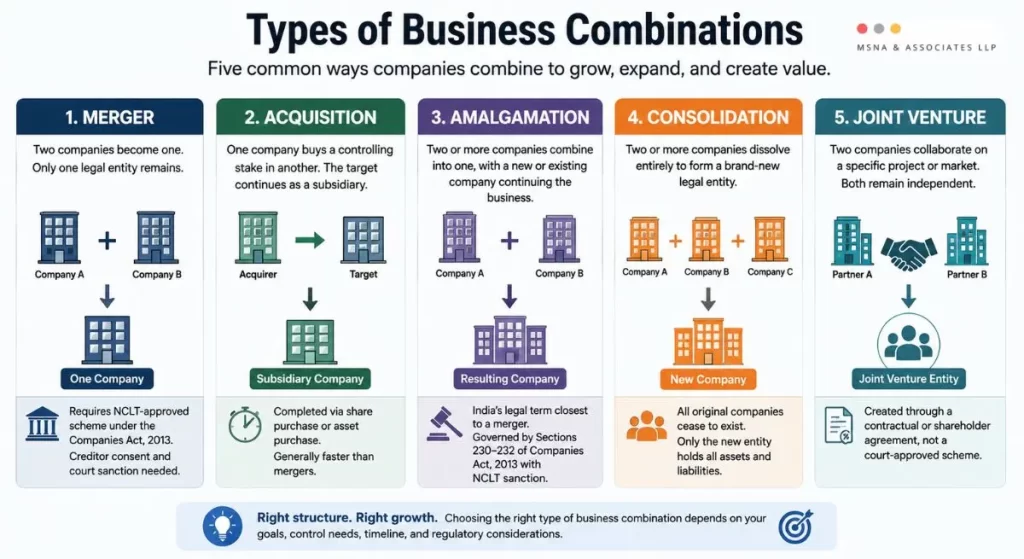
The main types of business combinations are mergers, acquisitions, amalgamations, consolidations, and joint ventures. They each have different legal structures and different outcomes for the firms.
1. Merger
It involves two companies becoming one, where there will be just one firm left as the legal entity. Most mergers in India go through an NCLT-approved scheme under the Companies Act, 2013, which means creditor consent and court sanction come before the deal closes.
2. Acquisition
An acquisition works differently. Here, one company simply buys a controlling stake in another, either through a share purchase or an asset purchase agreement, and the target does not have to dissolve. It can keep operating as a subsidiary under new ownership, which is why acquisitions tend to close faster than mergers routed through the NCLT. You can refer to our detailed guide on the merger vs acquisition.
3. Amalgamation
Here, two or more companies combine into one, with a new or existing company continuing the combined business. This is India’s legal term closest to what global markets call a merger, governed under Sections 230-232 of the Companies Act, 2013 and requiring NCLT sanction.
4. Consolidation
Two or more companies dissolve entirely to form a brand-new legal entity. Unlike a merger or amalgamation, all the original firms are wiped out, and only the resultant firm will own all assets and liabilities of the original ones.
5. Joint Venture
Two companies collaborate to use their resources or technologies for a specific project or market, yet both companies remain separate in their operations. A joint venture is formed through a contractual or shareholder agreement rather than a court-approved scheme.
CA Naveen S N, MSNA & Associates LLP, notes that founders frequently default to a share purchase because it looks fastest, without checking whether the target’s accumulated losses or unabsorbed depreciation could have been carried forward under an amalgamation structure instead. That single structuring choice can change the effective post-deal tax outflow by a meaningful margin.
A worked example: On ₹2 crore of accumulated losses, a straight share purchase can trigger Section 79 and block the carry-forward entirely. Route it through a Section 72A-compliant amalgamation instead, and those losses offset future profits, saving roughly ₹50 lakh at the 25.17% effective tax rate. Keep in mind that, under the Finance Act, 2025, this carry forward is now limited to eight years from the year of loss, and not from the date of amalgamation, for those mergers taking place after 1 April 2025.
How Do Horizontal, Vertical, and Conglomerate Combinations Differ?
Business combinations are also classified by the relationship between the companies involved, not just the legal mechanism.
Combination Type | Relationship Between Companies | Purpose | Example |
Horizontal combination | Same industry, same production stage | Market share, scale | Two SaaS companies serving the same customer segment merge |
Vertical combination | Different stages of the same supply chain | Supply chain control, cost efficiency | A manufacturer acquires its raw material supplier |
Conglomerate merger | Unrelated industries | Diversification, new market entry | An FMCG company acquires a fintech startup |
When market leaders combine horizontally, the Competition Act, 2002 tends to scrutinise the deal more closely, since it hits competition head-on in a way the other two structures don’t.
Merger, Acquisition, Amalgamation, Consolidation: What Is the Difference?
Indian company law uses overlapping terms for these structures, and the legal consequences differ even when the business outcome looks similar.
Term | Core Difference | Governing Provision |
Merger | Combines two companies into one surviving entity | |
Acquisition | One company gains control by buying shares or assets. The target can continue as a subsidiary | Share/asset purchase agreement |
Amalgamation | India’s legal term closest to a global “merger”, requiring NCLT sanction | Sections 230-232, Companies Act, 2013 |
Consolidation | None of the original companies survive. A new entity holds combined assets and liabilities | Sections 230-232, Companies Act, 2013 |
One provision worth flagging here is Section 72A of the Income Tax Act, 1961. It lets certain amalgamating companies carry forward and set off accumulated losses, but this is not available to every deal. Only industrial undertakings, banking companies, and a few notified sectors qualify for this benefit. And the conditions don’t end at the amalgamation either. Shareholding and business continuity requirements still have to be met afterward.
Why Do Companies Choose Joint Ventures or Strategic Alliances Instead of a Merger?
Not every growth opportunity needs full ownership change.
Structure | Ownership Change | Best Suited For |
Joint venture | None. Both parents form or fund a shared entity | Entering a regulated foreign market, sharing R&D cost, large infrastructure bids |
Strategic alliance | None. Purely contractual | Testing a partnership or market before committing capital |
A joint venture lets two companies pool capital, technology, or market access for a defined project while keeping their separate legal identities. A strategic alliance goes lighter still: there is no new entity and no equity exchange, just a contractual arrangement to collaborate on distribution, technology licensing, or co-marketing. Founders often start with a strategic alliance and move to a joint venture or acquisition once the relationship proves out.
How Does Ind AS 103 Define Type Of Combination In Business?
A business combination is defined under Ind AS 103, which is the accounting standard for Indian entities based on the Companies (Indian Accounting Standards) Rules, 2015, as a transaction in which an acquirer gets control of one or more businesses. It requires the acquisition method of accounting:
Ind AS 103 Requirement | What It Means |
Fair value measurement | Identifiable assets and liabilities acquired are measured at fair value |
Goodwill recognition | Recognised as the difference between purchase consideration and net identifiable assets |
Transaction cost treatment | Expensed in the period incurred, not added to acquisition cost |
A combination structured without modelling its Ind AS 103 treatment in advance often triggers goodwill impairment surprises within the first two reporting cycles, which can weaken the numbers a company presents to its next round of investors or lenders.
Founders evaluating types of combination in business should involve their finance function early enough to model the Ind AS 103 treatment alongside the legal structure, not after the deal closes.
What Are the Common Types Of Business Combination Structures in India?
The structure a company picks depends on sector, deal size, and regulatory route. Here are the common ones:
Structure | Description | Common Use Case |
Slump sale | Entire business undertaking transferred as a going concern, for a lump sum | Private deals outside the court route |
Scheme of arrangement (NCLT route) | Mergers, amalgamations, and demergers needing court and creditor approval | Sections 230-232 transactions |
Share purchase agreement | Direct acquisition of controlling shares | Faster deals, limited liability transfer |
Asset purchase agreement | Selective purchase of specific assets and liabilities | Buyers avoiding undisclosed obligations |
Cross-border structures | Combinations involving a foreign parent or subsidiary | FEMA and RBI approval, transfer pricing |
The choice comes down to three things: control needed, speed of closing, and risk the buyer will inherit.
How Does a Virtual CFO Help Choose the Right Types of Combination in Business?
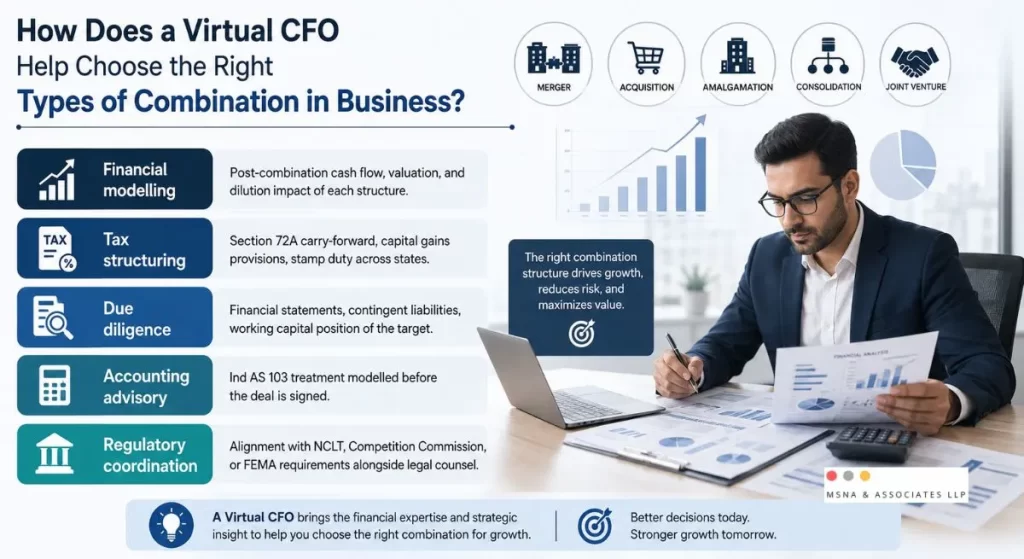
Choosing between a merger, acquisition, amalgamation, consolidation, or joint venture is a financial decision as much as a legal one. A Virtual CFO brings the financial modelling, tax structuring, and due diligence discipline that founders and internal teams often lack the bandwidth to build in-house, especially at growth stage.
Virtual CFO Role | What It Covers |
Financial modelling | Post-combination cash flow, valuation, and dilution impact of each structure |
Tax structuring | Section 72A carry-forward, capital gains provisions, stamp duty across states |
Due diligence | Financial statements, contingent liabilities, working capital position of the target |
Accounting advisory | Ind AS 103 treatment modelled before the deal is signed |
Regulatory coordination | Alignment with NCLT, Competition Commission, or FEMA requirements alongside legal counsel |
For founders and corporate strategy teams weighing multiple growth paths, this financial lens often decides whether a joint venture, an outright acquisition, or an internal merger of group companies serves the growth strategy better.
What Should CEOs Evaluate Before Choosing a Type of Combination in Business?
Factor | Question to Ask |
Control needed | Does the goal need full ownership, or does shared control work? |
Speed to close | Can the deal wait for an NCLT scheme, or does it need a faster share purchase route? |
Tax and loss carry-forward | Does an amalgamation unlock Section 72A benefits an asset purchase cannot? |
Regulatory exposure | Does the combination invite Competition Act scrutiny? |
Accounting impact | How will Ind AS 103 treatment affect reported goodwill and future fundraising optics? |
Integration capacity | Can the team absorb the heavier integration load of a consolidation or amalgamation? |
Choosing the Right Structure Starts With the Right Financial Advice
The business combination structure a company chooses affects its tax position, reporting obligations, and growth path for years after the deal closes. MSNA & Associates LLP’s Virtual CFO team works with founders and strategy teams to evaluate these structures against real financial data before they commit to one. If your business is weighing a merger, acquisition, or joint venture as its next growth move, reach out to discuss which structure fits your goals.
Call: +91 90367 27740 | Email: partners@msna.co.in
Choose the Right Business Combination
Frequently Asked Questions About The Types of Combinations In Business
What are the five main types of business combinations?
The five main types are mergers, acquisitions, amalgamations, consolidations, and joint ventures. Each carries a different legal structure and a different level of control transfer.
Is a joint venture a type of business combination?
A joint venture refers to the merging of two or more corporations with a specified aim, while at the same time, maintaining their independent legal standing.
What is the difference between horizontal and vertical combinations?
A horizontal combination joins companies at the same production stage in the same industry. A vertical combination joins companies at different stages of the same supply chain.
Does every business combination need NCLT approval in India?
No. Mergers, amalgamations, and demergers in the form of schemes of arrangement under Sections 230-232 of the Companies Act, 2013 need the approval of the National Company Law Tribunal. Purchases of shares and assets generally don’t.
Related
Discover more from MSNA & Associates LLP
Subscribe to get the latest posts sent to your email.