

Most US CFOs only think about transfer pricing after the Indian subsidiary has already invoiced the parent company, or after a management fee has already gone out the door. By then, the pricing is set. And if it wasn’t priced at arm’s length from the start, there’s no clean way to fix it retroactively.
Transfer pricing in India applies to every transaction between a US parent and its Indian subsidiary, including management fees, royalty payments, cost allocations, and intercompany loans, and requires each one to be priced at arm’s length- the price two unrelated parties would agree to under similar conditions.
The compliance mechanics follow directly from that requirement. Form 3CEB must be filed for every international transaction, with no minimum value threshold. Once transactions cross ₹1 crore in a year, detailed transfer pricing documentation becomes mandatory as well.
Neither step is optional once a threshold is crossed. A missed Form 3CEB draws a minimum ₹1,00,000 penalty on its own, and documentation failures are penalized separately, at 2% of the transaction value.
This guide covers what transfer pricing means for your India subsidiary, which transactions are covered, what documentation you need, and where US parent companies most often get it wrong.
What Is Transfer Pricing in India, in Simple Words?
Transfer pricing is the price your Indian subsidiary charges or pays your US parent company for goods, services, or the use of intellectual property.
Say your US company charges the Indian subsidiary a management fee, or the Indian subsidiary bills the US parent for software development work. That price isn’t set by an open market. It’s set internally, between two related companies.
Indian tax law calls this an arm’s length price: the price that would apply if the two companies weren’t related at all. The Income Tax Department checks that internal pricing doesn’t shift profit out of India through inflated fees or underpriced services.
What Are the Transfer Pricing Rules for Subsidiaries in India?
Transfer pricing rules for subsidiaries in India sit in Chapter X of the Income Tax Act, 1961 (Sections 92 to 92F), now recodified under Sections 161 to 173 of the Income-tax Act, 2025, effective April 1, 2026.
Provision | What It Governs |
Requires income from international transactions to be computed at arm’s length | |
Defines “associated enterprise,” generally 26% or more shareholding or voting power, or common management/control | |
Defines international transaction | |
Sets out how arm’s length price is computed | |
Enables Safe Harbour Rules | |
Enables Advance Pricing Agreements | |
Requires the Form 3CEB accountant’s report |
Most US-founded subsidiaries only look at India TP rules once a transaction is already underway. The stronger approach is treating the intercompany agreement and pricing policy as day-one legal documents.
Which Intercompany Transactions Trigger Transfer Pricing Compliance in India?
Indian subsidiary, which include:
- Management and other corporate services fees paid to the Indian entity
- Royalties paid for brand, software, or IP usage
- Allocations of costs of shared service functions like Human Resources, IT and Finance
- Sales/Purchase of goods by both parties
- Intercompany lending, guarantee and pooling of cash
- Secondment/Deputation of staff between entities
- Reimbursement of cost of services on a cost plus basis
How Is the Arm's Length Price Determined?
India recognizes six transfer pricing methods under Rule 10B. The right one depends on the nature of the transaction and available comparable data, and there’s no fixed hierarchy between them.
Method | Best Suited For |
Transactions with a direct market comparable | |
Resale Price Method (RPM) | Distribution and resale of goods |
Cost Plus Method (CPM) | Manufacturing and contract services |
Profit Split Method (PSM) | Transactions involving unique intangibles |
Transactional Net Margin Method (TNMM) | Captive IT, ITeS, and BPO service providers |
Other Method | Where none of the above fit reliably |
For most US-parented captive units in IT, ITeS, or R&D, TNMM is the most commonly used method for captive service providers, given the difficulty of finding clean external comparables in India. Budgeting for an annual benchmarking refresh keeps that margin defensible.
What Transfer Pricing India Documentation Do You Need to Maintain?
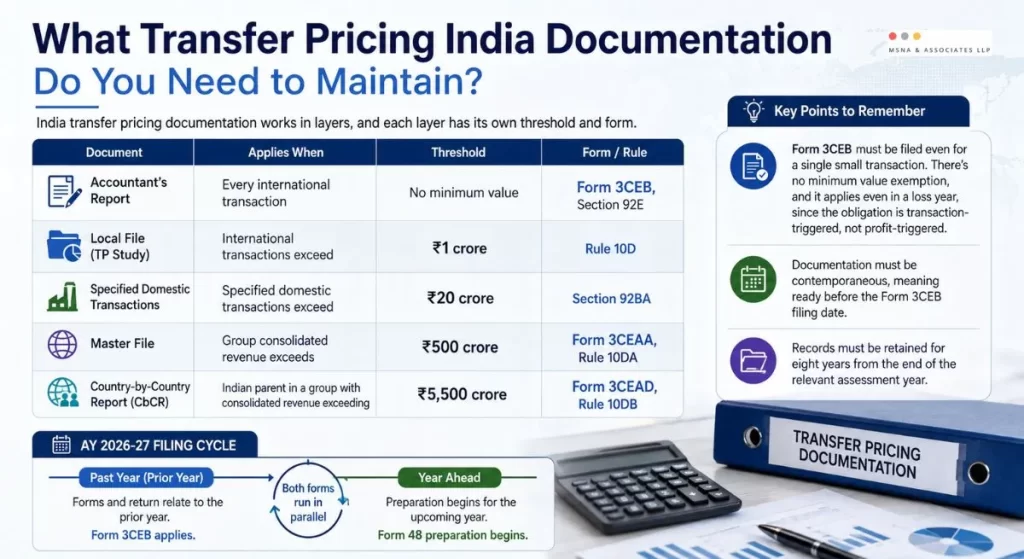
India transfer pricing documentation works in layers, and each layer has its own threshold and form.
Document | Applies When | Form / Rule |
Accountant’s report | Every international transaction, no minimum value | Form 3CEB, Section 92E |
Local file (TP study) | International transactions exceed ₹1 crore | |
Specified domestic transactions | Exceed ₹20 crore | Section 92BA |
Master File | Group consolidated revenue exceeds ₹500 crore | |
Country-by-Country Report | Indian parent in a group with consolidated revenue exceeding ₹5,500 crore |
A few things worth flagging directly:
- Form 3CEB must be filed even for a single small transaction. There’s no minimum value exemption, and it applies even in a loss year, since the obligation is transaction-triggered, not profit-triggered.
- Documentation must be contemporaneous, meaning ready before the Form 3CEB filing date.
- Records must be retained for eight years from the end of the relevant assessment year.
- During the AY 2026-27 filing cycle, both forms will run in parallel. Form 3CEB is for returns still covering the prior year, while Form 48 preparation begins for the year ahead.
What Are India's Safe Harbour Rules, and Should Your Subsidiary Use Them?
Safe Harbour Rules (Section 92CB) offer a shortcut: if your subsidiary accepts a pre-set profit margin, the tax officer generally accepts it without a full transfer pricing study.
- Software development and IT-enabled services have their own prescribed margin bands, recently revised under the new Act.
- Margins are periodically revised, so current-year figures should always be confirmed before opting in rather than relied on from a prior year’s guide.
- Safe harbour margins are usually higher than what a proper study would show. You pay a bit more tax, but you buy certainty and skip the audit hassle.
Who it’s best for: Smaller subsidiaries without in-house transfer pricing resources, especially ones that prefer predictability over squeezing out the lowest possible margin.
One more update to know: Starting Tax Year 2026-27 (AY 2027-28), you can opt into a multi-year pricing agreement. Once a price is accepted, it generally applies to similar transactions for a three-year block instead of redoing the study annually.
IT/ITeS transactions are treated differently: the block runs for five years rather than three. So worth noting, given that’s the segment most US-parented captives fall into.
When Does an Advance Pricing Agreement (APA) Make Sense?
An APA (Advance Pricing Agreement) as per Section 92CC refers to an agreement entered into prior to filing by the taxpayer with the Indian tax department regarding the method of transfer pricing applicable in future years.
- Unilateral APA: agreement with Indian authorities only.
- Bilateral APA: agreement with Indian and US authorities under the India-US tax treaty and thus reduces risk of double taxation on both sides.
- Multilateral APA: agreement covering more than two jurisdictions.
APA can offer certainty for five prospective years and additional four-year rollback, thus up to nine years in total. It involves an application fee and a negotiation process, so it tends to make sense for higher-value, recurring intercompany transactions rather than one-off dealings.
What Happens If Your Subsidiary Doesn't Comply?
Transfer pricing penalties in India apply separately from any tax adjustment, and they stack rather than replace each other.
Section | Trigger | Penalty |
Form 3CEB not filed | Fixed ₹1,00,000 | |
TP documentation not maintained or incorrect | 2% of transaction value | |
Documents not furnished to the TPO on request | 2% of transaction value | |
Under-reporting or misreporting due to a TP adjustment | 50% to 200% of tax on the adjustment |
On a ₹40 crore intercompany transaction, a documentation-failure penalty alone can run to ₹80 lakh, independent of whatever the underlying tax dispute is worth.
The US-India Transfer Pricing Mismatch Most CFOs Overlook
Your US parent has its own transfer pricing obligations under IRC Section 482, with its own documentation standard. And here’s the catch: India and the US don’t always agree on what “arm’s length” means for the same transaction.
When they disagree, the same income can get taxed twice. Once by India’s Transfer Pricing Officer, once by the IRS. The only way out is the Mutual Agreement Procedure (MAP) under the India-US tax treaty, which takes time and money.
There’s a second issue most people miss. If your Indian subsidiary’s margin is set too low, it doesn’t just risk an adjustment in India. It can also affect:
- How much of your Indian subsidiary’s income counts toward your US parent’s GILTI calculation
- How intercompany payments get treated under BEAT, depending on your parent’s size and structure
These are US-side questions for your Section 482 advisor. Not your India TP team. But both sides need to build their positions with the other in mind.
Our take:
Don’t treat India TP compliance and US Section 482 documentation as two separate filings run by two separate teams. Treat them as one policy. A pricing approach that holds up in Bangalore but doesn’t match what’s filed in the US creates the exact mismatch that lands you in a MAP negotiation.
What Are the Common Mistakes US Parent Companies Make With India Transfer Pricing?
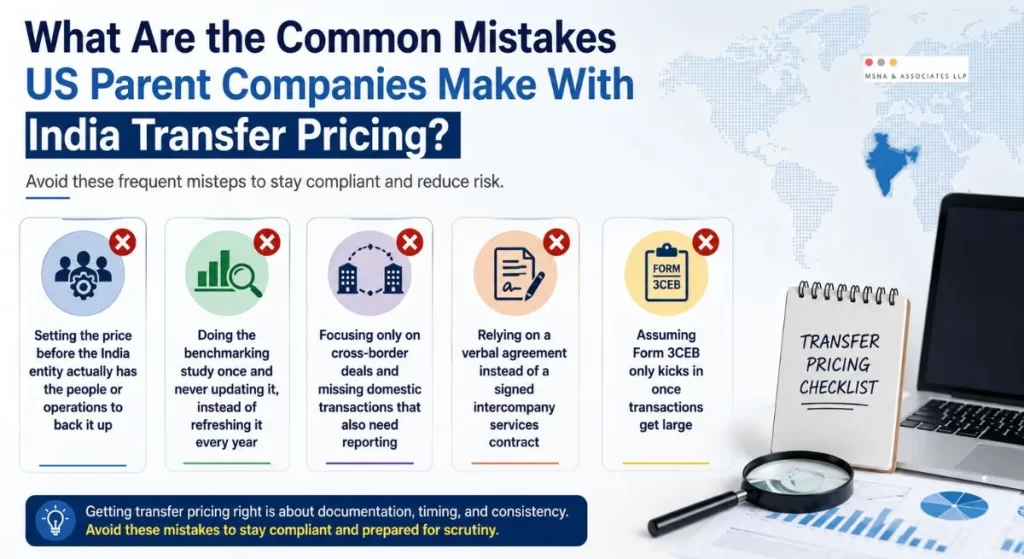
These show up repeatedly enough that they’re worth checking against your own setup directly.
- Setting the price before the India entity actually has the people or operations to back it up
- Doing the benchmarking study once and never updating it, instead of refreshing it every year
- Focusing only on cross-border deals and missing domestic transactions that also need reporting
- Relying on a verbal agreement instead of a signed intercompany services contract
- Assuming Form 3CEB only kicks in once transactions get large
Transfer Pricing India Compliance Checklist for CFOs and Tax Directors
Use this as a working checklist against your own subsidiary’s setup.
- Map every intercompany transaction between the US parent and India subsidiary
- Confirm which TP method applies to each transaction type
- Maintain a signed intercompany agreement for each transaction category
- Refresh the benchmarking study annually, not just at TP study creation
- File Form 3CEB by the due date, regardless of transaction size
- Evaluate safe harbour eligibility where it fits your risk appetite
- Assess whether a bilateral APA is worth pursuing for high-value, recurring flows
- Align India TP documentation with US Section 482 filings
Conclusion
Transfer pricing in India rewards preparation over reaction. Getting the intercompany agreement, benchmarking, and documentation right before filing season, rather than during it, is what keeps a routine Form 3CEB filing from turning into a TPO inquiry, or worse, a MAP negotiation with both tax authorities involved.
MSNA works with US parent companies specifically to keep the Indian TP study and the US Section 482 documentation consistent, rather than treating them as two unrelated compliance tasks.
Consulting an outsourced accounting service in India for US Businesses can help you assess how these rules apply to your subsidiary’s specific transaction structure.
Get Help With India Transfer Pricing Compliance
Frequently Asked Questions About Transfer Pricing In India
Does transfer pricing apply if my India subsidiary is wholly owned?
Yes, The ownership percentage does not absolve from the responsibility. In cases where organizations become associated enterprises, all the cross-border transactions between the two become subject to transfer pricing provisions whether the subsidiary is wholly or partially owned.
What's the penalty for not filing Form 3CEB?
A fixed penalty of ₹1,00,000 under Section 271BA, separate from any documentation or under-reporting penalty.
Can a US parent avoid TP scrutiny in India entirely?
Not entirely, but safe harbour rules and APAs both reduce it substantially for qualifying transactions.
Is TNMM always the right method for an India captive unit?
Not always, It’s common for service-based captives, but the most appropriate method depends on the transaction’s FAR (functions, assets, risk) profile.
Related
Discover more from MSNA & Associates LLP
Subscribe to get the latest posts sent to your email.