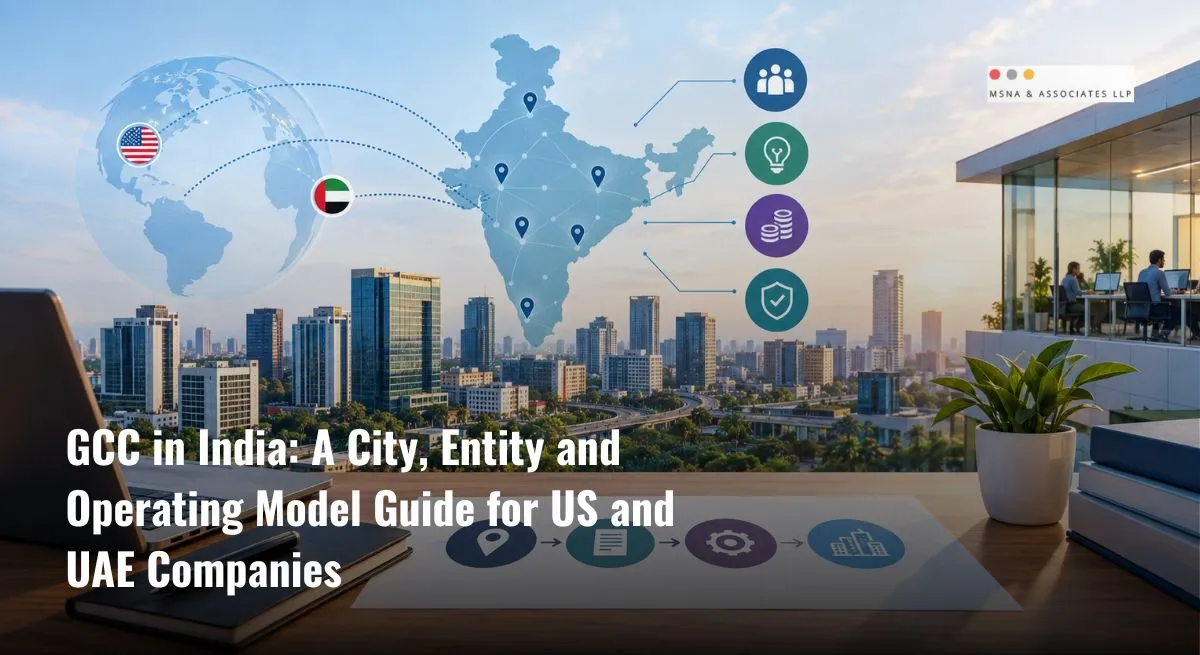

India is home to 2,117 Global Capability Centers (GCCs) employing about 2.36 million people, and each one began with the same three choices: where to locate, which legal entity to register, and how to run it. (Nasscom–Zinnov, GCC Landscape in India 2026)
For most US and UAE companies building a technology or engineering GCC, the common starting point is a wholly owned subsidiary under the Companies Act, 2013, in Bengaluru or Hyderabad, while finance-led centers often look at Mumbai or Chennai.
The right answer depends on the function you plan to house, the operating model you choose, and the scale you expect to reach. These three decisions work best when made together, in that order. Taken separately, they can lead to restructuring the entity or relocating teams later.
There’s also a fourth factor that most treat as a year-two problem: the 2026 transfer pricing safe harbour now ties directly into how your entity is designed, so it belongs in the planning stage alongside city, entity, and operating model.
This guide covers each decision about GCC in India, how they interact, the 2026 transfer pricing change that affects GCC economics, and a realistic setup sequence.
Which City, Entity and Operating Model Fit Which Kind of GCC In India?
The table below is a general starting point. Function comes first, then operating model, then entity, then city.
If your GCC is mainly… | Operating model usually considered | Entity usually paired | Cities usually shortlisted |
Product engineering or R&D | Captive or Center of Excellence | Bengaluru, Hyderabad, Pune | |
Data, analytics or AI | Captive or Center of Excellence | Wholly owned subsidiary | Bengaluru, Hyderabad, Pune |
Finance, banking or capital markets support | Captive or shared services | Wholly owned subsidiary | Mumbai, Chennai, Pune |
Standardized HR, finance or IT support across business units | Shared services | Wholly owned subsidiary | Chennai, Pune, Delhi NCR |
A first step into India with lower early risk | Build-Operate-Transfer | Partner’s entity first, then a subsidiary | Depends on the partner’s location |
Regulated sectors such as banking and insurance may face sector-specific requirements, so confirm these before fixing a structure.
What Is a GCC, and Why Do Companies Set One Up in India?
A Global Capability Center (GCC) is a company’s own office in another country, set up to handle important work internally instead of hiring an outside vendor. The parent company hires the staff, manages the center, and keeps full control over how it runs.
For example, instead of outsourcing IT support, accounting, or research to a vendor in India, a global firm from the US or UK sets up its own India-based unit. It hires employees directly and uses this center for work like software development, finance, customer support, or research, all as part of the parent company itself.
India is still considered favorable to most firms because of the availability of talent, English-speaking employees, and a clear legal framework through the Companies Act, 2013, and Foreign Exchange Management Act (FEMA). The estimated revenues for India’s GCCs in FY2026 stand at $98.4 billion, up from $64.6 billion in FY2024, according to a Nasscom-Zinnov study (Business World).
Functions commonly housed in India include:
- Software engineering and product development
- Finance and accounting (FP&A, controllership, GL)
- Data analytics and business intelligence
- Customer operations and support
- HR shared services
- R&D and innovation labs
The function you plan to house directly influences the city, entity, and operating model that fit best, which is why the three decisions cannot be made in isolation.
How To Choose the Right City for a GCC in India?
Choose the city after you know the function and the scale. The best-fit city is the one where the specific roles you need to hire are available at a sustainable cost, with enough Grade-A office space to grow.
What Talent Availability Looks Like Across Cities?
Talent depth varies by function, not just by city size.
- Bengaluru’s talent pool runs deepest in software engineering, product management, and R&D, and the city already hosts a large, established base of GCCs.
- Hyderabad has become a real hub for engineers and life sciences professionals.
- Chennai is known for its engineers, factory-floor manufacturing skills, and finance talent.
- Pune brings good engineering and analytics people, and it costs less to hire there than in many other cities.
- Mumbai, being India’s financial capital, naturally has the deepest pool of finance, banking, and capital markets talent.
- Delhi NCR, covering Gurugram and Noida, pulls together a mix of tech, consulting, and shared services professionals.
How Operating Costs Compare?
Operating costs include commercial real estate, compensation benchmarks, and workforce attrition, which affects hiring and retraining costs over time.
City | Talent Strength | Relative Operating Cost | Connectivity | Common GCC Functions |
Bengaluru | Very high (tech, R&D) | High | Strong (int’l airport) | Engineering, product, R&D |
Hyderabad | High (tech, life sciences) | Moderate-high | Strong | Engineering, analytics, life sciences |
Chennai | High (engineering, finance) | Moderate | Strong | Engineering, finance, manufacturing support |
Pune | High (engineering, analytics) | Moderate | Growing | Engineering, analytics, finance |
Mumbai | Very high (finance) | Very high | Strong (int’l hub) | Finance, banking, capital markets |
Delhi NCR | High (broad mix) | High | Strong | Technology, consulting, shared services |
This is a directional comparison based on commonly observed market patterns. There is no single authoritative public dataset that breaks talent depth, cost, and attrition down by city, and published estimates differ by source. Validate actual costs with local real estate and compensation benchmarking for your specific micro-market, building grade, and headcount plan before finalizing a city.
How Do Time Zones and Scalability Factor In?
India Standard Time (UTC+5:30) is 1.5 hours ahead of the UAE (UTC+4) and 9.5 to 10.5 hours ahead of US Eastern time, depending on daylight saving. India does not observe daylight saving, so US overlap shifts twice a year. UAE-based teams share most of the working day with India, while US-facing teams usually need staggered or shifted schedules.
Also consider onward connectivity to your headquarters and whether the city has enough Grade-A commercial real estate to support growth from, say, 50 to 500 people without a location change. Tier-2 cities such as Coimbatore, Ahmedabad, and Jaipur are emerging for cost-sensitive functions, though talent depth for specialized roles is still catching up to the six cities above.
Do State GCC Policies Change the City Decision?
They can influence the shortlist but should not drive it alone. Karnataka, Andhra Pradesh, Gujarat, Madhya Pradesh, Uttar Pradesh, Maharashtra, Rajasthan, and Odisha have each released dedicated GCC policies. Incentives, eligibility, and validity periods differ by state. Maharashtra’s 2025 policy runs to FY2029-30 and ties incentives to minimum investment and hiring, starting at ₹50 crore and 100 to 250 employees for its smallest tier.
Rajasthan’s 2025 policy defines a GCC as a wholly owned unit serving its parent or group, and Khaitan & Co notes this leaves it unclear whether joint-venture or BOT structures qualify. That is a direct link between state incentives and your entity and operating model choices. Check current terms before treating an incentive as part of your business case.
What Are The Practical Considerations Before You Finalize a City ?
- Does the city have more than one Grade-A commercial micro-market, so you’re not dependent on a single building or landlord as you scale?
- What is the realistic attrition rate for the specific skill set you’re hiring, not the city average?
- How many hours of working-day overlap does the city give you with your US or UAE headquarters?
- Is there an existing cluster of similar GCCs nearby, which usually signals a mature local talent supply chain and support ecosystem?
Which operating model should a GCC in India use?
It depends on how much control you want and how specialised the work is. If the work is core to your business, a captive center is the usual choice. If many business units need the same standard work done, shared services is a better fit. For niche, high-skill work, look at a financial Center of Excellence. And if you’re new to India, many companies start with Build-Operate-Transfer.
1. Captive Centre
You own it and run it yourself. It’s part of your company, uses your systems, and reports to your own leaders. You get the most control this way. Most companies set it up as a wholly owned subsidiary (WOS).
2. Shared Services
This is one team that handles the same kind of work for lots of business units or countries at once, things like finance, HR, or IT support. The point isn’t to be the smartest team in the room. It’s to keep things cheap and consistent across the board.
3. Centre of Excellence (CoE)
This is a small group of specialists who focus on just one area, maybe data science, cybersecurity, or some niche engineering skill. They’re not trying to cover everything. They go deep on one thing.
4. Build-Operate-Transfer (BOT)
A partner sets up the centre and runs it for a set period. After that, they hand it over to you. It’s less risky to start and gets the centre up and running faster, though you have less control in the early days.
Operating Model | Control Level | Best Suited For | Typical Setup Speed |
Captive Center | High | Core, strategic functions (product, R&D) | Slower, more setup effort |
Shared Services | Moderate | Standardised, multi-BU functions | Moderate |
Centre of Excellence | High (narrow scope) | Specialized, high-skill capability | Moderate |
Build-Operate-Transfer | Low initially, rises over time | Companies new to India, risk-averse | Faster initial ramp-up |
How Does the 2026 Transfer Pricing Safe Harbour Affect a GCC In India?
For eligible IT-services GCCs, the 2026 rules offer a simpler route to arm’s-length pricing with the parent. It changes how the entity and operating model should be designed, so it belongs in the planning stage.
What changed. The Indian GCC bills its parent for services, and those charges must meet the arm’s-length standard under Indian transfer pricing rules. From tax year 2026-27, software development, IT-enabled services, KPO, and contract R&D fall under a single “information technology services” safe harbour category, with a uniform 15.5% margin on operating expenses, an eligibility ceiling of ₹2,000 crore, and an automated approval process that can run for five years (Chambers; KPMG).
How it applies. A captive with a routine, low-risk profile may be able to opt for the safe harbour instead of commissioning a full benchmarking study. The trade-off is that eligibility depends on prescribed conditions, and electing commits the entity to that margin for the period. A BOT arrangement or a CoE with a more complex functional profile may not fit the same pricing approach.
What to do next. Settle the intended pricing approach while designing the entity and operating model, not in year two. Groups within the scope of global minimum tax rules should also model how the Indian margin interacts with their home-country position before electing.
Talk to MSNA’s transfer pricing advisory team about how the safe harbour applies to your specific structure before you file the incorporation paperwork
How Do City, Entity, and Operating Model Decisions Interact?
Decide in this order: function, then operating model, then entity, then city. These decisions are often evaluated separately, which is where many companies run into avoidable friction.
- Function should drive operating model first. A core engineering function usually points toward a captive center, while a standardized finance or HR function fits a shared services model.
- Operating model narrows entity choice. A captive center or CoE almost always pairs with a WOS, since both need full operational control. A BOT arrangement may start under the partner’s entity before transferring to a new or existing WOS.
- Entity and scale narrow city choice. A WOS planning to grow past a few hundred employees needs a city with enough Grade-A real estate and talent depth to support that growth without relocation, which is why Bengaluru and Hyderabad are frequently shortlisted for larger, tech-heavy GCCs.
Companies that lock in a city before clarifying function and operating model often optimize for cost, then find that the specialized talent they need is not as deep there as expected.
Mapping this sequence against your specific function, timeline, and intended transfer pricing position is where a co-designed plan with your CA and legal advisor pays off.
What Is a Realistic Timeline to Set Up a GCC in India?

Incorporation is quick relative to the rest of the GCC setup a complete application on the MCA’s SPICe+ form is commonly cited as taking roughly two to three weeks. Reaching operational readiness, with office, banking, and first hires in place, typically takes a few months.
Stage | What Happens | Typical Sequencing |
Entity incorporation | Name reservation, DIN, incorporation via SPICe+ (issues PAN and TAN with the certificate of incorporation) | Starts first, sets the foundation |
Statutory registrations | EPFO, ESIC, and the company bank account application through SPICe+; professional tax in Maharashtra, Karnataka, and West Bengal through SPICe+; GSTIN if applied for; other state registrations as applicable | Runs with or shortly after incorporation |
Banking and FDI reporting | India bank account; inward remittance; share allotment within 60 days of receipt; FC-GPR on RBI’s FIRMS portal within 30 days of allotment | Runs in parallel with registrations |
Ongoing FEMA reporting | Annual FLA return on RBI’s FLAIR portal by 15 July | Recurring, from the first year |
Office and real estate | Site selection, lease finalization, fit-out | Can start in parallel with incorporation |
Initial hiring | Leadership hires, core team onboarding | Begins once entity and office plans are firm |
Running office fit-out and early hiring in parallel with the later stages of incorporation, rather than strictly one after another, is what most compresses time to launch.
When Might This Sequence Not Apply?
Companies entering through a Build-Operate-Transfer arrangement follow a different path. The partner’s existing entity and office are used first, so incorporation and real estate decisions are deferred until the transfer stage. Some companies also start a very small pilot through an employer-of-record arrangement before incorporating; this should be reviewed for tax and labour characterisation risk, particularly where the foreign entity directly supervises the team.
Planning Your GCC Setup in India
Choosing the city, entity, and operating model together, rather than one at a time, is what determines whether a GCC scales cleanly or needs restructuring later. A qualified Chartered Accountant or advisory team with experience in India entity setup for the US and UAE, FEMA reporting, and transfer pricing can help you assess how these decisions apply to your company and sequence them from the start.
Plan Your GCC Setup in India
Frequently Asked Questions About a GCC in India?
Which city is best for a GCC in India?
There’s no universal answer; it depends entirely on the kind of work you’re bringing in. Bengaluru and Hyderabad are the go-to picks for tech and R&D. Mumbai makes more sense for finance-heavy operations. Chennai and Pune land somewhere in between, offering solid talent pools without the premium price tag.
Can a US or UAE company own 100% of its India GCC?
Yes, and the route is a Wholly Owned Subsidiary. The main thing to check first is whether FDI rules in your sector even allow full ownership. One small technicality worth flagging: Indian law requires private companies to have at least two shareholders on paper, so a nominee usually holds a nominal stake for the parent.
What's the difference between a captive center and a shared services model?
Captive centers are built around core, strategic work and stay closely tied to how the parent company operates. Shared services models work differently. They pull standardized functions from across business units into one place, chasing efficiency and consistency rather than deep strategic integration.
What transfer pricing margin applies to a GCC in India?
Come tax year 2026-27, eligible IT services entities get the option of a 15.5% safe harbour margin on operating expenses. There are conditions attached, plus a ₹2,000 crore ceiling. Anyone who falls outside those parameters just follows standard arm’s-length benchmarking.
Related
Discover more from MSNA & Associates LLP
Subscribe to get the latest posts sent to your email.