

For Indian founders and finance managers running a growing business, this question comes up sooner than expected: what is FP&A in business?
Financial Planning & Analysis (FP&A) is what a business does with its numbers after the books are closed – setting a budget, checking it against what’s actually happening every month, and adjusting course before a shortfall becomes a crisis rather than after.
FP&A does something a monthly GST or income tax filing can’t. It is the process that tells you whether you can afford to hire, when your cash position will get tight, and which part of the business is actually making money.
Here’s what that means in practice and why it matters sooner than most founders think.
What is FP&A in Business?
FP&A means Financial Planning & Analysis.
The acronym covers three activities working together: setting a financial plan, updating it as real numbers come in, and tracking how far actual performance has drifted from that plan. The output is not a set of reports for their own sake. It is the basis on which a hiring decision, a pricing change, or a new location gets approved or delayed.
Accounting closes the books. FP&A opens the next set of decisions such as spend, expectations, and mid-course corrections using that closed data as the starting point. It uses that historical accounting data as raw material to answer forward-looking questions: What will revenue look like next quarter? Can the business absorb a new hire? What happens to cash flow if a client owing you ₹15 lakh pushes payment past the quarter-end?
FP&A vs Accounting: Why Businesses Often Confuse the Two
This is one of the most common points of confusion among founders new to the concept, and it is worth addressing directly rather than glossing over it.
Aspect | Accounting | FP&A |
Time orientation | Past (what happened) | Future (what will happen) |
Core output | Financial statements, GST/TDS filings, ledgers | Budgets, forecasts, management reports |
Primary question | Is the record accurate and compliant? | Is the business on track, and what should change? |
Typical frequency | Monthly/quarterly closing cycle | Continuous, revisited as conditions change |
Audience | Regulators, auditors, tax authorities | Founders, management, investors, board |
Confusing accounting with FP&A is a mistake that catches up with a growing business fast, usually right when cash gets tight. A business can have flawless books and still run into a cash crunch, because clean historical records do not automatically translate into an informed view of what is coming next. Accounting tells you where you stood last month. FP&A tells you what’s next.
Many growing businesses already have accounting handled, in-house or through accounting outsourcing. FP&A only enters the picture later, once they need someone to make sense of what that accounting data means for the next quarter. This is often where a Virtual CFO role comes in.
What Are The Core Functions of FP&A ?
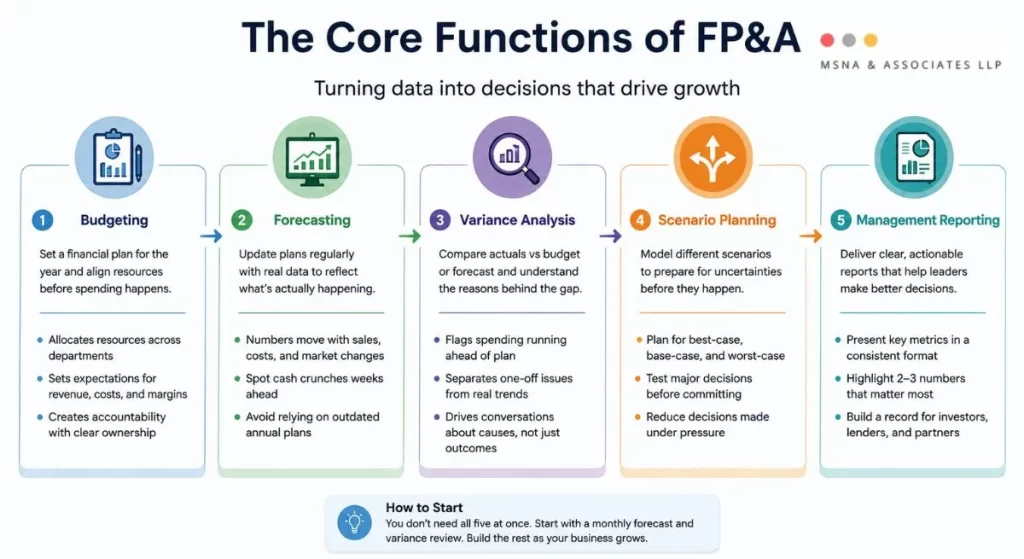
FP&A is not a single task. It is a set of connected activities that feed into each other.
Here are the five functions that make up the core of financial planning and analysis.
1.Budgeting
Budgeting is the process of setting a financial plan for a defined period, usually a year, broken down by department, product line, or cost head. Once it’s set, the budget becomes the number every later conversation gets measured against, like: is Q2 spend on track, is the new hire affordable, is the client’s payment delay actually a problem or just noise.
- Allocates resources across departments before spending happens
- Sets expectations for revenue, costs, and margins
- Creates accountability by giving each team owner a number to work against
2. Forecasting
A budget is set once a year and stays fixed. Forecasting is different. It’s updated regularly, often every month, using real numbers as they come in, so the plan actually reflects what’s happening in the business right now.
- Sales dip, costs creep up, market shifts, the numbers move with it
- You spot a cash crunch coming weeks before it actually hurts
- No more running the whole year on a plan you wrote in January and haven’t touched since
3. Variance Analysis
Variance analysis compares actual results to the budget or forecast and explains the gap. A number on its own does not tell you much. The reason behind the gap does.
- Flags where spending is running ahead of plan
- Separates one-off deviations from patterns that need a structural fix
- Turns monthly numbers into a conversation about causes, not just outcomes
4. Scenario Planning
Scenario planning models how the business would respond to different conditions: a slower sales quarter, a new competitor, a large input-cost increase, or a sudden funding delay. It replaces guesswork with a plan built in advance.
- Prepares the business for best-case, base-case, and worst-case outcomes
- Tests the impact of a major decision, such as opening a new location, before committing
- Reduces the number of decisions made under pressure
5. Management Reporting
Management reporting packages the output of budgeting, forecasting, and variance analysis into reports that founders, management teams, and boards can actually use to make decisions, rather than raw spreadsheets that need translation.
- Presents key metrics (revenue, margin, cash runway, burn rate) in a consistent format
- Highlights the two or three numbers that matter most that month, instead of everything at once
- Creates a record that supports conversations with investors, lenders, or partners
In practice, you don’t need all five functions running at once to start. A monthly forecast and one variance review against it is enough to begin. The rest can be layered on as the business grows.
Why Growing Businesses in India Need FP&A ?
Financial planning and analysis is often associated with large corporates that have dedicated finance teams. That association is outdated, and increasingly out of step with how businesses actually operate.
CRISIL Ratings’ bi-annual MSME Report shows the scale of the problem: the sector’s total debt need exceeds ₹100 trillion, and 70% of that is for working capital alone, a sign of how much of MSME finance is just about staying liquid, not growing.
What this means for a growing business is straightforward: the risk is not a distant, large-company problem. It shows up early, often before a business feels “big enough” to need formal financial planning.
India’s MSME base has also grown rapidly. Government figures put registrations on the Udyam portal at over 7 crore enterprises as of late 2025, and rising. In our experience, the businesses in that base that stay resilient through a slow quarter are rarely the ones with the most revenue. They are the ones with a clear, current view of their cash position and a plan for more than one outcome.
A business does not need to wait for a CFO hire or investor pressure to start FP&A. In our assessment, the right time is usually earlier than founders expect: as soon as the business has more than one revenue line, more than a handful of recurring costs, or a hiring decision that depends on next quarter’s cash position rather than this month’s bank balance.
How FP&A Looks Different for a ₹5–50 Crore Business vs a Startup ?
FP&A is not applied the same way at every stage. A pre-revenue or early-revenue startup and an established ₹5–50 crore business are usually solving different problems with the same core functions.
Early-stage startup | ₹5–50 crore business | |
Main FP&A concern | Cash runway: how many months until funds run out | Working capital: whether cash cycles can fund day-to-day operations without external credit |
Forecast horizon | Short and frequent, often weekly, tied to burn rate | Monthly or quarterly, tied to sales cycles and payment terms |
Who owns it | Usually the founder directly, sometimes alongside an investor-facing MIS | Often a finance manager or outsourced FP&A partner reporting to the founder or board |
Biggest risk if skipped | Running out of cash before the next funding round | Being profitable on paper while stuck in a working-capital crunch |
Typical trigger to formalise | Preparing for a funding round or board reporting | Adding a second revenue line, location, or a hiring decision that depends on next quarter’s cash |
The functions themselves- budgeting, forecasting, variance analysis- do not change. What changes is the time horizon, the audience for the reporting, and how much of it can stay informal before it needs a defined process.
What Are The Benefits of FP&A For Business Owners and Founders ?
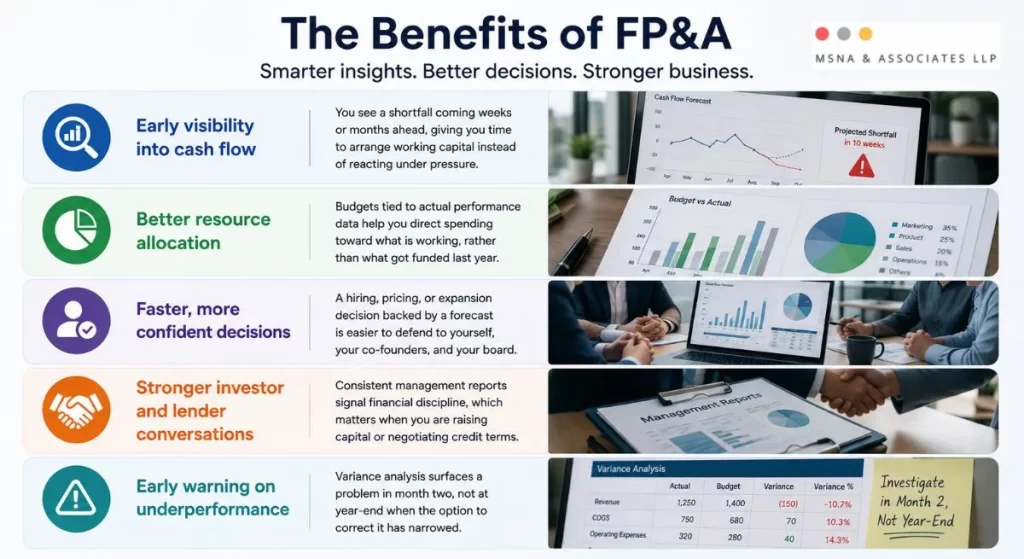
The functions above only matter if they change how a business owner actually runs the business, and this is where FP&A earns its place on the priority list.
Benefit | What it means for your business |
Early visibility into cash flow | You see a shortfall coming weeks or months ahead, giving you time to arrange working capital instead of reacting under pressure |
Better resource allocation | Budgets tied to actual performance data help you direct spending toward what is working, rather than what got funded last year |
Faster, more confident decisions | A hiring, pricing, or expansion decision backed by a forecast is easier to defend to yourself, your co-founders, and your board |
Stronger investor and lender conversations | Consistent management reports signal financial discipline, which matters when you are raising capital or negotiating credit terms |
Early warning on underperformance | Variance analysis surfaces a problem in month two, not at year-end when the option to correct it has narrowed |
When Should a Growing Business Set Up FP&A?
There is no fixed revenue threshold at which FP&A becomes necessary. It is more useful to think in terms of signals.
Signs a Business Has Outgrown Gut-Feel Finance
- You are making pricing or hiring decisions based on the bank balance rather than a forecast
- Monthly numbers surprise you, in either direction
- You have raised, or are planning to raise, external funding and need to report to investors
- The business has more than one product, service line, or location, and you cannot tell which one is actually profitable
- Cash flow feels unpredictable even though the business is profitable on paper
If two or more of these sound familiar, that is usually a practical starting point for setting up FP&A, even in a light-touch form. It does not have to mean building a full in-house team immediately. A monthly forecast, a variance review, and a clean management report are enough to start.
A Different Way to Think About FP&A: It Is Not Just a Big-Company Function
Most explanations of FP&A are written for large corporates with dedicated finance departments. We think that framing does growing businesses a disservice.
FP&A scales down as well as it scales up. A founder reviewing a rolling three-month cash forecast every month is doing FP&A, even without the title or the department. What changes as a business grows is not whether FP&A exists, but how formal and how frequent it becomes.
The businesses that struggle are usually not the ones without a finance team. They are the ones that treat financial decision-making as something to build later, once the business is “big enough.” By the time that feels true, the business has often already absorbed avoidable cash flow stress that a basic forecasting and reporting habit would have flagged months earlier.
If you’re unsure whether your business has crossed the point where FP&A stops being optional, a conversation with MSNA can help you assess it against the signals above.
Speak to a Chartered Accountant About FP&A for Your Business
Frequently Asked Questions About What is FP&A In Business
Is FP&A the same as accounting?
No, though they’re often bundled together, accounting closes the books and confirms the numbers are correct. FP&A picks those numbers up afterward and asks what they mean for the next quarter, a job accounting was never built to do.
Does a small or growing business really need FP&A??
Growing businesses often need FP&A more than established ones, because they have less cash cushion to absorb a forecasting error. FP&A does not require a large team. It can start with a monthly forecast and a simple management report.
Who typically owns FP&A in a growing business?
At larger companies, a dedicated FP&A analyst or director owns this and reports to the CFO. In a growing business, that job usually falls to the founder, a finance manager, or an outsourced finance partner, until the company is big enough to justify a dedicated hire.
What is the difference between a budget and a forecast?
A budget is fixed for the year. A forecast isn’t. It gets revised regularly as real performance and market conditions shift.
Related
Discover more from MSNA & Associates LLP
Subscribe to get the latest posts sent to your email.