
Is your finance team still spending more time chasing invoices and reconciling numbers than actually advising the business?
If your organisation is weighing where to centralise finance operations, a centre of excellence in finance in India solves three problems at once. It cuts processing costs, standardises reporting across geographies, and gives you access to a deep, English-speaking finance talent pool.
For US and UAE companies, the model works best when a Virtual CFO sits above the CoE, translating day-to-day execution into decisions the global leadership team can act on.
This is not a call centre for invoices. Done right, it is a governed, tech-enabled reporting engine that reports into your finance leadership on your terms.
What Is A Finance Centre Of Excellence India, And Why Are Global Companies Building One In India?
A Finance Centre of Excellence India (CoE) is a centralised unit that owns a defined set of finance processes for an entire group, instead of each country or business unit running its own version.
Global capability centre finance hubs in India typically absorb:
- Accounts payable and accounts receivable processing
- General ledger accounting and month-end close
- Financial reporting and MIS
- Payroll processing and statutory compliance filings under the EPF Act, ESI Act, and Professional Tax regulations
- Transfer pricing documentation and intercompany reconciliations
- FP&A support, budgeting inputs, and variance analysis
As a global capability centre finance hub, India has become the default location for this shift. NASSCOM’s GCC reports have repeatedly flagged India’s talent depth and cost efficiency as the leading factors, and that trend has only accelerated with the growth of finance-focused GCCs over the past few years. The talent pool is large and cost-efficient. Time zone overlap works for both US and UAE headquarters within a single working day.
English is the working language of finance. And the ecosystem, from Big 4 trained professionals to CA-led advisory firms, already understands US GAAP, IFRS, and multiple statutory frameworks side by side.
Our own opinion, formed from setting up and running finance functions for US and UAE subsidiaries in India, is that the CoE conversation has moved past a cost debate. Companies that still frame it as “cheaper accounting” are underusing it.
The real value sits in what a properly governed CoE frees up. Your finance leadership team stops firefighting transactional work and starts owning forecasting, capital allocation, and board-level narrative.
That shift only happens if someone senior owns the CoE output. That is where the Virtual CFO model comes in.
How Does The Virtual CFO model Support A centre Of Excellence In Finance?
A finance CoE model without senior oversight becomes a processing centre. It executes well but does not decide well.
A Fractional CFO closes that gap by sitting between the centre of excellence’s operational output and the parent company’s finance leadership, without the cost of a full-time expatriate CFO or a duplicate finance leadership layer in India.
The Virtual CFO’s role in a CoE structure covers:
Function | What it means in practice |
Reporting oversight | Reviews CoE output before it reaches global finance, adds commentary and context |
Compliance ownership | Signs off on statutory filings under the Companies Act, 2013, tax positions under the Income Tax Act, 1961, and transfer pricing documentation under Section 92 of the Income Tax Act |
Escalation point | Single accountable person for the parent company, instead of a rotating analyst pool |
Process governance | Owns the controls framework, SOPs, and exception handling for the CoE |
Board and investor support | Prepares India-specific board packs, MIS, and investor reporting inputs |
We think this is the part global companies underestimate when they first explore a finance CoE India model. A CoE built purely around headcount arbitrage, without an outsourced CFO or equivalent senior oversight, tends to plateau.
It processes transactions accurately but cannot flag a working capital problem before it shows up in the numbers three months later. Oversight is what turns a shared services centre into a genuine centre of excellence.
MSNA & Associates LLP works specifically in this space. We provide Virtual CFO Services for India operations and for Indian subsidiaries of US and UAE parent companies.
That means we sit inside exactly this structure: reviewing CoE output, owning statutory compliance, and reporting directly to global finance teams in a format they can use without translation.
What Operating Model Should A Centre Of Excellence In Finance Follow?
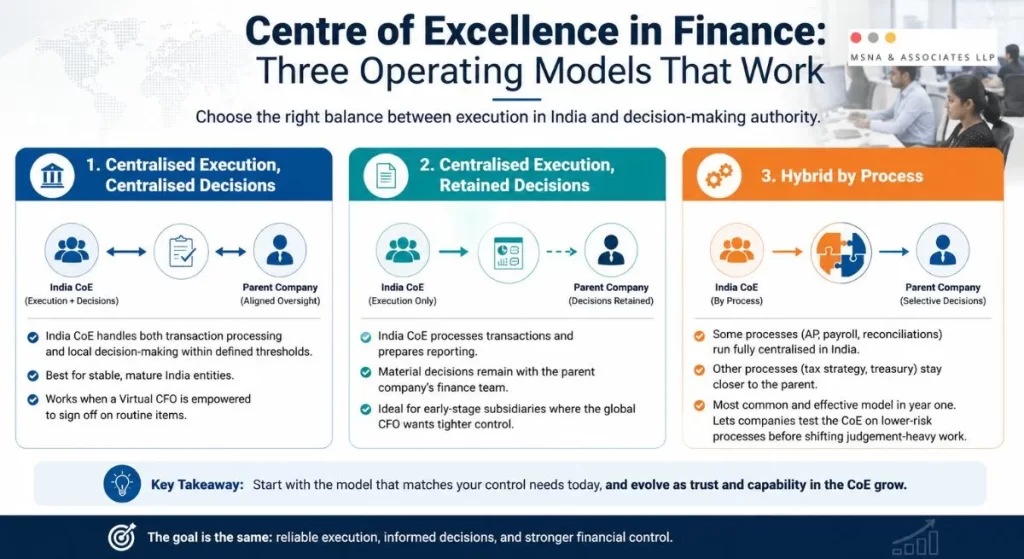
There is no single correct operating model. The right one depends on how much decision-making authority the parent company wants to retain versus delegate.
Three models are common in practice.
1. Centralised execution, centralised decisions. The India CoE handles both transaction processing and local decision-making within defined thresholds. This suits companies with a stable, mature India entity and a Virtual CFO empowered to sign off on routine items.
2. Centralised execution, retained decisions. The India CoE processes transactions and prepares reporting. Material decisions still sit with the parent company’s finance team.
It’s a setup that fits early-stage subsidiaries well. At this stage, the global CFO usually wants tighter control before handing over more.
3. Hybrid by process. Some processes (AP, payroll, reconciliations) run fully centralised in India. Others (tax strategy, treasury) stay closer to the parent. This is the model we see most often work in year one, because it lets a company test the CoE on lower-risk processes before shifting judgement-heavy work.
A quick way to gauge readiness:
Score each process 1–5 on three factors: how standardised it already is, how mature the underlying systems are, and how many manual handoffs it still requires (lower is better here). Processes scoring high on the first two and low on the third are ready to move into the CoE first
The higher the standardisation and system maturity, and the lower the manual handoffs, the faster a process is ready to move into the CoE. Processes still running on spreadsheets with multiple manual approvals are not ready.
Process standardisation comes first, then centralise. Centralising a broken process just moves the problem to a different time zone.
What Talent Strategy Does A Finance CoE Need?
Finance CoEs fail more often on talent structure than on process design. The common mistake is hiring only junior processing staff and expecting a senior person elsewhere in the group to catch errors.
That does not scale past a certain transaction volume.
A workable talent structure has three layers.
- Processing layer. Accountants and analysts handling day-to-day transactions, reconciliations, and data entry. Volume-driven, measured on turnaround time and accuracy.
- Review and control layer. Senior accountants or managers review what the processing layer produces, deal with exceptions, and keep the controls framework running.
- Oversight layer. A fractional CFO or equivalent senior finance leader who owns reporting quality, compliance sign-off, and the relationship with the parent company’s finance leadership.
Retention matters as much as hiring here. India’s finance talent market is competitive, and a CoE that loses its review-layer staff every 18 months never builds institutional knowledge of the parent company’s specific reporting requirements.
Cross-training within the CoE, clear progression paths from processing to review roles, and direct exposure to the global finance team all help retention in our experience.
Before scaling headcount, confirm the review layer is staffed first. Processing capacity without review capacity is where most CoEs stall.
What Technology Stack Does a Modern Finance CoE Run On?
Process standardisation depends on the systems underneath it.
A CoE running on disconnected spreadsheets cannot deliver centralised reporting no matter how skilled the team is.
Layer | Typical tools | Purpose |
ERP / accounting core | NetSuite, QuickBooks, Zoho Books, SAP, Tally | System of record for transactions |
Reconciliation and close | BlackLine, FloQast, or structured Excel workflows with review trails | Month-end close automation and audit trail |
Reporting and dashboards | Power BI, Tableau, or ERP-native reporting | Centralised MIS visible to global finance |
Workflow and approvals | Built-in ERP approval chains or dedicated workflow tools | Enforces the controls framework |
Data security | Role-based access controls, encrypted document storage | Protects group-level financial data |
Our view is that the technology stack matters less than most vendors suggest, and the integration between systems matters more.
A CoE with a modern ERP but a manual, email-based approval chain has not actually automated anything. It has just moved the bottleneck.
Before adding new software, map where handoffs currently happen and fix the handoff, not the tool.
What Governance Framework Keeps a Finance CoE Accountable?
Governance is the difference between a CoE the parent company trusts and one it constantly double-checks.
A working governance framework covers four areas.
1. Defined authority matrix.
Written thresholds for what the CoE can approve independently versus what needs parent company or Virtual CFO sign-off.
2. Reporting cadence.
Fixed monthly, quarterly, and annual reporting timelines, agreed in advance, not negotiated each cycle.
3. Audit trail and documentation.
Every reconciliation, approval, and adjustment logged and retrievable, supporting both statutory audit and any parent company internal audit.
4. Escalation protocol.
A named person, ideally the outsourced CFO, accountable for flagging issues to global leadership before they become quarter-end surprises.
Bonus tip: The authority matrix and escalation protocol should be drafted before the first process moves into the CoE, not after.
Centre of excellence models that skip formal governance tend to work fine until something goes wrong. A missed filing, a reconciliation gap, a compliance deadline, and then no one is quite sure who was accountable.
Building the governance framework before scaling the CoE, not after the first incident, is the more disciplined approach.
Not automatically. A finance CoE in India makes the strongest case when a company already has meaningful transaction volume from India operations, a subsidiary structure that benefits from centralised statutory compliance, and a global finance team that wants to spend less time on transactional oversight and more time on strategy.
Very early-stage subsidiaries, or ones with low transaction volume, may not yet justify a full CoE structure. These are often better served by a leaner Virtual CFO engagement that scales up as volume grows.
Looking ahead, we expect finance CoEs in India to keep moving up the value chain. The processing-heavy CoE of a decade ago is giving way to one where AI-assisted reconciliation and reporting tools handle routine work, and the India-based team spends more time on analysis, forecasting support, and compliance strategy.
Companies that build the governance and talent foundation now will be positioned to absorb that shift. Companies that treat the CoE as a fixed cost centre will likely find themselves rebuilding it in a few years.
Not sure whether your current transaction volume justifies a full CoE structure? A short scoping conversation with MSNA can usually clarify this in one call.
Where This Leaves Global Finance Leaders?
Building a finance centre of excellence in India is no longer an experimental move for global companies. It’s now a standard part of any serious finance transformation agenda. It is also a structural decision about where routine finance work gets done and who is accountable for the quality of that work.
The operating model, talent strategy, technology stack, and governance framework all matter. But the fractional CFO layer is what determines whether the CoE becomes a genuine extension of your finance function or a disconnected processing unit that needs constant supervision from headquarters.
MSNA & Associates LLP supports Virtual CFO and finance CoE oversight for India operations, including Indian subsidiaries of US and UAE parent companies.
Consulting a professional advisory team early in the CoE design process can help you assess which operating model, governance structure, and oversight level fits your organisation’s specific transaction volume and reporting needs.
Explore the Right Finance CoE Model for Your Business
Frequently Asked Questions About Centre Of Excellence In Finance
What is the difference between a shared services centre and a finance centre of excellence?
A shared services centre focuses on transaction volume and cost efficiency. A finance CoE adds standardised processes, governance, and senior oversight for decision support, not just processing.
How long does it take to set up a finance CoE in India?
A narrow CoE covering AP, payroll, and basic reporting can often be operational within a few months. A full CoE with FP&A and transfer pricing support takes longer.
Does a finance CoE need a Virtual CFO, or can it report directly to the parent company's finance team? I
It can report directly, but companies that skip senior India-based oversight often see inconsistent reporting quality and higher compliance risk.
Can a US or UAE subsidiary in India build a finance CoE without a large in-house finance team?
Yes, A Virtual CFO provider can manage CoE oversight and compliance while the subsidiary keeps a lean internal team, scaling as volume grows.
Related
Discover more from MSNA & Associates LLP
Subscribe to get the latest posts sent to your email.