


If your UAE company is planning to invest in an Indian subsidiary, joint venture, or downstream entity, the first decision that shapes everything else is which Foreign direct investment (FDI) in India applies to your sector and how much foreign equity you can hold.
Under India’s Consolidated FDI Policy and the FEMA (Non-Debt Instruments) Rules, 2019, most sectors allow up to 100% foreign ownership through the automatic route, meaning a UAE investor can set up a wholly owned Indian subsidiary without prior government approval in the majority of cases.
This article walks through the routes, caps, tax treatment under the India-UAE DTAA, and the FEMA/RBI reporting obligations a UAE business needs to plan for before wiring the first tranche of capital.
Key Takeaways
- Most sectors allow 100% Foreign Direct Investment in India through the automatic route, so a UAE company can set up a wholly owned Indian subsidiary without prior government approval
- Sector caps below 100% (insurance, defence, telecom, private banking thresholds, multi-brand retail, print media) route through government approval via the FIFP
- Land-border restrictions affect a UAE structure only if a bordering-country beneficial owner is in the chain. Since Press Note 2 of 2026, up to 10% without control can use the automatic route. Above that, or with control, approval is required
- FC-GPR must be filed within 30 days of share allotment, and the FLA return is due every July 15. Missed deadlines mean a compounding application, not an automatic default
- A valid TRC and Form 10F are needed every year to access the India-UAE DTAA’s capped withholding rates on dividends, interest, and royalties
- The India-UAE BIT (effective August 31, 2024) adds a layer of investor protection separate from the FDI policy itself
Why Is Foreign Direct Investment (FDI) in India Attractive for UAE Companies?
The India-UAE investment corridor has grown into one of the more active bilateral relationships for both countries.
- India recorded FDI inflows of roughly USD 81 billion in FY 2024-25, with cumulative FDI since 2014 crossing USD 748 billion
- Cumulative UAE investment into India has been estimated at around USD 25-26 billion between April 2000 and March 2026, making the UAE one of India’s top ten source countries for FDI (per DPIIT data cited by the Indian Embassy, Abu Dhabi)
- The India-UAE Comprehensive Economic Partnership Agreement (CEPA), in force since May 2022, has reduced tariffs and simplified trade flows between the two markets
- The India-UAE Bilateral Investment Treaty (BIT), effective from August 31, 2024, replaced the earlier 2013 agreement and gives UAE investors defined protections against expropriation, discriminatory treatment, and denial of due process, along with a shorter three-year local-remedies window before arbitration
None of this changes the core question a UAE promoter has to answer first: which route does your sector fall under, and what share of the Indian entity can you actually own?
What Are the Two Routes for Foreign Direct Investment (FDI) in India?
FDI into India moves through one of two channels, and the sector you are investing in decides which one applies.
Route | How it works | Timeline |
Automatic route | No prior government approval needed; the Indian company files post-investment reports with the RBI through the FIRMS portal | Investment can close as soon as banking and company law formalities are done |
Government route | Approval required from the administrative ministry via the Foreign Investment Facilitation Portal (FIFP) before the investment is made | Typically 4-8 weeks, sector-dependent |
When Does Foreign Direct Investment (FDI) in India Need Government Approval?
Most sectors relevant to UAE trading, IT, logistics, manufacturing, and services businesses fall under the automatic route at 100%. Government approval becomes necessary mainly where:
- The sector itself is capped below 100% on the government route (defence beyond 74%, private banking beyond 49%, multi-brand retail, print media, satellite services)
- The investment involves a swap of shares rather than cash
- The Indian investee already has existing foreign investment structured under the government route and the new UAE investment needs to align with that structure
- The ownership chain includes a beneficial owner from a land-border country who holds more than 10% or has control (see below)
One point UAE investors frequently ask about: Press Note 3 of 2020 required government approval where the beneficial owner was linked to a country sharing a land border with India (China, Pakistan, Bangladesh, Nepal, Myanmar, Bhutan, Afghanistan). The UAE is not one of these countries. A standard UAE-owned structure is therefore assessed on sector caps alone, unless the ownership chain includes a beneficial owner from a bordering country.
Press Note 2 of 2026, issued by DPIIT on March 15, 2026, eased this rule. A land-border beneficial owner holding up to 10% on a non-controlling basis no longer triggers government approval. The investment can use the automatic route, subject to sectoral caps, with a reporting obligation to DPIIT. Approval is still required if the stake exceeds 10%. It is also required if the investor has control, for example through director appointment or veto rights. For a UAE promoter, a small passive stake no longer blocks the automatic route. Any land-border-linked interest still needs to be sized and characterised before incorporation.
Illustrative scenario (hypothetical, not an actual client engagement): A Dubai-based IT services company wants to open an Indian delivery centre with a UAE holding structure that also has a minority shareholder incorporated in Hong Kong. Because Hong Kong is not one of the listed bordering territories, the land-border restriction would not be triggered on that basis alone. But if a beneficial owner in the chain traces back to mainland China, the outcome now depends on the size and nature of that stake. A non-controlling interest of up to 10% can proceed under the automatic route with DPIIT reporting, while a larger stake, or any stake carrying control rights, requires government approval regardless of the UAE parent’s own standing.
What Are the Sectoral FDI Caps a UAE Investor Should Check?
Sectoral caps decide both how much equity you can hold and which route applies once you cross a certain percentage. The table below reflects the caps most relevant to UAE outbound investors as of the current Consolidated FDI Policy and subsequent DPIIT press notes.
Sector | FDI cap | Route |
Manufacturing, IT/ITES, trading (B2B) | 100% | Automatic |
E-commerce (marketplace model) | 100% | Automatic, subject to marketplace-model conditions |
Insurance and insurance intermediaries | 100% | Automatic (raised from 74% under DPIIT Press Note 1 of 2026) |
Defence | Up to 74% | Automatic; beyond 74% requires government approval |
Telecom services | 100% | Automatic |
Private sector banking | Up to 74% | Automatic up to 49%; government route beyond that, subject to RBI/FDI policy conditions |
Multi-brand retail trading | Up to 51% | Government route, with state-level and sourcing conditions |
Print media / news publishing | Up to 26% | Government route |
Space sector (components/sub-systems) | 100% | Automatic |
Space sector (satellite manufacturing/operations) | Up to 74% | Automatic; beyond that, government route |
Atomic energy, lottery, gambling, chit funds | Not permitted | FDI prohibited |
Because sectoral caps and routes are amended through DPIIT press notes fairly often, the insurance cap itself moved from 74% to 100% via a February 2026 notification. Always confirm the applicable cap on the date of investment rather than relying on a cap you saw in an earlier filing or a general online source.
What Investment Structures Can a UAE Company Use to Enter India?
A UAE business generally has three structuring options once the route and cap are confirmed. See our step-by-step guide to company registration in India from the UAE for the incorporation mechanics behind each one.
1. Wholly Owned Subsidiary (WOS)
A UAE parent incorporates an Indian private limited company and holds 100% of its equity, where the sector permits it. This is the most common structure for UAE trading houses, IT services firms, and manufacturing groups because it gives full management control and a clean corporate identity for Indian customers, banks, and regulators. Our company registration service for UAE businesses covers the incorporation and attestation steps this structure needs.
2. Joint Venture (JV)
When a UAE company wants access to an Indian partner’s market, distribution network, or licences, a JV with a negotiated shareholding is common. JVs are also the practical route in sectors where the automatic-route cap is below 100%, and the balance needs an Indian co-investor.
3. Downstream Investment Through an Existing Indian Entity
If the UAE parent already has an Indian subsidiary, further investment into a second Indian company made by that first subsidiary is treated as downstream investment and is subject to the same sectoral conditions as direct FDI, with additional disclosure of the foreign investment chain under the FEMA Non-Debt Instruments Rules.
How Should a UAE Investor Approach FDI Tax Planning in India?
What Does the India-UAE DTAA Cover?
Since 1993, the India-UAE Double Taxation Avoidance Agreement has capped Indian withholding tax on certain cross-border payments, including dividends, interest, and royalties, to UAE residents. Updated in 2007 and 2013, it still works the same way: show a valid TRC and Form 10F, and you get the lower treaty rate instead of India’s standard rate.
Income type | DTAA-capped rate | Condition |
Dividends | 10% | Valid TRC and Form 10F filed with the Indian payer |
Interest | 5-12.5% depending on the lender category | TRC and Form 10F required |
Royalties (Article 12) | 10% | Valid TRC and Form 10F required |
Fees for technical services | No DTAA cap; the treaty has no separate article for these fees | Treatment depends on characterisation: business profits under Article 7 (taxable in India only where the UAE entity has a permanent establishment) or, where India taxes the payment at source, the domestic Income Tax Act rate (20% plus surcharge and cess) |
A UAE parent should not assume the 10% royalty cap covers management, technical, or support fees. The tax outcome differs by payment type, so each intercompany payment should be characterised and documented individually.
Without a valid TRC on file with the Indian company, the domestic withholding rate under the Income Tax Act applies instead of the treaty rate, which is usually higher. This is one of the most common avoidable costs for UAE parent companies receiving dividends or royalties from their Indian subsidiary.
What Should a UAE Parent Plan for on the Indian Entity’s Tax Position?
An Indian subsidiary of a UAE company is taxed as a domestic Indian company on its India-sourced profits, irrespective of the parent’s ownership. The transfer pricing regulations apply to all transactions between the Indian subsidiary and the UAE parent company/group companies, such as management charges, royalty payments, and services rendered, among others, which require contemporaneous documents for them to survive tax assessment.
What Are the FEMA and RBI Reporting Requirements for Foreign Direct Investment (FDI) in India?
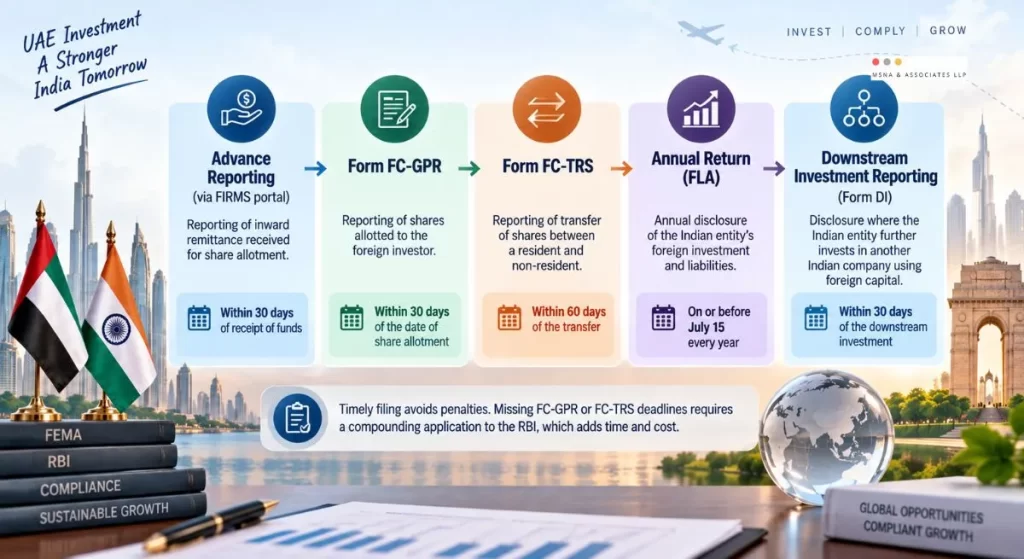
This is the stage where most delays and penalties happen, usually from missed filing windows rather than from the investment itself being non-compliant. Getting these deadlines onto your compliance calendar before the first remittance lands is generally worth a short conversation with an India-side advisor. It is far cheaper than a compounding application later.
Filing | What it covers | Deadline |
Advance Reporting (via FIRMS portal) | Reporting of inward remittance received for share allotment | Within 30 days of receipt of funds |
Form FC-GPR | Reporting of shares allotted to the foreign investor | Within 30 days of the date of share allotment |
Form FC-TRS | Reporting of transfer of shares between a resident and non-resident | Within 60 days of the transfer |
Annual Return on Foreign Liabilities and Assets (FLA) | Annual disclosure of the Indian entity’s foreign investment and liabilities | On or before July 15 every year |
Disclosure where the Indian entity further invests in another Indian company using foreign capital | Within 30 days of the downstream investment |
Missing the FC-GPR or FC-TRS deadline does not stop the investment, but it does trigger a compounding application to the RBI to regularise the delay, which adds time and a compounding fee to what should have been a routine filing. Building these deadlines into the incorporation timeline from day one avoids this entirely.
What Documentation Does a UAE Investor Need for Foreign Direct Investment (FDI) in India?
- Board resolution from the UAE parent authorising the Indian investment
- Certificate of Incorporation and Memorandum/Articles of the UAE entity, apostilled or attested as required by the Indian authority receiving them
- KYC of the foreign investor, typically certified by the UAE-based bank handling the remittance
- Valid Tax Residency Certificate (TRC) issued by the UAE Ministry of Finance and Form 10F, renewed annually, to access DTAA benefits
- Foreign Inward Remittance Certificate (FIRC) from the Indian bank confirming receipt of funds
- Share valuation certificate from a SEBI-registered merchant banker or a chartered accountant, as applicable, to support the issue price under FEMA pricing guidelines
Documents originating in the UAE generally need attestation before they are accepted by Indian banks, the Ministry of Corporate Affairs, or the RBI, so building attestation lead time into the incorporation schedule is worth doing early rather than at the banking stage.
What Should a UAE Business Do Before Investing in India?
Bringing this together into a practical sequence:
- Confirm the sector’s FDI cap and route against the current DPIIT Consolidated FDI Policy and any subsequent press notes, since caps do get revised.
- Choose the structure (wholly owned subsidiary, joint venture, or downstream investment) based on the cap, the control you want, and whether an Indian partner adds real commercial value.
- Set up TRC and Form 10F renewal as a recurring compliance item, not a one-time filing, so DTAA benefits on dividends and royalties are never lost to a lapsed certificate.
- Build FC-GPR, FC-TRS, and FLA deadlines into the incorporation and cap table calendar from the first funding round, so post-investment reporting doesn’t slip into compounding territory.
- Set transfer pricing documentation in place before the first intercompany transaction, rather than reconstructing it during an assessment.
Consulting an India-side compliance advisor – our Virtual CFO services for foreign subsidiaries are built for exactly this stage – before the first remittance is generally the more cost-effective point to get the structure, route, and documentation checked than after the funds have already landed.
Understand FDI Compliance Requirements
Frequently Asked Questions About Foreign Direct Investment (FDI) in India?
Can a UAE company own 100% of an Indian company?
In most sectors, yes, through the automatic route without prior government approval. Sectors such as insurance, defence beyond 74%, and multi-brand retail have lower caps or require government approval, so the sector needs to be checked before assuming 100% ownership is available.
Does the Press Note 3 (2020) land-border restriction apply to the UAE investors?
No. The UAE does not border India. The restriction applies only if a beneficial owner in the chain is from a bordering country. Under Press Note 2 of 2026, up to 10% without control can use the automatic route. Above that, or with control, approval is required.
How is a dividend from an Indian subsidiary taxed when paid to a UAE parent?
It’s capped at 10% under the India-UAE DTAA, but only if the UAE parent has a current Tax Residency Certificate and files Form 10F each year. Skip that paperwork and the company withholds at the regular domestic rate instead.
What happens if the FC-GPR filing deadline is missed?
Nothing happens to the investment itself. The company just needs to sort it out with RBI through a compounding application, pay the fee, and wait out the extra processing time.
Is a joint venture or a wholly owned subsidiary better for a UAE investor?
It depends on the sector cap and how much the UAE company values an Indian partner’s market access or licences. Where the sector allows 100% automatic-route ownership and the UAE company wants full control, a wholly owned subsidiary is generally the simpler structure to set up and administer.
Related
Discover more from MSNA & Associates LLP
Subscribe to get the latest posts sent to your email.