


An India subsidiary for a US startup with no prior India presence brings three practical changes: banks apply stricter KYC because there is no transaction history to reference, regulators expect first-time filings to be exact because there is no compliance record to fall back on, and vendors, clients, and employees judge the company on paper credentials alone.
None of this blocks the setup. It changes the sequence, the documentation load, and the first-year timeline. Under the Companies Act, 2013, and FEMA, a wholly owned subsidiary (WOS) of a US parent is a standard, well-used route into India. The friction shows up in execution, not in eligibility.
This piece covers what actually changes for a track-record-free parent, such as banking, compliance history requirements, credibility building, and the practical hurdles that show up in year one.
Key Takeaways
- Registration eligibility does not change for a first-time US parent. Documentation load and timeline scrutiny do.
- Banks don’t relax KYC for a new entity. Expect more document requests and a longer wait for account opening.
- Form FC-GPR matters most in year one. File within 30 days of share allotment, or pay RBI’s Late Submission Fee if it’s within three years of the due date, or go through compounding after that.
- Vendors and clients judge a new subsidiary on paperwork, not brand. Keep GST, PAN, and bank KYC clean and consistent.
- No law requires a parent company guarantee, but landlords, banks, and large vendors often ask for one anyway.
- Most first-time founders underestimate three things: the resident director rule, transfer pricing documentation, and GST reverse charge on parent-subsidiary transactions
What Does 'No India Track Record' Mean for an India Subsidiary for a US Startup?
A new Indian subsidiary of a US startup starts with zero history on every register that Indian institutions check.
- No prior GST filings, so tax authorities cannot see a compliance pattern.
- No prior bank transaction history, so AD banks cannot assess account behaviour.
- No credit history with Indian lenders or credit bureaus.
- No track record with vendors, landlords, or enterprise clients who check company age before signing.
A subsidiary of an established Indian group inherits some of that trust through group association. A first-time US-backed subsidiary does not. Every check starts from scratch, and every institution treats the first six to twelve months as the evaluation window.
How Does Registration Change for an India Subsidiary for a US Startup With No India History?
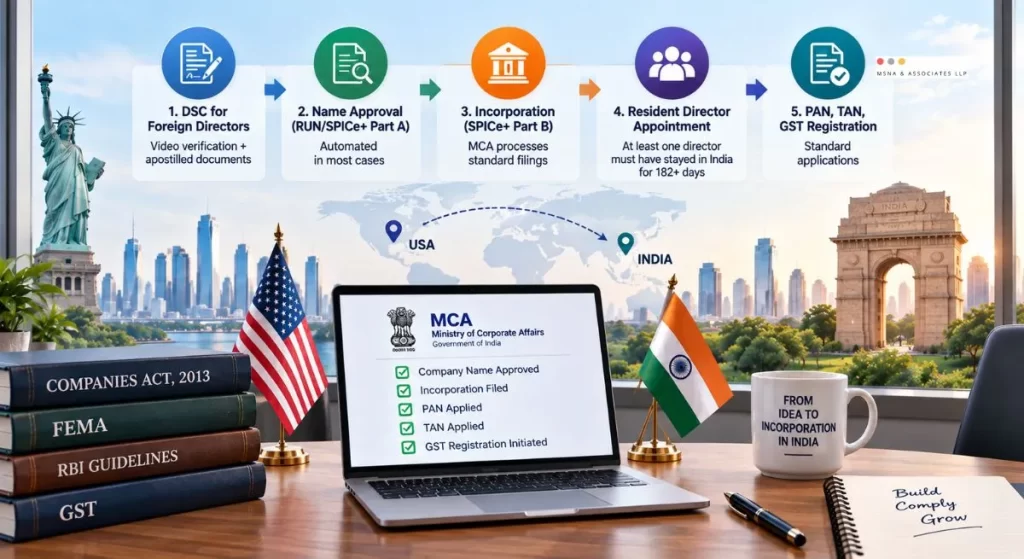
Registration itself does not change when setting up an India subsidiary for a US startup. The Companies Act process for incorporating a private limited company as a WOS is identical whether the US parent is a Fortune 500 company or a two-founder startup.
What changes is scrutiny at each step:
Step | Standard process | What a no-track-record parent should expect |
Digital Signature Certificate (DSC) for foreign directors | Video verification + apostilled documents | Longer turnaround when apostille or notarisation is incomplete |
Name approval (RUN/SPICe+ Part A) | Automated in most cases | Same, no added scrutiny |
Incorporation (SPICe+ Part B) | MCA processes standard filings | Same, but registered office proof and director details get a closer look for first-time foreign promoters |
Resident director appointment | Under Section 149(3) of the Companies Act, 2013, at least one director must have stayed in India for 182+ days in the previous calendar year | US founders almost never meet this on day one, so a resident nominee director is appointed under a signed indemnity agreement limiting them to a compliance role |
PAN, TAN, GST registration | Standard applications | Foreign promoters need the manual GST route rather than the automatic same-day route, since address and director verification take longer |
The incorporation itself is not the bottleneck. The steps that depend on a resident presence are.
Why Do Indian Banks Treat a First-Time Subsidiary Differently?
Banking is where the “no track record” problem shows up first and hardest, because Authorised Dealer (AD) banks in India operate under RBI and FEMA-linked KYC norms built for risk-based due diligence, not convenience.
A subsidiary account for a fresh WOS is opened only after incorporation, and the account itself becomes the channel through which the parent’s capital must legally arrive.
Common friction points:
- In-person or video KYC for foreign directors is mandatory, with documentation standards that differ from those applied to resident directors.
- Source-of-funds documentation on the parent company side is checked closely, since the bank has no prior relationship to lean on.
- Registered office proof must be current and match MCA records exactly, or the account opening stalls.
- Board resolutions and POA documents must be apostilled or consularised in the US before Indian banks accept them, which adds days when it isn’t planned upfront.
- Banks generally settle into the relationship once the first inward remittance lands and FC-GPR is filed, since that closes the loop that started it.
What documents does a first-time subsidiary need ready before approaching an AD bank?
Document | Why banks ask for it |
Certificate of Incorporation, MOA, AOA | Confirms legal existence and structure |
PAN of the Indian entity | Mandatory for any Indian bank account |
Board resolution authorising account opening | Confirms who can operate the account |
KYC documents of all directors (resident and foreign) | Standard RBI-mandated KYC |
Registered office proof | Must match MCA filings |
Parent company’s certificate of incorporation and good standing (apostilled) | Establishes the parent’s legal identity for the bank’s records |
Firms that run virtual CFO and outsourced accounting support for US-backed entities assemble this document set before incorporation is complete, so the bank account isn’t waiting on paperwork that could have been ready weeks earlier.
Getting this document set right early is where a virtual CFO helps most.
What Compliance History Do Indian Authorities Expect From a New Entity?
Regulators do not expect a compliance history from a brand-new subsidiary. They expect the first set of filings to be filed correctly and on time, because a clean start is what substitutes for a track record.
The most important filing in year one is Form FC-GPR.
- The Indian subsidiary must allot shares to the US parent within 60 days of receiving the foreign investment.
- The Indian subsidiary must then file Form FC-GPR on the RBI’s FIRMS portal within 30 days of that allotment.
- A late filing is usually regularised by paying RBI’s Late Submission Fee — ₹7,500 plus 0.025% of the investment amount per year of delay, available for filings made within three years of the due date. Formal compounding under FEMA comes into play for delays beyond that window or for more serious contraventions. Either route adds cost and paperwork that a clean, on-time filing avoids entirely.
First-year compliance checklist for a new Indian subsidiary
Requirement | Governing law/authority | Deadline |
Share allotment to parent | FEMA / Companies Act | Within 60 days of receiving foreign investment |
Form FC-GPR filing | RBI (FIRMS portal, Single Master Form) | Within 30 days of allotment |
GST registration (where applicable) | CBIC / CGST Act | Before making taxable supplies; mandatory for inter-state supply, imports, or OIDAR services regardless of turnover |
Annual Return on Foreign Liabilities and Assets (FLA) | RBI | Annually, by 15 July |
First board meeting | Companies Act, 2013 | Within 30 days of incorporation |
Auditor appointment | Companies Act, 2013 | Within 30 days of incorporation (first AGM) |
Commencement of Business filing (Form INC-20A) | Companies Act, 2013 | Within 180 days of incorporation |
A subsidiary with no track record does not get extra leeway on any of these. AD banks and RBI now review first-time foreign-promoted entities more closely on timeline discipline precisely because there is no history to offset a late filing.
How Does a New Subsidiary Build Credibility Without an Operating History?
Credibility for a first-year subsidiary in India is built on paper trail, not brand recognition. Indian vendors, landlords, and enterprise clients routinely run basic due diligence before signing, and a new entity has to pass that check with documentation instead of reputation.
What Indian counterparties verify before onboarding a new vendor or client relationship:
- GSTIN status, checked independently on the GST portal rather than taken from the certificate alone.
- PAN and company age, since a very young entity draws more scrutiny.
- Bank account confirmation (cancelled cheque or bank letter), matched to the registered entity name.
- For higher-value contracts, financial statements or a credit report, which a first-year subsidiary usually cannot supply.
In our own engagements with first-time US-backed subsidiaries, the recurring bottleneck is rarely the incorporation step itself. It is the gap between the first client conversation and having consistent, verifiable paperwork ready to back it up.
What actually helps a new subsidiary in this position?
- Get the GST registration and vendor documentation set completed early, before the sales or procurement conversations start. Missing GSTIN verification or an unregistered address is the most common reason onboarding stalls.
- Use the parent company’s standing as a supporting signal, not a substitute. Indian counterparties can check the parent’s incorporation and market presence even when the Indian entity itself is new. Use board resolutions, letters of intent, or website disclosures to put that in front of them.
- Keep the registered office and bank account details consistent across every document. Mismatches between MCA records, GST records, and bank KYC are a frequent reason vendor and client onboarding gets delayed.
- Front-load statutory registrations (PAN, TAN, GST, PF/ESI where applicable) so the paperwork is settled well before commercial conversations start.
Does the Parent Company Need to Provide a Guarantee?
Not as a matter of law. A WOS is a separate legal entity under Indian company law. The parent isn’t automatically on the hook for the subsidiary’s obligations.
In practice, a parent company guarantee comes up in specific situations for a track-record-free subsidiary:
- Lease agreements for office space, where Indian landlords may ask for a parent guarantee or an advance deposit in place of a track record.
- Early banking relationships, where a comfort letter or guarantee from the parent can support faster processing, though it is not a formal RBI requirement for account opening.
- Large vendor or enterprise contracts, where the counterparty wants assurance the obligation is backed by a company with an established history, since the Indian subsidiary itself has none yet.
None of this is mandatory under FEMA or the Companies Act. It is a commercial ask that shows up more often in year one, precisely because the subsidiary has no track record to point to instead.
What Practical Hurdles Come Up in the First Year of an India Subsidiary for a US Startup?
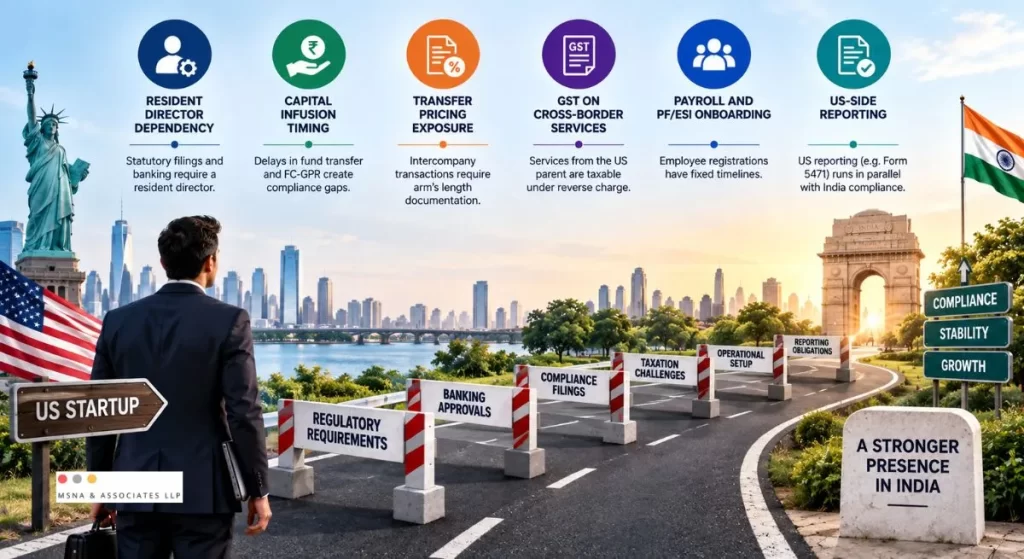
Beyond registration and banking, a handful of operational issues consistently trip up first-time US-backed subsidiaries in their first twelve months.
- Resident director dependency. Every statutory filing, board action, and bank instruction needs a resident director’s involvement, which means the nominee director arrangement has to be reliable and clearly scoped from day one.
- Capital infusion timing. Delays between wiring funds and completing FC-GPR create a compliance gap that gets harder to explain the longer it sits open.
- Transfer pricing exposure. Any transactions made between the US parent company and the Indian subsidiary, whether a cost allocations, management fees, or service charges, come under India’s Transfer Pricing laws. Documentation at an arm’s length price must be prepared for any transaction from its very beginning.
- GST on cross-border services. Services received from the US parent are taxable under reverse charge. Whether the subsidiary can claim input tax credit depends entirely on its own GST filing discipline.
- Payroll and PF/ESI onboarding. Once a new subsidiary hires its first employees in India, PF and ESI registration has fixed windows. Founders miss this often because it’s not top of mind during incorporation.
- US-side reporting. The US parent has its own reporting obligations (such as Form 5471 for a foreign subsidiary) that run in parallel with India-side filings, so India and US compliance calendars need to be tracked together, not separately.
What Should US Founders Do Before Setting Up an Indian Subsidiary?
- Confirm the resident director arrangement before incorporation, not after. This is the single most common cause of early delays.
- Apostille the parent company’s incorporation documents, board resolutions, and POA in the US before starting India-side filings, since Indian banks and MCA will ask for these early.
- Build the FC-GPR timeline (60-day allotment window, 30-day filing window) into the funding plan before the first wire transfer goes out.
- Set up the transfer pricing documentation approach before the first intercompany transaction, not after the first audit.
- Work with a Virtual CFO or compliance partner who maps the India-side and US-side compliance calendars together from day one.
Planning an India Subsidiary for Your US Startup?
Frequently Asked Questions About India Subsidiary for a US Startup?
Can a US startup own 100% of its Indian subsidiary with no local partner?
Yes, in most sectors. Software, IT services, consulting, and B2B e-commerce all fall under the FDI Automatic Route, so 100% foreign ownership is allowed without prior government approval. Only a small number of sectors carry caps or need approval first
Does a US founder need to be physically present in India to set up the subsidiary?
No. Digital signature issuance, incorporation filing, and most bank KYC steps can all be done remotely through video verification. Where physical originals are needed, apostilled documents can simply be couriered over.
What happens when FC-GPR is filed late?
A late filing is regularised by paying RBI’s Late Submission Fee (a fixed amount plus a small percentage of the investment value per year of delay), provided it’s filed within three years of the due date. Beyond that window, or for more serious contraventions, the filing goes through RBI’s formal compounding process under FEMA
Is a credit history required to open a bank account for a new subsidiary?
No. Banks do not require credit history for a new entity. They do require thorough KYC, source-of-funds documentation, and apostilled parent company documents, all of which take longer to assemble for a first-time filer.
Related
Discover more from MSNA & Associates LLP
Subscribe to get the latest posts sent to your email.