


Virtual CFO for Healthcare Business: A Guide to Financial Growth & Expansion
A clinic that comfortably handled 40 patients a day is now seeing 100. The waiting room is crowded, doctors are stretched, and patients are asking for more services. From the outside, it looks like a good problem to have.
But growth in healthcare comes with its own headaches.
A bigger team means higher salaries. A new branch means rent, equipment, technology, and operating costs. Insurance payments do not always arrive on time, but bills still need to be paid. Many healthcare businesses expand because demand is growing, only to realize later that managing the finances is much harder than managing the growth itself.
This is the reason you see so many providers turning to a Virtual CFO for healthcare business. Rather than relying on estimations or gut feeling for expansion decisions, clients get a solid financial plan, greater clarity into cash flow, and a plan to sustain long-term growth.
In this blog, we will see the financial problems that healthcare firms face when expanding, and how a Virtual CFO can help them to manage growth without compromising their profitability.
Why Expansion Planning Is More Complex for Healthcare Businesses?
You can’t grow a healthcare business like you’d grow a retail store or start up another restaurant. There are financial realities that come with health care, and those realities make expansion a lot more complicated.
1.High Capital Investment Requirements
Usually the first hurdle is the amount of money needed. Expansion of healthcare usually requires acquiring costly medical equipment, updating buildings, upgrading technology and investing in systems such as Electronic Health Records (EHR) and patient management software.
These are not optional costs. They are important for offering quality care.
This capital intensity is also a structural feature of the Indian healthcare market itself. Invest India, the Government of India’s official investment promotion agency, estimates the country will need 3.6 million additional hospital beds, 3 million doctors, and 6 million nurses by 2034 to meet global healthcare standards. For an individual provider, that nationwide shortfall translates into real competition for skilled staff, equipment vendors, and construction capacity, a factor that should be built into expansion timelines, not just the budget.
2.Rising Staffing and Operational Costs
As your business expands you will require more doctors, nurses, technicians and administrative people. And the cost of hiring experienced healthcare people doesn’t become cheaper. Other costs apart from salary are:
- Training and onboarding costs.
- Insurance & employee benefits.
- Payroll taxes.
- Maintenance of facilities and utilities.
- Tech support and software subscriptions.
3.Managing Multiple Revenue Streams
Most businesses have one source of revenue, however hospitals and other healthcare facilities might have money pouring in from multiple sources. These sources include:
- Private health insurers regulated by IRDAI.
- Patients who pay for themselves (out of pocket).
- Corporate health care schemes and employment-related initiatives.
- Government schemes like Ayushman Bharat PM-JAY, CGHS, and ESIC.
These suppliers have their own payment procedures, quantities and timelines.
4.Regulatory and Financial Compliance Requirements
Healthcare is one of the most heavily regulated businesses in the world. As a company grows, so does the need of financial reporting, billing accuracy, audit readiness and compliance.
A little billing mistake or reporting error can lead to late payments or penalties.
What Does a Virtual CFO for a Healthcare Business Do?
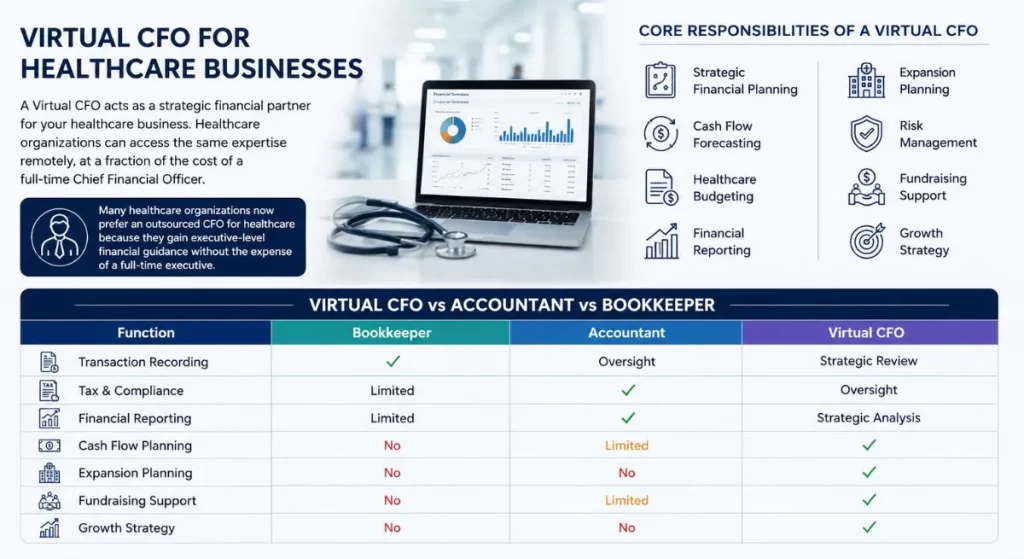
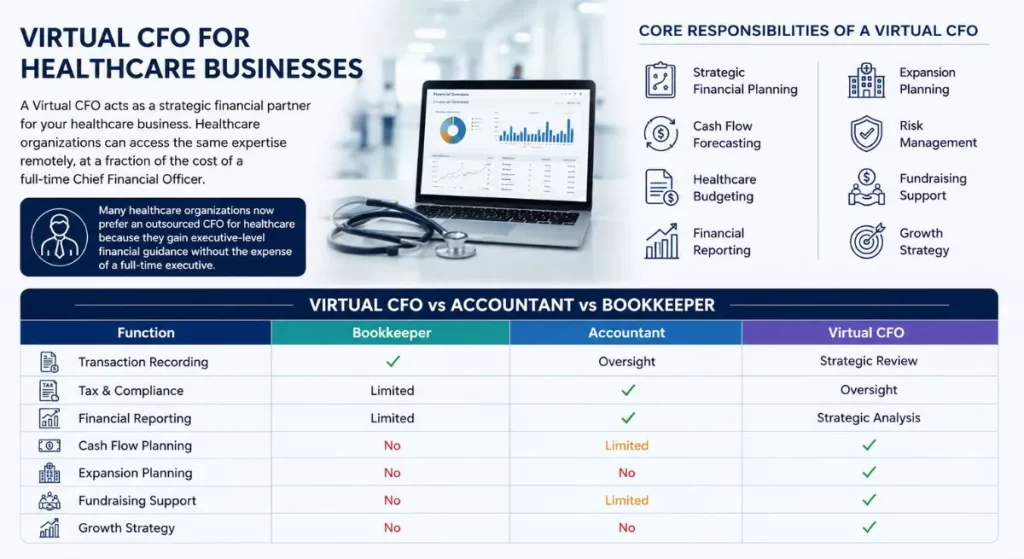
A Virtual CFO acts as a strategic financial partner for your healthcare business. Healthcare organizations can access the same expertise remotely, at a fraction of the cost of a full-time Chief Financial Officer.
Core Responsibilities of a Virtual CFO
A virtual CFO for a healthcare business helps with:
- Strategic financial planning.
- Expansion planning.
- Cash flow forecasting.
- Risk management.
- Healthcare budgeting.
- Fundraising support.
- Financial reporting.
- Growth strategy.
Many healthcare organizations now prefer an outsourced CFO for healthcare because they gain executive-level financial guidance without the expense of a full-time executive.
Virtual CFO vs Accountant vs Bookkeeper
| Function | Bookkeeper | Accountant | Virtual CFO |
|---|---|---|---|
| Transaction Recording | ✓ | Oversight | Strategic Review |
| Tax & Compliance | Limited | ✓ | Oversight |
| Financial Reporting | Limited | ✓ | Strategic Analysis |
| Cash Flow Planning | No | Limited | ✓ |
| Expansion Planning | No | No | ✓ |
| Fundraising Support | No | Limited | ✓ |
| Growth Strategy | No | No | ✓ |
When we develop a five-year growth model for a healthcare client today we insist on two separate payer-mix tracks, one for self-pay and individually insured patients and another for government-scheme and corporate/group patients. Most legacy models still put them all in one insurance line, which hides exactly where the receivable risk and the collection-timeline differences actually exist.
Common Financial Challenges Healthcare Businesses Face During Expansion
Growth creates opportunities, but also difficulties for which most healthcare organizations are not prepared.
1. Opening New Locations Without Accurate Profitability Forecasts
A common mistake is starting up a new branch without knowing how long it would take to become profitable.
Many providers spend a lot of money on infrastructure and equipment only to find out later that it takes longer than they imagined for patients to grow.
2. Equipment Financing Decisions
Medical devices can be quite costly and, at times, the decision of leasing versus buying is not always easy. Some factors that must be considered by healthcare companies include:
- Long-term ownership costs.
- Maintenance expenses.
- Financing options.
- Expected return on investment.
3. Rising Staffing Costs
Healthcare payroll is one of the biggest expense drivers in the healthcare industry and therefore, planning for future staffing demands is extremely important.
4. Managing Changing Payer Mixes
Revenue can fluctuate depending on:
- Insurance reimbursements.
- Government healthcare programs.
- Self-pay patients.
- Corporate healthcare contracts.
How a Virtual CFO for Healthcare Business Creates a Financial Roadmap for Expansion?
1. Assessing Financial Readiness
A Virtual CFO starts by understanding the current financial health of the business. They check the:
- Revenue trends.
- Profitability.
- Operating expenses.
- Existing debt.
- Cash reserves.
- Growth capacity.
2. Building an Expansion Strategy
This roadmap will include:
- Market opportunities.
- Service demand forecasts.
- Revenue projections.
- Operating cost estimates.
- Profitability scenarios.
This becomes an important part of a larger healthcare business growth strategy, letting business leaders to make decisions based on facts instead of assumptions.
3. Long-Term Financial Planning
Long-term financial planning also prepares healthcare businesses for different growth scenarios, making expansion less stressful and more predictable.
How a Virtual CFO Improves Cash Flow Management for Healthcare Practices During Growth?
If there’s one thing that can make or break an expansion, it’s the cash flow. A healthcare business may look like it’s profitable on paper, but if cash isn’t there, growth can become difficult. That’s why strong cash flow management for healthcare practices is very important.
1. Predicting The Future Cash Requirements
A Virtual CFO will forecast future cash needs by reviewing:
- Costs of facility expansion.
- Staffing expenses.
- Equipment purchases.
- Technology investments.
- Working capital requirements.
2. Managing Insurance Reimbursements
Insurance payment is yet another area of concentration. Healthcare providers suffer a lot due to delays in insurance payments. Despite having enough patients, it results in shortage of money.
A Virtual CFO keeps track of the reimbursement process, prepares budget for collection and ensures that there is sufficient money available.
The scale of this risk is visible in the regulator’s own numbers. According to the IRDAI Annual Report 2024-25, standalone health insurers recorded a combined incurred claim ratio (ICR) of 68.06% for the year, meaning roughly 32 paise of every premium rupee collected was retained for costs and margin rather than paid out as claims. For a hospital’s revenue cycle team, that is a reminder that partial settlements, deductions, and claim disputes are a structural feature of the business, not an occasional anomaly, and should be budgeted for as such, with a reserve built into the cash flow plan rather than treated as a one-off shortfall.
3. Improving Revenue Cycle Performance
They also keep a close eye on revenue cycle performance. This includes:
- Improving collections.
- Reducing claim denials.
- Minimizing revenue leakage.
- Tracking effectiveness of reimbursements.
Most of the cash gaps we experience during a client’s growth phase related to denials are not because of a tough insurer; they are because the new branch has not yet developed the same paperwork discipline and pre-authorisation checks that the original location built up over the years. Before we open the doors to a second site, we want the same internal control checklist of documentation, code accuracy, and pre-auth tracking that’s already running there, not thrown on after the first denial spike.
4. Tracking The Key Financial Metrics
Some important metrics are:
- EBITDA.
- Operating margins.
- Revenue per patient.
- Days in Accounts Receivable.
All these are tracked regularly to ensure growth remains financially sustainable.
MSNA’s Healthcare Expansion Readiness Index (HERI)
This is the six-pillar diagnostic we use with healthcare clients before greenlighting a new location. It’s meant to be rerun quarterly over the first 18 months of the new branch’s operation, not utilised only once before signing the lease.
| Pillar | What It Measures | Caution Threshold |
|---|---|---|
| Cash Runway Coverage | Operating cash reserves ÷ average monthly burn projected at the new location. | Below 6 months of runway |
| Payer-Mix Diversification | Largest single payer (a government scheme, one insurer, or one corporate contract) as a share of projected revenue. | Above 40% concentration in one payer |
| Receivables Velocity | Days in Accounts Receivable (DAR) at the new site versus the trailing 12-month average of the existing business. | Trending above the existing average |
| Debt Service Coverage | Post-expansion EBITDA ÷ total debt obligations. | Below 1.5x coverage |
| Equipment Payback Window | Time to recover major equipment cost, measured against the equipment’s useful life. | Payback exceeds 70% of useful life |
| Compliance Readiness | Clinical Establishment registration, NABH/empanelment paperwork, and statutory filings for the new location. | Any item incomplete before patient intake |
How CFO Services for Healthcare Expansion Help Secure Funding?
Most healthcare expansions require outside funding at some stage.
1. Preparing Financial Models for Investors
Some businesses choose bank loans. Others seek:
- Private investors.
- Growth capital.
- Strategic partnerships.
Lenders and investors want confidence, whoever is paying. They want to see:
- Revenue projections.
- Future cash flow estimates.
- Expansion costs.
- Profitability forecasts.
- Expected return on investment.
This confidence is well placed in the current market. IBEF, the trade promotion body under India’s Ministry of Commerce and Industry, reports that healthcare attracted ₹4,435 crore in private equity and venture capital investment in Q3 2025 alone, with the hospital segment accounting for nearly 80% of overall healthcare investment activity. Standalone health insurers have also grown their share of the non-life insurance market from 30% in FY20 to 41% as of April-December FY25, with 20-21% growth projected for FY26.
This is where CFO services for healthcare expansion are helpful. A Virtual CFO will construct detailed financial models that clearly show the firm’s growth and the return the firm is getting on the investments it is making.
2. Building Investor Confidence
When healthcare financial planning is strong, investors feel more comfortable supporting expansion plans.
Key Benefits of Hiring a Virtual CFO for Healthcare Business
The benefits of a Virtual CFO extend well beyond report preparation. The services provided by a Virtual CFO include:
- Strategic growth planning.
- Better financial visibility.
- Improved funding readiness.
- Stronger compliance management.
- Lower expansion risks.
- Higher profitability during growth.
Many companies that provide CFO services to hospitals and clinics specialize in helping healthcare organizations to grow while retaining financial stability.
How to Choose the Right Virtual CFO for a Healthcare Business ?
Not every Virtual CFO understands healthcare. And honestly, industry experience matters a lot.
1. Qualities to Look For
When choosing a virtual CFO company, look for someone who understands:
- Healthcare revenue cycles.
- Insurance reimbursement systems.
- Expansion planning.
- Financial modelling.
- Regulatory compliance.
- Risk management.
2. Healthcare Experience Matters
Smaller healthcare businesses that have big ambitions for growth but are not ready to engage a full-time CFO can take advantage of virtual CFO for startups services.
Professional firms like MSNA work with growing companies to provide strategic financial advice, forecasting and planning assistance. The right Virtual CFO is a long-term financial partner who helps your healthcare business scale and at the same time preserve financial security.
Future Healthcare Growth Requires Strategic Financial Leadership
A virtual CFO for a healthcare business helps organizations adapt to these changes while maintaining financial stability and profitability. These changes are creating exciting opportunities. But they also require stronger financial leadership than ever before. What we’re seeing is the rise of:
- Multi-location healthcare networks.
- Telehealth services.
- AI-powered healthcare solutions.
- Value-based care models.
Virtual CFO for Healthcare Business: Structured Support with MSNA
The use of Virtual CFO Services in India for a healthcare business makes it possible to expand in a risk-free manner. In a situation where expenses are increasing, cash flows become constrained, and growth becomes quicker than expected, there is a need for financial assistance. It is here that the need for proper guidance comes in. Professional teams like MSNA understand this type of financial strategy and help businesses that want to grow in a structured manner.
Plan Your Healthcare Expansion with a Virtual CFO
Related
Discover more from MSNA & Associates LLP
Subscribe to get the latest posts sent to your email.