

A business owner I spoke with recently had a problem that didn’t make sense at first.
His company was growing. Sales were coming in. New customers were signing contracts almost every month. Yet every few weeks, he found himself staring at the bank balance and wondering the same thing: “If business is doing so well, why does cash always feel tight?”
The answer wasn’t a lack of sales. It was a lack of control over cash flow.
Money was stuck in unpaid invoices. The inventory was sitting longer than expected. Expenses were going out faster than cash was coming in. This is exactly where a Virtual CFO Services In India can make a difference. Companies may now identify early cash flow concerns and make more correct financial decisions rather than waiting until problems emerge.
In this blog we’ll cover why working capital management is becoming important in 2026, the problems firms are having and how a Virtual CFO can help to make sure expansion does not turn into a cash flow nightmare.
Understanding Working Capital Management in Today's Business Environment
What Is Working Capital?
Most business owners don’t wake up thinking about working capital. They’re thinking about customers, employees, deadlines, supplier orders, and the hundred other things that demand attention every day.
Yet working capital quietly affects all of them. At its core, working capital is the money available to keep the business running.
The formula is simple: Working Capital=Current Assets−Current Liabilities
Current assets are things like cash, inventories and overdue customer debts whereas current liabilities are supplier payments, taxes, loan payments, and other short-term obligations.
Why Working Capital Management Is More Critical in 2026?
Business owners have always had to manage cash. What’s changed is how little room there is for mistakes.
A few years ago, a delayed payment might have been frustrating. Today, it can affect an entire month’s cash flow plan.
- Costs continue to rise.
- Supplier prices have increased.
- Software subscriptions have multiplied.
- Hiring and retaining talent is more expensive than it used to be.
- At the same time, many businesses are waiting longer to get paid.
That gap between making money and receiving money is becoming one of the biggest challenges businesses face.
The global Working Capital Management market was valued at USD 3.5 billion in 2025, and it is expected to grow at a CAGR of 9.5% to reach USD 7.8 billion by 2034. The Asia-Pacific region, including India, is the fastest-growing market with a CAGR of 12-13% due to SMEs’ digitization and use of fintech.
India has 63 million MSMEs and less than 5% of them have a trained financial professional on their management team. The gap points to a massive risk in the financial management of SMEs across the country, which is only a virtual CFO for working capital management is built to solve directly.
Common Working Capital Challenges Businesses Face
The interesting thing about cash flow problems is that they rarely show up all at once.
- A customer asks for a few extra weeks to pay.
- A large inventory order seems like a good idea at the time.
- A slow season lasts a little longer than expected.
None of these things seems alarming on their own. Then suddenly, cash feels tight. Many businesses discover that they don’t actually have a revenue problem. They have a timing problem. Money is getting stuck somewhere along the way.
What Is a Virtual CFO?
Definition of a Virtual CFO
A Virtual CFO is someone who helps business owners make financial decisions with more confidence. Your accountant may tell you what happened last month. A Virtual CFO is focused on what’s coming next. They look at cash flow, profitability, growth plans, financing needs, and potential risks. More importantly, they help connect financial information to everyday business decisions.
Virtual CFO vs Traditional CFO
Most growing businesses don’t need a full-time CFO sitting in the office five days a week. That’s one reason virtual CFO services have gained so much attention.
The difference between a virtual CFO and a traditional CFO is as follows:
| Factor | Virtual CFO | Traditional CFO |
|---|---|---|
| Annual Cost | ₹3–10 lakh (retainer-based) | ₹25–60 lakh+ (salary + perks) |
| Flexibility | High, scales with your business needs | Limited, fixed engagement model |
| Technology Expertise | Strong experience with ERP systems, dashboards, automation, and AI-driven financial tools | Varies depending on individual expertise |
| Availability | On-demand support with regular strategic reviews and check-ins | Full-time, in-house presence |
| Ideal For | SMEs, startups, and growth-stage businesses seeking cost-effective financial leadership | Large enterprises and listed companies requiring dedicated executive management |
| India Compliance Knowledge | Expertise in GST, TDS, MCA, RBI, and other regulatory requirements | Depends on the individual’s experience and specialization |
How a Virtual CFO for Working Capital Management Improves Cash Flow and Business Growth?
1.Improves Cash Flow Visibility and Control
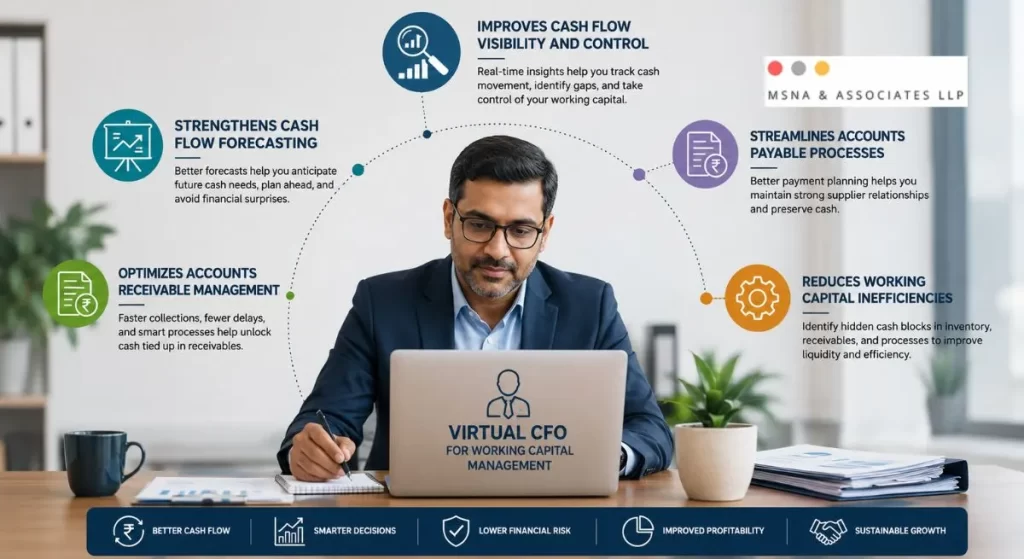
If one of your biggest customers delayed payment by 45 days, would you know today how that would affect your cash position two months from now?
Many businesses can’t answer that confidently. That’s not because they’re poorly managed. It’s because day-to-day operations consume most of their attention. A virtual CFO for working capital management helps create visibility.
Expert Insight: We developed a 13-week rolling cash flow model for a manufacturing client in Pune. In the first 90 days, it identified ₹38 lakh in stuck receivables that they hadn’t marked as late. That alone was enough to justify the engagement.
2.Strengthens Cash Flow Forecasting
Most business owners don’t enjoy surprises. Especially expensive ones. The trouble is that cash flow problems often start long before they become visible.
- A hiring decision made today may affect cash six months later.
- An inventory purchase made this quarter may create pressure during the next one.
Good forecasting helps connect those dots. It lets business owners plan ahead instead of always responding to what has already happened.
3.Optimizes Accounts Receivable Management
Almost every business owner has had the same thought at some point: “If customers paid on time, life would be much easier.” And they’re right. A surprising amount of cash gets trapped in unpaid invoices.
- The work has been completed.
- The product has been delivered.
- The invoice has been sent.
- Yet the money hasn’t arrived.
Strong accounts receivable management isn’t about chasing customers aggressively. It’s about creating processes that make payment easier, faster, and more predictable.
TReDS is a significant tool in India’s regulatory ecosystem and an RBI-operated electronic platform that allows MSMEs to discount their receivables through several financiers at competitive rates. A Virtual CFO can help you decide whether TReDS onboarding through platforms such as RXIL, M1xchange or Invoicemart makes financial sense for your organization.
Refer to the official RBI Guidelines on TReDS to know about compliance and onboarding methods.
4.Streamlines Accounts Payable Processes
Paying suppliers requires balance. Nobody wants to damage a good supplier relationship. At the same time, sending payments too early can create unnecessary pressure on cash reserves.
A Virtual CFO helps businesses find that middle ground. The goal isn’t delaying payments. The goal is to make sure cash leaves the business at the right time.
5.Reduces Working Capital Inefficiencies
Sometimes business owners assume they need more funding. Then someone takes a closer look and discovers the cash is already there. It’s just hidden.
- Maybe it’s trapped in slow-moving inventory.
- Maybe it’s sitting in overdue receivables.
- Maybe it’s tied up in processes that haven’t been reviewed in years.
Fresh eyes often spot opportunities that become invisible when you’ve been running the business for a long time.
Key Benefits of Hiring a Virtual CFO for Working Capital Management
Let’s be honest. Most business owners aren’t looking for another person to send them spreadsheets. All they really want is clarity.
1. Enhanced Liquidity Management
There’s another assurance that comes from knowing where you stand with your wealth. You don’t keep on checking the bank balance or thinking about how I will handle next month’s costs.
2. Lower financial risk
Most financial difficulties send out plenty of notice before they get bad. The trouble is, when you’re busy running the business, you might easily lose sight of them. A fractional CFO can assist in finding these problems early.
3. Better Business Decisions
Numbers help to back up the big decisions that seem a lot less dangerous. So you can go ahead and hire, expand or invest in something new, knowing the business can really back it up.
4. Improved Profitability and Funding Confidence
Good cash management frequently results in a better-run business. The financial part of the firm seems organised and under control. It makes it simpler to develop trust with lenders, investors and even stakeholders.
How Virtual CFOs Use Technology to Improve Working Capital Management?
The newest AI-based financial management tools can process huge volumes of data, identify trends and make more accurate predictions.
With that technology, a Virtual CFO can give information promptly and correctly. Today, companies are using:
- Real-time financial dashboard.
- Automation of financial movements.
- ERP and accounting program integration.
- Predictive analysis tools.
They also track key performance indicators such as:
- Current ratio.
- Quick Ratio
- Days Sales Outstanding (DSO)
- Cash Conversion Cycle (CCC).
- Days payable outstanding (DPO).
- Working Capital Ratio.
These data help us understand better the financial health of the business and how well it functions.
5-Minute Working Capital Health Check by MSNA: Is Your Business Financially Healthy?
This diagnosis is part of the MSNA advisory framework and reflects the same approach used by a virtual CFO for working capital management to identify hidden cash flow and liquidity issues.
Use it to evaluate where your working capital stress is coming from. Answer each question truthfully. Score: 2 = Yes, Always | 1 = Sometimes | 0 = No / Rarely.
- Do you know your current Cash Conversion Cycle (CCC) in days?
- Are your customers’ payment terms carried out via automated follow-ups?
- Do you check old receivables on a weekly or fortnightly basis?
- Are your inventories’ slow-moving items audited quarterly?
- Do you consistently update a rolling 13-week cash flow estimate?
- Are supplier payment terms negotiated intentionally rather than accepted?
- Do you have a clear early warning system for liquidity risk in your company?
- Do you claim GST ITC on time each month?
Scoring Guide:
14-16: Strong working capital discipline – investigate advanced optimization.
9-13: Moderate gaps – a Virtual CFO can systemise controls and projections.
0-8: High working capital risk – need for expert financial management now.
Expert Tip: Most SMEs we rate are 4 to 8. Most of the time, the gaps are not in revenue, but in process.
Signs It May Be Time to Hire a Virtual CFO for Working Capital Management
Sometimes the signs are obvious.
- Cash flow feels tighter than it should.
- Growth opportunities keep getting postponed.
- Debt is increasing.
- Financial reports exist, but they don’t provide clear direction.
- Or perhaps the business owner simply feels like they’re making important decisions without enough information.
If any of that sounds familiar, it may be time to bring in outside financial expertise
Why a Virtual CFO for Working Capital Management Is Becoming Essential?
At some stage, every business owner realizes that revenue only tells part of the story.
The bigger question is whether the business has enough cash to keep moving forward comfortably.
That’s where a virtual CFO for working capital management becomes valuable. Not because they create more reports, but because they help make sense of what’s happening behind the numbers. When cash flow is clearer, decisions become easier, surprises become fewer, and growth feels far more manageable.
It’s a practical shift that many businesses are making today, and one that professional firms like MSNA have seen become increasingly important as companies focus on building stronger financial foundations, not just bigger revenue numbers.
Need Better Control Over Your Working Capital?
Related
Discover more from MSNA & Associates LLP
Subscribe to get the latest posts sent to your email.