

A lot of business owners think that their company’s next move after it starts expanding gradually is an IPO. But that’s usually when the actual work starts.
The business probably has a solid name in the market, devoted clients, and there may be a lot of sales. But as the IPO planning starts, the challenges that were not expected often appear. When it comes to financial records and compliance regulations, it’s more important to pay attention to every detail.
In this, the services of a virtual CFO for IPO preparation can be helpful. A virtual CFO manages the firm’s finances behind the scenes, fills in any gaps of information, enhances reporting and gets the company ready to go public.
Because going public isn’t just a method to display how large a corporation has become. It shows that the company is ready to meet the standards of a public corporation.
In this blog post, we will discuss how a virtual CFO can help a business in meeting the requirements for an IPO, avoiding typical pitfalls, and preparing for the path to going public with greater ease.
Understanding IPO Listing Requirements
Companies that wish to go public have to follow lots of rules in the financial, legal, and government areas.
1.Financial Requirements Before Going Public
When preparing for an IPO, one of the first things to be looked at is the financial performance. Investors and government officials are looking at past financial statements to determine how much money the business made, how successful it was, how much cash it had, and how healthy it was overall.
According to the SEBI (Issue of Capital and Disclosure Requirements) Regulations, 2018, a company has to fulfill certain conditions before filing a Draft Red Herring Prospectus (DRHP) with SEBI.
The main financial eligibility criteria for a Mainboard IPO are:
- Paid-up equity capital of more than Rs 10 crore after issue.
- Minimum market capitalization of Rs. 25 crore.
- Positive net worth (for issue size below Rs. 500 crore).
- Minimum 3 years of experience as a promoter in the same area of business (as required by NSE).
2.The 2026 Regulatory Landscape
Following the SEBI Board meeting held on December 17, 2025, SEBI notified the ICDR Amendment Regulations, 2026, effective March 21, 2026, to explain the public issue requirements under SEBI ICDR Regulations, 2018.
The main changes with the 2026 amendments are:
- Where lock-in cannot be created, the depositories will mark pre-issue share capital as ‘non-transferable’ throughout the lock-in period.
- Disclosure rules are enhanced to allow companies to make comprehensive financial, governance and risk disclosures to minimize the investor-issuer information asymmetry.
- Stock Appreciation Rights (SARs) exercised for equity shares are included in pre-IPO share capital calculations, therefore increasing the required promoter contribution.
3.Regulatory and Compliance Requirements
Financial goals alone are not enough to meet. To be listed on SEBI, corporations need to comply with SEBI listing requirements such as the Companies Act, 2013 (administered by the Ministry of Corporate Affairs, or MCA) and the SEBI (Listing Obligations and Disclosure Requirements) Regulations, 2015 (LODR).
Virtual CFO focus mostly on the company’s management, quality of disclosure, historical record of compliance and internal controls.
Why IPO Readiness Matters?
India’s most important market has entered a new structural phase. The company must be IPO ready, which means it should meet the requirements of the public market.
In 2025, India had one of the most active IPO markets in the world with 373 IPOs (103 mainboard and 270 SME deals) raising Rs. 1.95 trillion. The trend is set to continue. Analysts predict primary markets to raise almost ₹4 lakh crore of capital in 2026.
So an IPO readiness review will help you in improving your overall financial reporting, governance, compliance and operational processes.
Companies that start their IPO preparations early are able to handle regulatory scrutiny, investor due diligence and governance standards while continuing to run their day-to-day operations.
What Does a Virtual CFO for IPO Actually Do?
Definition and Core Responsibilities
A virtual CFO or Chief Financial Officer is an executive-level financial professional that works part-time and is in charge of the company’s financial strategy.
Many financial tasks can be outsourced to a virtual CFO, including:
- Planning for and predicting money concerns.
- Reporting and compliance management.
- Prepare for an audit.
- Watching the cash flow.
- Risk management.
- Strategic financial decision making.
A virtual CFO will put in place the financial processes and have them ready for regulators and investors to review as the firm gets ready to go public for an IPO.
Why Growing Businesses Choose Virtual CFO Services Before an IPO?
There are a lot of professionals who help to prepare an IPO. Investors, accountants, lawyers, investment bankers, and regulators. It might be difficult to coordinate with investors, auditors, legal advisors, and investment bankers while managing daily operations. Professional Virtual CFO Services in India help businesses streamline financial planning, strengthen compliance, and build the systems required for a successful IPO.
At MSNA, we have had firms come to us 12 months before a projected listing date with financial records that are not investor-ready. Common problems include irregular revenue recognition, insufficient internal audit trails, and governance structures created for a private company. These are fixable, but only with sufficient runway. 24 to 36 months is the time when a Virtual CFO may truly alter a company’s IPO preparation.
Key Ways a Virtual CFO for IPO Helps Meet Listing Requirements
1. Strengthening Financial Reporting Systems
One of the main jobs of a virtual CFO is to make financial reports better.
A lot of businesses that are growing use methods that might not work for public companies. Often, reporting methods need to be standardized, documentation needs to be improved, and controls need to be made stronger.
A virtual CFO helps make sure that financial records are correct, consistent, and strong enough to withstand a close examination. They also help businesses get ready for a pre-IPO audit by helping them organise their records and fix any problems that might come up before the real audits start.
2.Building Investor-Ready Financial Documentation
You have to create and publish a lot of IPO documentation. Investors and regulators want to see in-depth the finances of a company, its operational model, risk considerations, growth trajectory and governance structures.
Key documents include Draft Red Herring Prospectus (DRHP), audited financial statements for last 3 years, risk disclosures and descriptions of objects of the issue. The DRHP sections typically include Risk Factors, Capital Structure, Objects of the Offer, Financial Information, Legal and Statutory Disclosures, Offer Details, and Other Material Information.
A Virtual CFO works with management and legal experts at every stage to ensure all documentation is comprehensive, correct and accessible.
3. Managing IPO Due Diligence
One of the most difficult parts of the IPO process is due diligence. The ICDR Regulations require an issuer to file a DRHP with SEBI at least thirty days before the opening of the issue for an IPO. SEBI issues its observations, the “SEBI observation letter” which must be incorporated before filing the final Red Herring Prospectus with the stock markets.
A Virtual CFO handles records, coordinates responses to information demands, and makes ensuring the company is ready for the volume and breadth of questions from auditors, bankers, attorneys and regulators.
Businesses also often use professional IPO readiness services during this time to identify and address issues that might arise before the official reviews begin.
4. Enhancing Corporate Governance Frameworks
One of the primary expectations from public companies is good governance. As a firm grows so should its governance to match the criteria of the investor and regulators.
Virtual CFO service can boost governance by:
- Board reporting procedures.
- Development of financial policies.
- Regulatory supervision.
- Accountability systems.
- Decision-making processes.
Most companies in the growth stage are caught off guard in the governance pillar. SEBI and Companies Act, 2013, require public firms to have independent directors and the right people on the audit committee. A board that worked effectively for a private company typically doesn’t have enough independent directors or the proper people on the audit committee. It is not just about following regulations; good governance is another signal that institutions use in determining whether a firm is ready to be listed.
5. Establishing Robust Internal Controls
Internal controls are very important to make sure that the finances are right and that operations are working properly.
On the other hand, weak controls increase the likelihood of reporting errors, non-compliance and operational inefficiencies.
A Virtual CFO helps in building and setting up control frameworks that fulfil the listing compliance in India standards and lower the company’s risk.
These regulations can help lay a firm foundation for both the IPO process and for the future operations of the public company.
Common IPO Challenges Businesses Face Without a Virtual CFO for IPO
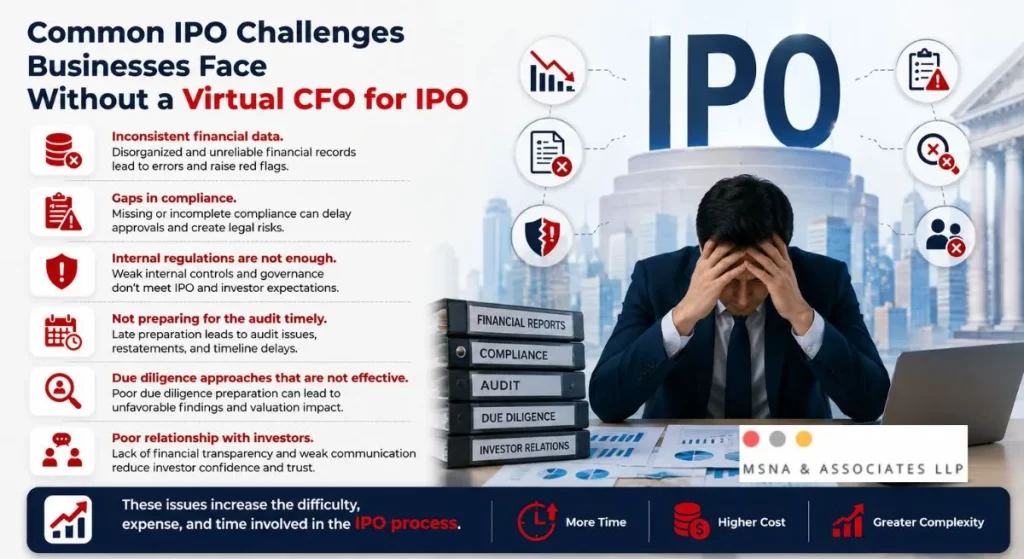
Without having strategic financial leadership, preparation for an IPO often leads to a number of problems. Some of the common problems include:
- Inconsistent financial data.
- Gaps in compliance.
- Internal regulations are not enough.
- Not preparing for the audit timely.
- Due diligence approaches that are not effective.
- Poor relationship with investors.
These issues increase the difficulty, expense, and time involved in the IPO process.
Benefits of Hiring a Virtual CFO for IPO Preparation
There are various advantages of using a virtual CFO in the IPO preparation process. Some of the key benefits are:
- Access to senior finance specialists.
- Better reporting accuracy.
- Stronger frameworks of compliance.
- Better governance practices.
- Greater investor readiness.
- Better audit and due diligence methods.
- Help with strategic pre-IPO financial planning.
The role of a Virtual CFO extends beyond IPO preparation. From securing private investments to preparing for public markets, businesses can learn how a Virtual CFO for Fundraising Helps You Secure Investor Funding Successfully through better financial planning, valuation support, and investor readiness.
IPO Readiness Checklist: What a Virtual CFO For IPO Should Help You Complete
Use this as a working reference for your virtual CFO for the IPO preparation process.
1. Financial Readiness
- Three years audited financial statements made according to proper accounting principles.
- Designed and implemented consistent revenue recognition policies.
- Pre-IPO audit completed without any pending observations.
2. Regulations Compliance
- Prepared updated ROC, GST, TDS and income tax filings as per MCA rules.
- SEBI and the stock exchange have not issued any pending regulatory notices.
3. Governance
- The composition of the Board complies with the criteria of the Companies Act 2013.
- Audit committee with at least one independent director.
- Related-party transactions have been documented and disclosed.
4. Internal Controls
- Segregation of duties applied for important financial procedures.
- Approvals matrices established for transactions over specified criteria.
- Internal audit performed and issues addressed.
5. Investor Communications
- MIS report on monthly basis.
- KPI dashboard for revenues, margins, cash flow and working capital.
- Framework for the application of funds documented for objects of the issue.
When Should a Business Engage a Virtual CFO Before an IPO?
Companies should begin working with a virtual CFO 24 to 36 months before they decide to go public. This allows you to have time to:
- Make the methods for reporting finances better.
- Make the foundations of governance stronger.
- Fix compliance concerns.
- Establish internal controls.
- Get ready for due diligence and audits.
At MSNA & Associates, we help developing businesses prepare for their IPOs, analysing their readiness, perfecting their financial systems and projecting what the regulators, investors and stock markets demand. Our analysis shows that early preparation helps businesses in meeting audit, due diligence and compliance demands without missing deadlines.
Virtual CFO for IPO: Why Early Preparation Matters
While an IPO might be a big door to open for a developing business, it’s only if the company is ready behind the scenes as well. That’s where a virtual CFO for IPO preparation comes in. Good reporting, clear compliance and continuous preparation make the whole process easier to take on.
At MSNA & Associates, this kind of early planning helps companies avoid stress at the last minute and confidently move forward. With the numbers, records and controls in place, the listing journey is lot less rushed and far more controllable.
Disclaimer: This blog is for general informational purposes only and is prepared by MSNA & Associates LLP. The information is based on SEBI (Issue of Capital and Disclosure Requirements) Regulations, 2018 and revisions thereafter including ICDR Amendment Regulations, 2026 as notified in the public domain. It is not legal, financial or regulatory advice and should not be relied on as such
Get IPO-Ready with Virtual CFO Support
Related
Discover more from MSNA & Associates LLP
Subscribe to get the latest posts sent to your email.