

“This has been our best year for sales so far. So why does it feel like we’re always out of money?” A business owner asked this during a review meeting.
On paper, everything looked fine. The team was growing. But once the numbers were examined properly, a different picture appeared.
Several customer invoices had been sitting unpaid for months. Expenses had quietly increased over the year. A few compliance items had been pushed aside because there was always something “more urgent” to handle.
That’s the tricky part about financial problems. They build quietly in the background while everyone is focused on running the business.
And that is why a finance audit checklist is important. It’s not only something that companies use before an external audit. It’s a good way to find weak spots, improve financial visibility, and fix small problems before they become expensive ones.
This blog will take you step-by-step through the 10 major areas a virtual CFO covers during a financial audit and why it’s important to focus on each for a business to stay financially healthy and ready to grow.
At MSNA & Associates, we are seeing an increase in the number of firms coming to us after receiving alerts from RBI or MCA, situations that could have been fully prevented by having a quarterly financial health check in place. Audit readiness is no longer a year-end event. It’s an all year thing.
The 10 Essential Areas Every Finance Audit Checklist Should Cover
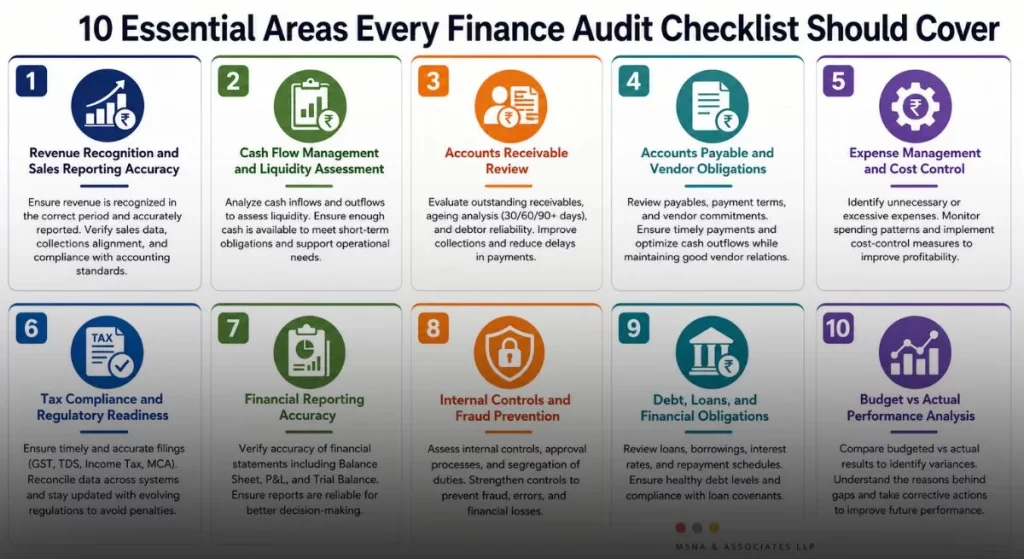
Below are the 10 critical areas included in a finance audit checklist that every business should review regularly.
1. Revenue Recognition and Sales Reporting Accuracy
Most businesses love talking about revenue. That’s understandable. Revenue feels like progress. But revenue might be deceiving if it is not reported properly.
A company might celebrate a strong sales month, only to discover later that some of those sales shouldn’t have been recognised yet. In other cases, revenue is recorded correctly, but collections become a problem.
A financial review isn’t just about looking for bigger sales numbers. It’s checking whether those numbers tell the truth.
2. Cash Flow Management and Liquidity Assessment
If there’s one section that business owners should pay attention to, it’s this one.
One of the biggest questions virtual CFOs hear is: “We had our best year of sales ever, so why are we running around to make payroll on the 1st?” The answer is rarely in money. It’s in time.
According to a 2026 working capital analysis by Credible, Indian MSMEs wait for around 195 days from agreed conditions to get paid, which is one of the longest delayed payment cycles among major countries internationally. Cash flow analysis measures the actual velocity of money and plays a critical role in Cashflow Management in Business During Expansion, where growing companies often face increasing working capital requirements. Even if you have a perfect P&L statement, if your expenses are due on day 7 and your customer cash is not accessible until day 60, you’ve got a liquidity situation.
3. Accounts Receivable Review
Most of the problems with receivables are caused by a lack of confidence. Customer promises to pay “next week.” Next week becomes next month, and another bill is postponed. The money is technically safe on the books, and no one is worried.
The reality? Landlords, suppliers, and staff salaries don’t accept promises. A VCFO audit classifies your debtors into precise aging buckets (30, 60, 90+ days). It shows you how many lakhs are stuck in pending invoices, who the repeat offenders are, and if your collection operations require a rapid change.
The Section 43B(h) provision, which prevents buyers from deducting payments made to MSMEs beyond 45 days, is one of the best collection tools small businesses have. We help our clients discover which of their buyers are covered by this clause and use it proactively in payment follow-up. Reference: Income Tax Act, Section 43B(h) – Ministry of Finance
4. Accounts Payable and Vendor Obligations
Businesses spend a lot of time tracking money coming in. They don’t always pay the same attention to money going out. That’s why accounts payable deserves a closer look.
A good review will clear things up. It reveals what the business owes, when it has to make payments and whether cash commitments are being effectively managed.
Important Update: MCA has introduced the Companies Compliance Facilitation Scheme 2026 (CCFS 2026), from 15 April to 15 July 2026. Firms that clear pending statutory filings before issuance of adjudication notices are not required to pay any penalty. This is especially true for firms with compliance responsibilities on the payment side.
5. Expense Management and Cost Control
One of the most eye-opening aspects that happens during a business finance audit is to observe how much money may be saved simply by sealing little, regular leaks.
A little spending never attracts notice. Say, a software subscription that is not being used or a SaaS product that is not being monitored for ₹15,000 a month, that is active only because it is on auto-debit on a corporate credit card. These operational costs go unregulated and silently destroy your net profit margins over a year.
6. Tax Compliance and Regulatory Readiness
Tax compliance audit is often one of those things that get set aside when business is busy. A VCFO tax audit ensures that your financial statements, internal registers, and government portals are all telling the same story. Important points are:
- GST Reconciliation: The key is that you don’t miss out on the actual Input Tax Credit (ITC) because a vendor forgot to submit their reports. Match your internal purchase register with GSTR-2B.
- TDS Depositions: Tax Deducted at Source (TDS) should be properly deducted and deposited on the 7th of each month in the relevant sections, else severe interest penalties will be attracted.
- MCA Compliance: Ensuring that Ministry of Corporate Affairs (MCA) annual filings like AOC-4 and MGT-7 are properly in sync.
7. Financial Reporting Accuracy
Think about how hard it is to hire someone, move offices, or make a pitch to investors when you have the wrong information.
Financial reports should never be prepared just to please an accountant. They are managerial tools that are supposed to create total clarity. When you get a full audit, you’re making sure your balance sheets, profit and loss statements, and trial balances are all balanced, error-free, and trustworthy enough to make big business decisions from.
8. Internal Controls and Fraud Prevention
Most financial losses don’t happen because someone planned an elaborate fraud scheme. More often, they happen because processes are weak. RBI Annual Report 2025-26 said the number of frauds had reduced, but the total value of bank frauds increased to ₹48,021 crore. That means the scams are getting larger and more elaborate.
- Maybe one employee can approve and make payments without supervision.
- Maybe there aren’t enough controls on who can use financial tools.
- Perhaps certain transactions aren’t checked by anyone.
Strong internal financial controls don’t mean creating regulations where they aren’t needed. They’re about catching mistakes before they get expensive.
9. Debt, Loans, and Financial Obligations
Debt is a great instrument for progress. Many successful Indian companies would not have scaled up without access to funding. The problem is determining when debt is fuelling growth vs when it is strangling your cash flow.
As a company grows, it can get so focused on performance that it stops watching its debt covenants or bank interest rates. Your monthly outgoings on Cash Credit (CC) limits, Overdrafts (OD), or term loans will be checked through a regular audit to help keep your Debt-Service Coverage Ratio (DSCR) healthy, and your commercial CIBIL score safeguarded.
10. Budget vs Actual Performance Analysis
Most budgets begin with optimism. Most actual results introduce reality. That’s not necessarily a bad thing.
The value comes from understanding the gap between the two.
- Why were expenses higher than expected?
- Why did one department outperform projections while another struggled?
Those answers provide insights that businesses can use immediately. In fact, reviewing budget variances is an important part of any finance audit checklist because it helps businesses identify issues early and make better decisions moving forward.
Why Every Business Needs a Finance Audit Checklist?
A lot of business owners think audits are something only big companies worry about.
But here’s the thing. Large companies usually have finance managers, accountants, and systems checking the numbers throughout the year. In smaller businesses, the owner is often juggling ten different things at once.
So finance often gets pushed to “later.” The problem is that money-related issues don’t wait.
As per the Economic Survey 2025-26 (Press Information Bureau), MSME loans grew by 21.8 per cent in November 2025. Micro and small enterprises grew by 24.6% year-on-year. Today, businesses have more financial choices than they have ever had before. That’s exactly why having a finance audit checklist is so important.
Financial Audits vs Financial Health Reviews
Think of it like a regular health check-up. A financial audit checks whether your records are accurate. A financial health review looks at whether the business is actually in good shape.
You can have clean books, and still have issues like:
- Slow customer repayments.
- Cash is getting tight.
- Rising debt.
- Increasing operating costs.
How a Virtual CFO Helps?
One of the biggest benefits of choosing Virtual CFO Services in India is having someone who can look at the business with fresh eyes. They ask questions that often get overlooked:
- Why is cash getting tighter?
- Why are receivables growing?
- Where are expenses creeping up?
Sometimes those answers reveal more than the financial reports themselves.
Common Red Flags Discovered During Finance Audits
Certain warning signs appear repeatedly during financial reviews.
- Your bank balance is always zeroing off, but you are making an all-time high revenue.
- Accounts receivable continue to increase, yet average collection days are over 60-90 days.
- The GST data on the portal (GSTR-2B) is not matching with your internal purchase logs because of which tax credits are not being captured.
- Your real revenue increase isn’t enough to cover your rising operating expenses.
- When vendor payments are delayed, MSME compliance criteria are being strengthened.
Is Your Business Financially Healthy? A 10-Question Finance Audit Checklist
Honesty is key. It takes just three minutes, yet it might save you lakhs. As a part of this finance audit checklist, give yourself 1 point for every “Yes” and 0 for every “No.”
- Do you have a separate cash flow statement for the month, audited?
- Is your DSO (Days Sales Outstanding) below 45 days?
- Is there monthly GST Return filing & Reconciliation with GSTR-2B?
- Have you noticed your bank CC/OD interest rate in recent 12 months?
- Are there separate responsibilities for approving and processing payments?
- Did you submit your MCA annual returns (AOC-4, MGT-7) for the FY 2024-25 in time?
- Do you do a budget vs actual review each quarter?
- Are all vendor contracts reviewed in recent 12 months?
- Do you have a documented escalation process for collections on bills that are 60+ days old?
- Is your DSCR always better than 1.25?
Grading:
8-10: Financial governance is strong. Stick with the quarterly cadence.
5-7: Moderate risk. Start with the red flagged things.
< 5: Extreme risk. A Virtual CFO involvement should be done before the end of the next financial year.
How a Virtual CFO Uses a Finance Audit Checklist More Effectively?
Traditional audits focus heavily on the past.
A virtual CFO audit focuses on both the past and the future.
The goal isn’t simply to identify mistakes. It’s to understand what those mistakes might mean six months from now.
- Will cash flow become a problem?
- Are expenses rising too quickly?
- Are compliance risks increasing?
- Could weak reporting affect funding opportunities?
That forward-looking perspective is often what makes Virtual CFO support valuable
Why a Finance Audit Checklist Matters for Long-Term Business Growth?
Most businesses don’t run into financial trouble because of one big mistake. More often, it’s a collection of small things that nobody noticed at the time, an overdue payment, rising costs, missing records, or compliance work that kept getting pushed aside.
That’s why a finance audit checklist is so useful. It gives you a reason to pause, look at the numbers properly, and catch issues while they’re still easy to fix. And honestly, that’s a lot easier than trying to untangle problems months later. For businesses that need a clearer view of their finances, professional firms like MSNA & Associates often step in as a strategic finance partner, helping business owners understand what’s happening behind the numbers and where attention is needed next.
Need a Complete Financial Health Check for Your Business?
Related
Discover more from MSNA & Associates LLP
Subscribe to get the latest posts sent to your email.