
If your business is based in the UAE and you’re planning to enter India, you have four legal routes to choose from: a wholly owned subsidiary, a branch office, a liaison office, or a project office. Which one fits determines your tax exposure, liability, and compliance load for years, so it’s worth getting right before you file anything.
Trade between the two countries has picked up since CEPA took effect in 2022, and a growing number of GCC founders are treating India as a next market rather than a distant one.
Incorporating a private limited company is only one route, and it is not always the right one for every business model.
If you’re a UAE trading company that wants a rep on the ground in Mumbai before you commit real capital, a wholly owned subsidiary might be overkill. If you’re a UAE contractor bidding on an infrastructure project in Gujarat, a project office will serve you better than anything else on this list.
This blog walks through every legitimate way to establish a business presence in India from the UAE. We’ll cover what each route actually involves, who it’s built for, what it costs, how long it takes, and what the Reserve Bank of India (RBI) and the Ministry of Corporate Affairs (MCA) expect from you at each step. We work with UAE-based founders and CFOs on this exact decision every quarter.
Key Takeaways
- UAE companies can enter India through four legal structures: Subsidiary, Branch Office, Liaison Office, or Project Office.
- The right structure depends on whether you want to generate revenue, test the market, or execute a single project.
- Most sectors allow 100% foreign ownership under India’s FDI Automatic Route.
- RBI, FEMA, MCA, and your Authorized Dealer (AD) Bank all play a role in the setup process.
- Choosing the wrong structure can increase taxes, compliance costs, and regulatory obligations.
Why UAE Businesses Are Looking at India Right Now ?
The India-UAE corridor isn’t just growing in trade volume. The infrastructure connecting the two economies is being built out in real time. India and the UAE have interlinked their instant payment systems, UPI and AANI, and their domestic card networks, RuPay and JAYWAN, making cross-border collections and payments between the two countries considerably smoother for a business operating on both sides.
On the institutional side, Invest India opened a dedicated office in Dubai -only its second overseas office after Singapore -with the UAE reciprocating with an office in New Delhi, a signal that both governments are actively de-risking the corridor rather than just talking about it.
There’s also a practical advantage UAE-based founders often underweight: the UAE is home to more than three million Indians, which means a UAE business expanding into India rarely starts from zero on the talent, vendor, or local-market-intelligence side.
But market opportunity doesn’t mean setting up business in India from the UAE is simple. India’s foreign investment rules run through FEMA (the Foreign Exchange Management Act), and every route below has to satisfy RBI’s FEMA Master Directions before you can move a single rupee or dirham across the border legally.
The Four Main Routes for Company Registration in India from the UAE
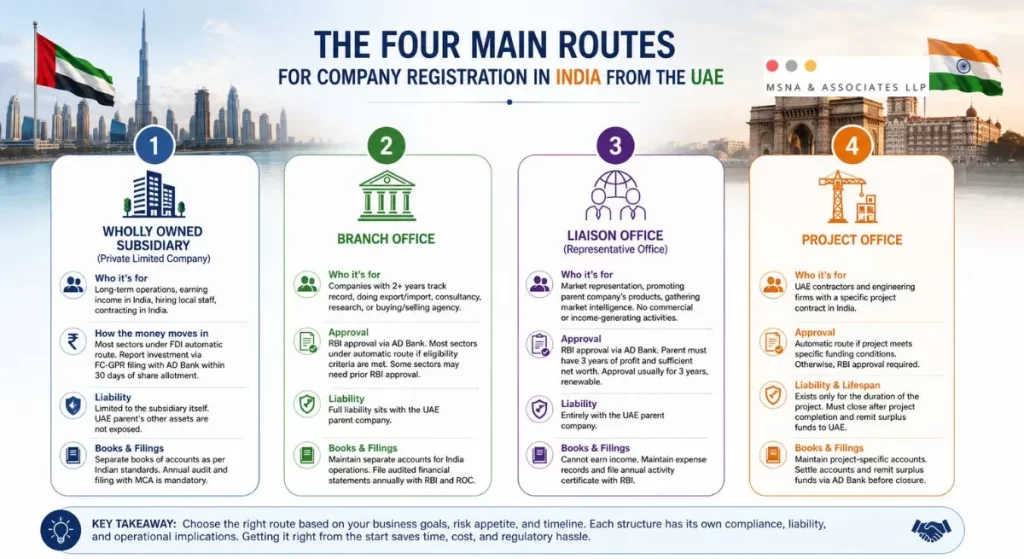
1. Wholly Owned Subsidiary (Private Limited Company)
This is the route most UAE businesses eventually land on, and for good reason. A wholly owned subsidiary is a separate Indian legal entity, incorporated under the Companies Act, 2013, and registered with the MCA. Your UAE parent company holds up to 100% of the shares, depending on the sector.
Who it’s for: Companies wishing to make money in India, employ local staff, enter into contracts based in India or establish a long-term operational base.
How the money moves in: Most sectors fall under the FDI automatic route, meaning you don’t need prior RBI or government approval to invest. You’ll still need to report the investment through an Authorized Dealer (AD) Bank using an FC-GPR filing (Foreign Currency-Gross Provisional Return) within 30 days of share allotment. Miss this filing and you’re looking at compounding penalties from RBI, so this isn’t a step to treat casually.
Liability: Limited to the subsidiary itself. Your UAE parent company’s other assets aren’t exposed if something goes wrong in India.
Books & Filings: Since the subsidiary is a separate legal entity, it keeps its own full set of books according to Indian accounting standards. These books are kept separate from your UAE accounts. The Companies Act says that it has to be audited, and every year it has to file annual financial statements and returns with the MCA.
If your goal is to register a company in India from the UAE for long-term operations, a wholly owned subsidiary is usually the most suitable structure. The FDI automatic route makes the entry itself faster than people expect.
2. Branch Office
A branch office lets a foreign company carry out specific, RBI-permitted activities in India without incorporating a new company. It’s not a separate legal entity. It’s an extension of your UAE parent.
Who it’s for: UAE companies with a two-year track record and the net worth to back it up, doing work like export/import, consultancy, research, or buying/selling agency. Retail trading and manufacturing generally don’t qualify.
Approval: Branch offices need RBI approval routed through an AD Bank, and in most sectors this falls under the automatic route if the parent company meets the eligibility criteria. Certain sectors and structures continue to need prior approval from the RBI.
Liability: That trade-off is the main thing to weigh here. Because a branch office isn’t a separate legal entity, your UAE parent company carries full liability for its India operations
Books & Filings: A branch office must maintain accounts for its India activities separately from the UAE parent’s books, and file audited annual financial statements with the RBI and the Registrar of Companies each year.
Branch offices get overlooked because “subsidiary” is the word everyone knows. But if you’re a UAE trading or consultancy business that wants to operate in India without setting up a fresh company, and you’re comfortable with the parent-level liability, this route can actually get you moving faster than incorporation.
3. Liaison Office (Representative Office)
A liaison office exists to represent your UAE parent company in India. It cannot earn income, invoice clients, or undertake any commercial activity. Mostly, it promotes your parent company’s products, gathers market intel, and keeps the line open between your India contacts and UAE headquarters.
Who it’s for: UAE businesses that want boots on the ground in India before committing capital to full incorporation. Common among GCC trading houses testing demand before setting up a subsidiary.
Approval: You’ll need RBI approval routed through an AD Bank. RBI will also want to see three straight years of profit from the parent company and a net worth that clears its threshold. Approval is typically granted for three years and is renewable. So don’t treat this as a permanent structure.
Liability: Sits entirely with the UAE parent company, since the liaison office has no independent legal status.
Books & Filings: A liaison office can’t generate income, so its accounting footprint is light — but it still needs to keep records of its expenses and activities to support the annual activity certificate it must file with RBI.
This is a route we regularly see founders misjudge. Founders sometimes open a liaison office thinking it buys them time to “figure out India” indefinitely. It doesn’t. RBI expects you to either convert to a subsidiary or branch office within a reasonable window, or wind down. Use it as a genuine market-entry scouting tool, not a permanent workaround.
4. Project Office
A project office is the narrowest and most specific of the four routes. It exists for one reason: to execute a specific contract an Indian entity has awarded your UAE company. You’ll see this mostly in construction, infrastructure, engineering, or turnkey projects.
Who it’s for: UAE contractors and engineering firms that have secured a specific project in India and need a legal presence for the duration of that contract, and nothing more.
Approval: Automatic route approval is available if the project is funded by inward remittance from abroad, funded by a bilateral or multilateral international financing agency, cleared by an appropriate authority, or if the Indian company awarding the contract has secured a term loan from a public financial institution or bank in India for the project. Outside these conditions, RBI approval is required.
Liability and lifespan: The project office exists only for the life of the contract. Once the project wraps up, the office has to close and remit any surplus funds back to the UAE, again reported through the AD Bank.
Books & Filings: The project office keeps project-specific accounts for the duration of the contract. Before closing, these accounts need to be settled and any surplus funds remitted back to the UAE through the AD Bank.
If your business model is genuinely project-based, a project office is usually the more efficient choice. It avoids the overhead of maintaining a subsidiary you would only need for the duration of one contract.
Compare Business Structures for Company Registration in India from UAE
| Factor | Wholly Owned Subsidiary | Branch Office | Liaison Office | Project Office |
|---|---|---|---|---|
| Legal Status | Separate Indian legal entity | Extension of the UAE parent company | Extension of the UAE parent company | Extension of the UAE parent company |
| Can Earn Revenue in India | Yes | Yes, within RBI-permitted activities | No | Yes, only for the approved project |
| Approval Route | Mostly under the FDI Automatic Route | Automatic or RBI approval, depending on the sector | RBI approval required | Mostly automatic if prescribed conditions are met |
| Liability | Limited to the subsidiary | Liability rests with the UAE parent company | Liability rests with the UAE parent company | Liability rests with the UAE parent company |
| Typical Timeline | 4–6 weeks | 6–10 weeks | 6–10 weeks | 4–8 weeks |
| Best Suited For | Long-term business operations in India | Established companies carrying out permitted business activities | Market research, brand promotion, and liaison activities without generating revenue | Executing a specific, time-bound project in India |
The structure you pick on day one shapes your accounting workload for years, not just your first compliance filing. Converting a liaison office into a subsidiary later means starting your books and statutory audit trail fresh nothing carries over. Bringing your accountant into the structuring decision alongside your lawyer, before anything is filed, avoids that rework.
What Compliance Can't You Skip After Incorporation?
Every route above touches the same three regulatory bodies, and this is where most UAE businesses underestimate the work involved. Incorporation is often treated as the finish line, when it’s closer to the starting point — annual filings, FEMA reporting, banking formalities, and bookkeeping require as much planning as the setup phase.
RBI and FEMA Master Directions: Every mode of entry, and every rupee that moves in or out, has to comply with RBI’s FEMA Master Directions on Establishment of Branch Office, Liaison Office, or Project Office in India, or the FDI regulations for subsidiaries. These directions get updated periodically, so what applied two years ago may not apply today. This is one of the biggest reasons DIY incorporation attempts run into trouble.
AD Bank as your gateway: You cannot deal directly with RBI for most of these approvals. You go through an Authorised Dealer Bank, which reviews your application and forwards it to RBI. Choosing an AD Bank that’s used to handling UAE-origin applications genuinely speeds things up.
MCA registration: For a subsidiary, incorporation happens through the MCA’s SPICe+ portal, which bundles company incorporation, PAN, TAN, and other registrations into a single filing. Branch, liaison, and project offices also need to register with the Registrar of Companies within 30 days of setting up.
FC-GPR filing: If you’re bringing in foreign direct investment for a subsidiary, this filing with the RBI (via your AD Bank) reports the share allotment. It’s a small form with a big consequence if you miss the deadline.
Resident Director Requirement:
Every company incorporated in India, including a wholly owned subsidiary, needs at least one director who has stayed in India for 182 days or more in the previous financial year, under Section 149(3) of the Companies Act, 2013. Most UAE-based boards don’t have this in-house and need to source one, which should be planned for before incorporation, not after.
Company Registration in India from UAE: Set Up Your Accounting Books from Day One
This is the part most India-entry guides skip: incorporation triggers an Indian accounting obligation from day one, and it’s worth setting up before the entity exists, not after the first invoice goes out.
Once your Indian entity is registered, it needs its own books maintained under Indian accounting standards, a separate chart of accounts from your UAE operations, and a bookkeeping cadence that can support the MCA and RBI filings covered above. Founders who wait until the first annual filing deadline to think about bookkeeping usually end up reconstructing several months of transactions under time pressure. Setting up the accounting function alongside the entity so every FDI inflow, intercompany transaction, and local expense is recorded correctly from the first rupee saves that scramble later.
What is the Cost to Register a Company in India from the UAE?
The cost of company formation in India from the UAE vary by structure, professional fees, and state of incorporation, but here’s a realistic range based on what we see UAE clients spend:
- Wholly owned subsidiary: Fees run ₹80,000 to ₹2,00,000, about AED 3,500 to AED 9,000, depending on capital and the firm you pick. Compliance costs are extra.
- Branch, liaison, and project offices: RBI approval processing, AD Bank fees, and registration costs typically run comparable to or slightly higher than subsidiary incorporation, given the additional documentation RBI requires.
There’s a recurring cost beyond setup too. Annual compliance means MCA filings, statutory audits, and RBI annual activity certificates, year after year.
Documents Required for Company Registration in India from UAE

Although documentation requirements for foreign company registration in India from the UAE vary depending on the structure, UAE companies generally require:
- Certificate of Incorporation of the UAE parent company
- Memorandum & Articles of Association
- Board Resolution approving India expansion
- Passport copies of directors
- UAE address proof
- Latest audited financial statements
- Net worth certificate (for Branch/Liaison Offices)
- Bank reference letter
- Power of Attorney (if applicable)
Remember that UAE-issued corporate documents must usually be apostilled before submission in India.
Common Mistakes to Avoid During Company Registration in India from UAE
These are the mistakes that most often cost UAE founders real time and money.
Choosing a subsidiary out of habit, not strategy. A subsidiary is frequently the default choice by name recognition alone, not because it was compared against the alternatives. A branch office or project office frequently proves cheaper and better suited to the operating model.
Underestimating document apostille timelines. Indian incorporation won’t accept UAE-issued documents without apostille certification under the Hague Convention. This step alone can add two to three weeks if you don’t start early, and it often becomes a last-minute bottleneck.
Treating RBI approval as a formality. For branch and liaison offices especially, RBI reviews the parent company’s financial track record closely. If your UAE company’s net worth or profitability doesn’t meet the threshold, the application won’t move, regardless of how good your business plan looks.
How MSNA Helps UAE Businesses Enter India ?
We work exclusively with cross-border clients moving between India and the GCC, and India entry structuring is one of the areas we spend the most time on. That includes helping decide which of the four routes actually fits a given business model, then handling MCA registration, RBI and AD Bank coordination, and FEMA compliance end-to-end. We also set up the Indian accounting function books under Indian accounting standards, a chart of accounts separate from your UAE operations, and a bookkeeping cadence that supports the compliance calendar above alongside the entity itself, so nothing needs reconstructing under time pressure later.
Learn more about our company incorporation services and outsourced accounting services, or send questions on which structure fits a specific expansion plan to contact@msna.co.in or +91 9036727740.
Need Professional Assistance with Company Registration in India from the UAE?
FAQs Related To Company registration in India from UAE
Can an NRI own 100% of a private limited company in India?
In most sectors, yes. IT services, consulting, and professional services all fall under the automatic route, so there’s no government approval needed upfront. A few regulated industries are the exception, so it’s worth checking your specific sector before you file.
Does an NRI director need to travel to India to get a DSC?
Not at all. You can get a Class 3 DSC done remotely, either through video verification or by submitting notarised passport copies, and it’s usually ready in a day or two.
Is the FLA return required even if there's no new investment during the year?
Yes. As long as there’s outstanding foreign shareholding on the books, even from a single NRI investor, the return is due every 15 July whether or not any money moved that year.
Related
Discover more from MSNA & Associates LLP
Subscribe to get the latest posts sent to your email.