
Rajesh operates a medium-sized manufacturing firm. On a monthly basis, he reviews sales figures, authorizes payments and keeps everything is under control. Then one day, his audit team tells him that duplicate vendor payments have been going out for months. Nobody noticed it earlier. And that moment changed how he looked at audits.
Stories like this are one reason why businesses are now comparing continuous auditing vs traditional internal audit more seriously. The old approach of reviewing records once or twice a year still has value. But when transactions happen every second and risks can appear overnight, many companies are asking a simple question: Is finding problems months later really enough anymore?
This is where continuous auditing enters the conversation. Risks would be discovered faster, monitored all the time and made more visible. Does it make internal audit methods outdated? Or is there a dual usage for each?
In this blog, we will go through each method, learn what makes them different from each other, their benefits and drawbacks, and whether you should pick one over the other in 2026.
The global market for internal audit services is projected to grow at a CAGR of 5.91% to reach USD 112.23 billion by 2032 from USD 74.83 billion in 2025. This growth is driven by the rising regulatory requirements, increasing stakeholder demands and the fast adoption of digital technologies.
What Is Traditional Internal Audit?
A traditional internal audit is really just a systematic review of how a business is run, including its finances, operations, controls and compliance with rules. The goal is to find the risks, check the efficacy of controls and provide recommendations for improvements.
It also plays a significant role in governance. It helps leaders to know whether policies are being followed and the organisation is running as it should.
Traditional Audit Methods and Processes
Most traditional audit methods follow a schedule. That could be once a year, every quarter, or something in between. The process looks like this:
- Planning the audit.
- Reviewing documents and policies.
- Testing a sample of transactions.
- Talking to employees.
- Evaluating risks and controls.
- Writing up a report.
Benefits of Traditional Internal Audit
There’s a reason why traditional audits are still so popular.
- They provide independent assurance, which is good. They help businesses find and fix problems.
- They are also more practical for small enterprises that may not have complex tools or vast resources.
- The structure is also useful. You will receive a thorough report with findings and recommendations, which can be very valuable for process improvement.
- Lastly, they help with compliance by making sure regulations and procedures are followed.
Working with an Internal Audit Firm in Bangalore can help organisations identify control weaknesses and improve operational efficiency through structured audit reviews
Limitations of Traditional Internal Audits
That being said, there are a few clear limitations.
- Timing is the largest. If something goes wrong in January and the audit is in June, the issue might not be discovered for months.
- Traditional audits are also more reactive. Their work is evaluating what happened, not catching problems as they happen.
What Is Continuous Auditing?
Continuous auditing differs greatly from traditional auditing. Traditional auditing is a review of transactions and controls after a period of time. Continuous auditing is performed on a continual basis; errors are discovered instantly.
These auditing processes include automated systems, large data analysis, etc., and so audits technology plays a big part.
Real-Time Auditing: The Foundation of Continuous Auditing
All these transactions are monitored in real time. The system is able to detect errors, such as an unexpected transaction or violation of control, as soon as they occur. This allows organizations to:
- Accelerate fraud detection.
- Surface issues before they escalate.
- Strengthen internal controls proactively.
- Reduce exposure to financial and reputational risk.
As PwC notes in its internal audit of the future research, companies that implement continuous auditing have been able to redirect internal auditors’ focus, enabling them to serve as business consultants who identify trends, investigate exceptions, and guide strategy, rather than simply reviewing past records.
How the Continuous Audit Process Works
The initial step is to pull data from numerous systems such as finance, payroll, procurement etc. The data is then checked with regulatory and risk indicators.
Automated audit procedures are regularly executed to discover any inconsistencies or gaps in transactions. If any unusual event is identified then an exception is raised to the auditors.
Dashboards can help managers to see what is going on in real-time and make faster decisions.
Technologies Powering Continuous Auditing
Technology makes it all possible.
- Artificial audit intelligence to flag unusual patterns across large transaction volumes.
- Machine Learning models that improve detection accuracy as more historical data feeds in.
- Data Analytics platforms that let auditors test 100% of a population instead of a sample.
- Robotic Process Automation (RPA) for repetitive reconciliation and control-testing tasks.
- Continuous Controls Monitoring (CCM) is an audit software tool that combines data gathering, testing, alerting and reporting into one layer. If your team is investigating vendors, Gartner’s CCM glossary item is a good primer.
Continuous Auditing Benefits for Modern Organizations
There are a lot of continual auditing benefits, especially for firms with sophisticated operations.
- One of the most significant ones is speed. Some abnormal situations may actually be detected before they become problems.
- Continuous auditing also improves compliance with regulations through regular review of legislation.
- Increased efficiency of the auditing process is another significant advantage. Routine processes are automated allowing auditors to focus on other tasks.
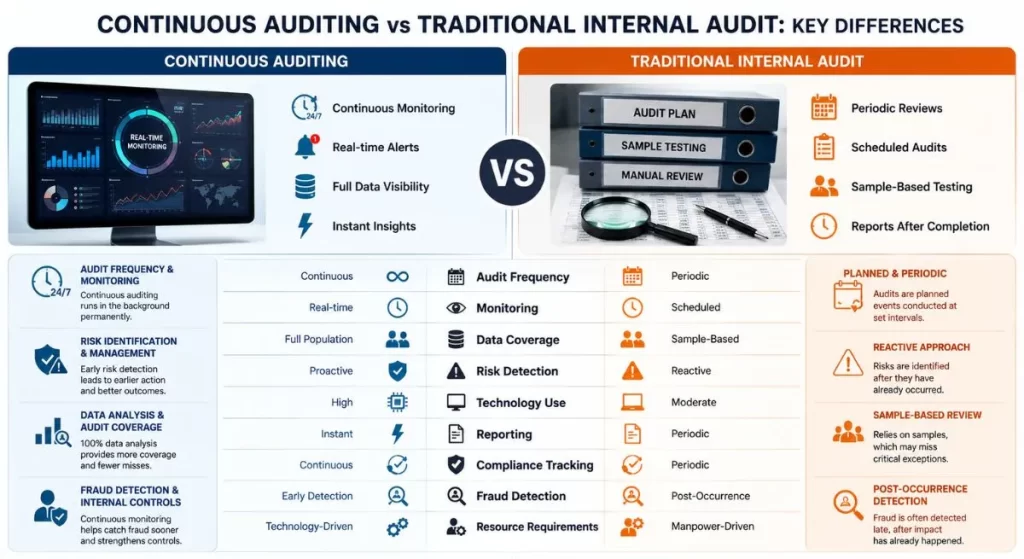
Continuous Auditing vs Traditional Internal Audit: Key Differences
| Feature | Continuous Auditing | Traditional Internal Audit |
|---|---|---|
| Audit Frequency | Continuous | Periodic |
| Monitoring | Real-time | Scheduled |
| Data Coverage | Full Population | Sample-Based |
| Risk Detection | Proactive | Reactive |
| Technology Use | High | Moderate |
| Reporting | Instant | Periodic |
| Compliance Tracking | Continuous | Periodic |
| Fraud Detection | Early Detection | Post-Occurrence |
| Resource Requirements | Technology-Driven | Manpower-Driven |
Audit Frequency and Monitoring Capabilities
Traditional audits are planned events. Continuous auditing runs in the background permanently. The IIA’s 2026 Risk in Focus report confirms that audit teams globally are being pushed toward more continuous assurance models as risk velocity increases.
Risk Identification and Management
- Traditional audits tend to find risk after it’s happened.
- Continuous auditing is about early risk detection and earlier action.
Data Analysis and Audit Coverage
- Traditional audits rely on samples.
- With continuous auditing, you can review every transaction, so there’s more coverage and less possibility of something getting missed.
Fraud Detection and Internal Controls
- With continuous auditing, you can catch fraud sooner because it’s being watched all the time.
- Traditional audits still have value for assessing control design and overall effectiveness.
Understanding how Fraud in Internal Audit is identified and investigated can help organisations strengthen controls and prevent financial losses before they escalate
Some of the main difficulties we find in Indian SMEs include duplicate vendor payments, irregular expenses and payroll discrepancies. These are seldom revealed in a yearly audit, by the time the auditor arrives, the pattern is months old. The only reliable way to catch these early is by continuously monitoring transaction-level data. But it needs a human expert to investigate the exception and understand the business context.
Compliance Monitoring and Regulatory Readiness
- Continuous auditing helps in increasing compliance monitoring through constant surveillance of the rules and regulations.
- Traditional audits confirm compliance at certain points in time.
Cost, Resources, and Technology Requirements
- Traditional audits tend to use less technology.
- Continuous auditing requires investment in equipment and people but can increase audit efficiency and risk management over time.
Why Organizations Are Shifting to Continuous Auditing in 2026 ?
There are a few clear reasons.
- Organizations are processing higher numbers of transactions digitally.
- Cyber threats and frauds are rising.
- Regulators demand quicker and more accurate reports.
- Advancements in technology have made real-time auditing more attainable.
- Finally, organizations simply want quicker insights to be able to make better decisions.
When Should Organizations Choose Traditional Audit Methods?
Traditional audits are still suitable in many cases, for example:
- Small and midsize companies.
- Organizations without advanced technology systems.
- Low-risk scenarios.
- Organizations having limited budgets.
When Is Continuous Auditing the Better Choice?
Continuous auditing is more appropriate for:
- High volume transaction environments
- Heavily regulated industries.
- Large or international organisations.
- Companies that are digitally transforming.
The biggest winners are sectors like banking, healthcare, insurance and e-commerce.
Can Continuous Auditing vs Traditional Internal Audit Work Together?
Yes, but then again in many situations they must be. This approach is often called a hybrid approach.
- Continuous auditing covers the areas of continuous monitoring and early detection.
- Traditional audits provide more detailed review and objective evaluations.
Internal audit shouldn’t be considered as a compliance burden, it’s a strategic asset. For fast-scaling startups and mid-sized firms in India, the most effective model is a risk-based hybrid, continuous controls monitoring on high-exposure areas such as vendor payments, payroll, and procurement; and structured periodic audits to assess governance and evaluate controls design. Neither approach alone tells the whole story.
Challenges of Implementing Continuous Auditing
Obviously, this is not an easy process.
- There can be problems with system integration or handling vast amounts of data.
- Quality of data can also become a problem.
- The increasing demand for auditors with knowledge of analytics and technologies has been noted.
- Moreover, there is a considerable amount of money needed for the initial investment.
The Next Five Years: What AI Means for Internal Audit
Trullion’s 2026 audit trends report identifies a structural shift: by late 2026, AI agents are expected to manage end-to-end audit workflows, covering planning, risk assessment, evidence collection, and financial statement review. Controls testing has been identified by the AICPA as the area with the greatest near-term AI benefit.
But here’s a minor thing that matters: AI affects the what of an audit, not the why.
As Drew Pfeifer, who leads audit and AI integration at Celsius, put it: “Be prepared for faster audits and quicker insights, but professional scepticism and ethical courage will always be core to audit credibility.”
What this means practically:
- AI-adopting auditors will audit 100% of transactions, not 5-10%.
- Routine sampling will be replaced with exception-based reviews.
- Human judgment moves upwards to interpretation, strategy, challenge, not data retrieval.
- The skills premium will go to auditors who can convert the outputs from AI into business stories.
The organisations who invest today in hybrid models that develop data connectivity for continuous monitoring yet retain skilled CA and CIA personnel for governance will be far ahead of those that wait, especially for Indian organisations.
The Future of Internal Auditing: What Businesses Can Expect
Internal auditing is certainly becoming more technology-driven.
- Agentic AI refers to those tools that retain context, measure progress, and deal with multi-step audit processes independently.
- Predictive analytics involves foreseeing any future issues and ESG audit becomes increasingly necessary in a variety of areas.
- With the development of quantum computing, post-quantum cybersecurity auditing is increasingly included into audit scope. (Source: ECIIA Risk in Focus 2026)
- Blockchain audit trail may enhance transparency and preciseness of financial reporting.
Continuous Auditing vs Traditional Internal Audit: Which Approach Works Better?
The debate between continuous auditing vs traditional internal auditing is not actually about choosing one and ignoring the other. Each firm is unique, with its own risks, goals, and rate of growth. It’s about creating an audit approach that offers you confidence and clarity. Many developing businesses nowadays are leaning towards a balanced approach of continuous monitoring and independent evaluations.
This is the approach firms such as MSNA are adopting. They offer a team of ICAI-qualified Chartered Accountants and IIA Certified Internal Auditors to help expanding enterprises in India. As organizations grow, internal audit is considered as a valuable business partner that can help them to improve controls, manage risk better, and make smarter decisions.
Disclaimer: Statistics are based on the most current publicly available reports from the IIA, ECIIA, PwC, and Thomson Reuters. For organisation-specific audit guidance, consult a qualified Chartered Accountant or Certified Internal Auditor.
Strengthen Your Internal Audit Framework with Expert Guidance
Related
Discover more from MSNA & Associates LLP
Subscribe to get the latest posts sent to your email.