


Outsourcing accounting to India gives US finance teams reliable capacity, faster closes, and specialised expertise under US GAAP without the months-long hiring cycle domestic recruiting now requires.
Here’s what that looks like in practice: a controller posts a job requisition for a senior accountant in March. By June, the role is still open, month-end close keeps slipping, and the two remaining accountants are covering three roles’ worth of work. This is close to the default hiring experience for US finance leaders right now, and it is the real backdrop against which the outsourcing conversation happens, whatever the initial trigger.
The case for outsourcing accounting to India used to begin and end with price. That framing made sense a decade ago. It no longer explains why outsourcing has moved from a budget decision to a structural one inside CFO offices and controller teams across the US.
NASBA reports 653,408 actively licensed CPAs in the US as of August 2025, a number that has been gently declining since 2019 amid retirements and fewer new entrants to the profession, even as demand for accounting talent continues to rise. Industry benchmarking from talent-recruiting firms’ placement data (Talentfoot,2025-26) shows CPA-required roles now averaging around 73 days to fill, roughly 41% longer than comparable roles without the credential, a gap consistent with Robert Half’s own 2026 findings that nearly half of finance leaders report accounting roles taking longer than expected to fill. Companies are no longer outsourcing because labour is cheaper elsewhere. They are outsourcing to build bench strength, improve financial reporting, and give internal finance leaders room to focus on planning instead of processing.
This guide walks through the specific benefits of outsourcing accounting to India, addresses the misconceptions that still shape how finance leaders think about it, and lays out how to tell whether it is the right move for your business.
Why Finance Leaders Are Rebuilding Their Accounting Operating Model ?
Accounting has always been built around headcount: more workload, more hires. That worked when hiring kept pace with growth. It does not anymore. Experienced accountants are harder to recruit, reporting expectations keep rising, and finance teams are asked to move faster with fewer people.
At MSNA, we see this gap show up the same way across most of the US businesses we work with: quietly, in a close date that slips by a day or two each cycle, or a board deck that goes out later than it used to. Nobody calls it a capacity problem until it has been one for months.
The companies that get ahead of it change how the work gets done, not just who does it. Transaction processing and routine reconciliations move to a dedicated operational team. Controllers and CFOs stay focused on forecasting and business planning. The shift is less about replacing employees and more about building a workflow that can handle more without needing a bigger team every time.
Companies rarely outgrow their finance team because people aren’t working hard enough. They outgrow it because business complexity grows faster than accounting capacity.
What Are the Key Benefits of Outsourcing Accounting to India?
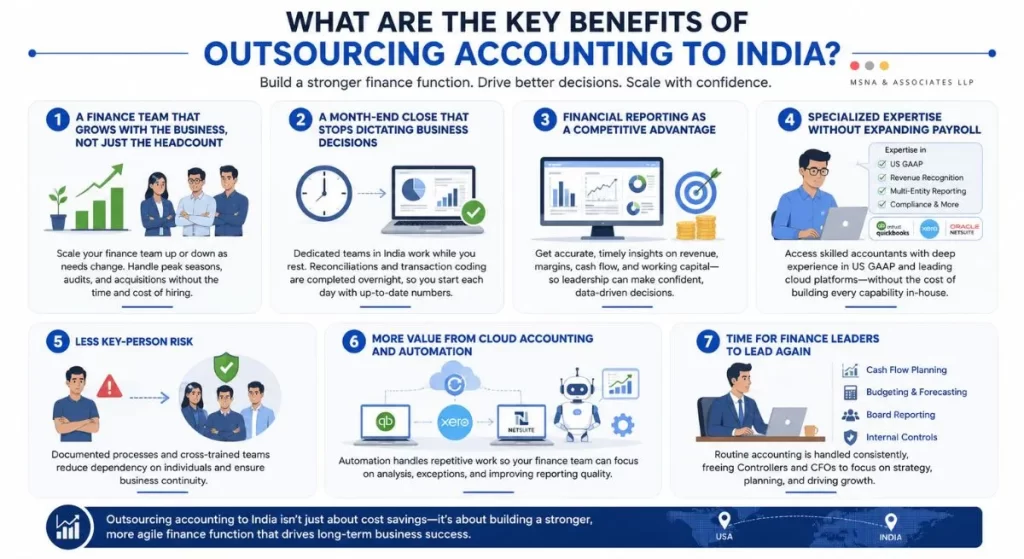
1. A Finance Team That Grows With the Business, Not Just the Headcount
Traditional hiring adds capacity one person at a time. Every new hire means going through a full recruiting and onboarding cycle, then carrying that salary on the books long-term, whether or not the work stays steady all year.
Outsourcing works differently.
A business gets a finance team that scales up or down as operational needs shift. Entering audit season or integrating an acquisition no longer means starting the hiring process from scratch. This allows finance capacity to expand alongside operational demand without disrupting reporting quality or internal workflows.
2. A Month-End Close That Stops Dictating Business Decisions
Every finance leader wants a faster close, but speed is not really the point. Accuracy, early enough to act on, is. When your team’s stuck reconciling half the month, leadership’s stuck reacting to old numbers the other half. Handing off accounts payable, accounts receivable, accruals, and journal entries to a dedicated team closes that gap and keeps your reporting steady, month after month.
The time zone gap helps here. Work handed off at the end of a US business day gets picked up as the India-based team’s day starts. So reconciliation and transaction coding are often done before the US side logs back in. The result is a finance function that starts each business day with reconciliations already progressing instead of waiting for the next shift to begin.
3. Financial Reporting as a Competitive Advantage
Many businesses have access to financial data. Far fewer have access to timely financial insight, and that gap matters more as a business grows. Strong accounting processes sharpen management reporting on revenue performance, operating margins, cash flow trends, and working capital. Departmental spend and budget variances matter too, just less. Whether leadership is evaluating an expansion or fielding questions from a lender, accounting should not just explain what happened last month. It should help decide what happens next.
4. Specialized Expertise Without Expanding Payroll
Growth adds complexity fast. Revenue recognition gets trickier, multi-entity structures bring new consolidation headaches, and regulations keep shifting under your feet. Hiring a specialist for every one of those disciplines just isn’t realistic for most mid-sized businesses.
But here’s the real advantage: it’s not about adding more accountants. It’s about tapping into specialists who’ve already solved these problems across dozens of industries and compliance environments. The right partner should have working depth in US GAAP, and fluency across QuickBooks, Xero, NetSuite, and other cloud platforms. That means you get support for new reporting requirements without having to build every capability in-house first.
5. Less Key-Person Risk
Many accounting departments run on institutional knowledge more than documented process. One senior accountant understands every reconciliation, one controller owns every deadline, and everything works until one of them resigns.
A well-managed outsourced model reduces that exposure through documented processes and cross-trained coverage rather than individual ownership. Business continuity improves because the knowledge lives in the process, not in one person’s head.
6. More Value From Cloud Accounting and Automation
Cloud platforms made financial data more accessible. But software does not fix a bad process on its own. Teams that get real value from cloud accounting platforms such as QuickBooks, Xero, or NetSuite pair the platform with clear workflows. An experienced outsourced team uses automation to take repetitive accounting work off the table. That frees up finance professionals to review financial risks and chase down exceptions, so reporting quality goes up instead of time going into manual admin work.
7. Time for Finance Leaders to Lead Again
Once routine accounting is handled consistently, finance leadership gets time back for higher-value work. Controllers and CFOs create the most value by helping the business make decisions, not clearing reconciliation backlogs after hours. But that’s what tends to happen as a company grows. When recurring accounting is handled elsewhere, that time goes back into cash flow planning, budgeting, board reporting, and internal controls.
What Accounting Functions Can Actually Be Outsourced?
- Accounts Payable
- Accounts Receivable
- Payroll
- Bookkeeping
- Financial Reporting
- Reconciliations
- Controller Support
- Virtual CFO Support
- Month-End Close
In-House vs. Outsourced Accounting: Which Model Fits?
You don’t have to go all in on outsourcing. Many organizations mix internal financial leadership with outsourced help to create something more flexible than either method alone.
| Area | In-House Accounting | Outsourced Accounting |
|---|---|---|
| Hiring | Recruit and onboard each employee individually | Add capacity without a new hiring cycle |
| Expertise | Limited to what the internal team has encountered | Exposure across industries and business scenarios |
| Business Continuity | Knowledge often resides with individual employees | Documented processes with shared team ownership |
| Flexibility | Capacity is directly tied to headcount | Resources scale up or down as business needs change |
| Technology | Depends on the team’s familiarity with accounting tools | Expertise across leading cloud accounting platforms |
| Reporting | Reporting may slow during peak workloads or staff absences | Dedicated support helps maintain timely and consistent reporting |
Is outsourcing accounting to India secure?
Security depends on governance, not geography. An outsourced team should work inside your own cloud accounting environment, under your own access permissions and audit trail, not a separate system you cannot see into.
Every action, who logged in, what they touched, and when, should be traceable back to your own platform, the same as it would be for an employee sitting down the hall. Role-based permissions, multi-factor authentication, segregation of duties, and audit logs are equally important safeguards that should exist regardless of where the accounting team is located.
The one credential worth asking for directly is SOC 2 compliance. If a provider has it and can produce the report on request, your data is protected to the same standard you would expect from any US-based vendor handling financial information. If they cannot produce it, or answer only in general reassurances, that is a fair reason to keep looking, regardless of how strong the rest of the pitch sounds.
Common Misconceptions About Outsourcing Accounting to India
“We’ll lose control of our books.”
This is not accurate in a properly structured engagement. The outsourced team works inside your own QuickBooks, Xero, or NetSuite file, using a login you assign and can revoke. Every entry they make is timestamped and attributed in your own audit trail, the same as an in-house employee’s would be. You retain full visibility and control of the file at all times.
“Offshore accountants don’t understand US compliance.”
This was more often true a decade ago, when offshore bookkeeping was viewed primarily as basic transaction processing adapted for whichever market needed it. It is less true today. Established providers train their teams specifically in US GAAP and staff them on US clients exclusively, rather than splitting the same team across multiple countries’ standards. This still varies by provider, so it is worth confirming directly rather than assuming.
“It’s just cheaper labour with lower quality.”
Cost is real and should not be dismissed, but treating it as the only factor misses the capacity argument above. Freeing up internal teams, not cost alone, is one of the most commonly cited motivations businesses cite for outsourcing accounting, which tracks with how constrained domestic hiring has become.
Why India: Comparing Outsourcing Destinations
These are general patterns, not guarantees. Outcomes on any engagement depend more on the individual provider’s process and staffing than on the country alone.
| Factor | India | Philippines | Eastern Europe |
|---|---|---|---|
| Time Zone Overlap with US | Limited live overlap; work handed off at the end of the US day is often completed by the next morning | Similar handoff model to India with limited live overlap | Greater overlap with US East Coast business hours |
| GAAP & Compliance Expertise | Large, established pool of accountants trained in US GAAP and compliance | Growing talent pool, historically stronger in BPO and customer support than finance-specific roles | Smaller US GAAP talent pool; generally stronger in bookkeeping and accounting support |
| English Proficiency | High, especially among finance and accounting professionals | High | Varies by country and service provider |
| Typical Specialization | Full-service accounting, controller support, CFO advisory, tax, and compliance | Transaction processing, accounts payable (AP), and accounts receivable (AR) | Bookkeeping, general ledger maintenance, and accounting support |
| Talent Pool Depth | Large and expanding, supported by increasing demand as the US CPA workforce declines | Moderate | Smaller compared to India and the Philippines |
What to Expect When Outsourcing Accounting to India ?
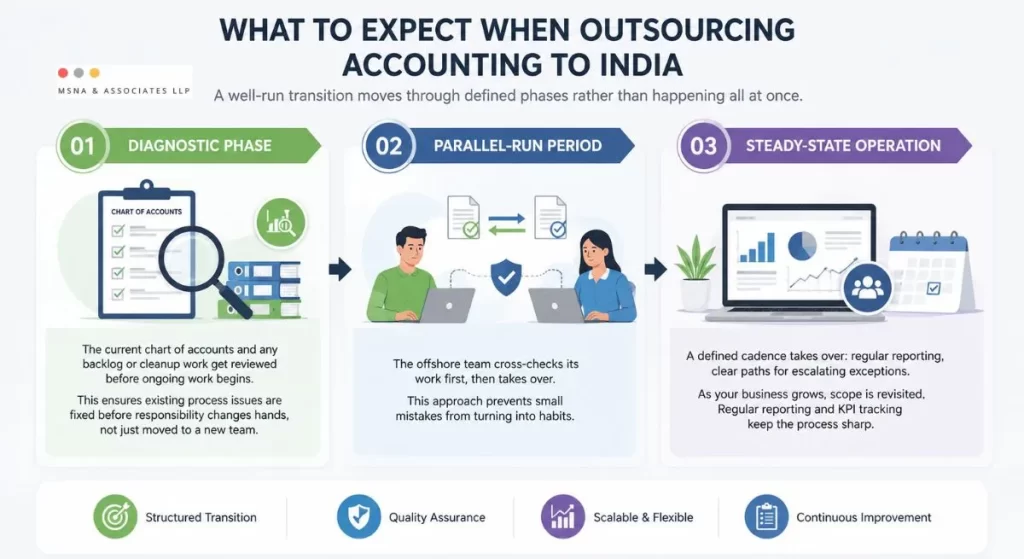
A well-run transition moves through defined phases rather than happening all at once.
- Diagnostic phase (typically 1–2 weeks): The current chart of accounts and any backlog or cleanup work get reviewed before ongoing work begins. Skipping this step is one of the most common reasons outsourcing engagements underperform, since it ensures existing process issues are fixed before responsibility changes hands, rather than simply moving the same problems to a new team.
- Parallel-run period (usually one full month-end cycle, roughly 2–4 weeks): The offshore team cross-checks its work first, then takes over. That way, small mistakes don’t turn into habits.
- Steady-state operation(from month two onward): After that, the work doesn’t stop. A defined cadence takes over: regular reporting, clear paths for escalating exceptions. If a company doubles headcount six months into the engagement, its scope should get revisited. It shouldn’t run on autopilot. Regular reporting and KPI tracking keep the process sharp.
Which business stages benefit most from outsourcing accounting to India?
Outsourcing tends to deliver the clearest value at specific inflection points rather than as a universal fit.
- Early-stage, freshly funded companies. Investors expect audit-ready reporting that a founder-led setup usually cannot produce on its own.
- Growth-stage companies scaling faster than they can hire. Transaction volume outpaces recruiting long before a new hire could realistically be onboarded.
- Companies already operating in India, or planning to. Centralizing support with a provider who understands both sides of that relationship is a natural efficiency play.
- Companies preparing for fundraising or acquisition due diligence. Diligence-grade reporting is a considerably higher bar than day-to-day bookkeeping.
The weaker fit is a business with highly specialized, judgment-heavy needs concentrated in one or two irreplaceable people, where the relationship itself, not the process, is the value being delivered.
Is Outsourcing Accounting to India Worth It?
The honest answer isn’t yes or no. It’s a question: is the real problem headcount, or is it the process itself?
If you just need one more pair of hands and everything else is working fine, outsourcing might just be a pricier way to fill a job opening. But that’s rarely the real situation by the time a finance leader starts asking this question. Usually the close has already slipped more than once. Or one person is the only one who knows how a certain reconciliation actually works. Or reports show up too late to matter for the decision they were supposed to support. None of those are headcount problems. They’re process problems. One more hire tends to buy about six months of relief before the same pressure comes right back.
Here’s the test: if hiring one more person would fix this for good, go hire that person. But if the honest answer is that your team would still be one resignation away from this same mess a year from now, outsourcing is solving a problem that hiring never could.
How to Evaluate an Accounting Outsourcing Partner ?
Choosing a partner takes more than comparing price sheets. MSNA is one of the providers offering dedicated outsourced accounting to US businesses, and the questions below are a useful way to evaluate any provider you’re considering.
How does the team support US GAAP reporting? Which platforms do they work in regularly? How are reconciliations reviewed before close, and what performance metrics do they actually track? How do they manage staff transitions without disrupting operations, and can they speak to SOC 2 or an equivalent standard in specifics rather than general terms? The quality of those answers usually says more about a provider than anything else.
Most outsourcing relationships that break down do so for the same reason: nothing was ever put in writing. A defined SLA turns vague expectations into commitments, close dates, reporting timelines, and deliverables that either hold or do not. Without one, there is nothing keeping the engagement accountable when it starts to slip. Asking to see a written SLA before signing is a smaller ask than it sounds, and a provider that resists putting one in writing is telling you something about how the engagement will actually run.
An initial conversation can help clarify whether outsourcing fits your situation. Questions about how a specific engagement would be structured can go to contact@msna.co.in or +91 9036727740.
Benefits of Outsourcing Accounting to India: Final Takeaways for US Businesses
The well-run finance organizations aren’t defined by where accounting work happens. They’re defined by how consistently they produce timely, accurate financial information that supports better business decisions. Accounting becomes a bottleneck well before leadership names it as one. The early signs are rarely a missed audit; they show up as delayed reporting and a finance team that cannot keep pace with what the business is asking of it. Companies that address that early tend to scale without rebuilding their finance function every eighteen months.
For US businesses weighing outsourcing against the cost of hiring into a shrinking talent pool, the benefits show up in stronger reporting, steadier operations, and a finance team built to grow.
Scale Your Finance Function With Skilled Outsourced Accounting
Related
Discover more from MSNA & Associates LLP
Subscribe to get the latest posts sent to your email.