
A finance manager was sure everything was under control. Payments were being made on time, reports looked fine, and nothing seemed out of place. Then an internal audit found that one supplier had been paid twice for the same invoices over several months. No one had noticed it because only a few transactions had been checked. The rest were never looked at.
This is one of the biggest reasons why data analytics in internal audit is becoming so important. There are many transactions that go on in a company every single day that can no longer be examined by manual examination.
Data analytics can be used to examine the entire data set, not just samples. This will enable them to identify anomalies, mitigate risk and be more effective in their work.
In this blog we will look at how the use of data analytics can allow them to spot risks, conduct audits efficiently, learn fraud detection analytics, and make firms embrace data analytics in their internal auditing system.
What Is Data Analytics in Internal Audit?
In simple terms, data analytics in internal audit is the application of tools and procedures to examine corporate data and detect risks, errors or control weaknesses. Rather than manually go through spreadsheets or reports, auditors rely on tools to quickly evaluate huge amounts of data.
For example, if a corporation handles thousands of purchase transactions a year it would be impossible to check each one manually. Analytics allow auditors to look at all transactions at once, flag anything strange, and focus just on areas that need attention.
Traditional Auditing vs. Data-Driven Auditing
Audit has used sampling for years. Auditors would look at a sample of transactions and draw conclusions about the system. This strategy may cover some scenarios, however issues outside the sample may be missed. This is where data-driven auditing comes in.
Auditors can now see all the data sets, rather than just one transaction at a time, to find errors in the organization.
| Traditional Auditing | Data-Driven Auditing |
|---|---|
| Reviews sample transactions | Reviews complete datasets |
| Periodic audits | Continuous monitoring |
| Manual testing | Automated analysis |
| Reactive approach | Proactive risk identification |
| Higher chance of missing issues | Better visibility into unusual activities |
The Four Types of Analytics Used in Internal Audits
Different types of analytics serve different purposes during an audit.
1. Descriptive analysis
Descriptive analytics addresses what has transpired. It summarizes historical data such as spending, payments or inventory movements.
2. Diagnostic Analytics
Diagnostic analytics is the why of what happened. For example, if costs grow unexpectedly, it’s useful to determine the reasons for the increase, such as duplicate invoices, price adjustments or missing approvals.
3. Predictive Analytics
Predictive analytics examines past data to recognize trends that could forecast future risk. If you keep having the same difficulties, it can show you what you need to fix in the future.
4. Prescriptive Analytics
Prescriptive analytics suggests potential actions. If you wish to reduce risk then it may advise that you enhance the approval process, strengthen controls or add extra checks.
Why Data Analytics in Internal Audit Has Become Essential in 2026?
1.Rising Volumes of Business Data
Most businesses use ERP, cloud accounting, and digital payment systems. Every day, these devices make a lot of data.
It would be very time-consuming to look at this data manually without analytics. Analytics can be used by auditors to quickly and correctly review very large data sets.
2. A Profession Under Resource Pressure
According to the 2026 North American Pulse of Internal Audit report, published by The Institute of Internal Auditors (IIA) and the Internal Audit Foundation, the share of internal audit functions reporting budget cuts rose from 11% to 19% between 2024 and 2025, while those reporting staff cuts climbed from 11% to 18% over the same period. Functions that stayed closely aligned with organizational strategy were 30 percentage points more likely to be adequately funded than those that were not.
This “do more with less” reality is precisely why data analytics for auditors matters more than ever; it lets a smaller audit team cover 100% of transactions instead of a 5-10% sample, without adding headcount.
3. The IIA’s 2024 Global Internal Audit Standards Now Mandate Technology Use
The 2024 Global Internal Audit Standards (GIAS), which became effective for quality assessments from January 2025, explicitly require Chief Audit Executives (CAEs) to implement a technology strategy for their audit functions. Under Standard 10.3, Technological Resources, the CAE must ensure the team has tools to “improve effectiveness and efficiency”, including data analytics and AI. This is no longer a recommendation; it is a mandatory requirement.
4. Increasing Regulatory and Compliance Requirements
Laws related to financial reporting, taxes, data security, among others, which are relevant for the industry they operate in, must be complied with by businesses. Data analytics makes the tracking of activities and the detection of violations very easy.
5.Growing Need for Real-Time Risk Visibility
Risks do not wait for the audit cycle. Things like fraud, double payments or a breach of policy might happen at any time. Continuous data analysis helps auditors to detect suspicious activity earlier and alert the management team before issues escalate.
6. Demand for Faster and More Accurate Audits
Sometimes you can’t wait weeks for audit results. Audit analytics tools help auditors to automate routine tasks, reduce manual work, and deliver more accurate results in less time.
How Data Analytics in Internal Audit Improves Risk Detection?
The auditors can now review complete datasets instead of sample sets. This can assist you to discover odd transactions and trends earlier.
1. Identifying Anomalies and Unusual Transactions
Every business has the odd transaction, but a pattern of unexpected transactions can mean there are bigger issues. Analytics can be used to identify:
- Duplicate payments.
- Transactions outside normal business hours.
- Payments outside approved limits.
- Weird vendor behavior.
- Unplanned inventory movements.
2. Detecting Control Weaknesses Earlier
Data analytics can be used by auditors to check that regulations are being followed accurately each time or not. For example, it can show the missing approvals or tasks that are not well split.
3. Strengthening Compliance Monitoring
Organizations are now able to track transactions on a continual basis instead of just evaluating transactions during regular audits. This will enable policy violation detection.
4. Enabling Continuous Risk Monitoring
With data analytics, monitoring is an ongoing activity year-round. This helps firms to respond to the risks when they happen, instead of waiting for the next audit cycle.
5. Predicting Emerging Risks Before They Escalate
Looking at past trends can often show risk in the future. Analytics can flag these trends at an early stage, for example, if payments to a single supplier increase abnormally or duplicate transactions start to show up. Auditors can then determine if the issue is caused by process gaps, system issues or something more significant.
Most Indian SMEs and growth-stage companies we work with already generate the data they need to catch issues like duplicate payments; the gap isn’t data, it’s that nobody is querying it continuously. Even a simple monthly Vlookup-based duplicate-invoice check across vendor master and payment ledgers catches more fraud than a quarterly sample review ever will.
Practical starting point: before investing in expensive analytics software, run basic duplicate-payment and Benford’s Law tests on your existing ERP export. It costs nothing and often surfaces the first red flag within a day.
How Data Analytics in Internal Audit Improves Audit Efficiency?
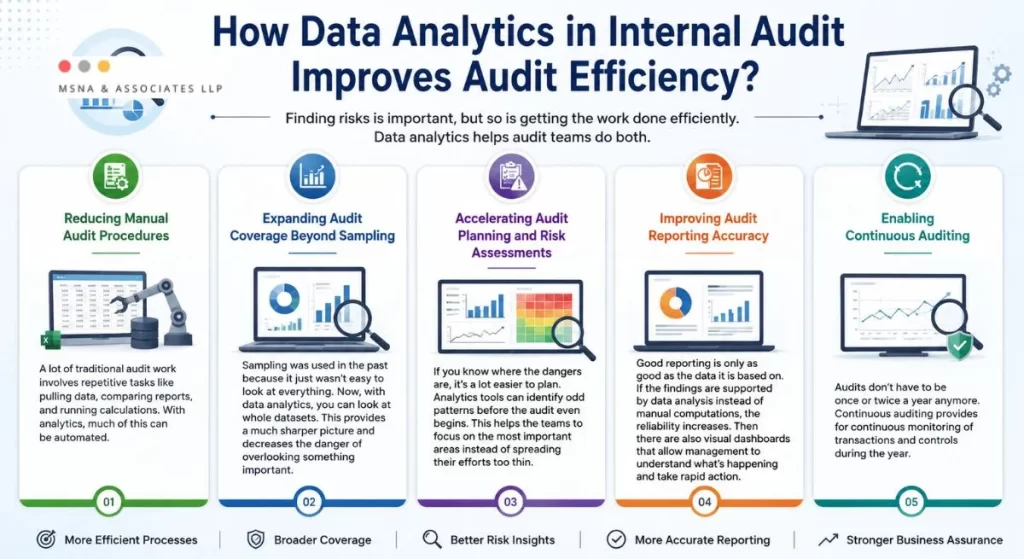
Finding risks is important, but so is getting the work done efficiently. Data analytics helps audit teams do both.
1. Reducing Manual Audit Procedures
A lot of traditional audit work involves repetitive tasks like pulling data, comparing reports, and running calculations. With analytics, much of this can be automated.
2. Expanding Audit Coverage Beyond Sampling
Sampling was used in the past because it just wasn’t easy to look at everything. Now, with data analytics, you can look at whole datasets. This provides a much sharper picture and decreases the danger of overlooking something important.
3. Accelerating Audit Planning and Risk Assessments
If you know where the dangers are, it’s a lot easier to plan. Analytics tools can identify odd patterns before the audit even begins. This helps the teams to focus on the most important areas instead of spreading their efforts too thin.
4. Improving Audit Reporting Accuracy
Good reporting is only as good as the data it is based on. If the findings are supported by data analysis instead of manual computations, the reliability increases. Then there are also visual dashboards that allow management to understand what’s happening and take rapid action.
5. Enabling Continuous Auditing
Audits don’t have to be once or twice a year anymore. Continuous auditing provides for continuous monitoring of transactions and controls during the year.
How Audit Automation Tools Improve Internal Audit Efficiency ?
Technology has changed the way audit teams work. Instead of spending hours gathering and organising information, auditors can now rely on audit automation tools to handle much of the routine work. Some of the key benefits include:
- Data collection through automation: The system is capable of collecting data even without any intervention from any user.
- Automatic audit testing: Testing through reconciliations and control checking will take place in a much faster way.
- Continuous monitoring: Continuous monitoring of controls, which is possible through automation.
- Workflow automation: systematic planning, documentation and approval.
- Transparency of dashboard: The management can get to know about the audit results easily.
Tools like ACL Analytics (Galvanise) and IDEA are commonly used for checking financial data, while Power BI and Tableau help with the visual reporting. Data preparation tasks require using Alteryx. In general, it all depends on the needs of the organisation and on the complexity of their data.
By leveraging automation and advanced analytics, an Internal Audit Firm in Bangalore can help businesses expand audit coverage while reducing manual effort and audit timelines
The Growing Role of AI in Auditing
Artificial intelligence is becoming more common in auditing, but it’s best seen as something that supports auditors rather than replaces them.
While data analytics helps to find trends, AI in auditing can take it one step further by learning from past data and identifying advanced abnormalities.
For example, machine learning algorithms can identify transactions that are not consistent with usual patterns, so auditors can target higher-risk areas. AI can also help to cut down on noise by ignoring transactions that really aren’t a worry.
The technology can also be used to review documents. AI will be able to read contracts, policies and communications faster than a human can, making it easier to identify any gaps or compliance issues.
AI can also be used for the prediction of risk. AI will study previous information from audits and operations to point out where risk is likely to develop in the future.
But still, we need human judgment, with all this. Auditors are to understand the facts and determine actions.
Further reading: The IIA released a dedicated Global Practice Guide on Data Analytics Skills for Internal Auditors in May 2026, a valuable resource for any audit function looking to build capability in this area.
The 5-Step Data Analytics Maturity Model for Internal Audit
Most organisations do not jump straight from manual audits to AI-powered continuous monitoring. Audit analytics capability develops in stages. Here is a practical five-level maturity model:
| Level | Stage | What It Looks Like |
|---|---|---|
| 1 | Ad Hoc | Excel-based testing; no formal analytics process. |
| 2 | Repeatable | Defined scripts for common tests (duplicates, Benford’s Law) run each audit cycle. |
| 3 | Defined | Audit planning using embedded analytics tools (ACL, IDEA). |
| 4 | Managed | Continuous monitoring of dashboards; automated alerts of control exceptions. |
| 5 | Optimised | AI/ML models predict risk; audit plans are dynamically adjusted based on live data. |
Real-World Applications of Data Analytics in Internal Audit
Data analytics is used across many types of audits.
- Financial auditing is needed to check transactions and detect irregular transactions.
- Operational audits helps to identify any inefficiencies and provide potential for improvement.
- During compliance auditing, it ensures that policies are followed.
- It is especially helpful in conducting IT and cybersecurity audits as it is able to detect any abnormal system activity.
- Risk analytics can be used by organizations to conduct analysis on their third parties, such as suppliers.
Audit Technology Trends Reshaping Internal Audits
Technology is changing and so is internal audit. More companies are going to continuous auditing where risks are checked on an ongoing basis rather than at defined times.
- AI and machine learning are helping auditors focus on what matters most, while process mining gives a clearer picture of how processes actually work in practice.
- Cloud-based systems are making it easier for teams to work together, especially when they are located in various parts of the world. Dashboards are also increasing communication of audit findings to management.
- Another key change is the adoption of integrated Governance, Risk and Compliance (GRC) systems which put everything together in one place.
All of these audit technology trends are helping internal audit move from simply reacting to issues to actively preventing them.
Building Stronger Data Analytics in Internal Audit with MSNA
Internal audit has come a long way, and has a long way to go. The main challenge today is not data collection. It’s knowing what to do with it. This is where data analytics in internal audit really comes into its own. It enables auditors to identify risks earlier, understand what is going on across the firm and spend less time looking for problems. So the end result is a better, more focused audit process.
If you want to build up your internal audit department, Firms such as MSNA can help you develop practical audit processes that are right for your organization, and not merely a checklist-based thing.
Transform Your Internal Audit with Data Analytics
Related
Discover more from MSNA & Associates LLP
Subscribe to get the latest posts sent to your email.