


The cost to set up a GCC in India is what a foreign parent spends, once and every year after, on entity formation, office space, hiring, technology, compliance and finance for its Global Capability Center. In 2026, that cost starts near $150,000 for a lean team of 10 to 25 people and can pass $2 million in Year 1 for a centre of 75 to 150 people.
After launch, GCC operating costs in India run $25,000 to $80,000 per employee a year, fully loaded, which is roughly 55% to 85% below the $180,000-plus fully loaded cost of a comparable US engineer.
This guide is written for CFOs, COOs, and global expansion teams at US and UAE companies planning a GCC investment under Indian law. It explains the cost of Global Capability Center setups by team size, city, and entry model. It also gives a practical India GCC budget with 2026 benchmarks for setup expenses, employee cost, office cost, technology cost, compliance cost, and ongoing operating expenditure.
Key Takeaways on the Cost to Set Up GCC in India
- Size drives cost: Year 1 runs $150K to $350K for a lean team and $2M+ at full scale.
- People lead the budget: load salaries 12% to 15% above gross and provide for attrition.
- Price office space at 2026 rents: The average rent transacted in Bengaluru exceeded ₹100 per sq ft per month in Q1 2026
- The entry model determines when each cost lands, and the city sets the rent and salary lines
- Budget feeds transfer pricing: under the 15.5% safe harbour, costs set the intercompany invoice.
- Include finance and compliance: these recurring lines belong in the budget from day one.
How Much Should You Budget for the Cost to Set Up GCC in India in 2026?
Year 1 cost depends mostly on headcount, so the table below starts there.
GCC size | Team | Year 1 all-in cost (USD) | Typical profile |
Lean | 10 to 25 | $150K to $350K | Pilot or single-function centre |
Growth | 25 to 75 | $350K to $900K | Multi-team centre with local leadership |
Full scale | 75 to 150+ | $900K to $2M+ | Several pods plus support functions |
Source: Colab91 2026 estimates, covering entity setup, workspace, initial hiring and technology.
(Year 1 figures assume phased hiring, with the team reaching stated headcount by months 9 to 12, so Year 1 salary spend is a fraction of the full-year run-rate.)
Four inputs set the total: headcount and seniority, city, function and entry model. Published estimates differ by source because each assumes a different hiring pace, city, and seniority mix.
Treat every range in this guide as a starting point for GCC budgeting. None of it is a quote.
What the Year 1 figure covers:
- Entity incorporation and legal setup expenses
- Office fit-out plus 12 months of rent and seat charges
- Recruitment and the first salary cycles
- Laptops, software and cloud technology cost
- Statutory compliance cost and accounting
Why Do 2026 Figures Matter for the Cost to Set Up GCC in India?
Rents and salaries in India’s major hubs have climbed as new GCCs bid for the same office space and engineers.
Metric (FY26E) | Figure |
GCCs in India | 2,117 |
GCC units | 3,728 |
Professionals employed | 2.36 million |
GCC revenue | $98.4 billion |
Share of new setups from North America | About two-thirds |
Sources: Nasscom-Zinnov, India GCC Landscape Report 2026 (The GCC Value Orbit), FY26E estimates, May 2026.
Office demand tells the same story. GCCs drove a record 14.4 million sq ft of leasing in Q1 2026, which was 48% of all office take-up in the eight major cities, according to Knight Frank. Knight Frank put GCC leasing at 20.6 million sq ft across the eight cities in H1 2026.
What Are the Main Components of GCC Setup Cost in India?
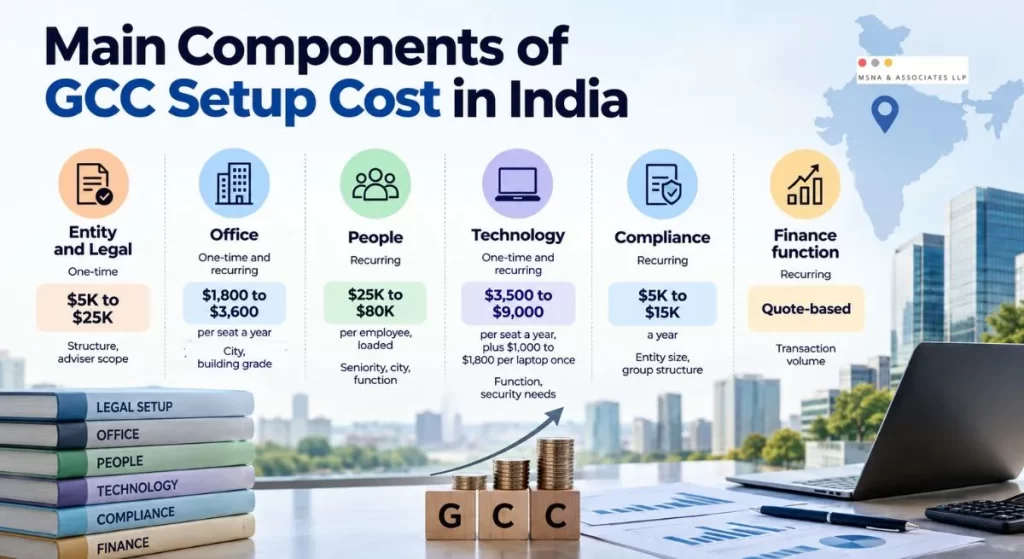
Six cost layers drive the total, and each behaves differently over time.
Layer | Nature | 2026 benchmark | Main driver |
Entity and legal | One-time | $5K to $25K | Structure, adviser scope |
Office | One-time and recurring | $1,800 to $3,600 per seat a year | City, building grade |
People | Recurring | $25K to $80K per employee, loaded | Seniority, city, function |
Technology | One-time and recurring | $3,500 to $9,000 per seat a year, plus $1,000 to $1,800 per laptop once | Function, security needs |
Compliance | Recurring | $5K to $15K a year | Entity size, group structure |
Finance function | Recurring | Quote-based | Transaction volume |
The next sections take each layer in turn.
Entity Setup Expenses
Entity setup expenses are small compared with people and office, yet they set the tone for everything after.
- Published estimates run from $5,000 to $25,000, depending on adviser scope.
- Most foreign parents form a wholly owned subsidiary in India. Subsidiary and LLP incorporation typically takes 3 to 6 weeks through the MCA portal.
- Budget for apostilled parent documents, bank account activation and at least one India-resident director, as Section 149(3) of the Companies Act, 2013 requires.
- The Indian company reports each inward remittance on the RBI FIRMS portal within 30 days of receipt. It allots shares within 60 days of receipt and files Form FC-GPR within 30 days of allotment, under the FEMA (Non-Debt Instruments) Rules, 2019.
Office Cost
Office cost is a significant line for most centres, and 2026 rents have moved.
- Grade A space costs $1,800 to $3,600 per seat a year, against $8,000 to $15,000 in the US.
- Managed or co-working seats run $2,400 to $4,800 per seat a year, and fit-out adds $800 to $1,500 per seat once.
- Bengaluru’s average transacted rent crossed ₹100 per sq ft a month for the first time in Q1 2026, at ₹100.6. Mumbai was already at ₹118 in Q1 2025 (Source: Knight Frank India Real Estate, Q1 2026 and Q1 2025).
- Compare managed-seat quotes with bare-shell per sq ft rates carefully, because they include different things.
Employee Cost
Employee cost is the largest part of GCC operating cost India, and the offer letter understates it.
Statutory component | Employer rate | Basis |
Provident Fund (EPF) | 12% | Basic plus DA, mandatory on the first ₹15,000 |
Gratuity provision | 4.81% | Basic plus DA |
ESI | 3.25% | Only for pay up to ₹21,000 a month |
Statutory bonus | Minimum 8.33% | Eligible employees |
Source: Astravise.
- Statutory on-costs add roughly 12% to 15% above gross pay before health insurance and allowances.
- Global pay structures often use a low basic and a high allowance stack. Under the Code on Wages, which came into effect on 21 November 2025, allowances above 50% of total pay can be treated as wages, which raises the PF and gratuity base.
- Add a replacement provision for attrition, since GCCs in the same city compete for the same senior engineers.
- Fully loaded cost per engineer runs $25,000 to $80,000 a year, against $180,000 or more in the US.
Technology Cost
Technology cost scales per seat, which makes it easy to forecast once headcount is fixed.
- Laptop and peripherals: $1,000 to $1,800 per person, one time
- Software licences: $2,000 to $5,000 per person a year
- Cloud infrastructure: $1,500 to $4,000 per person a year
Source: Neointelli GCC cost benchmarks. Engineering and AI centres sit at the top of these ranges.
Compliance Cost
Compliance costs recur every year and grow with entity complexity.
- Licences and statutory filings are benchmarked at $5,000 to $15,000 a year.
- Typical items include Registrar of Companies filings, statutory audit, GST, TDS, PF and ESI returns, and FEMA reporting.
- Transfer pricing documentation adds a separate line, covered in the section on intercompany recharges below.
- Strong internal controls reduce audit friction later. Our ICFR audit checklist shows what auditors test, and the scope of an internal audit helps you plan that cost early.
Finance Function Cost
Finance cost sits alongside people and office from day one, because every GCC needs bookkeeping, payroll, tax and reporting.
- Monthly accounting, payroll processing and GST compliance
- Management reporting in the parent’s currency and calendar
- Statutory audit coordination and board secretarial support
Many centres begin with outsourced accounting and add virtual CFO services until headcount justifies an in-house finance team. Costs here are quote-based and depend on transaction volume.
How Much Does a GCC Cost to Operate in India After Year 1?
Operating expenditure shifts from setup items to people and rent once the centre is running.
Stage | Dominant cost | What to watch |
Year 0 (pre-launch) | Entity, legal, recruiter fees | Approvals and apostille timing |
Year 1 | Fit-out, laptops, first hires | Cost per employee while headcount is small |
Year 2 and beyond | Salaries, rent, licences | Attrition, annual increments, rent escalation |
Two patterns matter for finance teams:
- Fixed cost per employee stays high until a centre passes roughly 30 to 50 people, because leadership, finance and facilities are shared across a small base.
- One benchmark estimates total-cost savings of 60% to 70% against the US from Year 2, after a Year 1 cost near 40% to 50% of a US equivalent. This is a whole-centre figure and is not comparable to the per-employee range above.
How Does the Entry Model Change the Cost to Set Up GCC in India?
The entry model sets when each cost lands.
Model | Speed to start | Setup cost | Trade-off |
Own subsidiary (captive) | 3 to 6 months | $0.5M to $3M in Year 1 | Full compliance stack sits with you |
Build-operate-transfer | 2 to 4 months | $0.3M to $1M | Vendor margin until transfer |
Managed GCC | 2 to 6 weeks | $200K to $800K | Lower control, higher cost at scale |
Employer of record | Days | About $99 per employee a month | Suits small trials only |
Sources: Calcguru and Wisemonk. The captive Year 1 range is wider than the tier table above because it includes leadership hires, the full compliance stack and larger starting teams.
A lean first step can also work well. Our guide to micro GCC setup in India explains how small teams test the model before committing to a full captive.
How Does City Choice Affect the Cost to Set Up GCC in India?
City choice affects both rent and salary, and the two do not move together.
City | Average transacted office rent growth, Q1 2026 (year on year) |
NCR | 15% |
Kolkata | 15% |
Hyderabad | 8% |
Chennai | 8% |
Bengaluru | 7% |
Mumbai | 6% |
Source: Knight Frank India Real Estate, Office and Residential Market, Q1 2026.
- Bengaluru captured 41% of GCC leasing in the quarter, so competition for space and talent is intense.
- Tier-2 cities run roughly 10% to 35% below Tier-1 rents, according to JLL
- Tier-2 saves the most for large, junior-weighted, stable teams. The saving shrinks when the first hires are senior, because senior pay gaps are closing.
- State incentives such as rent reimbursement and capex subsidies are negotiated before the lease is signed. Karnataka, Maharashtra and Gujarat each run a dedicated GCC policy, and terms differ by state. Confirm current terms on each state’s notification.
What Does the Cost to Set Up GCC in India Look Like for 50 Seats?
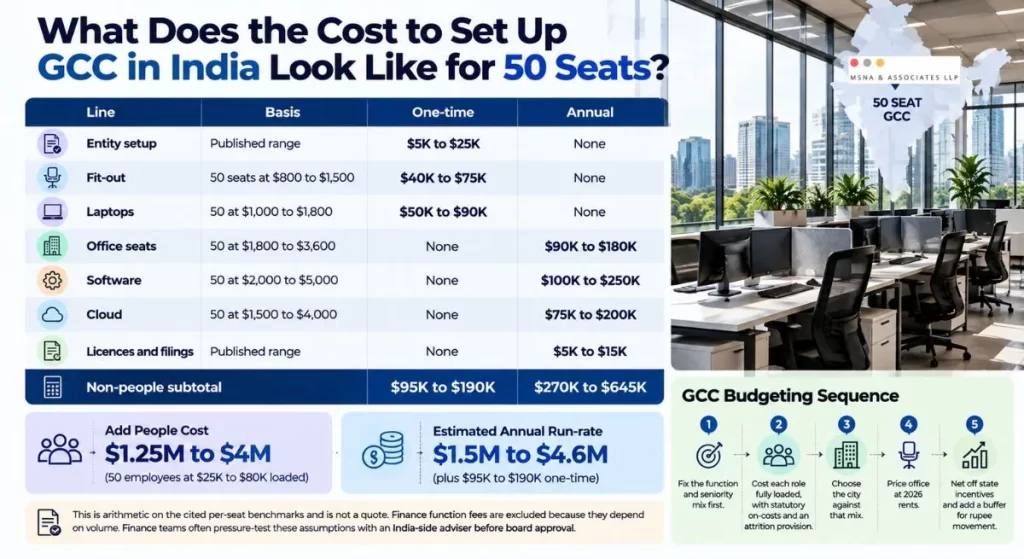
The table below applies the per-seat benchmarks above to a 50-seat centre, excluding people cost.
Line | Basis | One-time | Annual |
Entity setup | Published range | $5K to $25K | None |
Fit-out | 50 seats at $800 to $1,500 | $40K to $75K | None |
Laptops | 50 at $1,000 to $1,800 | $50K to $90K | None |
Office seats | 50 at $1,800 to $3,600 | None | $90K to $180K |
Software | 50 at $2,000 to $5,000 | None | $100K to $250K |
Cloud | 50 at $1,500 to $4,000 | None | $75K to $200K |
Licences and filings | Published range | None | $5K to $15K |
Non-people subtotal | $95K to $190K | $270K to $645K |
This is arithmetic on the cited per-seat benchmarks and is not a quote. Finance function fees are excluded because they depend on volume. Adding people cost of $1.25M to $4M (50 employees at $25K to $80K loaded) puts the annual run-rate for a 50-seat centre near $1.5M to $4.6M, plus $95K to $190K one-time. Finance teams often pressure-test these assumptions with an India-side adviser before board approval.
Add people cost from a current role-level salary survey. Then follow this GCC budgeting sequence:
- Fix the function and seniority mix first.
- Cost each role fully loaded, with statutory on-costs and an attrition provision.
- Choose the city against that mix.
- Price office at 2026 rents.
- Net off state incentives and add a buffer for rupee movement.
How Does Your GCC Cost Base Feed the Intercompany Charge?
In a captive model, your cost base also becomes your intercompany invoice.
A captive serves its foreign parent on a cost-plus basis. From 1 April 2026, the Union Budget 2026-27 changes set a uniform 15.5% safe harbour margin on operating expenses for information technology services. The category covers software development, ITES, KPO and software-related contract R&D. The revenue threshold rose from ₹300 crore to ₹2,000 crore. Approval is automated and an election runs for five consecutive tax years.
For budget owners, this has three practical effects:
- Every dollar of operating expenditure feeds the amount the Indian entity charges the parent, so budget errors flow into transfer pricing.
- The margin applies to operating expenses, so classification of costs matters.
- Safe harbour suits low-risk service centres. A centre that takes on product ownership may need a different approach, such as an advance pricing agreement.
Worked example: a 50-person centre
Line | Assumption | Annual amount (USD) |
Gross payroll | 50 employees at an average of $35,000 | $1,750,000 |
Statutory on-costs | 13%, the midpoint of the 12% to 15% range above | $227,500 |
Loaded people cost | About $39,550 per employee | $1,977,500 |
Non-people running costs | Office seats, software, cloud, licences and filings (within the $270K to $645K range above) | $400,000 |
Operating expenses | $2,377,500 | |
Safe harbour markup | 15.5% of operating expenses | $368,513 |
Intercompany invoice to parent | About $2.75 million |
This is an illustration using assumed figures, not a quote or advice. It excludes one-time items such as fit-out and laptops, whose treatment depends on how they are capitalised. A 10% error in the operating cost budget moves the annual invoice by roughly $275,000, which is why cost classification and budget accuracy matter.
Our transfer pricing compliance work covers the India side of this analysis. Treatment in the US or UAE should be reviewed with your home-country advisers, since MSNA works on the India side only.
What Do CFOs Get Wrong About the Cost to Set Up GCC in India?
Budget gaps come from missing cost lines.
“Budgets that stop at the first hire leave out the recurring lines. A GCC is a multi-year commitment, so finance, compliance and transfer pricing deserve the same attention as salaries and rent.”
CA Naveen S N, Co-Founder, MSNA & Associates LLP
Common budgeting mistakes:
- Using CTC as employee cost and ignoring statutory on-costs
- Applying 2021 rent assumptions to a 2026 lease
- Leaving out finance, audit and transfer pricing lines
- Treating a headline range as a plan for a specific function
- Ignoring the cost of attrition in a competitive hiring market
How Can You Plan Your India GCC Budget Before Board Approval?
A structured review of your assumptions can help finance teams test an India GCC budget before board approval. MSNA & Associates LLP, a Bangalore-based CA firm, supports India-side entity setup, accounting, compliance and transfer pricing for US and UAE parent companies.
You can explore our company setup in India, accounting and virtual CFO and transfer pricing compliance services, or start with a conversation about setting up a company in India from the USA or UAE.
Plan Your India GCC Budget with Confidence
Frequently Asked Questions About the Cost to Set Up GCC in India
What will be the minimum cost to set up GCC in India?
A lean GCC of 10 to 25 people typically costs about $150,000 to $350,000 in Year 1 in 2026, depending on seniority mix, city and hiring pace.
How long does it take to set up the legal entity?
Subsidiary and LLP incorporation takes 3 to 6 weeks through MCA. Hiring, office and banking run in parallel.
Is the India GCC budget the same for US and UAE parents?
India-side costs are the same. Reporting currency, group policies and home-country tax treatment differ, so confirm those with your own advisers.
What is the cost per employee in a GCC in India?
A fully loaded GCC employee in India costs $25,000 to $80,000 a year, against $180,000 or more in the US. Seniority, city and function set the position in that range.
Does transfer pricing affect GCC cost?
Transfer pricing sets the margin and documentation attached to your costs. The costs stay the same. Budget for it from the first year.
Related
Discover more from MSNA & Associates LLP
Subscribe to get the latest posts sent to your email.