
A micro GCC set up in India means launching a captive team of 5 to 50 people for one or two functions, then scaling only when three of six measurable triggers hold for two consecutive quarters. It suits CFOs, COOs and strategy heads at US and UAE companies who want India’s talent without a 300-seat commitment.
This guide covers entry routes, FEMA and tax compliance under Indian law, costs and the scaling triggers. Unlike a vendor-run centre, the team is yours, so you prove talent, delivery and compliance before you expand.
Note for UAE readers: GCC here means Global Capability Centre, not the Gulf Cooperation Council.
Key Takeaways on Micro GCC Setup in India
Treat a micro centre as a 24-month test with clear gates, not a smaller copy of a large build.
- Start with one function and 10 to 30 people (5 to 30 at launch).
- Choose your entry route (EOR, managed, or subsidiary) before the first hire.
- Entity, FEMA, tax, and payroll rules apply at any size.
- As announced in Budget 2026-27, IT services transfer pricing moves to one category with a 15.5% margin on operating cost and a five-year option.
- Scale only when three of six triggers hold for two quarters.
Why Micro GCC Set Up in India Is Gaining Ground in 2026?
As of 2025, mid-market centres made up 27% of the India GCC ecosystem, so a 20-person team is no longer an outlier.
Metric | 2026 figure | Source |
GCCs in India (FY26) | 2,117 | |
GCC workforce | About 2.36 million | |
GCC revenue | About $98.4 billion | |
Mid-market GCCs | 480+ centres, 210,000+ staff | |
Centres under 50 people | About 25% (A&M’s own 2025 count, a different base from the 2,117 total) | |
AI/ML talent in GCCs | Projected to reach about 250,000 by 2026 | |
Pay premium over IT services | 15% to 22% |
What Is a Micro GCC in India?
The defining test is ownership: staff in a micro centre work only for you, and techUK describes these small teams as a way to reach India’s talent without a large upfront commitment.
Feature | Typical micro GCC |
Headcount at launch | 5 to 30 |
Scope | 1 to 2 functions |
Legal home | Subsidiary, or an EOR or managed bridge first |
Location | One city |
Governance | Direct line to a global function head |
New to the model? Our primer on what a Global Capability Centre is covers the basics.
GCC vs Micro GCC: Which Model Fits Your Stage?
The sharpest difference is reversibility: a lease and a leadership layer are hard to unwind, while a 15-person pod can be paused within a quarter.
Factor | Full-scale GCC | Micro GCC |
Year-1 headcount | 100 to 500+ | 5 to 50 |
Functions at launch | Several | One or two |
Upfront commitment | High | Low |
Leadership | India head plus site leads | One lead |
Governance | Steering committee | Monthly review |
Reversibility | Hard | Easier |
- Choose a full GCC if you need 100+ people within 18 months. See our guide to GCC setup in India for large enterprises.
- Choose a micro GCC if you are unsure how teams will perform and want to protect cash.
Which Functions Suit a Micro GCC Set Up in India?
Pick work with a measurable output and a named owner at headquarters, because a 10-person team cannot absorb ambiguity.
Function | Why it works at small scale |
Software engineering and QA | Clear, measurable outputs |
Data engineering and analytics | Small expert teams deliver fast |
Cloud, DevOps, and IT operations | Coverage across time zones |
Finance operations | Process-driven and predictable |
Cybersecurity monitoring | Specialist skills, follow-the-sun cover |
Weaker fits: open-ended R&D without a sponsor, and work needing daily on-site collaboration
When Is a Micro GCC the Wrong Choice?
A micro GCC suits teams with a named function and a named headquarters owner, and it is a poor fit in these situations:
- You need 100 or more people within 18 months. A full GCC fits better.
- The work needs daily on-site collaboration.
- No board sponsor or headquarters owner exists.
- Your security and data policy cannot travel abroad.
Entry Routes for Micro GCC Set Up in India
Most small teams do not start with a subsidiary, and many convert later, so agree conversion terms before the first hire.
Route | How it works | Suits you if |
Employer of Record (EOR) | A local partner employs the team | You want to hire fast and defer the entity |
Managed or build-operate-transfer | A provider runs the centre, then hands it over | You want early operational support |
Own subsidiary | You incorporate and run it | You want full control from day one |
Edge case: converting from an EOR to a subsidiary. Moving the team from an EOR to your own subsidiary is the point where three separate Indian regimes apply together
- FEMA reporting. Capital remitted into the new subsidiary is foreign direct investment, and FC-GPR must be filed within 30 days of share allotment.
- Payroll and statutory registrations. The subsidiary needs its own PAN, TAN, PF, ESI and professional tax registrations before it can pay the transferred team. Agree employee transfer terms and service continuity in the EOR contract.
- Transfer pricing. Once the subsidiary bills the parent, related-party documentation applies from that point.
What Is the Process to Set Up a Micro GCC in India?
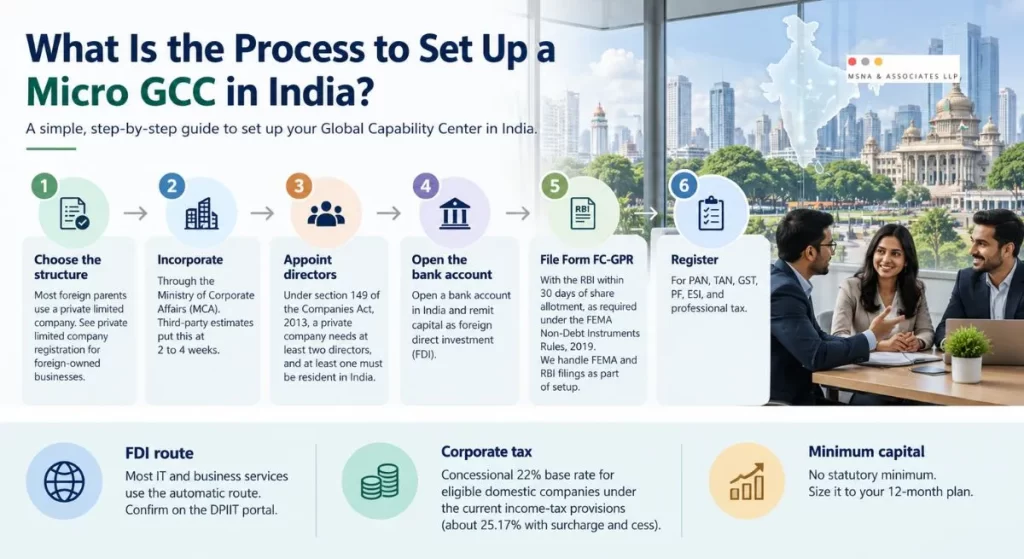
Foreign capital must be reported to the RBI within 30 days of share allotment, which makes that the first date to diarise in any GCC setup process.
- Choose the structure. Most foreign parents use a private limited company. See private limited company registration for foreign-owned businesses.
- Incorporate through the Ministry of Corporate Affairs. Third-party estimates put this at 2 to 4 weeks.
- Appoint directors. Under section 149 of the Companies Act, 2013, a private company needs at least two directors, and at least one must be resident in India.
- Open the bank account and remit capital as foreign direct investment.
- File Form FC-GPR with the RBI within 30 days of share allotment, as required under the FEMA Non-Debt Instruments Rules, 2019. We handle FEMA and RBI filings as part of setup.
- Register for PAN, TAN, GST, PF, ESI, and professional tax.
Topic | What to know |
FDI route | Most IT and business services use the automatic route. Confirm on the DPIIT portal. |
Corporate tax | Concessional 22% base rate for eligible domestic companies under the current income-tax provisions (about 25.17% with surcharge and cess) |
Minimum capital | No statutory minimum. Size it to your 12-month plan. |
How Do You Build the First 10 to 30 Hires?
Your first hire should be the India lead, because every later hire inherits their standards and network.
City type | Pros | Watch-outs |
Bengaluru | Deepest pool | Highest competition and attrition |
Hyderabad and Pune | Good depth, easier hiring | Smaller niche pools |
Emerging Tier-2 hubs | Lower cost | Thinner senior bench |
- Mix seniority: one lead, a few seniors, several mid-level hires.
- Budget for the premium: GCC pay runs 15% to 22% above IT services firms.
Plan the timeline. Allow roughly 2 to 3 months from lead hire to first pod hires, depending on role.
What Infrastructure and Technology Does a Micro GCC Need?
With 44% of office leasing done in GCCs during Q1 2026, a small group will get more out of managed space than from long-term leasing.
Layer | Lean approach |
Collaboration | Same tools as headquarters |
Identity and access | Single sign-on, role-based access |
Security | Managed endpoint protection, zero-trust principles |
Data protection | Align with the Digital Personal Data Protection Act, 2023 and its Rules |
Rule of thumb: if headquarters would not approve a tool, the India team should not use it.
What Compliance Applies to a 15-Person India Subsidiary?
A 15-person subsidiary files the same annual returns as a 1,500-person one, so build the compliance calendar before the first payroll run.
Area | What is typically required | Frequency |
Company law (Companies Act, 2013) | Annual return, financial statements, board meetings | Annual, quarterly |
Foreign investment (FEMA NDI Rules, 2019) | FC-GPR, annual FLA return | Event-based, annual |
Direct tax | Advance tax, TDS, annual return | Quarterly, annual |
GST | Returns and LUT. See GST on export of services. | Monthly or quarterly |
Transfer pricing (income-tax provisions) | Documentation and accountant’s report | Annual |
Labour and payroll | PF, ESI, professional tax, Labour Codes. See our payroll and statutory compliance support. | Monthly |
Data privacy (DPDP Act, 2023) | Consent, security, breach process | Ongoing |
How Does Budget 2026 – 2027 Change Transfer Pricing for a Micro GCC?
Captive centres usually bill the parent on a cost-plus basis, which is why the Budget 2026-27 changes matter.
What was announced
- Software development, ITES, KPO, and contract R&D are combined into one IT Services category.
- The common safe harbour margin announced is 15.5% on operating cost, not on revenue.
- The turnover threshold was raised from ₹300 crore to ₹2,000 crore, and the option can run five consecutive years.
What It Means for a Micro GCC
A micro centre sits well below the ₹2,000 crore threshold, so the practical gains are the single category, the margin, and the five-year option.
Safe harbour can cut dispute risk but fixes your margin. Model both routes and confirm eligibility and the opt-in procedure with your advisor, including transfer pricing documentation. Also review permanent establishment risk for the foreign parent.
For support, see our transfer pricing services and our breakdown of GCC setup
Operating Costs of Micro GCC Set Up in India
Payroll and the GCC pay premium usually outweigh rent, so model people costs first.
Cost head | Main driver | Lean lever |
Salaries and benefits | Seniority mix, city | Balanced team pyramid |
Workspace | Seats, city | Managed space |
Technology and security | Licences, devices | Reuse group contracts |
Entity and compliance | Filings, audits, payroll | One advisor for all |
Recruitment | Role difficulty | Employee referrals |
Transfer pricing margin | Cost base, tax route | Evaluate safe harbour |
techUK cites possible operating cost reductions of 40% to 70% for small centres, with break-even at 12 to 18 months for mid-sized centres. Treat both figures as directional.
For a line-by-line view, see our breakdown of GCC setup costs in India.
Phased Roadmap for Micro GCC Setup in India
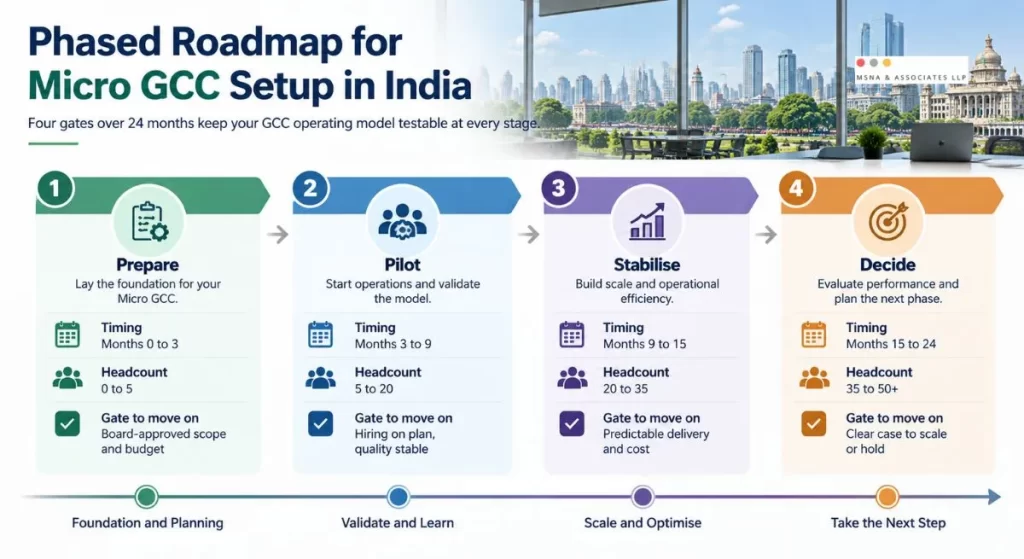
Four gates over 24 months keep your GCC operating model testable at every stage.
Phase | Timing | Headcount | Gate to move on |
Prepare | Months 0 to 3 | 0 to 5 | Board-approved scope and budget |
Pilot | Months 3 to 9 | 5 to 20 | Hiring on plan, quality stable |
Stabilise | Months 9 to 15 | 20 to 35 | Predictable delivery and cost |
Decide | Months 15 to 24 | 35 to 50+ | Clear case to scale or hold |
GCC Expansion: Graduation Triggers for Scaling
Most people explain how to scale but not when, so use measurable triggers instead of opinion.
Trigger | Signal to look for |
Delivery | Quality matches HQ standards for two quarters |
Retention | Attrition at or below plan |
Leadership | Local lead runs without daily HQ input |
Demand | Business units want more capacity than supplied |
Economics | Loaded cost per role below the home-market equivalent |
Governance | Filings on time, no open notices |
Rule of three: when three triggers hold for two consecutive quarters, take a scale proposal to leadership. In the Zinnov maturity framework, a micro centre typically sits at the earliest stage.
Is a Micro GCC Right for You? A Quick Fit Check
Six yes-or-no questions will tell you whether to launch now or prepare first.
- Do we have one clear first function and a named global owner?
- Can we hire a strong India lead within six months?
- Is a 12 to 24 month payback horizon acceptable?
- Do we have board-level sponsorship?
- Does our security and data policy travel abroad?
- Can we commit to monthly governance reviews?
Scoring: 5 to 6 yes is a strong fit, 3 to 4 means prepare first, and 0 to 2 means shrink the pilot.
If you scored 3 to 4, a short discussion with a professional can help you assess what to prepare first.
How Does the Setup Differ for US and UAE Parents?
India is 9.5 to 13.5 hours ahead of the US but only 1.5 hours ahead of the UAE, which changes how you staff and schedule.
Topic | US parent | UAE parent |
Overlap | Planned overlap hours | Near-complete |
Treaty context | India-US tax treaty | India-UAE tax treaty and CEPA |
Typical first functions | Engineering, data, support | Finance ops, shared services, IT |
Planning focus | Transfer pricing, data transfers | Holding structure, repatriation |
Our India entry services for US and UAE companies explain each corridor.
What Mistakes Slow a Micro GCC?
The costliest errors happen before hiring starts, while scope and exit terms are still easy to change.
- Starting too broad. Two functions dilute focus.
- Hiring volume before leadership. Hire the lead first.
- Treating compliance as an afterthought. Late filings create friction.
- Skipping the conversion plan. Bridge models need exit terms.
- Setting no scale criteria. Decisions become opinion-driven.
Working With a Partner on Micro GCC Set Up in India
Ask any advisor how they would handle your first FC-GPR filing and first transfer pricing report, because those two tasks reveal real cross-border depth.
- Experience with foreign-owned subsidiaries
- Clear scope, fees, and deliverables
- Support from pilot through scale
Good GCC consulting India support covers entity, tax, FEMA, payroll, and audit together. MSNA provides GCC setup services in India, and a short discussion with a professional can help you assess how this applies to your GCC India entry strategy.
Conclusion: Start Small, Scale With Evidence
A micro centre lets you test India before committing to it. For global companies planning a Micro GCC setup in India, that is the leaner path: prove the model, then scale with data.
MSNA’s India entry team can walk you through entity, tax, and compliance choices
Plan Your Micro GCC Setup in India
Frequently Asked Questions About Micro GCC Set Up in India
What is a micro GCC?
A small captive centre of 5 to 50 people built around one or two functions. It gives you a dedicated team without the cost of a large Global Capability Centre India build
How long does micro GCC set up in India take?
Incorporation usually takes two to four weeks. Bank account opening, capital remittance, and FC-GPR filing follow, and hiring starts once the entity is ready. An EOR route lets hiring begin sooner. Timelines vary with entry route and hiring pace.
Do I need my own entity to set up a GCC in India?
Not always. Some companies start with an EOR or managed model, then convert to a subsidiary.
What compliance does a small India GCC face?
Company law, FEMA, direct and indirect tax, transfer pricing, payroll, and data protection all apply, whatever the size.
Which functions suit a micro GCC?
Work with a measurable output and a named headquarters owner, such as software engineering and QA, data engineering, cloud and DevOps, finance operations, and cybersecurity monitoring.
Does a micro GCC need FEMA reporting?
Yes. Foreign investment into an Indian subsidiary is reported on Form FC-GPR within 30 days of share allotment, and an annual FLA return follows.
Related
Discover more from MSNA & Associates LLP
Subscribe to get the latest posts sent to your email.