


If you are a founder, CFO or investor planning a new branch, state or country, the role of due diligence is simple: it tests whether your finances can carry the expansion before you commit capital. Under Indian practice, that means checking cash, receivables, debt and tax position against a stressed forecast, not an optimistic one. A new site’s rent, salaries and deposits start on day one, while its revenue typically arrives months later.
This guide shows where financial risks hide, gives you a five-test stress check, and sets out a realistic 2026 timeline and cost range.
Key Takeaways
- Pre-expansion due diligence begins by examining your own business. You are the entity under review, with a new market added.
- Profit that never becomes cash, slower collections and flattering forecasts are the three most common hiding places.
- A forecast haircut of 25% plus a six-month delay shows a funding gap in an afternoon.
- Planning range: 1 to 10 weeks, depending on scope.
- Release capital in tranches tied to milestones, not in one lump.
What Is the Role of Due Diligence Before Business Expansion?
Due diligence is an evidence-based review of a business’s numbers, obligations and assumptions before a major commitment. Before expansion, it answers one question: can today’s business fund tomorrow’s without being damaged by it?
Startups raising capital face a version of the same test, and a virtual CFO for Series A funding often builds investor-ready numbers well before the round.
Why the importance of due diligence is higher for SMEs?
Large groups have treasury teams to catch a funding gap. SMEs and startups usually do not, so one wrong bet can consume the cash that runs existing operations. A risk-based approach keeps the effort proportionate by starting where mistakes would hurt most.
What does a good review deliver?
Output | Question it answers |
Financial health assessment | Is the base business strong enough to support a second site or market? |
Business risk evaluation | Which customer, supplier and regulatory risks grow with scale? |
Business valuation check | If investors or a JV partner join, what is the business worth before and after the plan? |
Conditional go/no-go | What must be true before the next rupee is released? |
CA Naveen S N: “Founders often ask whether to diligence the market or the money. I suggest the money first, because a strong market rarely repairs a weak balance sheet.”
Role of Due Diligence in Expansion vs Acquisition: What Changes?

Most explain acquisition diligence, where you examine someone else’s company. Expansion flips the direction.
Dimension | Acquisition | Expansion |
Who is examined | The target company | Your own business, plus the new market |
Information source | Data room and seller representations | Your own books, so gaps are your own |
Core financial question | Is the price justified, and which liabilities carry over? | Can existing cash flow fund the ramp-up? |
Typical red flags | Undisclosed debt, inflated earnings | Cash drain, stretched collections, forecast bias |
Role of valuation | Central, it sets the price | Supporting, it frames investor or JV terms |
Cost of being wrong | Overpayment, hard to reverse | A slow bleed of fixed costs before revenue arrives |
For the acquisition side of this comparison, MSNA’s guides to financial due diligence in India and merger vs acquisition cover earnings review, debt checks and hidden liabilities in detail.
A three-ledger view of expansion
Reviews of expansion plans work best when split into three ledgers.
1. Parent ledger
Twenty-four to thirty-six months of financial statement analysis, focused on cash generation rather than reported profit.
2. Project ledger
Incremental capex, fixed costs, ramp-up curve and the month the new site breaks even.
3. Market ledger
Local taxes, registrations, pricing norms and how customers in that market actually pay.
In our experience, failed expansions often have a tidy project ledger and an unexamined parent ledger.
Where Financial Risks Hide Before You Expand ?
A sound financial risk assessment looks past the profit and loss account. Four places deserve the first look.
1. Profits without cash
Reported profit reflects accounting judgement, whereas cash is independently verifiable. A cash flow assessment compares operating cash flow with profit across at least eight quarters.
Illustrative company | Figure |
Revenue | ₹12 crore |
Profit after tax | ₹1.2 crore |
Operating cash flow | ₹0.5 crore |
Receivable days (12 months ago → now) | 52 → 71 |
Extra cash locked in receivables | about ₹62 lakh |
The gap between profit and cash here is largely explained by customers paying later. Funding a new site from this base means borrowing against money already earned.
2. Rising receivable days
Your working capital position deteriorates quietly when collections slow. Nationally, the 2026 picture is stretched:
2026 indicator | Reading |
Average SME invoice settlement | 73 days, against a 45-day outer limit (15 days without a written agreement) |
Receivables overdue 360+ days, per SME | ₹3.83 crore |
Invoices issued on 0–30 day terms | 82.6% |
Delayed MSME payments (as reported) | roughly ₹8.1 lakh crore, over 4.6% of GVA |
Source: Recordent Indian SME Receivables Report 2026, based on about 110,000 MSMEs.
Under Section 43B(h), amounts owed to micro and small suppliers beyond the statutory period are deductible only when paid, which links payment timing to tax exposure (a Bombay Chartered Accountant Journal analysis, June 2025, explains the reform).
Without a written agreement, the payment limit is 15 days; with one, it is capped at 45 days under section 15 of the MSMED Act, 2006. The equivalent provision in the Income-tax Act, 2025 (in force from 1 April 2026) is section 37(2)(g); confirm the position with your auditor for the relevant tax year.
3. Over-optimistic projections
Forecasts for a new site usually fail quietly, through assumptions rather than arithmetic. Look for these tells:
- One scenario, with no downside case
- Breakeven in month four when your existing branch took twelve
- Flat costs while revenue grows
- No line for incremental working capital
A simple back-test helps: overlay your own existing branch’s real ramp-up curve on the new plan. Then size the cash need:
Funding need = capex + (months to breakeven × monthly fixed cost) + incremental working capital
4. Debt obligations, contingent liabilities and tax exposure
Hiding place | What to check | Why it matters on expansion |
Debt obligations | Covenants, repayment schedule, guarantees given | New borrowing can breach existing covenants |
Contingent liabilities | Litigation, disputed demands, guarantees disclosed under Ind AS 37 or AS 29 | A contingent item can crystallise during ramp-up |
Tax exposure | Open assessments, GSTR-1 vs 3B vs books, TDS defaults | A new state adds registrations and returns |
Profitability analysis | Margin by branch or product after allocated costs | A blended margin can hide a weak line |
Investment risk (overseas) | Headroom under the 400% of net worth financial commitment cap (net worth per the last audited balance sheet; guarantees count towards the cap) | The cap limits the size of the foreign bet |
Business Expansion Risk Assessment: A Five-Test Stress Check
A business expansion risk assessment does not have to wait for a consultant. Run these five tests on your own numbers before commissioning a full review; they take an afternoon and use data you already hold.
# | Test | How to run it | Red flag |
1 | Cash conversion | Operating cash flow ÷ EBITDA, last 8 quarters | Below 0.7 in most quarters |
2 | Receivable drift | Receivable days now vs 12 months ago, and vs your credit terms | Up 10+ days, or 15+ days beyond terms |
3 | Forecast haircut | Cut new-site revenue 25% and delay the ramp-up by 6 months | Cash runs out before breakeven |
4 | Debt service | Debt service coverage ratio under the haircut case | Below 1.25x |
5 | Liability sweep | Contingent liabilities plus open tax demands ÷ net worth | Above about 10%, or undocumented |
Scoring: pass all five and proceed to a full review. Pass three or four and fix the flagged areas first. Pass two or fewer and rebuild the plan before spending. These thresholds are working rules of thumb, not statutory limits; lender and sector norms differ.
What are the Six Steps That Put the Role of Due Diligence to Work?
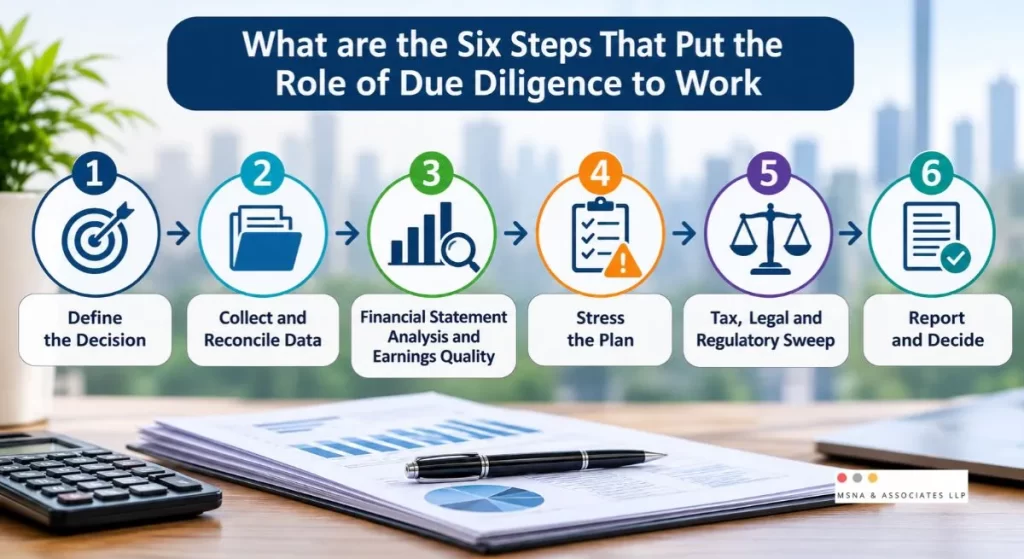
Each step below produces a number or document that the next step depends on, so skipping one weakens the rest.
Step 1: Define the decision
Write the go/no-go criterion first, such as “payback within 30 months with DSCR above 1.25x.”
Step 2: Collect and reconcile data
Tie management accounts to GST returns, bank statements and TDS filings. Mismatches are findings in themselves.
Step 3: Financial statement analysis and earnings quality
Strip out one-offs, test revenue recognition and trace profit to cash.
Step 4: Stress the plan
Run base, downside and severe cases, then apply the five tests above. This is where the financial risk assessment turns into numbers a board can act on, such as the exact month cash turns negative.
Step 5: Tax, legal and regulatory sweep
Confirm registrations, open demands and, for overseas plans, FEMA reporting. Reconciling indirect tax filings and open income tax demands early prevents surprises after launch. Where Ind AS applies, confirm your accounts follow the right standards; financial reporting advisory can support this. Your auditor’s statutory audit checklist is a useful starting point for documents.
Step 6: Report and decide
Deliver a conditional recommendation with open items and owners.
How Long Does It Take, and What Does It Cost?
The due diligence process is mostly a wait for clean data, so timelines depend on data quality more than on analyst hours. In our experience, mid-market financial due diligence in India typically takes three to six weeks, and reconciling 24 to 30 months of clean monthly closes takes three to four weeks. The planning ranges below are our estimates for Indian SMEs, not quotes. Fees depend on scope, data quality and the number of entities involved.
Scope | Typical situation | Timeline | Typical market fee range (indicative) |
Light check | New branch or city, one entity, clean close | 1–2 weeks | ₹50,000–₹2 lakh |
Standard financial due diligence | New state, product line or JV, 2–3 entities | 3–5 weeks | ₹2–8 lakh |
Deep dive | Overseas entity, investor-backed or acquisition-linked expansion | 6–10 weeks | ₹8 lakh and above, scope-based |
Start 30 to 90 days before you commit. Multi-entity groups, or companies that changed accounting software mid-period, can need six to eight weeks for reconciliation alone.
Mistakes That Make Expansions Fail
These six patterns recur when expansions strain cash, and most are visible in the plan before any money is spent.
Mistake | What it looks like | Better practice |
Diligence after commitment | Lease signed and hires made before numbers are tested | Review before irreversible spend |
Commingled funds | Expansion costs paid from the operating overdraft | Ring-fence a dedicated budget |
Copying mature-branch ratios | Applying year-five margins to year-one | Use ramp-up curves, not averages |
No stop-loss | Losses continue because nobody set a limit | Agree kill criteria upfront |
A one-time report | Findings go stale in a quarter | Re-test at each funding tranche |
No owner | Everyone assumes someone else watches cash | Name one accountable finance lead |
CA Naveen S N: “A review is most useful when it ends with conditions rather than applause. If the plan only works in the best case, the report should say so plainly.”
When a Full Review May Not Be Needed ?
Not every move needs a deep review. The importance of due diligence rises with irreversibility. A three-month pilot, a shared workspace or a pop-up can usually be tested with the five-test check alone. A long lease, heavy capex, senior hires or a foreign entity are hard to unwind, so they merit the full review. Our rule of thumb, not a regulatory threshold: if exiting would cost more than a quarter of your annual free cash flow, review properly.
Role of Due Diligence by Reader: What Each Decision-Maker Should Ask For
The same review serves different readers, so each should request the evidence that matters to their own decision.
Reader | Ask for |
Founder or SME owner | A 13-week cash forecast with the expansion layered on |
CFO or finance director | Reconciled MIS, covenant headroom and receivable ageing by customer |
Investor | A stress-tested model, milestone-linked tranches and valuation sensitivity |
Entrepreneur going overseas | Net worth headroom, FEMA filing plan and local tax set-up |
Next Step In the Role of Due Diligence
The role of due diligence in expansion is not to stop growth but to make it fundable. By testing profit against cash, receivables against credit terms and forecasts against your own branch history, you turn a hopeful plan into a decision with conditions attached. Expansions that are reviewed early, stressed on the downside and funded in stages give management more room to adjust course. Start with the five-test check this week, then decide how deep a review the commitment deserves.
Consulting a professional that deals in Due Diligence Service In India can help you assess how these checks apply to your situation. MSNA & Associates LLP’s teams can discuss scope with you.
Plan Your Business Expansion with Financial Clarity
FAQs on the Role of Due Diligence Before Business Expansion
Is due diligence only for acquisitions?
No. Any commitment that can strain cash, such as a new location, product line or country, benefits from the same discipline.
How is it different from a statutory audit?
A statutory audit expresses an opinion on historical financial statements under the Companies Act, 2013. Due diligence is decision-specific and forward-looking.
Who should carry it out?
Someone independent of the team championing the project, typically a Chartered Accountant, so the conclusions are not shaped by enthusiasm.
Does a clean review guarantee a successful expansion?
No. A clean report narrows the uncertainty around your finances and assumptions, but customer demand, execution and regulatory changes can still alter the result. Use it to inform the decision, not to predict the outcome.
Which documents should we prepare first?
Begin with 24 to 36 months of financial statements and the monthly management accounts behind them, then add receivable and payable ageing, loan sanction letters, GST and TDS filings, and the expansion budget with its assumptions.
Related
Discover more from MSNA & Associates LLP
Subscribe to get the latest posts sent to your email.