


Two companies want to combine. The lawyers draft a term sheet. Nobody’s asked the one question that actually decides the tax bill: is this a merger, or an acquisition?
A merger combines two companies into one surviving entity, usually through NCLT approval, and can qualify for tax-neutral treatment. An acquisition is one company buying another, faster to execute, but the seller pays capital gains tax on the sale.
The structure you pick isn’t just legal terminology. It changes your tax bill, your timeline, and what you’re liable for after the deal closes.
This guide covers the real differences between a merger and an acquisition in India, the tax and stamp duty consequences, where a Virtual CFO fits in, and a framework for choosing between a merger vs acquisition.
Key Takeaways
- A merger combines two companies into one; an acquisition means one company takes control of another, which usually continues as a subsidiary.
- Mergers routed through NCLT under Sections 230-232 can qualify for tax-neutral treatment under Section 2(1B) of the Income Tax Act. Acquisitions generally can’t.
- NCLT-approved mergers take 6-12 months. A straightforward share acquisition can close in weeks.
- Stamp duty on a merger scheme applies in every state where the transferring company holds property, not just one.
- NCLT approval alone doesn’t guarantee tax neutrality. Tax authorities can independently examine whether the deal actually meets the conditions.
- A Virtual CFO can model both structures against your specific deal before you commit, since the right call depends on your numbers, not general rules.
What Is the Real Difference Between a Merger and an Acquisition?
Both terms describe two companies coming together. What happens to each company’s legal identity afterward is where they split.
What Is A Merger?
A merger combines two companies into a single surviving entity. The Indian legal system recognizes this process as amalgamation which the Companies Act of 2013 regulates through Sections 230 to 232 and the National Company Law Tribunal (NCLT) must grant its approval.
One company usually absorbs the other, or both dissolve into a new entity. Shareholders of the absorbed company typically receive shares in the surviving company, not cash.
What Is An Acquisition
An acquisition is one company buying another, most often by purchasing its shares or specific assets. No NCLT approval is required for a straightforward share purchase.
The acquired company can continue operating as a subsidiary, keep its own brand, or get fully absorbed later, but that’s a business decision, not a legal requirement the way it is in a merger.
Merger vs Acquisition: Structural Differences at a Glance
Here’s how the two structures compare on the factors that actually matter once the deal closes.
Factor | Merger | Acquisition |
Legal entity | One or both companies may cease to exist | Target usually continues as a subsidiary |
Approval needed | NCLT sanction under Sections 230-232 | Board and shareholder approval only, in most cases |
Payment to sellers | Usually shares in the new entity | Usually cash, though shares are possible |
Typical tone | Framed as mutual, collaborative | Can be friendly or hostile |
Control after the deal | Often shared or blended | Acquirer holds control |
Why the Merger vs Acquisition Choice Is a Tax Decision?
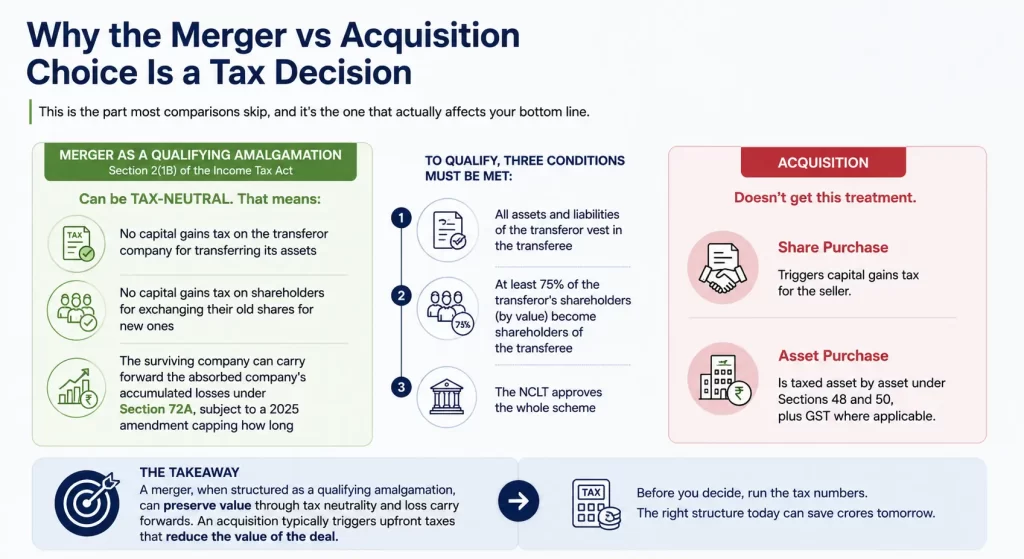
This is the part most comparisons skip, and it’s the one that actually affects your bottom line.
A merger structured as a qualifying amalgamation under Section 2(1B) of the Income Tax Act can be tax-neutral. That means:
- No capital gains tax on the transferor company for transferring its assets
- No capital gains tax on shareholders for exchanging their old shares for new ones
- The surviving company can carry forward the absorbed company’s accumulated losses under Section 72A, subject to a 2025 amendment capping how long
To qualify, three conditions must be met: all assets and liabilities of the transferor vest in the transferee, at least 75% of the transferor’s shareholders (by value) become shareholders of the transferee, and the NCLT approves the whole scheme.
An acquisition doesn’t get this treatment. A share purchase triggers capital gains tax for the seller. An asset purchase is taxed asset by asset under Sections 48 and 50, plus GST where applicable.
Deal teams often assume NCLT approval automatically means tax neutrality. It doesn’t. Tax authorities can independently examine whether a scheme meets Section 2(1B)’s conditions, regardless of what the NCLT sanctioned. Build the tax conditions into the scheme document itself, not as an assumption layered on top of legal approval.
The NCLT Timeline Most Founders Don't Budget For
Speed is where these two paths diverge sharply, and it’s worth planning around before you pick a structure.
Route | Typical Timeline |
NCLT-approved merger | 6-12 months, first motion to final sanction |
Share purchase acquisition | Weeks to a few months |
Asset purchase acquisition | Weeks to a few months, longer if multiple asset classes are involved |
A merger needs 75% approval in value of each class of shareholders and creditors at NCLT-directed meetings, on top of the tribunal’s own review. If your deal has a hard closing deadline, that timeline needs to be part of the decision, not an afterthought.
The Multi-State Stamp Duty Trap in Mergers
Here’s something almost no comparison of mergers and acquisitions mentions, and it can materially change deal economics.
Stamp duty on a merger scheme isn’t a single, one-time cost, and the rate isn’t uniform either.
- Maharashtra charges 10% of the value of shares issued plus cash consideration, capped at 5% of the immovable property’s market value.
- Delhi charges 3% on the consideration stated in the NCLT order.
- Haryana caps immovable property duty at 1.5%, up to Rs 7.5 crore, and charges nil on share issuance.
A merger spanning three states with different rate structures needs three separate calculations, not one blended estimate.
Our take:
Stamp duty planning deserves the same attention as tax structuring, and it usually gets far less. Two deals with identical Section 2(1B) tax outcomes can have very different total costs once state-by-state stamp duty is mapped out properly.
The 2025 Change to Section 72A That Shortens Your Runway
A 2025 amendment to Sections 72A and 72AA caps the carry-forward period at eight years from when the loss was first computed by the original predecessor, not from the merger date.
If a target has carried a loss for five years before acquisition, the merged entity gets only three years left to use it, not a fresh eight-year window.
This applies to amalgamations effected on or after April 1, 2025. If losses are a key deal driver, model the remaining window before structuring the merger.
What this means for deal timing:
If accumulated losses are a real driver of your merger decision, model the remaining window before you structure the scheme. A loss carried forward for six years under the original predecessor has two years of value left in the successor’s hands, regardless of when the merger closes.
Real Example: How the Vodafone-Idea Merger Used These Rules
The 2018 Vodafone-Idea merger, valued at roughly ₹1.5 lakh crore, is a useful real-world illustration of how these provisions actually work together.
Structured as an NCLT-approved amalgamation under Sections 230-232, the deal was built to secure the capital gains exemptions and loss carry-forward available to qualifying amalgamations, and helped consolidate spectrum holdings, though DoT clearance still required separate regulatory steps.
The deal became India’s largest telecom operator by subscribers at the time, built specifically on the advantages a merger structure made possible.
Types of Mergers and Acquisitions Worth Knowing
A quick reference, since the terminology shows up constantly in deal conversations.
Type | What It Means |
Horizontal merger | Two companies in the same industry combine |
Vertical merger | Companies at different stages of the same supply chain combine |
Conglomerate merger | Companies in unrelated industries combine |
Share purchase | Acquirer buys the target’s equity shares directly |
Asset purchase | Acquirer buys specific assets and liabilities, not the whole entity |
Slump sale | An entire business undertaking transfers as a going concern, taxed on net worth |
Where a Virtual CFO Fits Into This Decision
Most founders and CXOs don’t have the bandwidth to run tax modeling, timeline planning, and stamp duty mapping side by side while the deal clock is ticking. That’s usually where a Virtual CFO for Mergers and Acquisitions gets pulled in, working alongside your lawyers and bankers rather than replacing them, and translating the legal structure into financial impact your board can act on.
- Running the tax model both ways, comparing Section 2(1B) tax-neutral treatment against an acquisition’s capital gains exposure using your actual numbers.
- Mapping the NCLT timeline against your cash position, since a 6-12 month process has carrying costs your working capital needs to absorb.
- Coordinating the stamp duty exercise early, so the state-by-state property list is part of the cost comparison from day one, not a surprise during scheme drafting.
- Translating the deal team’s proposals into a plain financial recommendation for the board.
For companies without a full-time CFO function, or whose finance team is stretched thin during a transaction, fractional CFO support for the deal’s duration is often more practical than hiring for a one-time event. MSNA & Associates LLP works with founders and CXOs on this kind of deal-stage financial modelling, alongside the ongoing statutory and compliance work Indian companies need.
Which One Should You Choose Between Merger vs Acquisition? A Financial Decision Framework
Work through these four questions in order.
- Do you need speed, or can you plan around a 6-12 month timeline? A hard deadline usually rules out a merger.
- Does tax neutrality materially change your deal economics? If the numbers work either way, the simpler acquisition route often wins.
- Does the target hold property across multiple states? If so, model stamp duty state by state before assuming a merger is cheaper.
- Do you need the target’s accumulated losses or licenses to transfer cleanly? This is where a qualifying amalgamation has a real structural advantage an acquisition can’t replicate.
Common Mistakes Companies Make Choosing Between a Merger and Acquisition
These show up often enough to be worth checking against your own deal.
- Assuming NCLT approval guarantees tax neutrality, without confirming the Section 2(1B) conditions are actually met.
- Budgeting stamp duty as a single state’s cost, when the transferring company’s property actually spans several.
- Choosing a merger for speed, when an acquisition would have closed in a fraction of the time.
- Structuring for tax benefits alone, without checking whether 75% shareholder continuity is realistically achievable.
- Running the deal without a dedicated financial lead, leaving tax, timeline, and stamp duty modeling scattered across teams instead of consolidated in one place.
Making the Financially Smarter Choice
Merger and acquisition aren’t interchangeable words for the same transaction. They carry different tax outcomes, timelines, and stamp duty exposure, and the right choice depends on what your deal actually needs, not which term sounds more familiar. Consulting a professional, whether that’s your deal counsel or a Virtual CFO Services who can model both structures against your specific numbers, can help you make that call with the full financial picture in front of you.
Make an Informed Deal Decision
Frequently Asked Questions About Merger vs Acquisition
Is an acquisition a quicker process as compared to a merger in India?
No, because section 2(1B) provides tax exemption only in case of a merger/amalgamation approved by NCLT; certain transfers of assets also have specific provisions.
Can an acquisition be tax neutral?
No, because section 2(1B) provides tax exemption only in case of a merger/amalgamation approved by NCLT; certain transfers of assets also have specific provisions.
Does every merger get automatically approved by NCLT?
Often, particularly for a share purchase, which typically attracts minimal stamp duty. A merger scheme involving property across states can carry a materially higher cost.
Do I need a Virtual CFO for a merger or acquisition, or is this purely a legal decision?
It’s both. Your lawyers structure the scheme and manage compliance. A Virtual CFO models what each structure costs and how it affects cash flow, so the structure you choose is also one your finance function can live with.
Is stamp duty always cheaper in an acquisition than a merger?
Often, particularly for a share purchase, which typically attracts minimal stamp duty. A merger scheme involving property across states can carry a materially higher cost.
Related
Discover more from MSNA & Associates LLP
Subscribe to get the latest posts sent to your email.