

A legal due diligence checklist for a private limited company should verify ten areas: incorporation documents, MCA filings, statutory registers, shareholder agreements with director disclosures, material contracts, pending litigation, intellectual property, employment records, regulatory licences and pending legal obligations. Legal due diligence before acquisition matters because a share purchase hands you the company’s entire history, including defaults nobody mentioned in the pitch.
This guide is written for promoters, acquirers, investors, corporate lawyers and M&A advisors. It shows what to request, what each document reveals, and how verified findings change price and deal terms.
Key Takeaways
- A legal due diligence checklist tests title, validity, and exposure. It does not test the numbers.
- Begin with the Certificate of Incorporation, MoA and AoA, then trace every share from allotment to its current holder.
- Cross-check the data room against public records before relying on it.
- Rate every finding red, amber, or green and attach one deal response to each.
- Five recent legal and regulatory changes, from Press Note 2 (2026) to the labour codes, now belong on the checklist.
What Is Legal Due Diligence for Private Limited Companies, and Who Does What?
Legal due diligence for private limited companies is the legal verification of company records, rights and obligations before money or control changes hands. Think of it as a company legal audit that tests validity, not valuation: does the company exist as described, own what it claims, and carry legal liabilities the price ignores?
Different professionals verify different layers:
Reviewer | What they verify |
Advocate | Title opinions, litigation outcomes, contract enforceability, IP ownership |
Company secretary | Charter documents, registers, MCA filings, board and shareholder approvals |
Chartered accountant | Tax and statutory dues, contingent liabilities, financial due diligence |
Buyer’s deal team | Commercial fit, integration plan, negotiating position |
MSNA’s CA and CS team supports the records and compliance layer and works alongside the buyer’s advocate where legal opinions are needed.
Why Does Legal Due Diligence Before Acquisition Matter More in 2026?
Fewer, larger deals mean one missed liability weighs more. Grant Thornton Bharat’s 2026 Dealtracker series shows the pace:
2026 quarter | M&A and PE transactions | Total deal value |
Q1 | 686 | $16 billion |
Q2 | 565 | $36.3 billion |
Q3 | 608 | $23.1 billion |
Source: Grant Thornton Bharat Dealtracker Q1 2026, Dealtracker Q2 2026 and Dealtracker Q3 2026; BCG, India M&A 2026. M&A and PE only, excluding IPOs and QIPs. Q3 value is the sum of the reported M&A and PE figures.
A BCG analysis of the first seven months found volumes down nearly 20% while value slipped only 2%. M&A legal due diligence must also read each target against fresh rules:
Recent change | Status as of 16 November 2026 | Add to your checklist |
Effective 2 May 2026, after the FEMA NDI amendment | Trace beneficial ownership against the PMLA test for land-border links | |
JPC report tabled 3 August 2026; confirm enactment | Do not price relief that is not yet law | |
Four labour codes | In force from 21 November 2025 | Test wage definition, gratuity and PF base |
DPDP Rules, 2025 | Phased over 18 months | Check consent notices and processor contracts |
Competition Act deal value threshold | ₹2,000 crore, since September 2024 | Test CCI notification even for a small target |
What Are the 10 Areas to Verify in a Legal Due Diligence Checklist for Indian Companies?
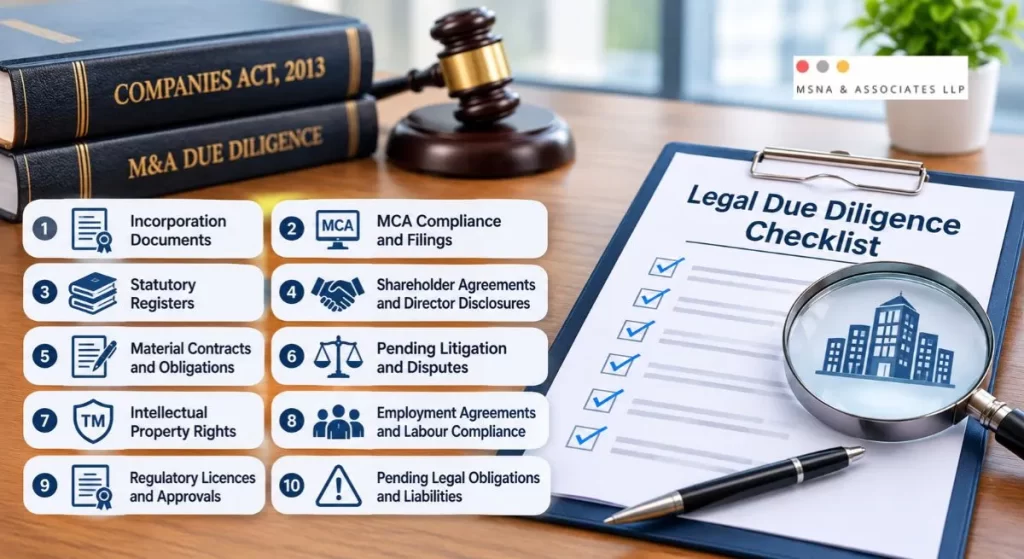
For each area, request the documents below and test the point in the middle column.
1. Incorporation Documents: Certificate of Incorporation, MoA and AoA
Start with the three documents that prove the company exists, define what it may do, and decide who can stop a sale:
Document | Check | Liability exposed |
Certificate of incorporation, plus name-change or conversion certificates | CIN, date and status match MCA master data | Wrong entity, struck-off or dormant status |
Memorandum of association | Objects clause covers the current business | Activity outside stated objects |
Articles of association | Transfer limits, pre-emption, board consent, drag and tag rights | A sale the board can block |
A private company’s articles must restrict share transfers (Section 2(68), Companies Act, 2013), so the AoA decides whether your purchase can complete. Confirm every amendment passed by special resolution and was filed.
2. MCA Compliance and Filings
Check these four filing families first, because each one points to a different kind of default:
Filing | What to confirm |
AOC-4, MGT-7 or MGT-7A | Last three to five years filed on time; shareholding matches the register |
DIR-3 KYC, DPT-3, MSME-1 | Directors active; deposits and MSME dues reported |
PAS-3, SH-7 | Every allotment and capital change reported |
CHG-1, CHG-4 | Charges registered and satisfied ones removed |
Three continuous years of non-filing disqualify directors under Section 164(2), and Section 248 allows strike-off. A corporate legal compliance checklist should therefore test filing dates, not only filing status. The documents that delay audit sign-off in our statutory audit checklist often delay filings too. Pull records straight from the MCA portal rather than relying on seller copies.
3. Statutory Registers
- Register of members (Section 88). Lay it next to the cap table, the share certificates and every SH-4. If a transfer shows up in one and not the others, find out why, and check that stamp duty was actually paid.
- The other registers. Directors and KMP (Section 170), contracts (Section 189), loans and investments (Section 186) and charges (Section 85) should be up to date and signed. Entries that all carry the same recent date deserve a question.
- Significant beneficial owners (Section 90, Form BEN-2): identify who ultimately owns the shares.
- Dematerialisation: Rule 9B requires most private companies, small companies excepted, to issue securities in demat form.
Statutory registers are the company’s own memory. Where they are missing or written up late, treat dependent facts as unverified.
4. Shareholder Agreements and Director Disclosures
Shareholder agreements and cap table
- Compare the agreement with the articles. In V.B. Rangaraj v. V.B. Gopalakrishnan (1992), the Supreme Court held that transfer restrictions outside the articles do not bind the company.
- List reserved matters, pre-emption, tag and drag, anti-dilution, put options and lock-ins.
- Trace convertible instruments such as CCPS and CCDs, the ESOP pool and any unrecorded equity promises.
Director disclosures
- Form MBP-1 interest disclosures (Section 184) and DIR-8 declarations.
- Related-party approvals (Section 188) and loans to directors (Section 185).
5. Material Contracts and Contractual Obligations
Search every contract for these five clauses, since each one changes what the buyer actually acquires:
Clause to find | Why it matters |
Change of control, assignment | A customer may terminate or demand consent after a share sale |
Exclusivity, non-compete | Limits growth after closing |
Termination for convenience | Revenue may be less durable than invoices suggest |
Liability caps, indemnities, guarantees | Open-ended contractual obligations |
Signatory and stamping | Whether the right person signed and the document is admissible |
Review the top customers and vendors by value first, then agree a sampling rule for the rest.
6. Pending Litigation and Disputes
Run the same name search across these four forums, because a dispute filed in one is rarely visible in another:
Forum | What to search |
Civil and criminal matters against the company, promoters and directors | |
NCLT and NCLAT | Insolvency petitions, oppression and mismanagement claims |
Tax departments and tribunals | Notices, demands, appeals |
Consumer, labour, arbitration, regulators | Orders, awards, show-cause notices |
Look for Section 8 demand notices under the Insolvency and Bankruptcy Code, which precede petitions, and cheque-dishonour cases under Section 138 of the Negotiable Instruments Act. Ask the seller for a schedule of pending litigation with claim values, then compare it with your searches.
7. Intellectual Property Rights
- Trademark, patent, design and copyright registrations stand in the company’s name, with renewals current.
- Founder, employee and contractor work is assigned in writing (Section 19, Copyright Act, 1957).
- Software licences and open-source terms are reviewed.
- Domains and social handles belong to the company, not to individuals.
8. Employment Agreements and Labour Compliance
- Appointment letters, key-employee agreements and ESOP documents.
- PF, ESI, gratuity, bonus and POSH Internal Committee compliance, tested against the new labour codes.
- Contractor classification.
- Post-employment non-competes are generally unenforceable under Section 27 of the Indian Contract Act, so rely on notice periods, lock-ins and retention incentives instead.
Our guide to HR due diligence in India covers fifteen workforce checks in more depth.
9. Regulatory Licences and Approvals
- Note each licence, who holds it, when it expires and whether it can transfer: shops and establishment, GST, factory or trade, pollution consents, FSSAI, import-export code and sector licences.
- If foreign money came in earlier, check the FC-GPR and FC-TRS filings and the share pricing.
- List the regulatory approvals needed to close, including CCI thresholds and any NBFC or insurance regulator.
10. Pending Legal Obligations and Liabilities
- Charges over company assets (MCA and CERSAI), and loan terms that need the lender’s consent if shareholding changes.
- Guarantees, comfort letters and indemnities given to third parties.
- Unpaid TDS, GST, PF and ESI, and open assessments, which financial due diligence can quantify.
- Unstamped or deficiently stamped documents.
Which Five Registry Tie-Outs Expose Gaps the Data Room Hides?
Each tie-out sets a company record against an outside record, and the register of members comes first because every voting and exit right depends on who legally holds the shares:
Company record | Cross-check against | Gap may signal |
Register of members | MGT-7 shareholding, PAS-3 and SH-7 | Unreported allotments or transfers |
Board minutes approving borrowings | MCA and CERSAI charge records | Undisclosed or unapproved borrowing |
Register of directors | MCA master data and DIN status | Disqualified directors, hidden interests |
Seller’s litigation schedule | eCourts, NCLT and tax portals | Understated disputes |
Seller’s IP list | Trade Marks Registry search | Lapsed or third-party registrations |
Treat each mismatch as a query for management, not proof of wrongdoing.
How Does Legal Verification of a Company Turn Findings Into Deal Terms?
Legal verification of a company pays off only when each finding lands in the agreement:
Rating | Typical finding | Deal response |
Red | Invalid allotment of the shares being bought; licence that cannot transfer | Restructure or walk away |
Red | Quantified liability, such as a tax demand or unpaid dues | Price reduction, specific indemnity or escrow |
Amber | Missing filings, IP assignment gap, lender consent | Condition precedent before closing |
Amber | Labour-code or privacy readiness | Condition subsequent with a deadline |
Green | Housekeeping gaps | Post-closing tracker |
In M&A legal due diligence, a short bring-down check before closing refreshes litigation, charges and licence status for the gap since the report. Structure also changes the exposure: in an asset purchase most liabilities stay with the seller, while licences and contracts need transfer, as our guide to merger vs acquisition explains.
Expert Insight: What Do Experienced Advisors Check First?
“The costliest legal finding is seldom the biggest dispute. It is the small break in a chain, such as a share transfer nobody recorded or an IP assignment nobody signed, that surfaces after you own the company. In a recent share-purchase review, a transfer recorded in the register but missing from MGT-7 led to a price retention until the filing was regularised. Verify the chain first, then read the story the seller tells.”
Naveen S N, Co-Founder, MSNA & Associates LLP
Sellers can run the same checklist first. A company legal audit before the buyer arrives lets you fix registers and filings early, and startups raising capital often pair it with a virtual CFO for Series A funding.
When Should You Start, and What Do Buyers Often Get Wrong?
Timing and scoping decide how much negotiating leverage a buyer keeps, and three habits weaken it most:
- Start before the price is final. Findings found after signing carry little negotiating weight.
- Agree a materiality threshold at the start. Without one, a minor stamp-duty gap sits beside an invalid allotment with equal weight.
- Do not accept a disclosure letter as verification. It lists what the seller chose to disclose.
How Can MSNA Help With Legal Due Diligence Checklist?
If you are evaluating a private limited company, MSNA’s team can discuss how this checklist applies to your target, from records verification to financial exposure. Consulting a professional early can help you assess how these checks apply to your transaction. You can explore our due diligence services or browse the Due Diligence knowledge hub.
This article is for general information and is not legal advice. Confirm the current status of each law before relying on it.
Planning an Acquisition?
FAQs on Legal Due Diligence Checklist
Can a CA firm perform legal due diligence?
A CA and CS team can verify records, filings, registers and compliance, and quantify exposure. Opinions on title, enforceability and litigation outcomes come from advocates.
What is the difference between a corporate legal compliance checklist and legal due diligence?
A compliance checklist tests current filings. Due diligence also tests history, title and the consents a specific transaction needs.
Is legal due diligence mandatory in India?
No statute requires it for a private acquisition. Investors, lenders and regulators expect it in practice.
Is it legally mandatory?
No statute requires it for private deals. It is standard commercial practice because liabilities generally follow the entity in a share purchase.
How long does it take?
A single-entity review commonly runs a few weeks. Data-room readiness and the number of entities set the range.
Does the checklist change for a minority investment?
Yes. Depth shifts toward the cap table, investor rights and governance, while control deals add contracts, licences and historic liabilities.
Related
Discover more from MSNA & Associates LLP
Subscribe to get the latest posts sent to your email.