

An expense audit is a structured review that confirms your business spending was genuine, approved, documented and taxed correctly under Indian law. If you run a business or finance team in India, it tells you whether your spending would stand up to a statutory auditor, a GST officer or your own board.
This guide shows how to conduct an expense audit in six steps, with a red-flag table, GST and TDS checkpoints and a sample finding. It is written for business owners, CFOs, finance managers, internal auditors and compliance teams at SMEs, and it helps you surface financial irregularities early. The guidance draws on the internal audit and internal controls over financial reporting (ICFR ) work of M S N A & Associates LLP, a Bengaluru-based firm of Chartered Accountants. Its risk advisory team performs internal audits, expense and reimbursement reviews, and ICFR control testing for Indian businesses
Key Takeaways
- An expense audit tests whether spending is valid, approved, documented and tax-correct, not merely whether the books balance.
- Sample by risk: examine every high-value or near-limit claim, then random-test the rest.
- Duplicates, round amounts and weekend claims are the fastest red flags to test.
- India adds a tax layer: GST credit eligibility, TDS and cash-payment disallowance.
- A finding is closed only when the policy gap behind it is fixed.
What Is an Expense Audit?
An expense audit is a systematic examination of business expenses that tests four things: the spend actually occurred, it was authorised under policy, it is supported by valid documents, and it is recorded and taxed correctly. The auditor samples transactions, tests them against evidence, reports exceptions and recommends control fixes.
In simple words, it is a check on how, why and by whom your money was spent. Reconciliation asks whether the numbers match. An expense audit asks whether the spend should exist at all, and whether the right person approved it.
Expense Audit vs Financial Audit vs Internal Audit
The table below separates the three reviews so you can see where each one starts and stops.
Aspect | Expense audit | Financial (statutory) audit | Internal audit |
Question answered | Was each expense valid, approved and compliant? | Are the financial statements true and fair? | Are processes and controls working? |
Scope | Spend categories and claims | Entire financial statements | Selected processes across the business |
Sampling | Risk-weighted, often 100% of high-value items | Materiality-based | Risk-based |
Output | Findings, recoveries, policy fixes | Audit opinion | Control recommendations |
Usual frequency | Quarterly or half-yearly | Annual | Periodic |
An internal audit of expenses is usually one module within a broader internal audit plan. A standalone expense audit goes deeper into individual claims and vendor spend. MSNA’s guide to choosing an internal audit partner explains how that wider scope is set.
Four Types You Can Run
- Employee expense audit: reviews claims for travel and entertainment expenses, per diems, fuel and mobile.
- Expense reimbursement audit: a post-payment review of what was actually reimbursed, including advances and settlements.
- Operating expense audit: tests rent, utilities, subscriptions and professional fees paid to recurring vendors.
- Business expense audit: a tax-focused review of deductibility, GST credit and TDS across all spend.
Why Run an Expense Audit in 2026?
The ACFE’s Occupational Fraud 2026 report analyses 2,402 cases from 143 countries. Its findings make a practical case for routine expense fraud detection. Note that the data is global, reported in USD, and drawn from a survey of fraud examiners.
Metric | 2026 finding | What it means for your audit |
Revenue lost to occupational fraud | About 5% | Treat spend as a risk area, not an admin task |
Median loss per case | $104,000 (down from $145,000 in 2024) | Losses are falling, but not vanishing |
Median loss, firms under 100 employees | $126,000 (vs $123,000 for 10,000+) | Smaller firms feel each case more |
Median loss, expense reimbursement schemes | $36,000 | Small repeated claims add up quietly |
Frauds detected by tips | 43% | Pair audits with a reporting channel |
Surprise audits | Associated with about 50% lower median losses | Unannounced sampling is worth adding |
Proactive data monitoring | Associated with about 53% lower median losses | Run analytics monthly, not yearly |
Our reading: SMEs are exposed because owners and senior managers often approve their own claims. The ACFE found that frauds by owners or executives caused median losses over nine times larger. Not every leak is fraud, either. Unauthorised spending, such as unapproved subscriptions and out-of-policy trips, often involves no bad intent at all.
How to Conduct an Expense Audit: 6 Steps
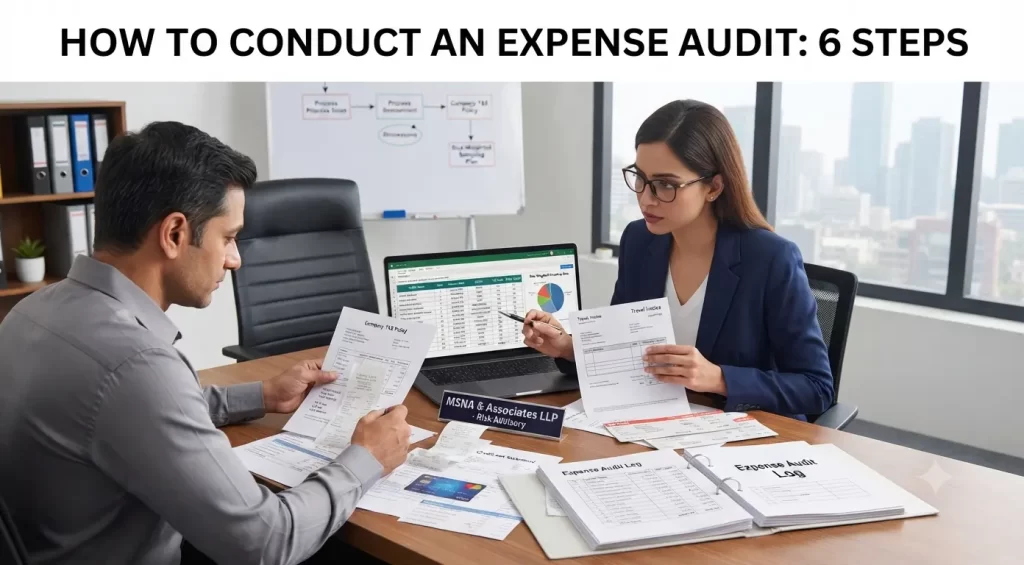
Each step builds on the one before, so follow them in order for your first cycle.
Step 1: Set the Scope and Sampling Plan
Fix the period, entities and categories before pulling a single receipt. For an operating expense audit, start with your top ten vendors by value. For employee claims, start with travel, meals and cash advances.
Risk-Weighted Sampling Plan
Tier | What to pull | Suggested coverage |
1. High value | Items above your approval threshold | 100% |
2. High risk | Round amounts, weekend dates, near-limit and repeat claims | 100% via filters |
3. Senior spend | Director, promoter and CXO claims | 100% |
4. Routine | Everything else | Random 10–15% |
These ranges are a working approach. Widen the Tier 4 sample if its error rate crosses the tolerance you set in advance.
Step 2: Collect Receipts and Records
Expense documentation is where most audits stall. Request evidence in one batch, and do not accept summaries in place of source documents.
Expense Audit Checklist: Documents to Collect
- Original invoices and receipts showing the supplier’s GSTIN
- Bank and card statements for the same period
- Pre-approved travel or purchase requests
- GSTR-2B and vendor ledgers
- Tickets, boarding passes and hotel folios
- The policy version in force on the date of spend
Check each supplier invoice before accepting it. Verify the supplier’s GSTIN on the GST portal, confirm the invoice serial numbers are unique and in sequence, and confirm that your own GSTIN appears as recipient.
Step 3: Match Against Policy
Compare each sampled item with the policy and its approval trail. Each sampled claim should pass five checks:
- Purpose: is a business reason stated and plausible?
- Evidence: do amount, date and payee match the receipt?
- Limit: is it within the cap for that grade and category?
- Approval: was it signed by someone independent of the claimant?
- Payment: did the money go by bank transfer to the claimant or vendor?
Trace the payment to the bank statement before you close any item. Tick all five checks on your checklist for every sampled claim.
Step 4: Spot Duplicates and Red Flags
Run these tests in Excel or your ERP before reading any receipt. In an employee expense audit, they find most issues in hours, not weeks:
- Duplicate expense claims: same vendor, amount and date, or one invoice number claimed twice.
- Round figures: a high share of amounts divisible by 500.
- Limit hugging: claims clustered just below an approval threshold.
- Calendar mismatch: weekend or holiday spend with no travel approval.
Expense Red-Flag Table
The table below links each warning sign to a test and its Indian tax consequence.
Red flag | What it may indicate | How to test | India tax angle |
Same invoice number or amount twice | Double reimbursement | Sort by vendor, amount, date | Possible duplicate ITC claim |
Round-figure claims | Estimated, not actual, spend | Filter amounts divisible by 500 | Weak evidence for deduction |
Claims just under the limit | Splitting to avoid approval | Cluster at 90–99% of limit | Approval-matrix breach |
Cash above ₹10,000 per person per day | Payment-mode non-compliance | Match to bank statement | Disallowance risk |
Hotel or restaurant bill without GSTIN | Personal use or unregistered supplier | Check bill header | ITC likely unavailable |
Same approver on every claim | Weak independence | Approver frequency count | Control deficiency |
Vendor bank account matches an employee’s | Fictitious or related-party vendor | Compare vendor and HR masters | Deduction and fraud exposure |
A professional review can help assess how this applies to your approval matrix. Talk to MSNA’s risk advisory team
Step 5: Report Findings
Write each finding in five parts: condition, criteria, cause, effect and recommendation. Rate it high, medium or low, and quantify the tax effect separately from the cash effect. Keep the reviewer independent of the process owner, in line with the principles of auditing in India, and share the draft with the owner for factual accuracy before it reaches the board or audit committee.
Step 6: Fix the Policy Gaps
Strong expense management controls matter more than the recoveries. Map each gap to a specific fix:
Gap found | Control fix |
Peers approving each other’s claims | An approval matrix by value and grade, with CFO sign-off above a set limit |
Receipts filed months late | A submission deadline, for example 30 days from spend |
Unverified vendor bank changes | Vendor payment controls: maker-checker approval and a three-way match of PO, GRN and invoice |
Vague travel rules | Hotel and per-diem caps by city tier |
Unreviewed promoter spend | Independent review of director and owner claims |
Many finance teams record these fixes as written SOPs and test them through a risk control matrix under an ICFR framework. MSNA’s ICFR audit checklist for 2026 lists the control tests auditors typically ask for.
Expense Audit in India: GST, TDS and Deductibility
A business expense audit in India must test tax treatment as well as policy. The Income-tax Act, 2025 renumbered the provisions, though the substance on these points largely carries over. Confirm current rules on the Income Tax Department portal.
Income-Tax and TDS Checkpoints
These four provisions decide whether an expense is deductible and whether TDS was handled correctly.
Checkpoint | Old section → 2025 Act | What to verify |
Wholly and exclusively for business | S.37(1) → S.34 | Purpose recorded; no personal element |
Cash payment above ₹10,000 per person per day | S.40A(3) → S.36 | Paid by account-payee or bank transfer, or deduction is lost |
Dues to micro and small enterprise supplier | S.43B(h) → S.37 | Payables aged against the agreed period: 15 days where there is no written agreement, 45 days maximum with one |
TDS on contractors, professionals, rent | Chapter XVII-B → S.393 | Correct rate, threshold, deposit and filing |
Thresholds matter before concluding TDS applies. Contractor payments (old Section 194C) are covered once a single payment crosses ₹30,000 or the year’s total crosses ₹1,00,000. Verify against the current Section 393 schedule, since limits are revised periodically. For edge cases, MSNA’s income-tax advisory team can interpret the position on your facts.
For expenses incurred before 1 April 2026, apply the Income-tax Act, 1961 sections. The 2025 Act applies from tax year 2026-27.
GST Input Tax Credit by Expense Type
Credit eligibility depends on the nature of the expense, so check each category against the table below.
Expense | ITC position | Audit check |
Software, office supplies, professional fees | Generally eligible | Invoice appears in GSTR-2B; supplier paid within 180 days |
Employee air and hotel travel | Eligible if business-related | Your GSTIN is on the invoice. Vacation or leave-travel benefits to employees are blocked under S.17(5)(b). |
Staff meals, outdoor catering, club or health memberships | Generally blocked under S.17(5)(b), subject to exceptions (for example, where the employer is legally obliged to provide the item, or the same category is supplied outward) | Reverse any credit claimed |
Motor vehicles (up to 13 seats) for general use | Blocked, S.17(5)(a), with limited exceptions | Confirm the vehicle’s actual use |
Goods given as gifts or free samples | Blocked, S.17(5)(h) | Look for credit taken on festive spend |
Claim only what shows in GSTR-2B. ITC for FY 2025-26 invoices must be claimed by 30 November 2026 or the annual return date, whichever is earlier (confirm on the GST portal). MSNA’s indirect tax advisory team supports these reconciliations.
Sample Expense Audit Finding (Illustrative)
This example uses a hypothetical 180-employee services company. It shows the five-part format from Step 5.
Element | Finding |
Title | Duplicate and out-of-policy travel claims in Sales |
Condition | In a sample of 120 claims, nine reused one hotel invoice across two reports. Fourteen meal claims included club bills, and ITC was availed on them with no exception applying. |
Criteria | Travel policy clause 4.2; CGST Act S.17(5)(b); the approval matrix |
Cause | Manual submission with no duplicate-invoice check; approvers untrained on blocked credits |
Effect | Overpaid reimbursements; ITC liable for reversal with interest |
Recommendation | Recover duplicates, reverse ineligible ITC, add an invoice-uniqueness check, train approvers, re-test next quarter |
Risk rating | High |
What an Expense Audit Cannot Catch?
Know the limits so you can compensate for them:
- Collusion: an approver and claimant with matching paperwork. Surprise audits and a tip channel help.
- Management override: owners who bypass the process. Use an independent reviewer.
- Compliant but wasteful spend: policy-clean items still need budget scrutiny.
- Off-book spending: needs bank-to-ledger completeness testing.
Vendor-side collusion is the hardest to spot. MSNA’s case study archive includes a vendor kickback example.
When this may not apply: very small teams with no approval hierarchy may not need a formal audit cycle. A periodic owner review of bank statements may be enough.
Conclusion On Expense Audit
An expense audit works best as a repeatable cycle: sample by risk, verify against evidence, test the tax treatment, report clearly and fix the control behind each finding. This guide is informational and not a substitute for professional advice on your specific facts. If you would like an independent view, you can contact internal auditors to discuss how a scoped internal audit of expenses might fit your business.
Strengthen Your Business Expense Controls
FAQs About Expense Audit
How often should a business run an expense audit?
Quarterly for employee claims and half-yearly for vendor spend works for most SMEs. Run an expense reimbursement audit after any policy change.
Should it be done in-house or by an external firm?
In-house teams know the processes, but independence suffers when finance reviews its own approvals. An external reviewer adds objectivity, especially for expense verification of senior and promoter spend. Where no full-time finance head exists, a virtual CFO can own the review cycle; MSNA’s note on remote financial control explains the model.
Is an expense audit mandatory in India?
No standalone statutory requirement exists. However, tax audit reporting (old Section 44AB, now Section 63) and statutory audits both examine expenses, so an internal review reduces surprises.
What documents does an expense audit need?
Original invoices with GSTINs, bank and card statements, approval records, travel evidence, GSTR-2B and vendor ledgers, and the policy in force on the date of spend.
How long does an expense audit take?
For an SME sample, usually a few weeks. It depends on transaction volume and how quickly records are produced.
What is the difference between an expense audit and a tax audit?
An expense audit tests whether spend is valid, approved and tax-correct, and results in recommendations. A tax audit is a statutory report on tax compliance (old S.44AB, now S.63) and is mandatory above prescribed limits.
Related
Discover more from MSNA & Associates LLP
Subscribe to get the latest posts sent to your email.