


If your board wants a statutory auditor out before the term ends, the law does not allow a simple replacement.
Removal of auditor under Section 140(1) needs prior approval of the Central Government (exercised by the Regional Director), a special resolution of members, and a reasonable opportunity of being heard for the auditor.
This guide covers the removal of an auditor under the Companies Act 2013, how it differs from resignation, non-reappointment, and casual vacancy, and the exact order of steps. It is written for directors, promoters, CFOs, startup founders, and audit firms.
Key Takeaways
- Removal of auditor needs three things together: Regional Director approval, a special resolution, and a fair hearing for the auditor.
- A board resolution alone never ends an auditor’s appointment.
- Form ADT-2 goes in within 30 days of the board resolution; the general meeting follows within 60 days of approval.
- Silence from an auditor is not resignation. Resignation, non-reappointment, and casual vacancy are separate routes.
- If fraud is the concern, Section 140(5) is a separate route: the Tribunal decides, and you don’t file ADT-2.
- As of 19 November 2026, the Corporate Laws (Amendment) Bill, 2026 is still pending; the JPC report was tabled on 3 August 2026. Today’s Section 140 is the one to follow
What Is Removal of Auditor Under Section 140 of the Companies Act, 2013?
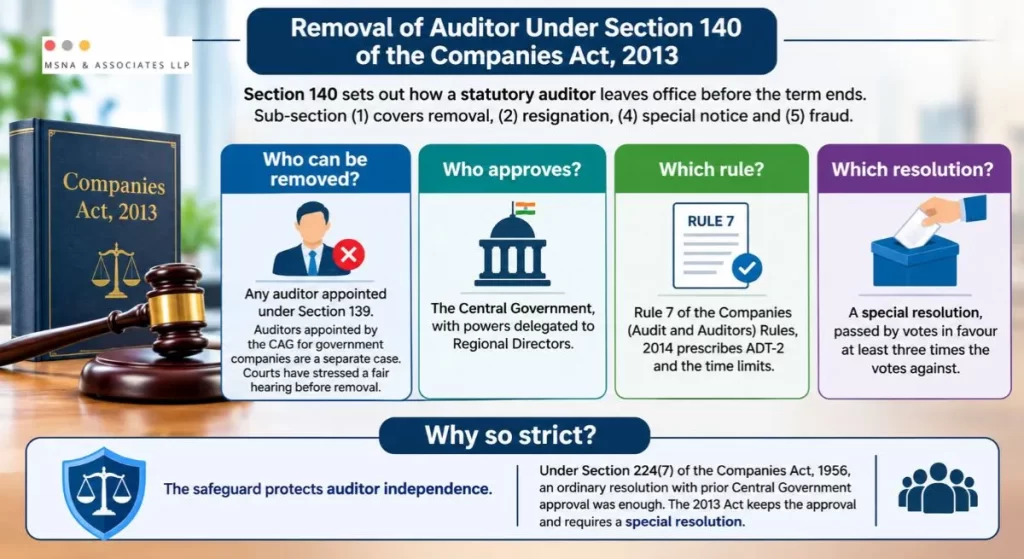
Section 140 sets out how a statutory auditor leaves office before the term of office ends. Sub-section (1) covers removal, (2) resignation, (4) special notice and (5) fraud.
- Who can be removed: any auditor appointed under Section 139. Auditors appointed by the CAG for government companies are a separate case. Courts have stressed a fair hearing before removal.
- Who approves: the Central Government, with powers delegated to Regional Directors.
- Which rule: Rule 7 of the Companies (Audit and Auditors) Rules, 2014 prescribes ADT-2 and the time limits.
- Which resolution: a special resolution, passed by votes in favour at least three times the votes against.
Why so strict? The safeguard protects auditor independence. Under Section 224(7) of the Companies Act, 1956, an ordinary resolution with prior Central Government approval was enough. The 2013 Act keeps the approval and requires a special resolution
Removal of Auditor vs Resignation vs Non-Reappointment vs Casual Vacancy
These four exits look alike but follow different law. Choosing the wrong route can leave a replacement open to challenge.
Route | Initiated by | Provision | Government approval | Key forms and notes |
Removal before expiry | Company | s.140(1), Rule 7 | Yes (Regional Director) | ADT-2, INC-28, MGT-14 |
Resignation | Auditor | s.140(2), Rule 8 | No | ADT-3, filed by the auditor |
Non-reappointment | Members at AGM | s.139, s.140(4) | No | Special notice if someone other than the retiring auditor is proposed |
Casual vacancy | Event (resignation, death, disqualification) | s.139(8), s.141(4) | No | Board fills within 30 days; resignation cases also need member approval within 3 months |
Term completion | Law | No | New appointment at AGM, ADT-1 |
Quick test: which route applies to you?
- Auditor willing to continue, company wants to exit → removal.
- Auditor has formally resigned → casual vacancy.
- Auditor has gone silent → still removal, because non-response is not resignation.
- Term ending at the AGM → non-reappointment or rotation.
- Auditor disqualified under Section 141(3) → vacates office automatically.
When and Why Can a Company Pursue Removal of Auditor Before Expiry of Term?
The Act lists no grounds, so the board must document its own. The Regional Director considers the grounds stated in ADT-2.
Grounds boards commonly rely on
- Repeated delays in audit reports or limited reviews.
- Unresponsiveness during an ongoing audit.
- Group restructuring where subsidiaries must align with the parent’s auditor.
- Capacity gaps for a larger or more complex business.
- An audit committee assessment, ideally supported by internal audit findings on reporting quality.
Grounds that invite scrutiny
- Removal soon after a qualified opinion or a fraud-related report by the auditor.
- Fee negotiations used as the primary reason.
- Any reason that suggests an attempt to influence the audit outcome.
To see how auditors flag control gaps in their reports, read our guide on qualified ICFR reports.
What is The Procedure for Removal of Auditor: Step-by-Step
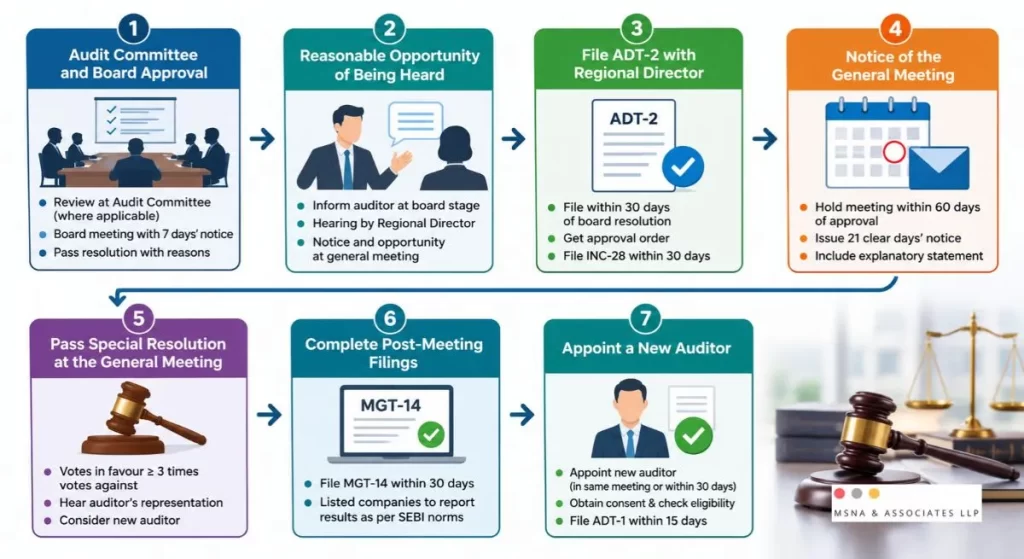
At a Glance
Grounds documented; audit committee view and board resolution, auditor informed → | Auditor’s opportunity of being heard (board, Regional Director, general meeting) → | ADT-2 to Regional Director within 30 days; order, then INC-28 within 30 days → | Notice of the general meeting (and special notice, where it applies) → |
Special resolution within 60 days of approval; auditor heard → → | MGT-14 within 30 days; listed-company disclosures → | New auditor appointed; ADT-1 within 15 days of the meeting |
Step 1: Audit committee and board approval
- Where Section 177 applies, the audit committee should look at the proposal first. In practice, that means listed companies and public companies above the prescribed paid-up capital, turnover or borrowing limits.
- Call a board meeting with at least 7 days’ notice under SS-1, and send the agenda and the draft resolution along with it.
- The board resolution records the reasons, approves the ADT-2 application and authorises a signatory.
- Listed companies disclose under Regulation 30 of the SEBI LODR Regulations, within 30 minutes of the board meeting’s closure.
Board hygiene matters here. Our board meeting compliance checklist covers notice, quorum and minutes.
Step 2: Reasonable opportunity of being heard
The proviso to Section 140(1) makes this mandatory. In practice it arises at three points:
- Board stage: inform the auditor of the meeting date and the proposal.
- Regional Director stage: the auditor can appear at the hearing on ADT-2.
- General meeting: the auditor is entitled to receive notice and attend under Section 146.
What a hearing notice should contain
- The proposal to remove the auditor and the reasons behind it.
- Date, time and venue of the board meeting, and later of the Regional Director hearing and the general meeting.
- An invitation to submit a written representation, with a reasonable reply date.
- Delivery by traceable means (email plus courier), with the acknowledgement filed in the minute book.
Step 3: File ADT-2 with the Regional Director
- Filed within 30 days of the board resolution, with the prescribed fee and the grounds.
- The Regional Director fixes a hearing and issues an order approving or declining removal.
- File the certified order with the Registrar in INC-28 within 30 days of receiving it.
- A second board meeting then notes the order and fixes the general meeting.
Step 4: Notice of the general meeting
- The meeting must be held within 60 days of receiving approval.
- Notice is 21 clear days, or shorter with consent under Section 101.
- The notice carries an explanatory statement with the grounds.
- Special notice under Section 115 means members holding at least 1% voting power (or shares of ₹5 lakh paid-up value) give the company 14 days’ notice of the resolution. Section 140(4) triggers it when an AGM proposes someone other than the retiring auditor. Commentary notes it is not a separate step inside Section 140(1) itself, so confirm its application to your fact pattern.
Step 5: Pass the special resolution at the general meeting (AGM/EGM)
- Votes in favour must be at least three times the votes against.
- Let the auditor’s representation be heard.
- Move the appointment of a new auditor and remuneration in the same meeting where possible.
Step 6: Complete post-meeting filings
- MGT-14 within 30 days of the resolution. Our MGT-14 filing guide lists attachments.
- Listed companies report meeting outcomes within 12 hours of the meeting’s conclusion and voting results within 2 working days.
Step 7: Filling the Vacancy: Appointing a New Auditor
- Many practitioners place the new appointment in the same general meeting. Others treat the gap as a casual vacancy under Section 139(8), giving the Board 30 days. Interpretations vary, so take a professional view before relying on either.
- Obtain written consent and an eligibility certificate, and test Section 141 disqualifications.
- Before accepting, the incoming CA has to write to the previous auditor, as ICAI’s Code of Ethics requires.
- File ADT-1 within 15 days. Our auditor appointment guide walks through the form.
What Are the Statutory Deadlines for Removal Of an Auditor?
The procedure for removal of auditor is time-boxed at most stages. The Regional Director’s decision time is the exception, so build slack around it.
Stage | Deadline | Source |
Board meeting notice | 7 days (shorter in urgency) | s.173, SS-1 |
ADT-2 filing | 30 days from board resolution | Rule 7 |
Regional Director hearing and order | No fixed period | s.140(1) |
INC-28 | 30 days from certified order | Registrar filing |
General meeting held | 60 days from approval | Rule 7 |
Meeting notice | 21 clear days | s.101, SS-2 |
Special notice by members | 14 days before meeting | s.115 |
MGT-14 | 30 days from resolution | s.117 |
ADT-1 for new auditor | 15 days from appointment | Rule 4 |
Listed company disclosure | Reg 30(6): 30 minutes after a Board decision; 12 hours for events arising within the company; 24 hours for auditor resignation. Confirm the applicable limb with the company secretary. | LODR Reg. 30 |
Planning insight: the fixed windows alone allow up to 90 days from board resolution to the meeting, before any Regional Director delay. A removal started late in the year may not conclude before year-end audit work begins.
Consulting a professional can help assess how Section 140 applies to your situation.
Worked Example: A Private Company Removing Its Auditor
This hypothetical example assumes a private company with a 31 March year-end and a Regional Director order that takes about eight weeks. Real timing varies.
Illustrative date | Event | Rule applied |
1 Feb 2027 | Board resolves to remove the auditor | Auditor informed beforehand |
20 Feb 2027 | ADT-2 filed | Within 30 days of board resolution |
15 Apr 2027 | Regional Director approves after hearing | No fixed period |
12 May 2027 | INC-28 filed; board fixes meeting | Within 30 days of the order |
10 Jun 2027 | Special resolution passed; new auditor appointed | Within 60 days of approval |
25 Jun 2027 | ADT-1 filed | Within 15 days of appointment |
10 Jul 2027 | MGT-14 filed | Within 30 days of resolution |
Two practical points follow. The order arrives after 31 March, so the incumbent remains auditor of record at year-end and the new auditor starts with pending work. Agree a handover plan early, covering working papers and unfinished audit periods, because the incoming auditor must form an independent opinion.
What if the Auditor Is Involved in Fraud? Section 140(5) and the Tribunal Route
Section 140(5) works differently. It is not company-initiated and needs no ADT-2.
Feature | Section 140(1) | Section 140(5) |
Trigger | Company decision | Auditor acting fraudulently, abetting or colluding in fraud |
Authority | Regional Director + members | Tribunal (suo motu or on application by the Central Government or a person concerned) |
Outcome | Removal after approval | Direction to change auditors |
Auditor consequence | Hearing rights | Five-year bar and action under Section 447 |
If an auditor has reported fraud under Section 143(12), removing that auditor soon afterwards is likely to draw questions from the Regional Director.
Non-compliance with Section 140 attracts Section 147: a fine of ₹25,000 to ₹5 lakh on the company and ₹10,000 to ₹1 lakh on officers in default under the current text. The 2026 Bill proposes revisiting penalty provisions.
2026 Update: What Is Pending Before You Plan a Removal of Auditor
Section 140 as currently in force governs every removal today. Two 2026 milestones are worth tracking.
Date | Development | What it means for removal |
23 Mar 2026 | Corporate Laws (Amendment) Bill introduced, amending 88 sections | Not law yet; current Section 140 applies |
3 Aug 2026 | JPC report tabled with 169 recommendations | Final text may change; recheck before filing ADT-2 |
Conclusion On Removal of Auditor
Removal of auditor is a regulated process that rewards preparation: documented grounds, a hearing record, disciplined timelines and a clean successor appointment. Choose the route that matches the facts, and keep the paper trail audit-ready. A professional review can help assess how Section 140 applies to your situation.
Ensure Compliance in Auditor Removal
Frequently Asked Questions About Removal of Auditor
Can shareholders initiate removal of auditor themselves?
Yes, members can requisition under Sections 100 and 111, but Section 140(1) approval and hearing requirements still apply.
Do investor consent rights in a startup affect removal of the auditor?
Often, yes. Many shareholders’ agreements reserve auditor changes for investor approval. Check the agreement before the board meets, because contractual consent never replaces the statutory steps.
What happens if the Regional Director declines the ADT-2 application?
The auditor stays in office. The company can wait for the term to end and propose a different auditor at the AGM under Section 140(4), or address the Regional Director’s concerns and take advice on a fresh application backed by better-documented grounds.
Does removal of auditor under Section 140(1) bar future appointments?
No statutory bar follows from Section 140(1) removal. The five-year bar applies only where the Tribunal passes an order under Section 140(5).
Does removal affect audit reports already signed?
No. Removal operates from that point forward. Reports signed for completed periods stand, and the removed auditor remains answerable for that work.
Related
Discover more from MSNA & Associates LLP
Subscribe to get the latest posts sent to your email.