


The principles of auditing are the ground rules that make an audit credible: ethics, independence, competence and due care, professional skepticism, and planning that produces sufficient, documented audit evidence. In India, they come mainly from SA 200, with SA 300 covering planning and SA 230 covering documentation.
Searching for the principles of auditing returns three different answers. ISO 19011:2018 sets out seven principles for management system audits, ISSAI 100 sets out fundamental principles for public sector audits, and the Standards on Auditing issued by ICAI govern financial statement audits in India.
This guide is written for CA Intermediate and Final students and for trainees in articleship. It explains the principles of auditing under the Indian framework as five pillars.
Principles of Auditing at a Glance
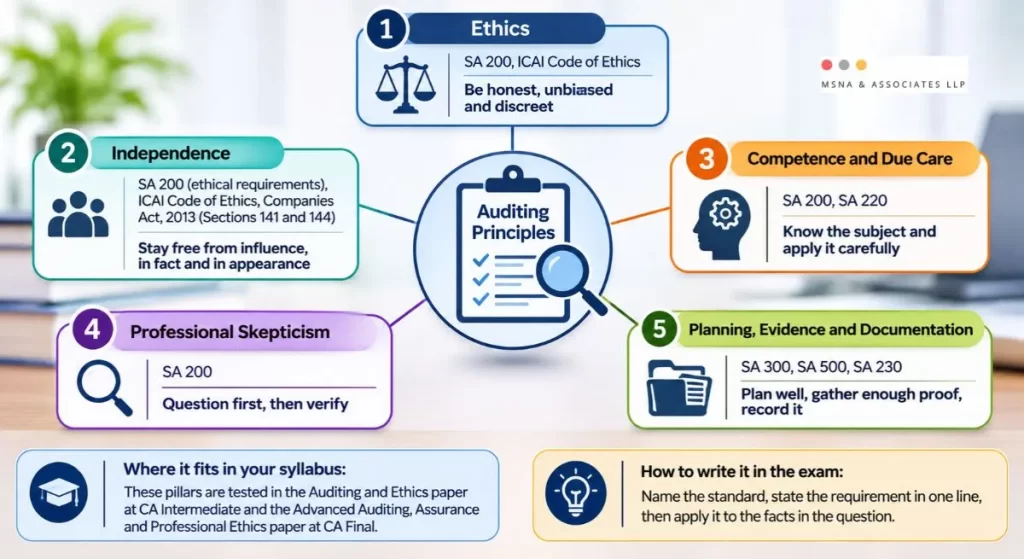
# | Pillar | Main source | What the standard asks for | In one line |
1 | Ethics | SA 200, ICAI Code of Ethics | Integrity, objectivity, confidentiality and professional behaviour | Be honest, unbiased and discreet |
2 | Independence | SA 200 (ethical requirements), ICAI Code of Ethics, Companies Act, 2013 (Sections 141 and 144) | Independence of mind and independence in appearance | Stay free from influence, in fact and in appearance |
3 | Competence and due care | SA 200, SA 220 | A skilled team and a partner who owns quality | Know the subject and apply it carefully |
4 | Professional skepticism | SA 200 | A questioning mind and critical assessment of evidence | Question first, then verify |
5 | Planning, evidence and documentation | SA 300, SA 500, SA 230 | A plan, sufficient appropriate evidence and a file others can follow | Plan well, gather enough proof, record it |
Where this fits in your syllabus: these pillars are tested in the Auditing and Ethics paper at CA Intermediate and the Advanced Auditing, Assurance and Professional Ethics paper at CA Final.
How to write it in the exam: name the standard, state the requirement in one line, then apply it to the facts in the question.
Pillar 1: Ethics, the First of the Principles of Auditing
SA 200 requires an auditor to comply with relevant ethical requirements, which in India means the ICAI Code of Ethics. The core duties are integrity, objectivity, confidentiality and professional behaviour. A breach weakens every other pillar, because an opinion built on compromised ethics cannot be relied on by its readers.
- Integrity: be straightforward and honest in all professional dealings.
- Objectivity: do not let bias, conflict of interest or pressure shape conclusions.
- Confidentiality: do not disclose client information without proper authority or a legal duty.
- Professional behaviour: comply with relevant laws and avoid conduct that discredits the profession.
Worked example (Illustrative):
An auditor notices that personal holiday costs were booked as business travel. The director is a long-time acquaintance and asks for a quiet adjustment. Integrity and objectivity mean the item is evaluated on facts and raised with management. Confidentiality means the auditor never discusses it with the client’s competitor at an industry event.
A common slip is treating a friendly relationship as a reason to soften a finding.
Pillar 2: Auditor Independence in the Principles of Auditing
The Companies Act, 2013 protects independence through Section 141, which lists disqualifications for appointment as auditor, and Section 144, which bars a statutory auditor from providing certain services to the company. Independence has two sides: independence of mind and independence in appearance. Both must hold for the opinion to be credible.
- Independence of mind: the auditor’s thinking is not swayed by relationships or fees.
- Independence in appearance: a reasonable observer would not doubt the auditor’s impartiality.
The Code of Ethics groups threats to independence into five types:
- Self-interest: heavy dependence on one client’s fees.
- Self-review: auditing work the firm itself prepared.
- Advocacy: the auditor starts arguing the client’s case and loses a neutral view.
- Familiarity: a long, close relationship with management.
- Intimidation: the client leans on the auditor so hard that the auditor holds back.
Worked example (illustrative)
A firm writes a company’s books and also audits them, so it would be reviewing its own work. Section 144 of the Companies Act, 2013 bars a statutory auditor from providing certain services directly or indirectly to the company, its holding company or its subsidiary, including “accounting and book keeping services” and internal audit. Section 141 separately lists disqualifications for appointment as auditor, so independence is tested at appointment as well as during the engagement.
It matters because investors and lenders rely on financial reporting only when the auditor is clearly independent.
Next step: list the five threats and note one safeguard for each before your next mock test.
Pillar 3: Professional Competence and Due Care in the Principles of Auditing
Competence means the engagement team has the knowledge the audit needs, and due care means applying it diligently. SA 200 and SA 220 expect suitable skills in the team and an engagement partner who owns quality. If the skills are missing, the firm should train, add a reviewer, use an expert or decline the work.
Worked example (illustrative)
A team accepts a first-year audit of a lender, but nobody has studied the sector’s regulatory reporting. Competence and due care mean upskilling, adding an experienced reviewer, using an expert, or declining the work. Learning on the client’s time is not an option.
A common slip is accepting an engagement first and checking skills later.
Next step: before your next engagement, list the skills it needs and mark any gap in your own team
Pillar 4: Professional Skepticism in the Principles of Auditing
SA 200 describes professional skepticism as a questioning mind that stays alert to possible misstatement and critically assesses audit evidence. It matters most in estimates, related party transactions, revenue recognition and going concern. Skepticism is not distrust. It is verifying before concluding.
Worked example (illustrative)
Sales jump in the last week of March. Management says a large customer ordered in bulk. The skeptical auditor asks for dispatch records, requests customer confirmation and checks April credit notes.
Skepticism is not distrust. It is a habit of verifying before concluding, and a plausible explanation is not accepted simply because the client has been reliable in earlier years.
Next step: take one account balance from a past engagement and write the evidence you would ask for before accepting management’s explanation.
Pillar 5: Planning, Evidence and Documentation as Principles of Auditing
Planning (SA 300), evidence (SA 500) and documentation (SA 230) together reduce audit risk. The auditor sets a strategy and plan, gathers sufficient appropriate evidence for reasonable assurance, and records the work so an experienced auditor with no prior link to the engagement can follow it.
1. Planning (SA 300)
Audit planning means setting an overall audit strategy and a detailed audit plan. It continues through the audit rather than ending at the start.
2. Audit evidence (SA 500 and SA 200)
Evidence must be sufficient, meaning enough in quantity, and appropriate, meaning relevant and reliable. The aim is reasonable assurance, not absolute certainty. Evidence is generally more reliable when it is:
- obtained from an independent external source,
- obtained directly by the auditor rather than inferred,
- available in documentary form rather than oral,
- an original document rather than a copy.
3. Documentation (SA 230)
Audit documentation should let an experienced auditor with no prior link to the engagement understand what was done, what was found and why.
Worked example (illustrative)
For a warehouse client, the plan flags inventory as high risk and schedules attendance at the count. The evidence is the physical count, test counts and a reconciliation to the books. The documentation is signed count sheets, photographs and a written conclusion.
Next step: pick one past working paper and check that it states its purpose, procedure, result and conclusion.
How Audit Risk Connects to the Principles of Auditing?
Audit risk is the risk of giving an inappropriate opinion when the financial statements are materially misstated. It has two parts the auditor must handle: the risk of material misstatement, which exists before the audit, and detection risk, which the auditor controls through planning and evidence. Better planning therefore lowers overall audit risk.
Component | Meaning | How the auditor responds |
Risk of material misstatement | Errors or fraud already sitting in the financial statements before the audit starts | Get to know the entity and assess where things could go wrong (SA 315) |
Detection risk | The chance that the auditor’s procedures miss those errors | Plan carefully and collect evidence aimed at the riskiest areas |
The auditor cannot change the first risk, but can control the second. Better planning and stronger evidence reduce detection risk, which keeps overall audit risk low.
Principles of Auditing in 2026: Numbers and Rules to Know
A few 2026 numbers show why people now look hard at how the principles of auditing are applied in practice, not just recited.
Data point | Source | What it means for you |
15 lakh+ ICAI members and students | A large cohort means examiners see many similar answers, so tying each principle to a named standard sets yours apart. | |
8,964 new CAs at the 12 September 2026 convocation | Every cohort learns the same definitions. Applying them to a real situation is what gets noticed. | |
About 4.42 lakh active ICAI members at 31 March 2026 | ICAI Eastern India Regional Council annual report 2025-26 (all-India figure) | The profession keeps growing, so audit exposure during articleship counts for a lot. |
About 38% of the 4.23 lakh active members were in practice in 2024-25 | Only about two in five practise, so hands-on audit experience sets you apart. | |
NFRA published inspection reports on ten audit firms in March 2026, and several note internal control and documentation gaps | Skepticism and supervision only count if the file shows them. Working papers have to tell the story. | |
ICAI deferred SQM 1 and SQM 2, and SQC 1 continues | Firms still work under SQC 1 today. In an exam answer, treat SQM 1 as where things are heading, not current law. SA 220 as currently applied works with SQC 1, a revised SA 220 was issued alongside SQM 1 and SQM 2, and its status after the deferral is unclear, so confirm before citing it. | |
Revised SAs, including SA 600, reported in June 2026 as proposed from 1 April 2027 (status last checked 11 November 2026) | Group audit rules may tighten once notified. Treat SA 600 as pending and re-check before each exam attempt. |
Our take: NFRA’s 2026 reports show audit quality being judged from what is in the file. That is why skepticism and documentation deserve extra study time.
Do the Principles of Auditing Change for Internal Auditors?
Internal auditors apply the same principles of auditing with a different purpose. Section 138 of the Companies Act, 2013 requires certain companies to appoint an internal auditor.
Pillar | External audit | Internal audit |
Independence | From the company, for shareholders | From the activities audited, with reporting to the board or audit committee |
Evidence | Supports an opinion on financial statements | Supports findings on controls and risks |
Planning | Driven by financial statement risk | Driven by a risk-based annual plan |
Documentation | SA 230 | ICAI Standards on Internal Audit and the Global Internal Audit Standards |
Internal audit often overlaps with enterprise risk management and management audit, where the same pillars apply to controls and operations.
Our guides on how to choose an internal audit partner in India and how to determine the scope of an internal audit in India show the contrast in practice.
What Are the Five Common Myths About the Principles of Auditing?
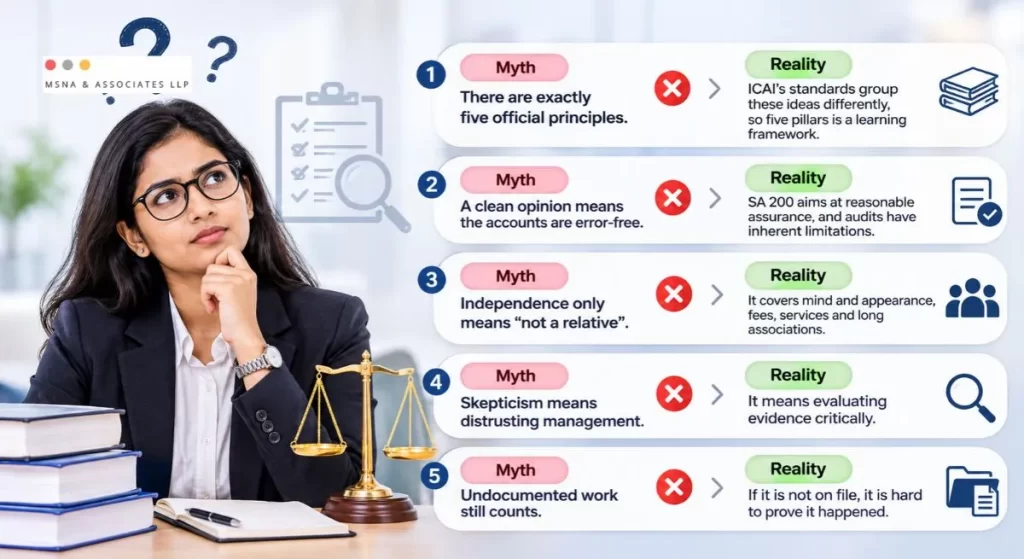
Five misconceptions come up repeatedly among CA students and trainees, and each one has a short correction.
1. Myth: there are exactly five official principles.
Reality: ICAI’s standards group these ideas differently, so five pillars is a learning framework.
2. Myth: a clean opinion means the accounts are error-free.
Reality: SA 200 aims at reasonable assurance, and audits have inherent limitations.
3. Myth: independence only means “not a relative”.
Reality: it covers mind and appearance, fees, services and long associations.
4. Myth: skepticism means distrusting management.
Reality: it means evaluating evidence critically.
5. Myth: undocumented work still counts.
Reality: if it is not on file, it is hard to prove it happened
Which Principle of Auditing Is at Risk? A Quick Self-Check
The table below links common red flags to the pillar they put at risk and a sensible response.
Red flag | Pillar at risk | Sensible response |
Client pressures you to “adjust” a figure | Ethics | Document the request and escalate |
You also prepare the client’s accounts | Independence | Review safeguards and Section 144 |
Unfamiliar sector or new standard | Competence and due care | Train, consult or use an expert |
Explanation accepted verbally | Skepticism | Obtain corroborating evidence |
Working paper has no conclusion | Documentation | Complete it before the file is assembled |
Need Clarity on How the Principles of Auditing Apply to Your Situation?
Ethics, independence, competence and due care, professional scepticism, and well-documented planning and evidence make up the principles of auditing. Knowing the standard behind each pillar turns theory into a confident exam answer.
Applying the principles of auditing to a real engagement depends on the entity, its size and the law that governs it. Consulting an Internal Audit Firm in Bangalore can help you assess how they apply to your situation. You can request a callback from MSNA’s team.
Apply the Principles of Auditing with Professional Clarity
FAQs On the Principles of Auditing
What are the basic principles of auditing?
They are ethics, independence, competence and due care, professional skepticism, and planning with sufficient evidence and documentation. These five pillars are a teaching framework drawn from SA 200 and related Indian Standards on Auditing, not an official list.
Are the principles of auditing the same as AAS 1?
AAS 1 was the earlier ICAI statement of the basic principles governing an audit, and its ideas now sit in SA 200 and the standards around it. Many textbooks still follow AAS 1, which is why their counts differ from this guide.
How many principles of auditing does ISO 19011 list?
ISO 19011:2018 lists seven: integrity, fair presentation, due professional care, confidentiality, independence, an evidence-based approach and a risk-based approach. It applies to management system audits, not to statutory audits of financial statements.
Which SA covers audit documentation?
SA 230, Audit Documentation. It expects the file to be complete enough for an experienced auditor with no prior link to the engagement to understand the work.
Which SA deals with audit planning?
SA 300, Planning an Audit of Financial Statements. Planning is continual and covers both the overall strategy and the detailed plan.
Related
Discover more from MSNA & Associates LLP
Subscribe to get the latest posts sent to your email.