


Your auditor asks one question no policy manual can answer: show me the control, and show me it worked in every month of the year.
An ICFR risk control matrix (RCM) is the register that makes that answer possible. It links each financial reporting risk to the control that prevents or detects it, the role that owns it, and the evidence that proves it ran. If you are an MSME owner, startup founder, director, or finance head facing a statutory audit, lender review or investor diligence in FY 2026-27, this guide shows how to prepare an ICFR risk control matrix under the Companies Act, 2013 and the ICAI Guidance Note on Audit of Internal Financial Controls Over Financial Reporting. It also covers a borrowings and debt servicing example, a cycle that standard templates often omit.
Key Takeaways
- An ICFR risk control matrix is the baseline auditors test against. Without it, controls exist but cannot be evidenced.
- Seven steps build it: scope, walkthrough, risks, controls, ownership, key-control tagging, and a design test.
- Standard templates often stop at procure-to-pay and order-to-cash. Businesses funded by bank lines should add a borrowings and treasury cycle.
- Management owns the matrix. A virtual CFO can maintain it, but testing should stay independent.
- The small company limits went up on 1 December 2025, but your Board report must still comment on controls, and lenders may still ask to see them.
What Is an ICFR Risk Control Matrix?
ICFR stands for internal control over financial reporting. It is the set of policies, processes, and checks a company uses to keep its financial statements reliable, complete, and prepared under the applicable accounting framework. The risk control matrix is the document that records those controls row by row, so each one can be tested.
The 2013 COSO Internal Control – Integrated Framework is the reference most Indian companies use to measure controls. Within it, the RCM sits under control activities. It turns a general statement such as “we review payments” into a specific, testable row.
Four legal anchors explain why Indian finance teams maintain one:
Provision | What it requires | Link to the RCM |
Section 134(5)(e), Companies Act, 2013 | Directors of listed companies confirm that internal financial controls are adequate and operating | The confirmation needs documented backing |
Rule 8(5)(viii), Companies (Accounts) Rules, 2014 | Every company’s Board report comments on internal financial controls | Applies even where the auditor opinion is exempt |
Section 143(3)(i) | The auditor reports on internal financial controls over financial reporting | The RCM becomes the test baseline |
CARO 2020 | Where CARO 2020 applies (small companies and OPCs are exempt), the auditor reports on specific matters, including loan repayment default (clause 3(ix)) | Debt-related controls feed these answers |
“In ICFR engagements, the matrix rarely fails for lack of controls. It fails because a row describes a policy, when it should describe an action that a stranger could re-perform.” — Naveen S N, Partner, MSNA & Associates LLP
Does Your Company Need an ICFR Risk Control Matrix in FY 2026-27?
The small company definition changed recently. The thresholds below apply only to private companies; public companies, holding and subsidiary companies, Section 8 companies and companies governed by special Acts are excluded.
Period | Paid-up capital limit | Turnover limit |
Up to 14 Sep 2022 | ₹50 lakh | ₹2 crore |
15 Sep 2022 to 30 Nov 2025 | ₹4 crore | ₹40 crore |
From 1 Dec 2025 (G.S.R. 880(E)) | ₹10 crore | ₹100 crore |
Small companies, One Person Companies and private companies below ₹50 crore turnover and ₹25 crore borrowings from banks, financial institutions or body corporates (G.S.R. 583(E), 2017) can be exempt from the auditor’s opinion, subject to clean ROC filings. Lenders and acquirers may still ask for control evidence. MSNA’s note on internal financial controls applicability for private companies sets out the conditions.
What Does an ICFR Risk Control Matrix Contain? The 12 Columns?
Each row should be specific enough that two testers would perform it the same way.
# | Column | What to capture | Example |
1 | Process and sub-process | The cycle and step | Procure-to-pay, vendor onboarding |
2 | Risk | What could go wrong | Fictitious vendor created |
3 | Assertion | Existence, completeness, accuracy, valuation, rights, presentation | Existence |
4 | Control objective | What the control must achieve | Only verified vendors are paid |
5 | Control activity | Who does what, when and how | AP head verifies GSTIN and bank proof |
6 | Nature | Manual, automated or IT-dependent | IT-dependent |
7 | Type | Preventive or detective | Preventive |
8 | Frequency | Per transaction to annual | Per vendor |
9 | Owner | A role, never a person’s name | Accounts Payable Manager |
10 | Key control | Yes or no | Yes |
11 | Evidence | The artefact that proves performance | ERP approval log |
12 | Test reference | Link to test result | WP-P2P-04 |
How to Prepare an ICFR Risk Control Matrix: 7 Steps
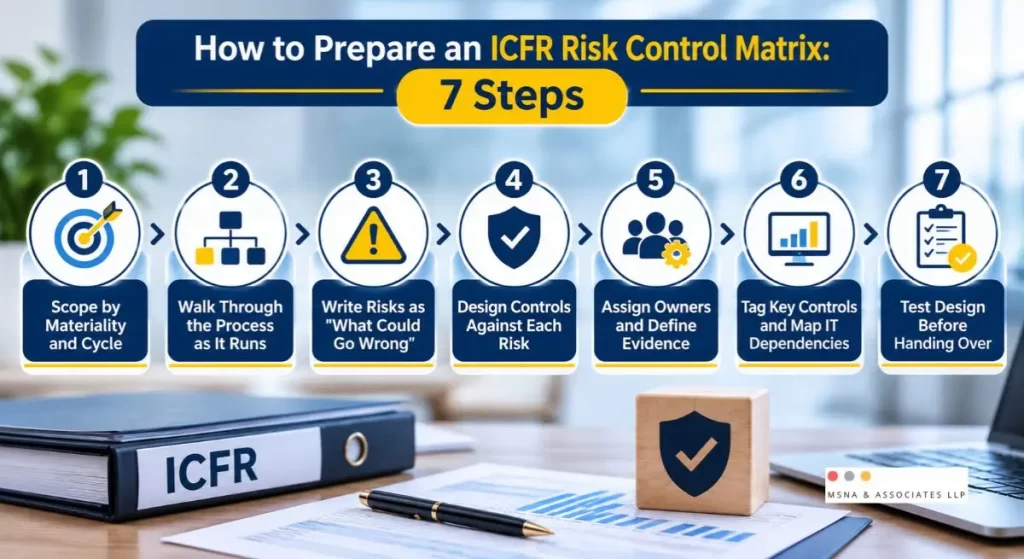
Work through the seven steps below in order, because each one feeds the next.
Step 1: Scope by Materiality and Cycle
Start from the trial balance, not from a template. Pick the significant accounts and map them to cycles such as order-to-cash, procure-to-pay, record-to-report, payroll, fixed assets and borrowings. For smaller companies, a lean scope of five or six cycles is usually more maintainable than a sprawling one.
Step 2: Walk Through the Process as It Runs
Trace one real transaction from origin to ledger with the person who handles it. Record the spreadsheets, WhatsApp approvals and workarounds, because those are where risk hides.
Step 3: Write Risks as “What Could Go Wrong”
A good risk statement names the error and the assertion it threatens. “Duplicate vendor invoice booked, overstating payables” is testable. “Payables risk” is not.
Step 4: Design Controls Against Each Risk
Prefer preventive controls
Set approval limits, system validations and segregation of duties so a wrong entry is blocked before it reaches the ledger.
Back them with detective controls
Reconciliations and exception reports catch what slips through. Neither type alone is enough.
Step 5: Assign Owners and Define Evidence
Name the owning role, the frequency and the exact artefact produced, such as a dated reconciliation with preparer and reviewer sign-off. Evidence that is a by-product of normal work survives staff changes.
Step 6: Tag Key Controls and Map IT Dependencies
Mark the controls whose failure could cause a material misstatement. Then note which ERP report, access right or interface each one relies on, since an unreliable report undermines the control built on it.
Step 7: Test Design Before Handing Over
Ask whether the control, if performed as written, would stop the risk. Fix design gaps now. Operating tests, sample sizes and deficiency grading follow in MSNA’s ICFR audit checklist for 2026.
ICFR Risk Control Matrix Example: Borrowings and Debt Servicing
Standard templates often end at sales and purchases. Yet for many MSMEs, working capital lines and term loans carry real reporting exposure: unrecorded liabilities, covenant breaches and misclassified maturities. This cycle also supports debt management for businesses that rely on bank funding.
Risk | Control | Type and frequency | Evidence |
Loan, interest or charge not fully recorded | Loan ledger reconciled to lender statements and sanction letters; differences cleared before close | Detective, monthly | Signed reconciliation, lender confirmation |
Instalment or interest date missed, creating a CARO clause 3(ix) matter where CARO applies | Repayment calendar built from sanction terms; payment approved before the due date | Preventive, per due date | Calendar, bank advice |
Covenant breach goes unnoticed | Tracker computes the debt-to-equity ratio and debt servicing ratio from the trial balance; breaches escalated | Detective, monthly | Tracker with reviewer sign-off |
Interest accrued at the wrong rate | Interest recomputed independently against the lender statement | Detective, monthly | Recomputation sheet |
Current and non-current split wrong, or restructuring booked incorrectly | Maturity analysis reviewed against Schedule III; modified terms assessed under applicable Ind AS or AS | Preventive, quarterly and per event | Maturity schedule, accounting memo |
Cash shortfall threatens repayments | Rolling 13-week cash flow forecasting compared with actual bank balances | Detective, weekly | Variance report |
What These Rows Add Beyond Compliance
- Debt repayment planning becomes auditable because the calendar is a control, not a reminder.
- Interest cost optimisation gets a factual base when recomputed interest is compared with the sanctioned rate.
- Working capital management improves when drawing power statements are checked against the ledger.
- Any debt restructuring triggers an immediate matrix update, since terms, classification and covenants may all change.
One caution: the ₹25 crore test for borrowings from banks, financial institutions and body corporates in G.S.R. 583(E) is applied at any time in the year, so a short peak can matter. Track your highest drawdown, not only the closing balance.
The Covenant Early-Warning Ladder
Waiting for a lender’s breach notice is too late for negotiation, so build alert levels into the tracker. The levels below are illustrative; calibrate them to your own sanction terms.
Alert level | Trigger (illustrative) | Action | Owner |
Green | Ratios sit comfortably inside covenant limits | Routine monthly tracker review | Finance Manager |
Amber | Debt-to-equity ratio or debt servicing ratio nears the covenant limit | Rework the cash flow forecast and brief the CFO | CFO or virtual CFO |
Red | A breach looks likely within the next quarter | Open early lender dialogue and assess restructuring options | Board and CFO |
Where ICFR Risk Control Matrices Fail: What 2026 Benchmarks Indicate
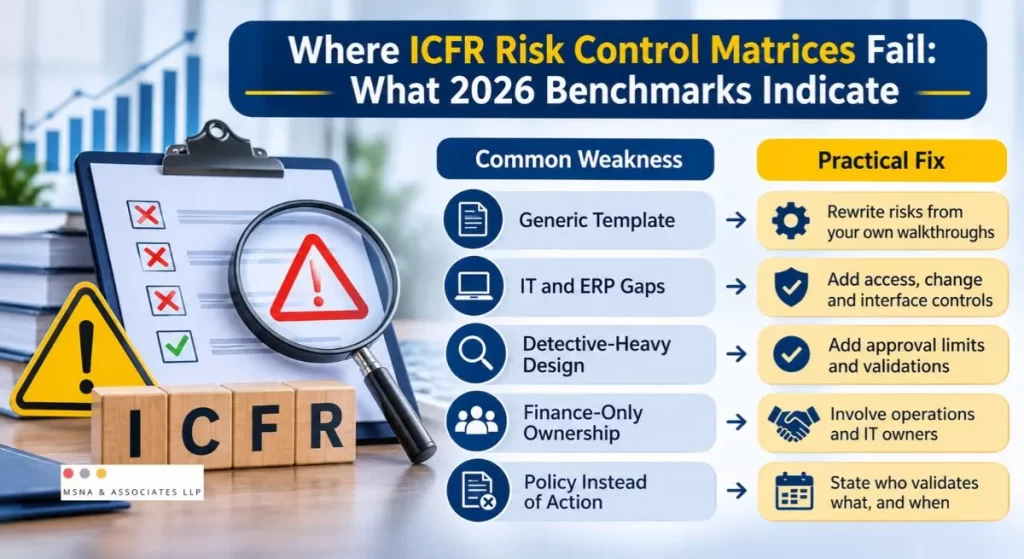
Based on PKC Management Consulting’s internal audit and IFC engagements, Indian enterprises above ₹100 crore turnover document 150 to 350 risk-control pairs, yet coverage is often uneven. Its message is that quality matters more than row count.
Weakness | What it looks like | Practical fix |
Generic template | Risks copied from a library, none specific to your business | Rewrite risks from your own walkthroughs |
IT and ERP gaps | Manual controls detailed, system controls absent | Add access, change and interface controls |
Detective-heavy design | Reconciliations everywhere, few system blocks | Add approval limits and validations |
Finance-only ownership | Inventory, logistics and sales controls described thinly | Involve operations and IT owners |
Policy instead of action | “Expenses follow policy” | State who validates what, and when |
These gaps matter for financial risk management as well, since an unmapped risk is simply an unmanaged one.
How Healthy Is Your Matrix? A Five-Question Self-Score
Give one point for each “yes”.
- Does the matrix reflect a process walkthrough done in the last twelve months?
- Is every significant ledger account mapped to at least one key control?
- Are borrowings and treasury covered, not only sales and purchases?
- Were last year’s design gaps closed and retested?
- Does the audit committee or Board see a summary of deficiencies?
Score | Reading | Suggested next step |
0 to 1 | Documentation is thin | Rebuild from scope and walkthroughs |
2 to 3 | Foundation exists | Repair the weakest cycle first |
4 to 5 | Reasonably mature | Maintain and test on a schedule |
Who Should Own the Matrix? Where a Virtual CFO Fits
Responsibility for internal financial controls rests with management and the Board. Section 144 limits the statutory auditor from providing internal audit services, so separation of roles matters.
Ownership model | Strength | Gap to watch |
Founder or accountant-led | Close to daily operations | Limited time and control design experience |
Full-time CFO | Deep context | Cost may not suit smaller companies |
Virtual CFO with independent internal audit | Senior oversight with separate testing | Needs clear role definitions |
What Virtual CFO Services Add Beyond Documentation?
Virtual CFO services can connect the matrix to decisions. MSNA’s note on virtual CFO for MIS shows how reporting and controls reinforce each other.
Cash flow and covenant oversight
A virtual CFO ties the matrix to cash flow by owning the forecast, variance review and covenant tracker. If you are unsure of the role, see what a virtual CFO does.
Debt discipline
For debt management for businesses, the same person can lead debt repayment planning and review restructuring offers. Our financial decision making service covers this layer.
Build Your ICFR Risk Control Matrix With Professional Support
If you would like to discuss how this applies to your company, the Chartered Accountants at MSNA & Associates LLP support ICFR documentation, SOP and RCM preparation and testing, alongside Virtual CFO services and financial planning for SMEs. The right scope depends on your size, systems and funding structure.
Strengthen Your ICFR Framework with the Right Controls
Frequently Asked Questions About the ICFR Risk Control Matrix
What should you do if only one person knows how a control works?
In an ICFR risk control matrix, a control known to only one person should be documented as a written step. Record the owning role, the frequency and the evidence it produces, then assign a backup owner so the control survives staff changes.
What is the difference between a key control and a compensating control in ICFR?
A key control is a control whose failure could cause a material misstatement in the financial statements. A compensating control is a separate control that reduces the same risk when the key control has a gap. Both should be recorded in the matrix.
How are outsourced provider controls recorded in an ICFR risk control matrix?
Controls performed by outside providers, such as payroll processors or cloud ERP vendors, are listed as service-provider controls. The company adds its own check on the provider’s output, such as reviewing the payroll report, and requests the provider’s assurance report where one exists.
How long should ICFR control evidence be kept in India?
Control evidence should be kept at least as long as the books of account, which Section 128(5) of the Companies Act, 2013 requires companies to preserve for eight financial years. Confirm the exact period with your statutory auditor.
Related
Discover more from MSNA & Associates LLP
Subscribe to get the latest posts sent to your email.