
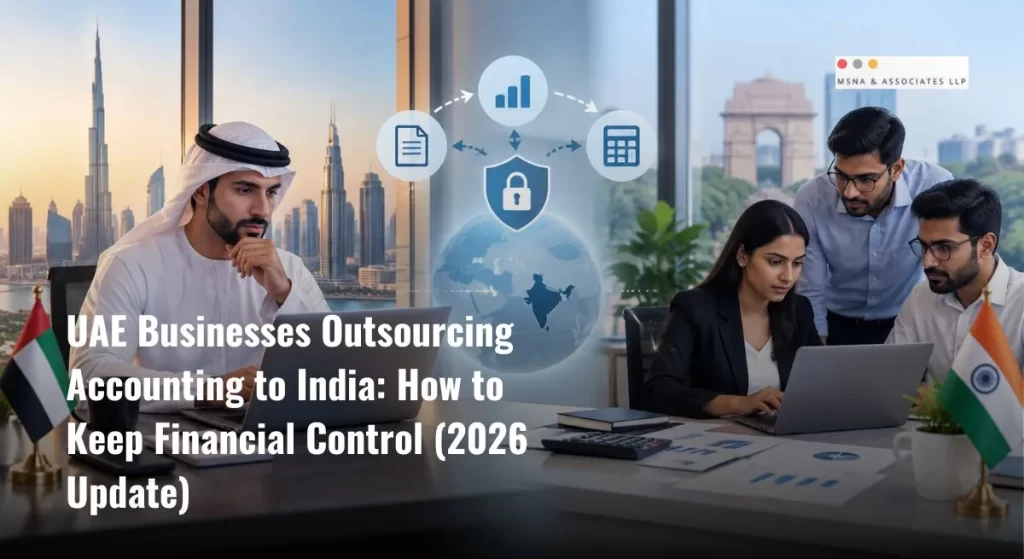

Outsourcing your accounting to an India-based provider doesn’t mean losing financial control for a UAE business. It just means splitting the work differently. Let the outsourced team handle transaction processing, reconciliations, and reporting. But approvals, bank access, and vendor payments? Keep those with someone inside your UAE company. This split, backed by a documented approval workflow and an audit trail, keeps outsourcing efficient without weakening oversight.
As more UAE SMEs move bookkeeping offshore to manage Corporate Tax, VAT, and WPS obligations, the question finance heads ask most is not whether outsourcing accounting to India saves money, but whether they will still know what’s happening in their own books.
What Does Financial Control for UAE Business Mean Once Accounting Moves Offshore?
Outsourcing does not remove control; it relocates tasks while control itself stays in-house. Financial control breaks down into five functions:
- Authorization: who approves a payment, journal entry, or vendor onboarding
- Custody: who holds banking credentials, digital signatures, and payment tokens
- Recording: who enters transactions, reconciles accounts, and prepares statements
- Review: who checks recorded numbers against source documents and business context
- Reporting: who consolidates data into decisions the business can act on
An India-based team handles recording and, in many models, first-level reconciliation. Authorization, custody, and final review are functions a UAE business should retain.
Why Are More UAE Businesses Outsourcing Accounting to India in 2026?
A compliance calendar that has grown heavier since 2023 is driving the shift.
Driver | What Changed | Why It Pushes Outsourcing |
Corporate Tax at 9% | In force since June 2023, filing due nine months after the year-end | SMEs need audit-ready books, not the year-end scrambles |
Small Business Relief re-election | Extended to periods ending on or before 31 December 2029, same AED 3 million threshold | Relief is elective, so clean records still matter |
VAT and WPS obligations | Ongoing monthly and quarterly filings | Small finance teams stretched across the regulators |
Market growth | UAE’s outsourced finance sector has expanded on a structural basis, not a cyclical one | Reflects a structural shift, not a cost-cutting trend |
So what exactly is Small Business Relief? It’s an election under UAE Corporate Tax law that lets an eligible business be treated as having no taxable income for a given period, meaning no Corporate Tax is due for that period. It’s open to businesses with revenue up to AED 3 million.
The relief now covers periods ending on or before 31 December 2029, so there’s less near-term pressure. But the core requirements stay the same. A business still has to register for Corporate Tax, file its return, and keep proper records every year. Relief must be claimed each period; it isn’t automatic. And if revenue crosses AED 3 million even once, eligibility is lost for that period. This is why many UAE businesses are formalizing outsourced accounting arrangements now, rather than waiting for a deadline.
For a fuller picture of the upside beyond audit-readiness, see the benefits of outsourced accounting services to India for UAE firms, and against what it costs to set up and run, covered in our breakdown of what it costs to outsource accounting to India.
Which Financial Controls Should Stay With the UAE Business?
A clear division of responsibility, agreed before the engagement starts, prevents most disputes later.
Function | Delegated to India Team | Stays With UAE Business |
Bookkeeping and data entry | Yes | No |
Bank and VAT reconciliations | Yes (first level) | Signed off by UAE finance lead |
Vendor bill processing | Yes | Payment release needs UAE-side approval |
Bank login and payment execution | No | Yes, always |
Journal entry creation | Yes | Posting above a threshold needs approval |
New vendor or payee setup | Draft only | Final approval and verification |
Monthly MIS and reports | Prepared | Reviewed against business context |
Statutory filings (VAT, CT return) | Prepared/supported | Signed under UAE-side authority |
This is a segregation of duties model applied across borders: the person who records a transaction should never be the one who authorizes payment for it.
How Should Approval Workflows Support Financial Control for a UAE Business?
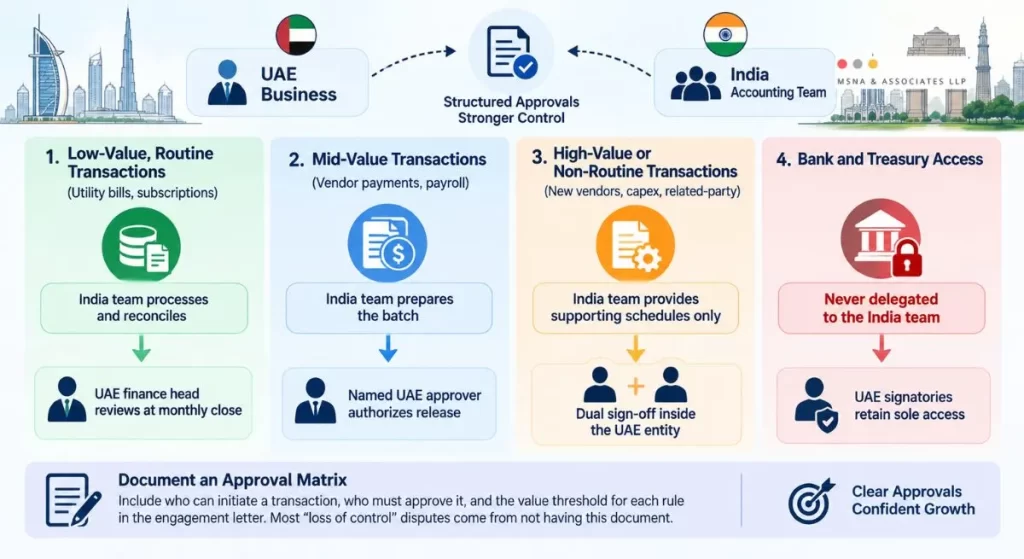
Approval workflows work best when tiered by risk, not applied uniformly.
- Low-value, routine transactions (utility bills, subscriptions): India team processes and reconciles; UAE finance head reviews at monthly close
- Mid-value transactions (vendor payments, payroll): India team prepares the batch, a named UAE approver authorizes release
- High-value or non-routine transactions (new vendors, capex, related-party): dual sign-off inside the UAE entity, outsourced team provides supporting schedules only
- Bank and treasury access: never delegated; UAE signatories retain sole access
A simple approval matrix in the engagement letter makes this work in practice. It should name who can initiate a transaction, who must approve it, and the value at which each rule applies. Most “loss of control” disputes come from not having this document.
What Should the Agreement Say About Audit Trails and Vendor Governance?
An engagement letter covering only pricing and turnaround leaves oversight to informal trust.
Clause | What It Should Specify |
Audit trail | Every entry, edit, and reconciliation timestamped and traceable; logs retained for the statutory period |
Access control | Role-based access, India team restricted from payment execution and admin settings |
Reporting cadence | Defined close timeline, report formats, escalation path for discrepancies |
Dashboard visibility | Real-time or near real-time access, not just month-end PDFs |
Right to audit | UAE business can have an independent auditor review the provider’s working papers |
Data handling | Where data is stored, how it is transferred, what happens if the engagement ends |
Real-time dashboards deserve particular attention, since they turn oversight into continuous monitoring rather than a monthly retrospective exercise.
What Does Financial Control for UAE Business Look Like as a Business Grows?
A new outsourcing setup doesn’t need the same level of oversight as one running for years. Controls should get stronger as revenue and complexity grow.
Stage | What Oversight Looks Like | Typical Trigger | Biggest Risk If Left Unaddressed |
1. Reactive | One shared bank login. No approval matrix. | First few months of outsourcing | No record of who approved what |
2. Managed | Approval matrix in place. Reconciliations signed off. | Revenue crosses AED 3-5 million | Gaps in visibility between monthly closes |
3. Proactive | Approvals tiered by risk. Real-time dashboard in use. | Multiple entities or related-party deals begin | Data transfer basis not documented |
4. Governed | Automatic variance alerts. Independent annual audit. | Financing, restructuring, or an FTA audit | Low risk, if earlier stages are already in place |
A Dubai-based trading company outsourcing bookkeeping to India usually starts at Stage 1: one shared login, approvals over WhatsApp. The move to Stage 2 typically happens after a payment gets released without proper sign-off. Businesses that reach Stage 3 before their first Corporate Tax audit spend far less time reconstructing records later.
Does UAE Data Protection Law Apply to Data Sent to India?
Yes, and this is the part of the outsourcing decision that gets the least attention.
- Under Federal Decree-Law No. 45 of 2021 (the PDPL), personal data can’t be transferred outside the UAE unless the destination country offers adequate protection or contractual safeguards are put in place
- No formal adequacy list exists yet from the UAE Data Office. That means businesses sending data to India need to lean on documented contractual safeguards and a clear legal basis, not an assumption that it’s fine
- Invoices, payroll records, and employee identifiers all count as personal data more often than people expect, which is why the engagement agreement needs its own dedicated data processing clause
- One exception worth knowing: DIFC and ADGM-registered entities answer to their own data protection regimes, not the federal PDPL
What Mistakes Undermine Financial Control for a UAE Business?
Most control failures are process gaps, not provider failures.
- Bank credentials get shared for convenience. Access is rarely revoked afterward.
- The monthly report is treated as the only checkpoint. It isn’t enough.
- There’s no written approval matrix. Transactions run on informal trust instead.
- Compliance is assumed to sit with the provider. It doesn’t. Filings still need UAE sign-off.
- The data transfer clause gets left out of the agreement. That’s a PDPL gap.
- There’s no exit plan. Switching providers becomes a continuity risk when there’s no plan for it.
What Does Monthly Oversight Look Like in Practice?
Consistent oversight comes from a short, repeatable checklist.
Frequency | Control Activity | Owner |
Weekly | Review pending approvals and cash position | UAE finance head |
Weekly | Spot-check vendor bills against documents | UAE finance head |
Monthly | Sign off on bank reconciliation | UAE authorized signatory |
Monthly | Review MIS report, flag anomalies | UAE finance head / owner |
Quarterly | Review access logs and permissions | UAE finance head |
Quarterly | Revisit the approval matrix | UAE finance head |
Annually | Independent review of working papers | External auditor |
Where Is Financial Control for UAE Business Headed Next?
Most UAE SMEs currently treat oversight as a monthly reconciliation habit. That is likely to change as Corporate Tax filings mature and FTA scrutiny on documentation increases. As a result, real-time dashboard access is moving from a nice-to-have to a baseline expectation.
Data governance is the other shift worth watching. As UAE Data Office guidance on cross-border data transfers becomes clearer, agreements that treat data transfer as a footnote will need to formalize it as a standing clause, reviewed alongside pricing and SLAs.
Where This Leaves UAE Finance Heads?
Outsourcing accounting to India does not require choosing between cost efficiency and control. It requires deciding, in writing, which functions move offshore and which stay with the UAE entity, then backing that decision with an approval matrix, an audit trail, and a data transfer clause that holds up under scrutiny.
Consulting a professional can help you assess how these control structures apply to your outsourcing arrangement.
Need Clarity on Financial Control for Your UAE Business?
Frequently Asked Questions About Financial Control for UAE Business
Can a UAE business be penalized for errors made by its India-based team?
Yes. The provider doesn’t carry statutory responsibility; the UAE entity does. That’s exactly why final review and sign-off can’t be delegated away.
Does outsourcing mean losing real-time visibility into finances?
Not if it’s set up properly. Dashboard access and a fixed reporting schedule solve this. If visibility feels like it’s slipping, that’s usually a hole in the agreement, not a problem with outsourcing itself.
How often should a business review its provider's controls?
A weekly dashboard check, a monthly sign-off, and an annual independent review of working papers is a reasonable baseline.
Is it safe to share UAE financial data with a provider in India?
It can be, as long as the engagement includes a documented data transfer basis, role-based access, and an audit trail, confirmed before the engagement starts.
Does the Small Business Relief extension to 2029 change any of this?
No. It reduces near-term pressure, but relief still has to be claimed each year, and filing and record-keeping obligations remain.
Related
Discover more from MSNA & Associates LLP
Subscribe to get the latest posts sent to your email.