


Your books are a week behind. VAT filing season is coming up, and the one person who understands your accounts just handed in their notice. Hiring a replacement in the UAE means another AED 8,000-18,000 a month, plus weeks of recruiting you don’t have time for right now.
This is the exact point where outsourcing to India starts making sense. UAE firms commonly report cost reductions in the 60-80% this way, while gaining a full team of qualified accountants instead of one in-house hire, also without the visa sponsorship, the recruiting cycle, or the risk of losing everything when one person leaves.
Cost isn’t the only reason this model has grown across the UAE.
This guide walks through seven specific benefits of outsourced accounting to India from the UAE, the parts of the process such as what onboarding actually looks like, free zone vs mainland nuances, and the mistakes firms make and the concerns first-time outsourcers raise before signing on.
Benefit 1: Cost Savings of 60-80% Over an In-House Hire
The cost comparison is usually where this conversation starts, and it’s the easiest one to verify.
Option | Typical Monthly Cost |
In-house accountant in the UAE, fully loaded | AED 8,000-18,000 |
Outsourced accounting, UAE-based firm | AED 999-5,000 |
Outsourced accounting, India-based firm | Often lower still, commonly cited at roughly 50% below UAE market rates |
Our view: the businesses that get the most value from this shift aren’t just comparing a salary line to a service fee. They’re comparing one full-time hire’s bandwidth against a small team, a bookkeeper, a reviewer, and a manager, for close to the same money. That structural difference matters more than the headline savings percentage.
Benefit 2: Access to a Deep Chartered Accountant Talent Pool
Finding and retaining qualified accounting talent in the UAE isn’t simple:
- Sponsoring a visa
- Matching competitive local salaries
- Finding candidates who bring both UAE compliance knowledge and broader accounting depth
All of it makes hiring harder than it should be.
India’s Institute of Chartered Accountants has over 400,000 qualified members, among the largest professional accounting bodies in the world by membership. That’s real depth, not a thin market stretched to meet demand. A single local hire also caps what your business has access to:
- One person
- One level of experience
- One specialty
- One set of blind spots
If that person leaves, the knowledge usually leaves with them.
Outsourcing to India removes most of that friction. A UAE firm gets access to Chartered Accountants and trained bookkeepers:
- Without sponsoring a visa
- Without a lengthy local recruitment cycle
- Without carrying the cost of a role that may only need part-time attention in its early stage
Benefit 3: A Time Zone Overlap That Works for Daily Collaboration
At the core of this advantage is a simple fact:
India and the UAE are only 1.5 hours apart. The UAE runs on GST (UTC+4); India runs on IST (UTC+5:30).
Compare that to outsourcing relationships with the US or UK, where a 9- to 12-hour gap means real-time collaboration barely overlaps with the local business day. A UAE finance head working with an India-based team can join the same calls, get same-day answers, and review work together in real time, not just hand off tasks overnight and hope for the best.
We’ve seen UAE firms assume outsourcing means slower turnaround, based on experience with far more distant time zones. With India, the opposite tends to be true. A query raised at 11 AM in Dubai can be answered before lunch, not the next morning.
Benefit 4: VAT and Corporate Tax Compliance Built Into the Engagement
Under Federal Decree-Law No. 8 of 2017 on VAT, registration is mandatory once taxable supplies and imports cross the AED 375,000 threshold on a rolling 12-month basis. Corporate Tax applies at 9% above the same threshold under Federal Decree-Law No. 47 of 2022. Missing either isn’t a small mistake.
Late VAT registration alone carries a fixed AED 10,000 penalty under Cabinet Decision No. 49 of 2021 (as amended by Cabinet Decision No. 129 of 2025, effective 14 April 2026), on top of any backdated VAT owed from the date the threshold was crossed, and penalties scale further depending on the nature and duration of the non-compliance.
A properly structured outsourced accounting engagement includes:
- Monthly bookkeeping that feeds directly into VAT return preparation
- VAT filing support aligned to FTA deadlines, not reconstructed at the last minute
- Corporate Tax return support, including the IFRS-based record-keeping the law requires
- Record retention handled correctly: seven years for Corporate Tax records from the end of the relevant tax period (Federal Decree-Law No. 47 of 2022), five years for VAT records (Federal Decree-Law No. 8 of 2017)
Benefit 5: A Finance Function That Scales With Transaction Volume
A single in-house accountant has a ceiling. Once transaction volume, entity count, or reporting complexity outgrows what one person can handle, the business either hires again or falls behind. An outsourced team scales by adjusting scope, adding hours or a second reviewer, without a new hiring cycle, a new visa, or a new desk.
The businesses that benefit most from this are the ones growing unevenly, a strong quarter followed by a quieter one, where a fixed in-house headcount is either underused or overwhelmed depending on the month. A scalable model matches cost to actual workload instead of guessing at a fixed hire in advance.
Benefit 6: A Built-In Review Layer A Single In-House Hires Doesn't Structurally Have
A single in-house accountant closes their own books. There’s no structural second pair of eyes unless the business pays for one separately. Most outsourced engagements are staffed differently by design: a bookkeeper who prepares the entries, and a senior accountant or manager who reviews them before they reach you. That review layer is part of the standard engagement scope, not an add-on.
Our view:
This matters most in the months that feel routine, when a single overworked in-house hire is most likely to miss a reconciliation gap or a misclassified entry. A second reviewer catches that before it becomes a VAT filing problem, not after.
How Does Outsource Accounting to India from UAE Onboarding Look in the First 90 Days?
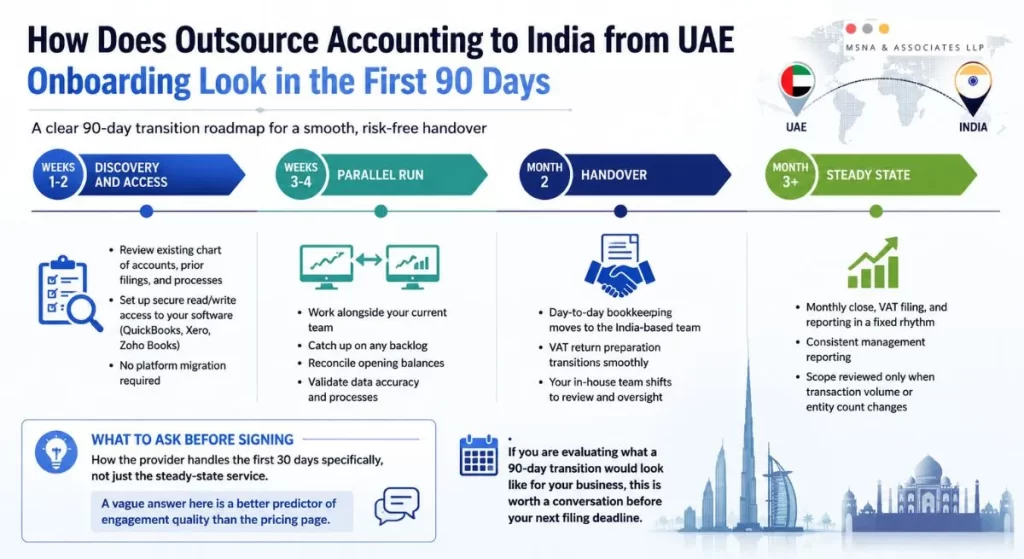
In practice, a properly run transition follows a rough sequence that lands somewhere in the 60-90 day range, though a larger backlog, multiple entities, or a more complex chart of accounts can extend it. Knowing the accounting outsourcing process to India in advance is what separates a smooth handover from a messy one.
- Weeks 1-2: discovery and access. The provider reviews your existing chart of accounts, prior filings, and software (QuickBooks, Xero, or Zoho Books), and sets up read/write access without requiring you to migrate platforms.
- Weeks 3-4: parallel run. The India-based team works alongside whoever currently handles your books, catching up on any backlog and reconciling opening balances before taking primary ownership.
- Month 2: handover. Day-to-day bookkeeping, VAT return preparation, and reporting cadence move fully to the outsourced team, with the in-house side shifting to review rather than data entry.
- Month 3 onward, steady state. Monthly close, VAT filing, and management reporting settle into a fixed rhythm, and the engagement scope is revisited only when transaction volume or entity count changes.
What to ask before signing: how the provider handles the first 30 days specifically, not just the steady-state service. A vague answer here is a better predictor of engagement quality than the pricing page.
If you are evaluating what a 90 – day transition would look like for your business, this is worth a conversation before your next filing deadline.
Free Zone vs Mainland: Does It Change What You Should Outsource?
This is a UAE-specific nuance that’s easy to miss and expensive to get wrong.
Free zone entities (DMCC, JAFZA, DIFC, and similar) used to carry a separate Economic Substance Regulations (ESR) filing obligation on top of everything else. That standalone requirement was abolished for financial years starting 1 January 2023 onward under Cabinet Decision No. 98 of 2024, so there’s no separate ESR notification or report to submit anymore.
What replaced it matters more. To keep the 0% Corporate Tax rate as a Qualifying Free Zone Person (QFZP), a free zone entity now has to demonstrate adequate substance directly through its Corporate Tax filing. That means the underlying documentation, UAE-based staff, assets, and operating expenditure evidencing real activity has to be scoped into the bookkeeping from day one, not assembled after the fact.
Mainland entities generally follow the standard FTA compliance calendar without the QFZP substance layer, but may have different UBO (Ultimate Beneficial Owner) reporting timelines depending on the licensing authority.
A generic bookkeeping engagement scoped without accounting for which category your entity falls into is one of the more common gaps we see. If your business operates in a free zone and relies on the 0% rate, confirm the outsourced provider explicitly scopes QFZP substance documentation into the engagement, not just standard VAT and Corporate Tax bookkeeping.
Common Mistakes UAE Firms Make When Outsourcing to India
These come up often enough in early conversations that they’re worth naming directly, rather than only listing what to look for in a provider.
1. Treating it as “fire and forget.”
Outsourcing reduces day-to-day involvement; it doesn’t remove the need for a monthly review call. Businesses that skip this tend to be the ones surprised by a filing issue.
2. Not confirming software access upfront.
If the provider asks you to export data into a separate system rather than working inside your existing QuickBooks, Xero, or Zoho Books account, that’s worth questioning before signing.
3. Underestimating the backlog catch-up period.
If your books are already behind, budget for the parallel-run phase to take longer than a clean handover would.
4. Not asking who reviews the work.
A provider that can’t clearly describe their internal review layer (see Benefit 6) is likely running a single-preparer model with an outsourcing label on it.
5. Ignoring the free zone vs mainland distinction.
A generic engagement scope that doesn’t account for QFZP substance requirements can leave a free zone entity’s 0% Corporate Tax rate exposed at filing time.
Is My Financial Data Actually Secure?
This is usually the first concern a UAE business owner raises, and it’s a fair one before handing over financial records.
A reputable provider should be able to show real security standards, not just claim them:
- SOC 2 Type II or ISO 27001 certification, independently verified, not self-declared
- Encrypted data transfer and storage, both in transit and at rest
- No local data downloads. Work should happen inside your existing accounting software, not in files copied onto a personal device
- Clear data residency and access controls, so you know exactly who can see what
Ask for these directly before signing anything. A provider that can’t produce them isn’t the right fit for a UAE business handling FTA-facing records, regardless of price. MSNA’s team outlines what documentation and access controls are covered as standard.
Common Concerns UAE Business Owners Have Before Outsourcing
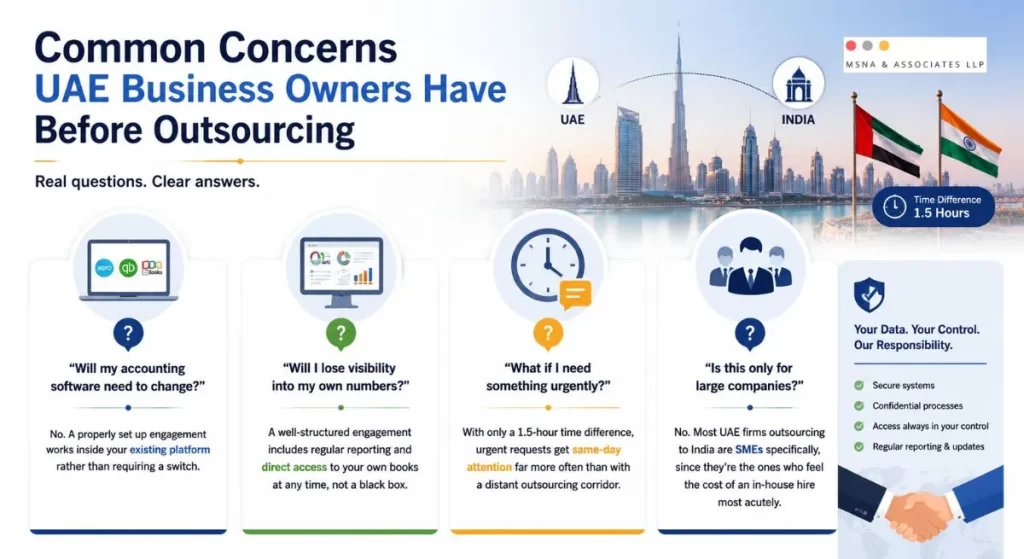
These are the questions that come up in nearly every first conversation on the benefits of outsourced accounting to India from the UAE.
“Will my accounting software need to change?”
No. A properly set up engagement works inside your existing platform rather than requiring a switch.
“Will I lose visibility into my own numbers?”
A well-structured engagement includes regular reporting and direct access to your own books at any time, not a black box.
“What if I need something urgently?”
With only a 1.5-hour time difference, urgent requests get same-day attention far more often than with a distant outsourcing corridor.
“Is this only for large companies?”
No. Most UAE firms outsourcing to India are SMEs specifically, since they’re the ones who feel the cost of an in-house hire most acutely.
Benefits of Outsourced Accounting to India from UAE: Getting Started
The benefits of accounting outsourcing from the UAE to India go beyond the cost savings that usually start the conversation: real talent depth, a workable time overlap, a built-in review layer, and a finance function that scales with the business rather than against it.
MSNA works with UAE firms specifically to structure this properly from the start, VAT and Corporate Tax support included, free zone and mainland nuances accounted for, not bolted on later. Consulting a professional can help you in Outsource Accounting / Bookkeeping Services To India For UAE Business what a properly scoped engagement would actually look like for your business.
Evaluate Your Accounting Outsourcing Needs
Benefits of Outsourced Accounting to India from UAE: Frequently Asked Questions
What are the main benefits of outsourced accounting to India from UAE?
Lower cost, typically 60-80% below an in-house hire, access to a deep pool of qualified accountants, a workable time zone overlap, a built-in review layer, and a team that scales with transaction volume instead of a fixed headcount.
Is outsourcing accounting to India cheaper than hiring within the UAE?
Yes, significantly. An in-house accountant in the UAE runs AED 8,000-18,000 a month fully loaded. Outsourced accounting, particularly from India, typically comes in well below that.
How long does it take to transition to an outsourced accounting team?
A structured transition typically runs 60-90 days: discovery and access in the first two weeks, a parallel run through week four, handover in month two, and steady-state operation from month three onward.
How big does a business need to be before outsourcing to India makes sense?
There’s no minimum size. Many UAE SMEs outsource specifically because they’re too small to justify a full-time in-house hire, not despite it.
Related
Discover more from MSNA & Associates LLP
Subscribe to get the latest posts sent to your email.