


If your company has already completed branch office registration in India, the setup stage is behind you. What comes next is a recurring compliance cycle.
It touches the RBI, the Registrar of Companies (ROC), the Income Tax Department, and GST authorities. Each one runs on its own timeline. Missing any one of them can put the branch office’s operating approval at risk.
This guide covers the branch office compliance requirements that a branch office in India by a foreign company must maintain year after year.
2026 update: The Income-tax Act, 2025 came into force on 1 April 2026, replacing the six-decade-old Income-tax Act, 1961 from Tax Year 2026-27 onward. It renames “Assessment Year” and “Previous Year” as a single “Tax Year,” and renumbers sections (for example, the tax audit rule under Section 44AB of the 1961 Act becomes Section 63 under the new Act). The compliance obligations themselves (PAN/TAN, ITR-6, tax audit, transfer pricing) stay the same in substance. Only the terminology and section numbers change. Income earned up to 31 March 2026 is still assessed under the 1961 Act.
Key Takeaways
- Branch office compliance spans four independent systems such as RBI (via AD bank), ROC, Income Tax, and GST. None of them cross-check automatically, so mismatches between filings can trigger queries from more than one regulator.
- The Annual Activity Certificate, due every September 30, underpins nearly everything else. Three consecutive years of missed AAC filings can trigger automatic closure of the branch.
- FC-3 and FC-4 look similar but run on different clocks from the same year-end: FC-4 is due within 60 days, FC-3 within 6 months.
- For US and UAE parent companies, the Indian branch’s April – March compliance year never lines up with the parent’s own fiscal calendar, so group consolidation needs its own reconciliation step.
What Is a Branch Office in India by a Foreign Company, and What Law Governs It?
A branch office is one of three routes a foreign company can use to have a physical presence in India. The other two are a liaison office and a project office. For US and UAE parent companies weighing their options before committing to a branch structure, it’s worth comparing this against the alternative: you can set up a new company in India from the USA or set up a new company in India from the UAE as a wholly owned subsidiary instead.
A foreign company’s branch office in India operates as an extension of the parent company. It is not a separate Indian legal entity. That is exactly why its compliance sits across two regulatory systems at once:
Framework | Governs | Key requirement |
Setup and ongoing activity | Prior RBI approval via an AD Category-I bank | |
Companies Act, 2013 – Section 380 | Annual reporting to the ROC | FC-3 and FC-4 filings each year |
Both frameworks apply continuously, not just at the point of registration.
What Activities Can a Branch Office in India by a Foreign Company Legally Undertake?
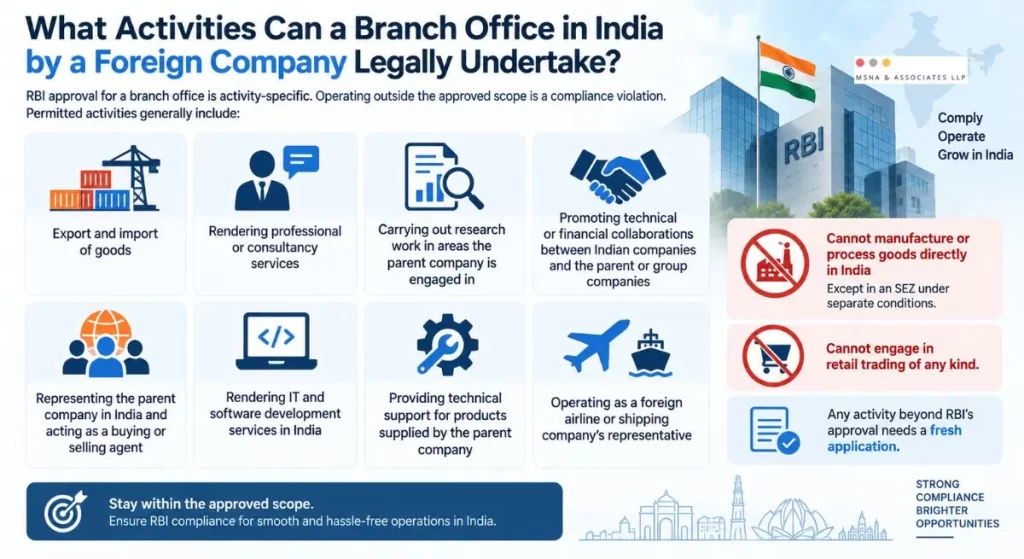
RBI approval for a branch office is activity-specific. Operating outside the approved scope is itself a compliance violation. Permitted activities generally include:
- Export and import of goods
- Rendering professional or consultancy services
- Carrying out research work in areas the parent company is engaged in
- Promoting technical or financial collaborations between Indian companies and the parent or group companies
- Representing the parent company in India and acting as a buying or selling agent
- Rendering IT and software development services in India
- Providing technical support for products supplied by the parent company
- Operating as a foreign airline or shipping company’s representative
A branch office cannot manufacture or process goods directly in India, except in an SEZ under separate conditions. It also cannot engage in retail trading of any kind. Any activity beyond RBI’s approval needs a fresh application.
What RBI Compliance for Branch Office in India by a Foreign Company is Needed After Setup?
The most consistent post-registration requirement is the Annual Activity Certificate (AAC).
Every branch office must send an AAC to its AD Category-I bank each year. It comes with the audited financial statements and confirms the office stayed within its RBI-approved activities. If the branch has offices in more than one state, one consolidated AAC covering all locations is required.
AAC requirement | Detail |
Who certifies it | A practising Chartered Accountant |
Filed with | The AD Category-I bank, and a copy to the Directorate General of Income Tax (International Taxation), New Delhi |
Due date | On or before 30 September each year, for the year ending 31 March (six months from the balance sheet date if the branch’s year-end differs) [Source: FEMA 22(R)/2016] |
Consequence of repeated non-filing | Three consecutive years of missed AAC filings can trigger automatic closure proceedings for the office |
Beyond the AAC, ongoing FEMA compliance includes:
- Reporting any change in the branch’s activities, address, or authorised signatories to the AD bank
- Keeping remittance records, since profits can be sent to the parent company only after tax and only with the documents the AD bank asks for
- Renewing RBI approval if it was granted for a limited period. Approval is not always indefinite
- Following any conditions attached to the original approval letter, which can vary by sector
The branch office is not a separate Indian company, so its funding stays under FEMA’s watch too. It should be funded through inward remittances from the parent, and local borrowing is restricted.
What ROC Compliance for Branch Office in India by a Foreign Company Is Required Under the Companies Act, 2013?
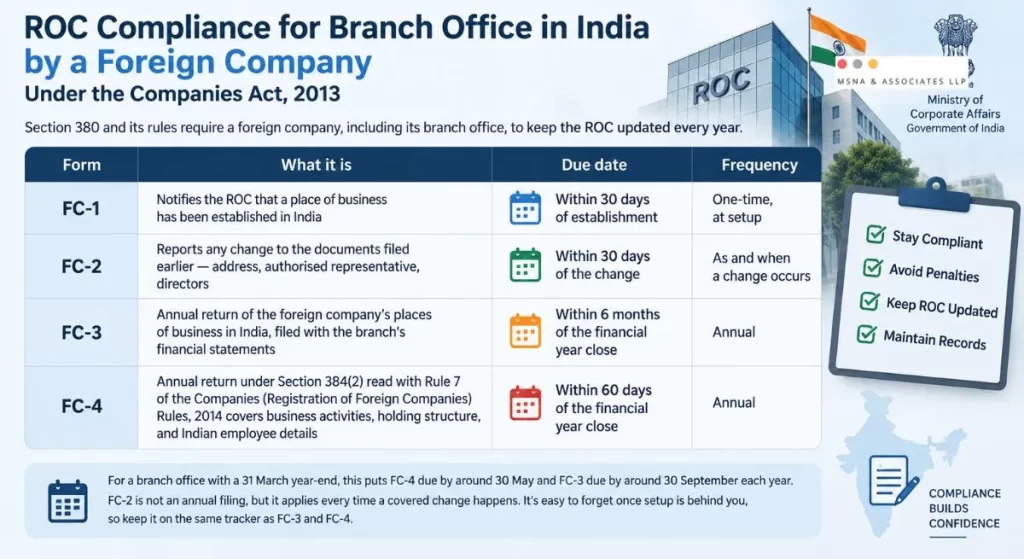
Section 380 and its rules require a foreign company, including its branch office, to keep the ROC updated every year.
Form | What it is | Due date | Frequency |
FC-1 | Notifies the ROC that a place of business has been established in India | Within 30 days of establishment | One-time, at setup |
FC-2 | Reports any change to the documents filed earlier — address, authorised representative, directors | Within 30 days of the change | As and when a change occurs |
FC-3 | Annual return of the foreign company’s places of business in India, filed with the branch’s financial statements | Within 6 months of the financial year close | Annual |
FC-4 | Annual return under Section 384(2) read with Rule 7 of the Companies (Registration of Foreign Companies) Rules, 2014 covers business activities, holding structure, and Indian employee details | Within 60 days of the financial year close | Annual |
For a branch office with a 31 March year-end, this puts FC-4 due by around 30 May and FC-3 due by around 30 September each year.
FC-2 is not an annual filing, but it applies every time a covered change happens. It’s easy to forget once setup is behind you, so keep it on the same tracker as FC-3 and FC-4.
What Are the Income Tax Obligations for a Branch Office?
Income tax is one of the more detailed layers of foreign company compliance in India, alongside the RBI and ROC obligations covered above.
For income tax purposes, a branch office is treated as a foreign company earning income in India. It is taxed at the foreign-company rate, plus surcharge and cess, generally higher than the rate that applies to an Indian domestic company.
Under the Finance (No. 2) Act, 2024, the base tax rate for foreign companies was cut from 40% to 35%, effective retroactively from 1 April 2024. This rate continues to apply for FY 2025-26 (AY 2026-27). Here is how it works out, before any tax treaty relief:
Total income slab | Base rate | Surcharge | Health & education cess | Approx. effective rate |
Up to ₹1 crore | 35% | Nil | 4% on tax | ~36.4% |
Above ₹1 crore, up to ₹10 crore | 35% | 2% of tax | 4% on tax + surcharge | ~37.1% |
Above ₹10 crore | 35% | 5% of tax | 4% on tax + surcharge | ~38.2% |
Sources: base-rate cut – UNCTAD Investment Policy Monitor; surcharge slabs – Income Tax Department, “Domestic Company for AY 2026-27” and related CBDT guidance
Royalty and technical service fee income under certain older agreements can attract a separate, higher flat rate. Check this with your tax advisor rather than assuming the general rate applies.
Core recurring obligations:
- PAN and TAN: the branch needs its own, separate from the parent company
- Income tax return: filed annually in Form ITR-6
- Tax audit: mandatory once the turnover threshold is crossed (see table below)
- Transfer pricing (Form 3CEB): transactions with the foreign parent or group entities must be benchmarked at arm’s length and certified by a Chartered Accountant
- TDS: deduct, deposit, and report tax on salaries, professional fees, or rent, like any other Indian taxpayer
Tax audit thresholds and 2026 due dates (FY 2025-26 / AY 2026-27):
Category | Threshold | Report due | Return due |
Business (general) | Turnover above ₹1 crore | 30 September 2026 | 31 October 2026 |
Business (95%+ digital receipts and payments) | Turnover above ₹10 crore | 30 September 2026 | 31 October 2026 |
Cases requiring a transfer pricing report (Form 3CEB) | N/A | 31 October 2026 | 30 November 2026 |
[Source: Section 44AB, Income-tax Act, 1961 – thresholds and 2026 due dates as compiled from CBDT-aligned filing calendars]
Missing the tax audit deadline attracts a fee under Section 271B (0.5% of turnover, capped at ₹1,50,000, whichever is lower.)
Is GST Registration and Return Filing Mandatory?
If the branch office supplies goods or services from India to Indian customers, or to the parent and group entities abroad, GST registration is generally required, subject to the applicable threshold and the nature of the activity.
Once registered, the branch steps into the standard GST cycle:
- Monthly or quarterly outward and inward supply returns
- Monthly tax payment
- An annual return
- Reconciliation between the branch’s books and the returns filed
Cross-border services to the parent company raise a specific question: does the transaction qualify as an export of services, or as an intermediary service? The GST treatment differs sharply between the two. This is worth reviewing with a tax advisor rather than assuming by default.
What Happens During an RBI or ROC Compliance Review?
Most branch offices never face a formal review. It usually only comes up if a filing is missed, or a mismatch appears between what was reported to the AD bank and what was filed with the ROC.
A review is document-based, not an on-site inspection:
- The AD bank may ask for the AAC trail from past years, the RBI approval letter with its conditions, and proof that remittances match the profits in the audited financials.
- The ROC may cross-check the FC-3 financials against the FC-4 return, looking at activities, employee counts, and holding structure.
- The Income Tax Department may separately ask for the transfer pricing documentation behind Form 3CEB, especially if related-party transactions look large compared to reported income.
These three checks aren’t coordinated with each other. So a small inconsistency, say, a rounding difference between the AAC and the FC-3 financials can trigger queries from more than one regulator at once. Reconciling the AAC, FC-3, FC-4, and the tax audit report to the same audited financials before filing each one is the simplest way to avoid this.
What Happens If a Branch Office in India by a Foreign Company Falls Behind on Compliance?
These branch office compliance requirements aren’t optional extras. Each regulator can act on non-compliance separately. Here’s what the current rules provide for:
Regulator | Trigger | Penalty / consequence |
RBI / FEMA | Late or missing AAC, unreported changes | Compounding proceedings with the RBI, involving a penalty to regularise the lapse; three consecutive years of missed AACs can trigger automatic closure |
ROC (Companies Act, Section 392) | Contravention of Chapter XXII (foreign company provisions), including FC-3/FC-4 defaults | Fine of ₹1 lakh to ₹3 lakh on the company, plus up to ₹50,000 per day for a continuing default; officers in default face a separate fine of ₹25,000 to ₹5 lakh |
Income Tax Department (Section 271B) | Missed tax audit deadline | Fee of 0.5% of turnover, capped at ₹1,50,000, whichever is lower |
[Source: Section 392, Companies Act, 2013 (as amended by the Companies (Amendment) Act, 2020); Section 271B, Income-tax Act, 1961]
These outcomes are not automatic. They depend on the extent and duration of the lapse, and most can be resolved through timely regularisation once identified.
Practical Considerations for US and UAE Companies
For a finance team managing an Indian branch from outside the country, the hard part isn’t understanding any single requirement. It’s coordinating deadlines across authorities that don’t talk to each other. Teams still working through branch office registration India should build this calendar from day one.
A quick view of the annual cycle for a 31 March year-end branch:
Month | What’s due |
May | Form FC-4 (60 days from year-end) |
July–September | Tax audit report (30 September), GST annual return cycle continues |
September | Annual Activity Certificate (30 September), Form FC-3 (6 months from year-end) |
October–November | Income tax return (31 October, or 30 November for transfer pricing cases) |
Ongoing | GST monthly/quarterly returns, TDS returns, FC-2 whenever a covered change occurs |
A common friction point for US parents: their books close on 31 December, but the Indian branch’s year runs 1 April to 31 March under Indian law. The AAC, FC-3, and FC-4 clocks start from a different date than the parent’s reporting calendar, so consolidating the branch’s numbers into group reporting needs its own reconciliation step. UAE parents, often on a calendar year too, face the same mismatch.
Some companies eventually find a wholly owned subsidiary suits their long-term India plans better than a branch office. Our guide on Setting Up a Company in India from the USA walks through that comparison.
Reconciling the AAC, FC-3, FC-4, and tax audit filings against one set of financials is easier with the right advisory support. MSNA & Associates can help you build that compliance calendar.
Understand Your Branch Office Compliance Requirements
Frequently Asked Questions About a Branch Office in India by a Foreign Company
Does a branch office need a separate PAN and TAN from the parent company?
Yes. It needs its own PAN and TAN in India, separate from the parent’s registration back home. This is because it files its own income tax return and takes care of its own TDS as well.
Can a branch office freely repatriate profits to its parent company?
Not automatically. Profits can be sent to the parent only after Indian taxes are paid, and only with the documents the AD Category-I bank asks for. It is not an unconditional transfer.
Is a statutory audit mandatory for a branch office every year?
Yes, every year, without exception. A Chartered Accountant has to audit the branch’s financial statements annually, and that audited statement is what backs up both the AAC filed with the RBI and the Form FC-3 filed with the ROC.
What's the deadline for reporting share allotment to a UAE parent?
Form FC-GPR has to be filed with the RBI within 30 days of allotting shares. Miss that window, and there’s no extension.
How is a branch office different from a liaison office in terms of ongoing compliance?
A liaison office cannot earn income in India. It’s limited to representational work. So its compliance load is lighter: mainly the AAC and basic ROC filings. A branch office can earn income, so it also carries full income tax, transfer pricing, and often GST obligations on top of the RBI and ROC filings both structures share.
Related
Discover more from MSNA & Associates LLP
Subscribe to get the latest posts sent to your email.