


The cost to outsource accounting to India for UAE businesses is between AED 1,000 and AED 25,000 a month, depending on transaction volume and scope. It usually works out 40 to 60% cheaper than the fully loaded cost of hiring in-house in the UAE, once visa, insurance, and gratuity are added to the salary comparison.
That gap is why so many UAE businesses look at outsourcing after their third accountant in eighteen months resigns, taking recruitment time, handover time, and institutional knowledge with them, right as a VAT return is due or a Corporate Tax filing window is closing. The exact number depends on your transaction volume, the pricing model you choose, and how the provider structures its fees.
This guide breaks down the pricing models, typical fee ranges by business size, and what an in-house UAE accountant actually costs by comparison, so you can weigh offers like for like before you sign anything.
Key takeaways
- Outsourced accounting from India runs roughly AED 1,000–25,000/month for UAE businesses, scaling with transaction volume and scope.
- Three pricing models dominate the market: per-transaction, dedicated team, and fixed monthly package.
- A fully loaded in-house UAE accountant costs AED 4,500–30,000+/month once visa, insurance, and gratuity are added to salary.
- The lowest hourly quote isn’t always the lowest total cost. Staff continuity and UAE-hours overlap matter as much as the rate card.
- A short pilot engagement, before signing a full annual contract, is the single biggest predictor of a smooth transition.
What Does It Cost To Outsource Accounting To India?
The cost to outsource accounting to India generally falls into three bands, based on business size and scope of work.
Business Profile | Typical Monthly Range (AED) | What’s Usually Included |
Small business or startup (under 100 transactions/month) | 1,000 – 3,500 | Bookkeeping, bank reconciliation, basic MIS |
Growing SME (100–500 transactions/month) | 3,500 – 9,000 | Full-cycle accounting, VAT support, payroll processing |
Established company or group entity (500+ transactions/month) | 9,000 – 25,000+ | Dedicated team, management reporting, Corporate Tax coordination |
These ranges reflect industry pricing patterns for UAE-facing outsourced accounting providers. Actual quotes vary by scope, so treat this as a planning benchmark rather than a fixed rate card.
Hourly-based engagements are also common, particularly for firms that outsource in phases. Based on quotes MSNA has reviewed across India-based accounting outsourcing providers, hourly rates broadly run USD 8 to USD 35 (roughly AED 29 to AED 129), depending on the complexity of the work and the seniority of the professional assigned.
What Pricing Models Do India-Based Providers Use?
Not every outsourcing engagement is priced the same way. Understanding the pricing models helps you compare quotes accurately, since a “cheap” hourly rate can end up costing more than a fixed package once volume goes up.
1. Per-Transaction Pricing
Here you pay per invoice, per reconciliation entry, or per payroll run. It works well if your volume is predictable and stays low to moderate, since your costs scale directly with how much activity there actually is. It becomes harder to budget for if your transaction volume fluctuates seasonally.
2. Dedicated Team Pricing
You pay a fixed monthly fee for one or more accountants who work exclusively on your books, often during hours that overlap with UAE business time. This is the most common model for SMEs and mid-sized companies that want consistency and a single point of contact, rather than a shared pool of staff.
3. Fixed Monthly Package Pricing
A flat fee covers a defined scope, such as bookkeeping plus VAT return preparation plus monthly MIS. This model gives the most cost predictability but requires a clear scope document upfront, so scope creep doesn’t quietly erode the value of the package.
How Much Does An In-House Accountant Cost In the UAE?
To judge whether outsourcing makes financial sense, compare it against the fully loaded cost of an in-house hire, not just the base salary.
Role | Typical Monthly Salary (AED) | Notes |
Entry-level accountant | 4,500 – 8,000 | 0–2 years’ experience |
Mid-level accountant | 8,000 – 15,000 | 3–6 years, VAT and Corporate Tax exposure valued |
CPA / Financial Controller | 20,000 – 30,000+ | Multinational or group-level reporting |
Salary is only part of the picture. An in-house hire also brings visa sponsorship, medical insurance, annual leave, end-of-service gratuity, software licensing, and the recruitment cost of replacing them when they leave, which in the UAE’s competitive finance job market happens more often than most business owners expect.
How Much Can You Save On The Cost Of Outsourcing Accounting To India?
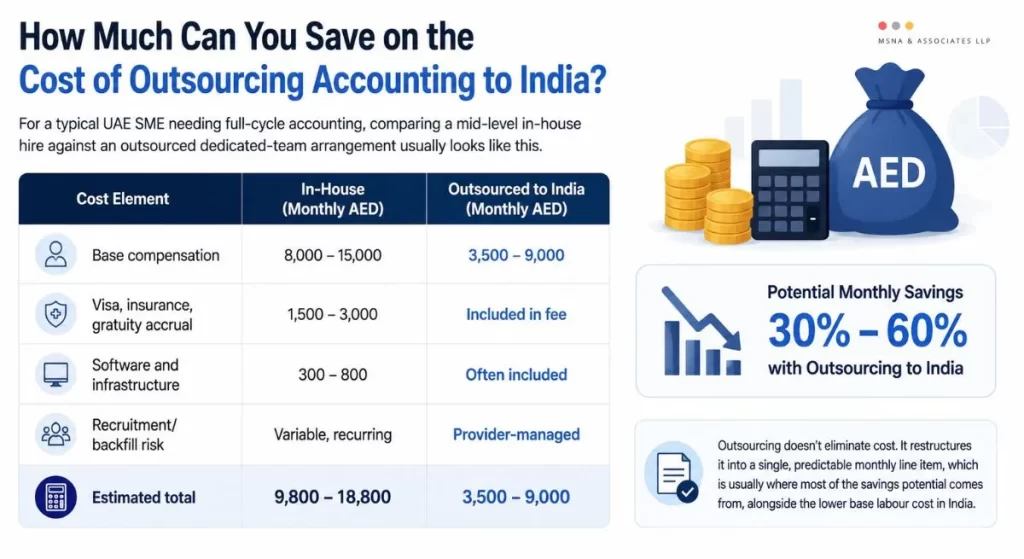
For a typical UAE SME needing full-cycle accounting, comparing a mid-level in-house hire against an outsourced dedicated-team arrangement usually looks like this.
Cost Element | In-House (Monthly AED) | Outsourced to India (Monthly AED) |
Base compensation | 8,000 – 15,000 | 3,500 – 9,000 |
Visa, insurance, gratuity accrual | 1,500 – 3,000 | Included in fee |
Software and infrastructure | 300 – 800 | Often included |
Recruitment/backfill risk | Variable, recurring | Provider-managed |
Estimated total | 9,800 – 18,800 | 3,500 – 9,000 |
Outsourcing doesn’t eliminate cost. It restructures it into a single, predictable monthly line item, which is usually where most of the savings potential comes from, alongside the lower base labour cost in India.
The savings conversation often stops at salary comparison, but the bigger shift is operational. A dedicated outsourced team removes single points of failure. If one accountant is on leave, the engagement doesn’t stop, because the provider staffs for continuity rather than relying on one person holding all the knowledge.
-Naveen S N- Partner – Risk Advisory(MSNA)
A Worked Example
A Dubai-based trading company with around 300 transactions a month and a single mid-level in-house accountant is typically looking at AED 8,000 to 15,000 in salary alone, before visa, insurance, and gratuity accrual push the fully loaded cost toward AED 10,000 to 18,000. The equivalent outsourced dedicated-team arrangement, covering full-cycle bookkeeping, VAT return preparation, and monthly MIS, typically lands in the AED 5,000 to 8,000 range for that transaction volume, a saving in the region of AED 5,000 to 10,000 a month, or AED 60,000 to 120,000 a year, before accounting for recruitment and backfill risk.
What Factors Affect Accounting Outsourcing Fees In India?
Quotes vary widely because providers price against several variables, not a flat rate. The main drivers of accounting outsourcing fees to India include:
- Transaction volume. More invoices, payments, and reconciliations mean more billable effort, plain and simple.
- Number of entities. If you’re running a group structure with multiple UAE or Indian entities, consolidation costs more.
- Reporting frequency. Want weekly MIS instead of monthly closing? That comes at a higher price point.
- Software stack. Xero, QuickBooks, Zoho, SAP, each one demands a different level of familiarity from the provider, and that shows up in the quote.
- Compliance scope. VAT filing support, Corporate Tax coordination, payroll, these all stack on top of the base bookkeeping fee.
- Turnaround expectations. Need same-day or next-day reporting? Standard monthly cycles are cheaper than that kind of speed.
What Hidden Costs Affect UAE Accounting Outsourcing Pricing?
Most cost comparisons stop at the monthly invoice. A few less-discussed factors can quietly change the real economics of outsourcing.
1. Time Zone Overlap
India runs a fixed 1.5 hours ahead of the UAE year-round, since neither country observes daylight saving, which is a genuinely useful overlap for same-day queries. Providers that don’t structure shift timing around UAE working hours can create response-time gaps that cost you more in delays than the fee saves you in dirhams.
2. Data Residency and Access Control
Cloud accounting means your data sits wherever the provider’s systems are hosted. Ask where data is stored, who has access, and what happens to it if the engagement ends. This isn’t usually itemised in a quote, but it should be in the contract.
3. Jurisdiction-Specific Knowledge Gaps
Bookkeeping in India and UAE-compliant bookkeeping are not the same skill. A provider fluent in Indian GST may still need ramp-up time on UAE VAT treatment, Corporate Tax adjustments under Federal Decree-Law No. 47 of 2022, and FTA-specific documentation. Factor a short onboarding period into your cost and timeline expectations, rather than assuming day-one fluency.
Is the Lowest UAE Accounting Outsourcing Pricing Always Better?
Not necessarily, and this is where a lot of cost-focused comparisons miss the point. The lowest hourly rate on the market is rarely the lowest total cost.
A provider quoting USD 8 per hour with no dedicated team, no UAE-hours overlap, and high staff turnover can end up costing more in rework, missed deadlines, and management time than a provider quoting a higher fee with a stable, dedicated resource. The real question isn’t “what’s the cheapest quote,” it’s “what’s the cost per accurate, on-time close.”
Businesses that treat outsourcing purely as a cost-cutting exercise tend to under-invest in the handover and governance process, which is usually where problems start. Businesses that treat it as a capability decision, choosing a provider based on process maturity and communication structure, tend to see the savings hold up over time.
What Should You Check Before Signing An Outsourcing Contract?
A few practical checks before committing:
- Get a scope-linked quote, not a flat “starting from” number. Ask what happens when transaction volume grows.
- Confirm UAE-hours overlap in writing, including who your day-to-day point of contact is.
- Ask about staff continuity. Find out how the provider handles leave, attrition, and knowledge transfer.
- Clarify data handling and exit terms, including how records are returned if you switch providers.
- Check compliance familiarity with UAE VAT and Corporate Tax specifically, not just general bookkeeping experience.
If you’re comparing quotes right now, it’s worth walking through your specific transaction volume and compliance scope with a provider before signing anything. MSNA’s outsourced accounting services page covers how that scoping conversation typically works.
What Mistakes Do UAE Businesses Make When Switching Providers?
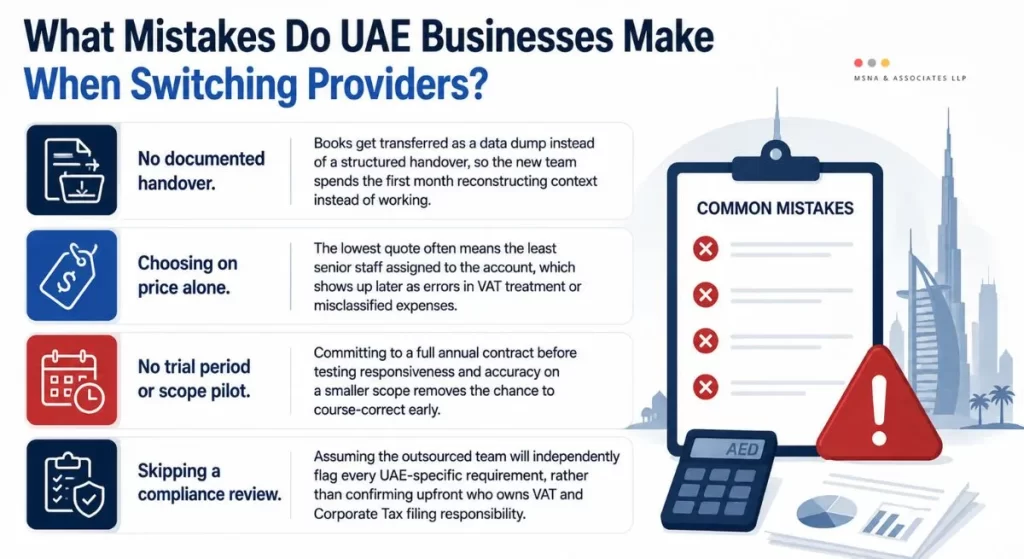
A pattern shows up repeatedly in transitions that go badly, and it rarely has anything to do with the outsourcing model itself.
1. No documented handover.
Books get transferred as a data dump instead of a structured handover, so the new team spends the first month reconstructing context instead of working.
2. Choosing on price alone.
The lowest quote often means the least senior staff assigned to the account, which shows up later as errors in VAT treatment or misclassified expenses.
3. No trial period or scope pilot.
Committing to a full annual contract before testing responsiveness and accuracy on a smaller scope removes the chance to course-correct early.
4. Skipping a compliance review.
Assuming the outsourced team will independently flag every UAE-specific requirement, rather than confirming upfront who owns VAT and Corporate Tax filing responsibility.
The transitions that go smoothly almost always start with a short pilot, usually one or two months on a defined scope such as bank reconciliation and AP processing, before the full engagement begins. It costs a little more upfront in coordination time, but it catches process mismatches before they touch a filing deadline.-Naveen S N- Partner – Risk Advisory(MSNA)
The Bottom Line On The Cost To Outsource Accounting To India
Outsourcing accounting to India is rarely just a savings exercise on paper. When done well, it trades a fragile, single-person function for a structured, continuity-backed process at a lower monthly cost than most in-house alternatives in the UAE. Done carelessly, on price alone, it can introduce the same instability it was meant to solve.
MSNA & Associates LLP works with UAE businesses on the India-side delivery of outsourced accounting for UAE businesses, supporting bookkeeping, reporting, and compliance-ready recordkeeping for companies and Indian subsidiaries managed from the UAE. If you’re weighing this decision for your business, a conversation with a professional about your specific transaction volume and compliance needs can help you compare options with real numbers rather than list prices.
Understand Your Accounting Outsourcing Options
Frequently Asked Questions About Cost To Outsource Accounting To India
Is it legal for UAE businesses to outsource accounting to India?
Yes, UAE businesses are free to work with an offshore accounting provider. There’s no restriction on that. The one thing to watch is statutory filings. VAT and Corporate Tax returns still need to be reviewed and submitted in line with FTA requirements. That part usually falls to a UAE-qualified professional or the business itself.
Does outsourcing accounting affect UAE Corporate Tax compliance?
Not negatively,Outsourced bookkeeping actually helps here. It keeps your records accurate and your audit trail in order, which sets you up well for Corporate Tax season. But the filing itself, and any judgment calls on tax positions, needs someone who knows UAE Corporate Tax law under Federal Decree-Law No. 47 of 2022 inside and out.
How long does it take to transition to an outsourced accounting team?
Usually two to six weeks. The exact timeline comes down to two things: how clean your existing books are, and how many systems need to be migrated or connected.
Related
Discover more from MSNA & Associates LLP
Subscribe to get the latest posts sent to your email.