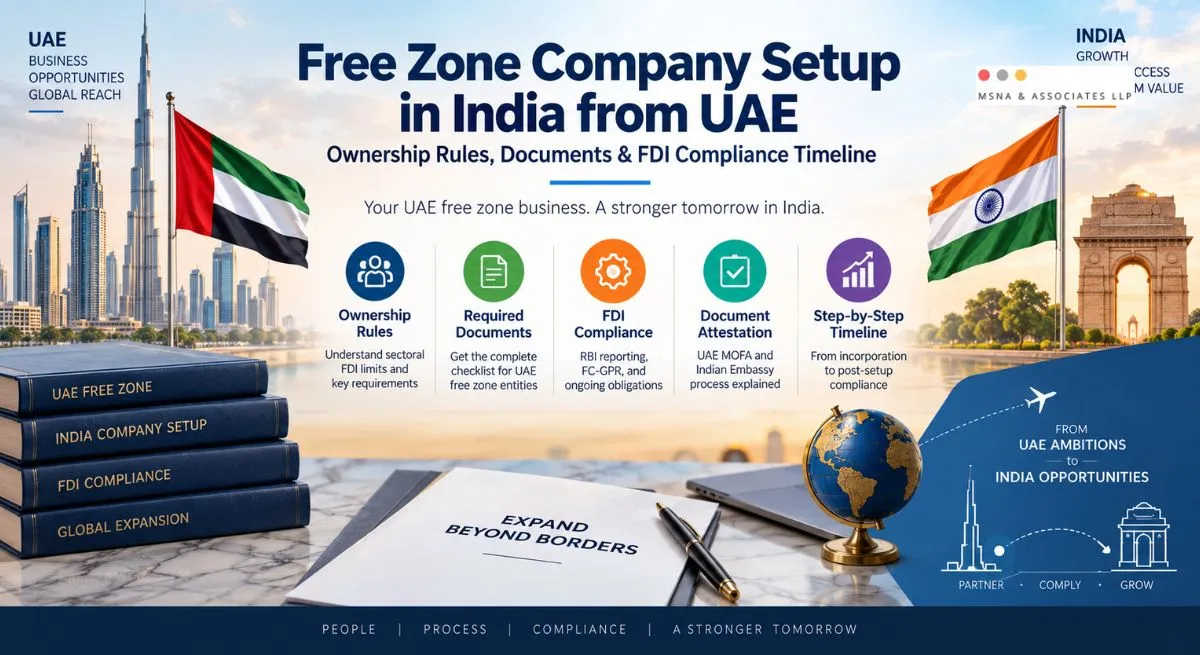

If you run a UAE free zone company and want an India entity, the process is simpler than most people expect.
A free zone company setup in India from the UAE follows the same route as any other foreign investment, with a 30-day RBI reporting deadline once shares are allotted and one Indian resident director required on the board. India’s law does not create a separate category for free zone entities.
This guide is for UAE free zone business owners, expansion consultants, and legal advisors planning an India entry. It covers ownership structures, the documents you’ll actually need, and the compliance steps once incorporation is done.
The numbers behind this trend:
- UAE companies have poured USD 18.01 billion into India since April 2000 (through December 2023), per DPIIT data.
- Most of it went into computer software and hardware. Over 17%.
- India pulled in USD 58.85 billion in foreign investment overall in FY 2025-26, up 18% on the year before, per DPIIT’s June 2026 numbers.
What Counts as a "Free Zone Company" Under Indian Law?
Indian regulators do not check whether your UAE company sits in a free zone or on the mainland. Both are simply “foreign companies” for FDI purposes under the FEMA (Non-Debt Instruments) Rules, 2019.
This matters because some consultants assume free zone companies get special treatment or extra restrictions. Neither is true. What actually changes the process is your Indian entity structure, not your UAE free zone license.
What Are the Ownership Rules for a Free Zone Company Setup in India From UAE?
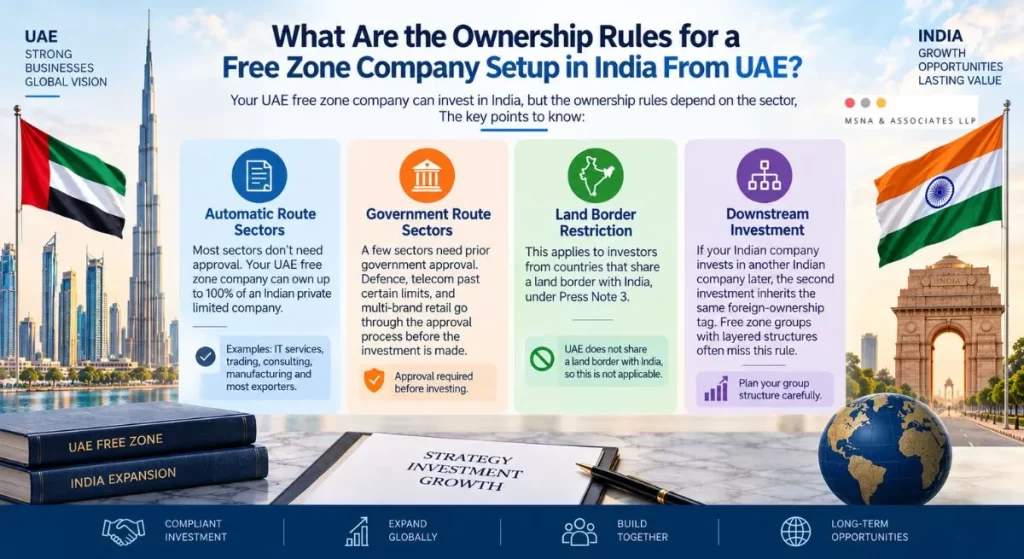
Free zone ownership rules on the UAE side allow 100% foreign ownership already. On the India side, ownership depends on the sector you want to enter.
Here is how it works:
1. Automatic route sectors:
Most sectors don’t need approval at all. Your UAE free zone company can own up to 100% of an Indian private limited company. IT services, trading, consulting, manufacturing, and most exporters all fall here.
2. Government route sectors:
A handful of sectors need sign-off first. Defence, telecom past certain limits, and multi-brand retail go through approval before the money moves.
3. Land border restriction:
This one’s for investors from countries that share a land border with India, under Press Note 3. UAE doesn’t border India, so it’s a non-issue here.
4. Downstream investment:
Say your Indian company invests in another Indian company later. That second investment inherits the same foreign-ownership tag. Free zone groups with layered structures miss this one often.
Cross a certain foreign shareholding threshold, and the Companies Act, 2013 requires you to name your Significant Beneficial Owner (SBO). If your free zone structure uses nominee shareholders or holding layers, trace that chain carefully before you file, not after.
Practitioner’s note:
UAE free zone companies often sit under a holding company, a trust, or a family office. This is common for succession planning or protecting assets.
India doesn’t care about those layers, as its SBO rule looks past all of them. It wants to know one thing: which real person ultimately controls the shares. Map out your full ownership chain before you incorporate, as this avoids a re-filing cycle later.
Which India Entity Structure Suits a Free Zone Company?
Your India entity structure for free zone companies depends on what you plan to do in India.
For most UAE free zone companies planning an active business in India, a wholly owned subsidiary set up as a private limited company is the simplest option. It supports full FDI, has predictable compliance, and lets you hire directly.
A branch office suits UAE companies that want to execute existing contracts and represent the parent. But you’ll need RBI approval, and what you can actually do stays limited.
A liaison office is for market research and brand visibility. Nothing more. It can’t generate revenue in India. An LLP fits professional services with fewer compliance layers, though FDI in LLPs is allowed only in sectors with a 100% automatic route and no performance conditions.
What Documents Do You Need for Free Zone Company Setup in India From UAE?
Documentation for free zone company India entry falls into two buckets: documents about your UAE company, and documents about the people behind it.
From the UAE free zone company:
- Certificate of Incorporation
- Memorandum and Articles of Association, or the free zone equivalent
- Board resolution approving the India investment
- Certificate of good standing from the free zone authority, if the Indian bank or registrar asks for one
From directors and shareholders:
- Passport copies of all directors and shareholders
- Proof of residential address
- Digital Signature Certificate (DSC) and Director Identification Number (DIN) for proposed India directors
- Power of Attorney authorising a representative to sign incorporation forms, if the shareholder cannot sign directly
For the Indian entity itself:
- Proposed name approval through the RBI’s SPICe+ form
- Registered office proof in India
- No Objection Certificate from the property owner, if the office is leased
Every foreign document used for India incorporation must be properly authenticated before the Registrar of Companies will accept it.
Do UAE Free Zone Documents Need an Apostille?
Document apostille for free zone entities is one of the most misunderstood steps in this process, and getting it wrong causes real delays.
The UAE is not a member of the Hague Apostille Convention. This means an apostille sticker on a UAE-issued document has no legal standing in India. What your free zone company actually needs is embassy attestation, not an apostille.
The correct chain looks like this:
- Notarise the document with a UAE notary
- Get it attested by the UAE Ministry of Foreign Affairs (MOFA)
- Get it legalised by the Indian Embassy or Consulate in the UAE
Only documents carrying this full attestation chain will be accepted by Indian banks, the Registrar of Companies and the RBI. If your consultant uses the word “apostille” loosely, ask which of the two processes they actually mean.
What FDI Compliance Steps Come After Incorporation?
Incorporation is the easy part. FDI compliance is where most UAE free zone companies lose time if they are not prepared.
- File Form FC-GPR within 30 days of allotting shares to the UAE parent, per RBI’s foreign investment reporting norms under FEMA. There is no grace period. So missing this means filing a compounding application with the RBI later, at a cost in time and penalty.
- Route funds through an AD Category-I bank. Inward remittance for share capital must come through a bank authorised to handle foreign exchange.
- File the annual FLA return with the RBI. This reports your Indian company’s foreign liabilities and assets. It applies as long as the UAE parent holds shares or a convertible instrument.
- Keep transfer pricing documentation ready. Every transaction between the Indian subsidiary and the UAE free zone parent needs a paper trail.
- Fund through equity, not informal loans. Working capital brought in as an intercompany loan instead of equity can trigger separate External Commercial Borrowing (ECB) compliance.
Practitioner’s note on transfer pricing: UAE corporate tax lets a Qualifying Free Zone Person pay 0% on qualifying income, while standard income above AED 375,000 is taxed at 9%. That gap is exactly what Indian transfer pricing officers look for.
Say your Indian subsidiary prices a transaction with its UAE parent. If that price shifts more profit to the 0%-taxed side than an unrelated third party would ever agree to, it raises a flag. This falls under Section 92 of the Income Tax Act, and it invites closer scrutiny.
The fix is simple: price every intercompany transaction at arm’s length. This protects the structure on both sides (UAE and India)
What Mistakes Do UAE Free Zone Businesses Commonly Make?
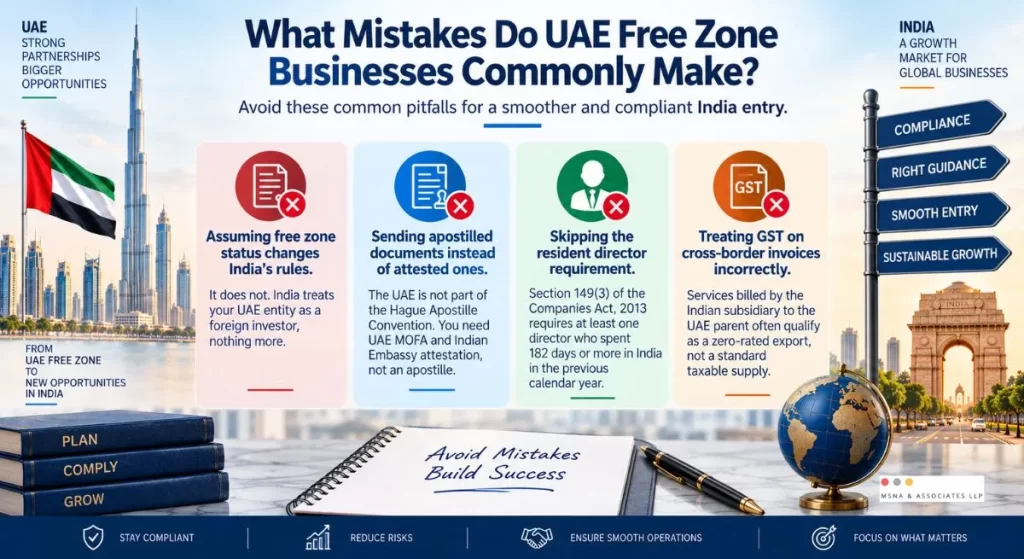
A UAE free zone expansion to India usually runs into the same handful of avoidable problems.
- Assuming free zone status changes India’s rules. It does not. India treats your UAE entity as a foreign investor, nothing more.
- Sending apostilled documents instead of attested ones. This UAE-specific mismatch catches people out repeatedly.
- Skipping the resident director requirement. Section 149(3) of the Companies Act, 2013 is clear on this. Every Indian private limited company needs at least one director who spent 182 days or more in India in the previous calendar year.
- Treating GST on cross-border invoices incorrectly. Services billed by the Indian subsidiary to the UAE parent often qualify as a zero-rated export, not a standard taxable supply.
When Does the Standard Process Not Apply?
A few scenarios call for extra steps beyond the standard free zone company setup in India from UAE:
- Your business falls in a sector that needs government approval instead of the automatic route
- Your free zone entity has multiple layers of holding companies above it, and that changes how SBO reporting works
- You’re looking to raise debt funding in India rather than bring in equity from the UAE parent
None of this replaces the compliance steps above. It just adds extra filings or approvals on top.
What Should You Do Next for Free Zone Company Setup in India from UAE?
Setting up in India from a UAE free zone is a well-established path with a predictable set of steps. What decides whether it goes smoothly is preparation.
At MSNA & Associates LLP, an ICAI-registered, peer-reviewed Chartered Accountancy practice, we work with UAE-based businesses on the India side of this kind of entry, from entity structuring to FDI and transfer pricing compliance. Consulting a professional familiar with both UAE free zone structures and Indian FEMA rules can help you assess how these apply to your ownership chain and sector.
Plan Your India Entry with Clarity
Frequently Asked Questions About Free Zone Company Setup in India from the UAE
Can a UAE free zone company own 100% of an Indian company?
Yes, in most sectors under the automatic route. A few strategic sectors need prior government approval before the investment can go through.
Does a UAE free zone company need an Indian resident director?
Yes, and it’s not optional. Section 149(3) of the Companies Act, 2013 spells it out: one director on the board has to have spent 182 days or more in India in the financial year.
Is an apostille valid for UAE company documents used in India?
No. The UAE isn’t part of the Hague Apostille Convention. What you actually need is embassy attestation through UAE MOFA and then the Indian Embassy.
What's the deadline for reporting share allotment to a UAE parent?
Form FC-GPR has to be filed with the RBI within 30 days of allotting shares. Miss that window, and there’s no extension.
Is there a minimum capital requirement for a UAE-owned Indian subsidiary?
No. Indian law sets no minimum or maximum paid-up capital for a private limited company. The right amount depends on what the Indian operations need to run.
Related
Discover more from MSNA & Associates LLP
Subscribe to get the latest posts sent to your email.