


Interim CFO firms provide senior finance leadership for a fixed period, usually three to eighteen months, to cover a leadership gap, a fundraise, an M&A process, or a turnaround, without the long-term cost and recruitment cycle of a permanent hire.
A permanent CFO makes more sense when the business needs open-ended ownership of finance strategy rather than a defined mandate with a clear endpoint.
Your board wants a CFO in the room for the next funding call, but a proper search takes four months, and the call is in three weeks. That’s the exact gap interim CFO services exist to close.
This guide is written for business owners and boards in the US, UAE, and India deciding between the two right now, along with the HR leaders who often run the search. It covers the specific situations where interim CFO services fit, how cost and commitment structures differ between the two paths, and what to check before engaging an interim CFO firm.
What Does an Interim CFO Firm Actually Provide?
Interim CFO firms place an experienced finance leader into a business for a fixed period, usually three to eighteen months, to handle a specific mandate. That mandate could be closing a leadership gap, preparing for a funding round, supporting a merger, or steering a business through a cash crunch.
The engagement has a start date and an end date, built around a defined scope. This is different from a permanent CFO, who is hired for open-ended, long-term ownership of the finance function.
Interim CFO services are not a downgraded version of a full-time CFO. They are a different tool for a different situation. A business in the US, UAE, or India considering this route is usually trying to solve one of two problems: it needs senior finance judgment now, or it needs that judgment for a known, limited window.
If you’re not sure which situation you’re in, MSNA’s Virtual CFO services team can help map the gap before you commit to either path.
Interim CFO Firms vs Permanent CFO: The Core Differences
Before deciding, it helps to see the two options side by side.
Factor | Interim CFO | Permanent CFO |
Engagement length | Fixed term, typically 3–18 months | Open-ended |
Onboarding speed | Fast, usually within weeks | Slower, includes recruitment cycle |
Cost structure | Fee for scope or retainer, no equity or long-term benefits | Salary, bonus, often equity or long-term incentives |
Best suited for | Transitions, specific projects, urgent gaps | Ongoing strategic ownership of finance |
Institutional memory | Limited to the engagement period | Builds over years |
Exit process | Defined at the start of the engagement | Requires succession planning |
This table is a starting point, not a formula. The right answer depends on what the business actually needs solved.
When Does It Make Sense to Hire an Interim CFO?
Most businesses that consider interim CFO firms are dealing with one of these situations.
1. Leadership Transition and CFO Succession Planning
When a CFO resigns, retires, or is asked to leave, the finance function cannot pause. Month-end close and investor updates continue, and the board still expects its reporting, regardless of whether a permanent replacement is in place.
An interim CFO steps in to keep the function running while the business runs a proper search for a permanent hire. This also gives the board time to define what the next CFO actually needs to look like, instead of rushing a hire under pressure.
CFO succession planning done well treats the interim period as productive time, not dead time. A good interim CFO documents processes and flags gaps along the way, so the function that gets handed over is cleaner than the one they inherited.
We’ve seen Bangalore-based PE-backed startups use this exact window to formalize investor-grade reporting ahead of a Series B, rather than rush a permanent hire under board pressure.
2. Fundraising Support
Businesses raising a funding round need financial models and data rooms that hold up under scrutiny, backed by investor-ready reporting. This is a short, intense body of work with a clear endpoint: the round closes, or it does not.
Fundraising support from an interim CFO makes sense when the business does not have in-house capacity to run this process alongside day-to-day operations. Once the round closes, the business can decide whether the finance function needs a permanent leader or whether the interim scope should extend into the next phase.
3. M&A and Deal Readiness
Mergers and acquisitions involve due diligence, valuation support, integration planning, and a level of financial scrutiny that most internal teams are not built to absorb on top of regular work.
An interim CFO with deal experience can lead this process without pulling the rest of the finance team away from operations. Once the deal closes and integration stabilizes, the business can reassess whether the workload justifies a permanent CFO or whether the interim engagement can wind down.
MSNA’s M&A advisory services support exactly this due diligence and integration workload for Indian entities and Indian subsidiaries.
4. Turnaround Management
A business facing cash flow stress or breached covenants, sometimes with declining margins on top, needs someone who has managed a turnaround before. Turnaround management is a specific skill set. It involves renegotiating terms with lenders and resetting the cost base, all while rebuilding forecasting discipline under pressure.
This is usually a defined-scope engagement. The interim CFO is brought in to stabilize the situation, not to run the business indefinitely. Once the numbers stabilize, the board can decide on the next step.
Interim CFO Firms vs Permanent CFO: Cost and Commitment Compared
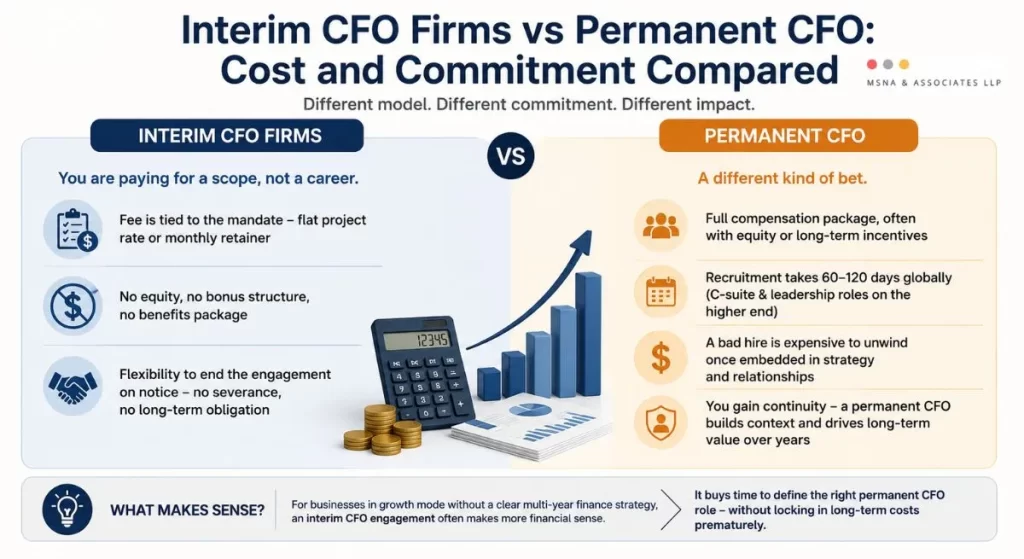
The cost difference between interim and permanent CFO solutions is not just about the fee. It is about what the business is signing up for.
With an interim CFO, you are paying for a scope, not a career:
- The fee is tied to the mandate, whether that is a flat project rate or a monthly retainer
- No equity or bonus structure attached, and no benefits package to negotiate
- If the engagement is not working, you can end it on notice, without a severance conversation or a board explanation about why the CFO left after two months
A permanent CFO is a different kind of bet:
- You are paying a full compensation package, often with equity or long-term incentives layered in
- Recruitment for a CFO role commonly runs 60 to 120 days globally, per Corporate Navigators’ 2026 executive search benchmarks, with C-suite and functional-leadership searches landing at the higher end of that range
- A bad hire is expensive to unwind once someone is embedded in the company’s strategy and relationships
- What you get in return is continuity. A permanent CFO builds context over years that an interim engagement, by design, does not have time to build
For businesses in growth mode without a clear multi-year finance strategy yet, an interim engagement often makes more financial sense. It buys time to figure out what the permanent role actually needs to look like, without locking in a long-term cost structure prematurely.
If you’re weighing this cost trade-off for your own business, MSNA’s Virtual CFO services team can help you work out what each path would actually cost over the engagement window before you commit either way.
How Do You Evaluate an Interim CFO Firm Before Signing?
Business owners, boards, and HR leaders comparing interim CFO firms should look past the pitch and check for a few concrete things.
- Ask for evidence of relevant experience in the specific situation you are facing. A turnaround looks nothing like a fundraise, and a leadership gap is different again
- Confirm how the firm structures handover at the end of the engagement, and what documentation you will be left with
- Check whether the interim CFO will have access to a broader team for specialized areas like tax structuring, audit coordination, or cross-border compliance
- Clarify how quickly the engagement can start, since urgency is often the reason interim support is being considered in the first place
- Get clarity on reporting cadence and who the interim CFO reports to on your board or leadership team
A firm that cannot answer these clearly in the first conversation is not ready to run your engagement.
How Does the Interim CFO Decision Shift Across the US, UAE, and India?
The core logic is the same everywhere, but market conditions change how urgently businesses need to act.
United States
- Interim CFO services are common in venture-backed and private-equity-backed businesses moving through funding rounds or leadership changes at speed.
- Often used especially where fund LPAs or board bylaws mandate CFO-level reporting during a raise.
- The talent market for permanent CFOs is competitive, and searches can take months which makes interim bridges a practical default during that gap.
UAE
- Business setup timelines, free zone structures, and a fast-growing SME and family business sector mean interim CFO support is often used during expansion phases or when a business is professionalizing its finance function for the first time.
- This is particularly common for businesses operating through DIFC or ADGM free zone structures, where reporting expectations differ from mainland entities. DIFC entities must file IFRS-audited financials within four months of year-end, ADGM allows up to nine.
- Boards here frequently use the interim period to also assess whether their reporting structures meet the standard investors or regulators expect.
India
- Interim CFO engagements are increasingly used by PE-backed startups preparing for the next funding round, and by traditional family businesses going through generational leadership transitions.
- Especially relevant where Companies Act, 2013 reporting thresholds or investor due diligence requirements demand a level of financial discipline the business hasn’t built yet.
- Under Section 203 (Rule 8), listed companies and public companies with paid-up capital of Rs 10 crore or more must appoint a whole-time CFO. Businesses crossing that threshold, often mid-year after a funding round, use an interim CFO to stay compliant while running a permanent search.
Our View: Stop Asking Which Option Is "Better"
The question “is an interim or permanent CFO better” does not have a stable answer, and treating it as a binary choice usually leads to the wrong decision.
The better question is: what problem are we solving, and does that problem have a natural endpoint?
If the endpoint is clear (the round closes, the deal completes, the turnaround stabilizes, the search finds a permanent hire), interim support fits. If there is no natural endpoint and the business needs someone to own finance strategy indefinitely, a permanent hire is the right call, even if it takes longer to find the right person.
We also think businesses under-invest in the transition itself. Too many companies treat the interim period as a placeholder and skip the documentation and handover work that makes the eventual permanent hire’s first ninety days easier. That handover discipline is where an interim engagement either adds lasting value or just delays the real work.
Interim CFO Firms: Choosing the Right Support for Your Business
Deciding between interim and permanent CFO support depends on the specific situation your business is in, not on a general preference for one model over the other. If you are working through a leadership transition, a fundraise, an M&A process, or a turnaround, it can help to talk through the specifics with a firm that has run these engagements across US, UAE, and Indian businesses. Consulting a professional can help you assess how this applies to your situation.
Need to Choose the Right CFO Structure?
Frequently Asked Questions About Interim CFO Firms
How long does a typical interim CFO engagement last?
Most engagements run three to eighteen months, depending on the mandate. Fundraising and turnaround engagements tend to be shorter and more intense. Leadership-gap coverage during a search can run longer.
Can an interim CFO become the permanent CFO?
Yes, this happens regularly. Some businesses structure the interim engagement specifically to evaluate fit before making a permanent offer. This should be discussed and agreed upfront, not assumed.
Is an interim CFO less experienced than a permanent CFO?
No, Interim CFOs are typically senior professionals who choose project-based work over a single long-term role. Experience level is not the differentiator between the two paths.
What happens to the finance team once the interim CFO leaves?
A well-run engagement includes a documented handover: processes, dashboards, open items, and recommendations for the next leader. This should be agreed as part of the engagement scope, not left until the last week
Related
Discover more from MSNA & Associates LLP
Subscribe to get the latest posts sent to your email.