
Most founders think investor reporting is just a preference. It usually isn’t.
PE funds answer to their own regulators and their own limited partners. In India, this means Regulation 28 of the SEBI (Alternative Investment Funds) Regulations, 2012. SEBI’s March 4, 2026 circular set a clear two-tier framework: a full Annual Activity Report within 30 days of the March close, and a Quarterly Activity Report within 15 days for the other three quarters.
US and UAE funds don’t answer to the same kind of regulator-set clock. In the US, the SEC’s 2023 rule that would have mandated standardized quarterly investor reporting was struck down by a federal appeals court in 2024. So reporting there runs on the fund’s own Limited Partnership Agreement, often benchmarked against the ILPA Reporting Template that many institutional LPs now expect as a baseline.
In the UAE, funds structured in the DIFC or ADGM report periodically to the DFSA or FSRA; funds structured elsewhere follow the same LPA-driven cadence as their US counterparts.
So when your investor chases you for numbers, it’s usually their own deadline. Not an internal formality.
This reframes what financial reporting for investors really is an input into your investor’s own compliance duty, wherever that fund is based. A Virtual CFO for PE-backed startups builds the investor MIS reports, cap table, rolling forecasts, and board packs your investors need. You get this without the cost of a full-time in-house hire.
What Do PE Investors in India, US and UAE Actually Expect From a Portfolio Company's Reporting?
Private equity investors are not evaluating a startup the way a bank evaluates a loan applicant. Once the money is in, they track whether the company is performing the way the investment thesis assumed. That’s true whether the fund sits in Mumbai, New York, or Dubai. Understanding how a Virtual CFO Helps Startups provides useful context before exploring the specialised reporting and governance requirements that arise once a startup becomes PE-backed.
In practice, investor reporting usually covers:
- Cash burn and runway, updated on a predictable schedule. A slipped schedule reads as a discipline problem, not an admin one.
- KPI dashboards built around the metrics that drove the investment decision, such as ARR, gross margin, or CAC payback. Extra vanity metrics only dilute the story investors are tracking.
- Statutory filing status. Are the financial statements filed and up to date? Investors want to know before they walk into a review, not find out during one.
- Cap table updates. Option grants, new share issuances, dilution. If this only gets updated right before a board meeting, investors are looking at old numbers the rest of the time.
- Variance analysis. Why did actuals move away from budget or forecast, and what is management doing about it? Investors weigh this bullet the heaviest, since it separates founders who understand the business from founders who only understand the spreadsheet.
Industry best practice is to keep investor reporting compliance focused on decision-making rather than data volume. Board packs that explain key variances, highlight emerging risks, and connect financial performance to strategic priorities are generally more valuable than reports overloaded with operational metrics.
What Investor Reporting Documents Does a Virtual CFO for PE-Backed Startups Own in India, US and UAE?
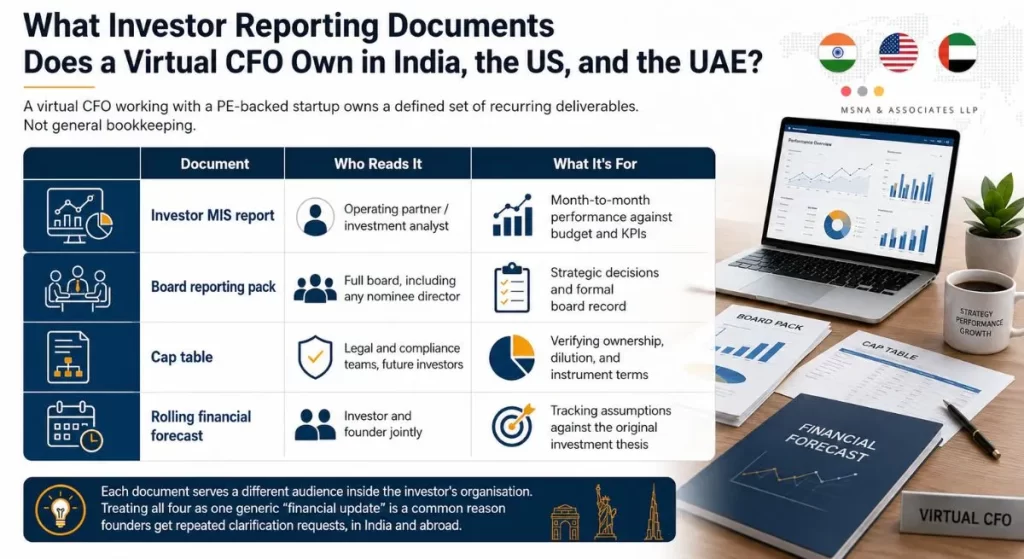
A virtual CFO working with a PE-backed startup owns a defined set of recurring deliverables. Not general bookkeeping.
| Document | Who Reads It | What It’s For |
|---|---|---|
| Investor MIS Report | Operating partner / Investment analyst | Tracks month-to-month financial performance against budget, forecasts, and key performance indicators (KPIs). |
| Board Reporting Pack | Full board, including nominee directors | Supports strategic decision-making, governance discussions, and maintains the formal board record. |
| Cap Table | Legal and compliance teams, current and future investors | Verifies ownership structure, dilution, shareholding changes, ESOPs, and instrument terms. |
| Rolling Financial Forecast | Investors and founders | Monitors financial assumptions, cash flow, and performance against the original investment thesis while supporting future planning. |
Each document serves a different audience inside the investor’s organisation. Treating all four as one generic “financial update” is a common reason founders get repeated clarification requests, in India and abroad.
The strongest investor reporting packs answer questions before investors ask them. If board meetings spend most of their time explaining last month’s numbers, the reporting process is already behind.
How a Virtual CFO for PE-Backed Startups Builds an Investor-Ready MIS Report for US, UAE and Indian Startups?
An investor MIS report generally:
- Maps actuals against the budget approved at the last board meeting
- Flags variance with a short explanation rather than a raw number
- Tracks the specific unit economics or SaaS metrics tied to the original deal terms
- Reconciles to the statutory books, since discrepancies between management accounts and filed financials are a common source of investor pushback
A virtual CFO builds this by first closing that reconciliation gap. Then structuring the report so a reader can move from headline numbers to the underlying driver without a call to the founder.
That’s the real difference between an internal accounting close and reporting built for investors. One is for your team. The other has to stand on its own.
MSNA recommends limiting every MIS report to the metrics management actually uses internally. Reporting loses credibility fast when a dashboard carries KPIs founders themselves never check.
Why Does Cap Table Accuracy Matter So Much in PE Portfolio Company Finance?
A cap table isn’t just a record of who owns what. For a PE investor, it’s the document confirming their economic and voting rights stay protected as the company raises further rounds, issues ESOPs, or changes structure.
An outdated or inconsistent cap table is one of the most common flags in due diligence for the next round, no matter where the fund sits.
A Virtual CFO for PE-backed startups maintains the cap table as a living document, updated at the point each transaction happens rather than reconstructed before a fundraise. This includes tracking:
- Convertible instruments and their conversion triggers
- ESOP pool movements and unallocated headroom
- Anti-dilution provisions and how they affect ownership under different exit scenarios
- Board and shareholder approvals tied to each allotment
What shapes the cap table also depends on where the company is incorporated:
| Market | What Shapes the Cap Table |
|---|---|
| India | ESOP issuance under Section 62(1)(b) of the Companies Act, 2013, through direct allotment or a trust structure, along with share allotments and regulatory compliance requirements. |
| United States (US) | Delaware C-Corp conventions, 409A valuations for option strike pricing, equity incentive plans, and Qualified Small Business Stock (QSBS) considerations. |
| United Arab Emirates (UAE) | Entity structure determines the cap table framework, including DIFC or ADGM free zone regulations, or mainland ownership rules for companies incorporated outside free zones. |
A virtual CFO working across these markets keeps the cap table logic specific to the entity’s actual jurisdiction.
Investor Reporting Compliance Gets Harder With Every Funding Round
Early-stage investors often accept reporting that just explains business performance. Private equity investors expect reporting that supports decisions. As companies grow, board packs, KPI dashboards, and variance analysis get more detailed. That’s because investors are evaluating management’s ability to anticipate risk, not just results. In our experience, startups that build institutional reporting standards before the next round spend less time answering investor requests and more time talking growth strategy with the board.
How Does a Virtual CFO Support Fundraising Readiness and Due Diligence Across India, the US and UAE?
Fundraising readiness is a continuous state, not a sprint that starts once a term sheet lands. When due diligence begins for the next round, investors and their advisors will ask for:
- Historical financial statements for the past two to three years
- A breakdown of revenue recognition policies
- Related-party transaction disclosures
- Reconciled bank statements
A virtual CFO who has managed PE portfolio company finance on an ongoing basis can usually produce this data room content in days, not weeks. The records were already kept to that standard.
Companies that leave financial hygiene until the last minute get a different outcome. Due diligence surfaces gaps that were invisible during normal operations. Once external auditors start asking questions, those gaps become real problems.
How Does Financial Forecasting Align With PE Reporting Standards?
Private equity reporting standards expect a forecast that is revisited on a rolling basis. Not a static projection created once at the time of investment. A virtual CFO rebuilds the forecast each quarter based on actual performance, then reconciles it against the original investment case. Both the founder and the investor can see where assumptions have shifted and why.
This matters because a forecast that drifts too far from actuals without explanation erodes investor confidence faster than one bad quarter does. Investors read a well-maintained rolling forecast as a signal that the PE portfolio company finance function understands the business drivers.
Common Mistakes Founders Make With Investor Reporting Compliance
Mistake | Why It Happens | What It Costs You |
Reporting what’s easy to produce, not what the covenant requires | Internal team builds around existing accounting workflows | Recurring follow-up requests from the investor |
Updating the cap table only annually or pre-fundraise | Treated as a compliance task rather than a live document | Discrepancies surface during due diligence, slowing the next round |
Freezing the forecast after fundraising | No process for quarterly revisiting | Variance explanations become guesswork by quarter three or four |
Delivering MIS reports late in the cycle | Bookkeeping close isn’t scheduled to the investor’s calendar | Erodes investor confidence independent of the actual numbers |
None of these are unusual for a growth-stage company managing reporting internally alongside operations. They are, however, the specific gaps a virtual CFO is typically brought in to close.
When Might a Virtual CFO for PE-Backed Startups Not Be the Right Fit Yet in India, US, or UAE?
Not every PE-backed company needs external CFO support immediately after closing a round. A very early-stage company with a small, straightforward cap table and a single institutional investor may be adequately served by a strong finance manager and a good accounting system for a period of time.
The need for a virtual CFO becomes clearer as the number of investors, ESOP participants, or reporting covenants increases, or as the company approaches its next fundraise and financial due diligence comes into view.
What's Next for Investor Reporting in PE-Backed Startups?
Investor reporting expectations are tightening across India, the US, and the UAE. That trend isn’t levelling off.
Trend | What’s Changing | Why It Matters for Founders |
Live dashboards over static PDFs | PE firms with larger portfolios are standardising a single reporting template across all portfolio companies | Retrofitting data into a new template mid-relationship is more disruptive than building it correctly from the start |
Driver-based, rolling forecasts | Funds are under pressure from their own LPs to report portfolio performance with less lag | Companies that build this discipline early face less disruption when it becomes the norm |
ESG and non-financial KPIs in term sheets | Appearing even outside sectors traditionally associated with sustainability reporting | A finance function already tracking structured, recurring reporting can absorb this expanding scope with less rework |
What Should You Consider Before Hiring a Virtual CFO for PE-Backed Startups in India, US or UAE?
A few questions are worth working through before engaging a Virtual CFO for PE-backed startups:
- How many active investors and reporting covenants does the company have, and how much do their formats differ?
- Is the finance team closing the books on a schedule that supports monthly reporting, or is the close itself the bottleneck?
- Does the cap table reflect every transaction to date, including ESOP grants that may not be formally documented?
- Is the next fundraise close enough that due diligence readiness needs attention in the next two to three quarters?
The answers shape whether a company needs full virtual CFO support, or a narrower engagement focused specifically on MIS reporting and cap table management, aligned to startup CFO services more broadly.
Consulting a Virtual CFO Services In India can help you assess how your current reporting setup compares to what your investors expect, and whether engaging a Virtual CFO for PE-backed startups is the right next step at your current stage
Strengthen Investor Reporting with Virtual CFO Support
Frequently Asked Questions About Virtual CFO for PE-Backed Startups
What does a virtual CFO do for a PE-backed startup?
A virtual CFO builds and owns the investor MIS reports, cap table, rolling forecasts, and board packs a PE investor expects, without the cost of a full-time hire.
How often do PE-backed startups need to report to investors?
Most PE investors expect monthly MIS reporting. In India that’s timed to the SEBI filing clock; in the US and UAE it’s timed to the cadence set in the fund’s Limited Partnership Agreement, rather than an internal schedule.
Why does cap table accuracy matter so much to PE investors?
An outdated cap table is one of the most common red flags that surfaces during financial due diligence for the next funding round.
When should a PE-backed startup bring in a virtual CFO instead of managing reporting internally?
Once the number of investors, ESOP participants, or reporting covenants grows, or the next fundraise is two to three quarters away.
Related
Discover more from MSNA & Associates LLP
Subscribe to get the latest posts sent to your email.