

If your company is preparing for an acquisition, a merger, or a strategic sale, financial risk is usually the reason a deal underperforms. A Virtual CFO for Mergers and Acquisitions provides business owners, CEOs, founders, and corporate finance teams with dedicated financial leadership throughout the deal. This includes M&A financial due diligence, valuation advisory, deal structuring, and post-merger integration. And all this without the cost of a full-time executive hire.This is particularly valuable for businesses managing M&A financial due diligence, valuation advisory, and deal structuring while continuing to run day-to-day operations.
The financial discipline behind this is the same everywhere. What changes by market is which deal structure is available, how it’s taxed, and which regulator has to clear it before the deal can close – in India, the US, and the UAE alike.
Key Takeaways
- A Virtual CFO for Mergers and Acquisitions helps identify financial risks before they reduce deal value.
- Financial due diligence should influence valuation, not simply validate it.
- Deal structuring, tax planning, and integration planning should begin before signing the term sheet.
- Post-merger integration often determines whether expected synergies actually happen.
- Businesses undertaking their first acquisition benefit from independent financial leadership throughout the transaction.
What Does Virtual CFO for Mergers and Acquisitions Do During Financial Due Diligence and Deal Structuring?
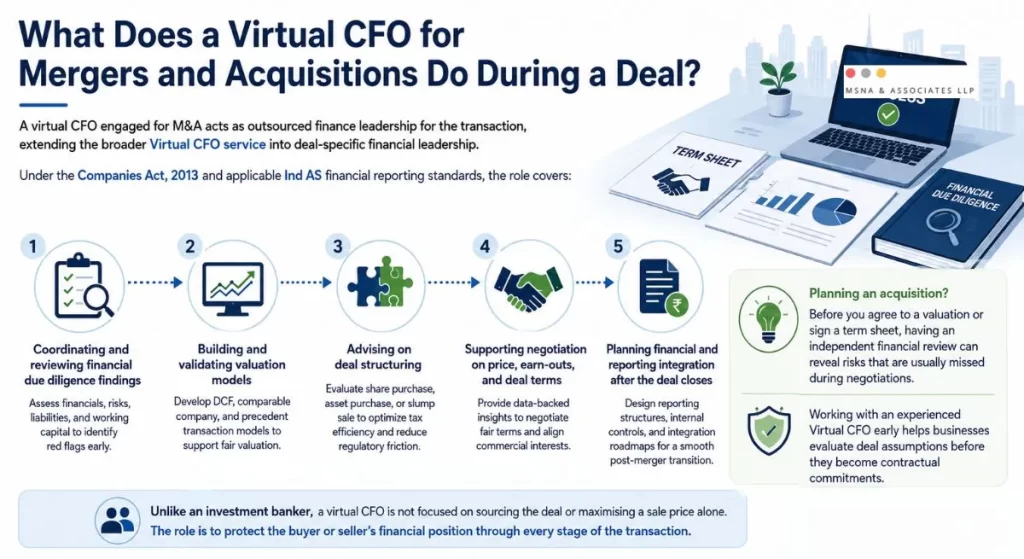
A virtual CFO engaged for M&A acts as outsourced finance leadership for the transaction, extending the broader Virtual CFO service into deal-specific financial leadership. Under the Companies Act, 2013 and applicable Ind AS financial reporting standards, the role covers:
- Coordinating and reviewing financial due diligence findings
- Building and validating valuation models
- Advising on deal structuring (share purchase, asset purchase, or slump sale)
- Supporting negotiation on price, earn-outs, and deal terms
- Planning financial and reporting integration after the deal closes
Unlike an investment banker, a virtual CFO is not focused on sourcing the deal or maximising a sale price alone. The role is to protect the buyer or seller’s financial position through every stage of the transaction.
Planning an acquisition? Before you agree to a valuation or sign a term sheet, having an independent financial review can reveal risks that are usually missed during negotiations. Working with an experienced Virtual CFO Services In India early helps businesses evaluate deal assumptions before they become contractual commitments.
Why Do Mergers and Acquisitions Deals Fail to Deliver Their Expected Value?
Many acquisitions don’t deliver the value the deal was signed on. Usually it comes down to two things: the buyer didn’t have a clear enough view of cash flow and liabilities, or the synergy numbers were never properly tested before the deal closed.
Risk area | What typically goes wrong | Financial oversight that reduces it |
Working capital | Buyer runs short on cash right after the deal closes | A working capital clause, checked before the deal closes |
Hidden liabilities | Hidden claims or costs show up after signing | A closer look at liabilities during due diligence |
Synergy assumptions | Expected savings or extra revenue don’t happen | An independent check on those numbers before the deal is priced |
Integration cost | Integration costs more than planned | Integration costs built into the deal budget upfront |
Valuation gap | Buyer and seller can’t agree on what the business is worth | More than one valuation method, cross-checked |
In our experience, management teams usually spend more time negotiating purchase price than validating the assumptions behind that price. That imbalance often becomes the costliest mistake after closing.
What Does M&A Financial Due Diligence Actually Cover?
M&A financial due diligence is where most deal risk is either caught or missed. A thorough M&A financial due diligence review covers:
Due diligence area | What is examined |
Quality of earnings | Whether reported profit reflects sustainable, recurring operations |
Working capital trends | How cash moves through the business across the year, including how quickly customers pay |
Debt and off-balance-sheet liabilities | Loan covenants, guarantees, lease commitments |
Revenue quality | How much revenue depends on a small number of customers, and the terms of those contracts |
Statutory and compliance records | Registrar filings, licences, and statutory compliance history |
Tax exposure | Review of tax compliance history, past assessments, and pending disputes as part of risk assessment |
Related-party transactions | Pricing and terms compared with arm’s-length norms |
A virtual CFO doesn’t usually carry out the audit-level testing. Their role is to coordinate the due diligence team. They weigh the findings against the deal thesis and flag anything that should affect price or terms.
Some of the biggest risks don’t show up on standard checklists. They surface only through pointed questions. An informal related-party arrangement is one example. A business that depends heavily on the founder’s personal relationships with a few key customers is another.
Take a company projecting 20% annual revenue growth. Financial due diligence finds that 45% of that revenue comes from a single customer, whose contract expires in six months. That single fact changes the valuation conversation. It directly affects how the earn-out should be structured. This information could influence the valuation and earn-out.
How Does a Virtual CFO Support Deal Structuring and Valuation Advisory?
Deal structuring and valuation advisory decisions made early in a transaction are difficult to unwind later. A virtual CFO works across:
Valuation approaches
- Discounted cash flow (DCF), built on realistic, future cash flow projections
- Comparable company analysis, benchmarked against similar transactions
- Precedent transaction analysis for sector-specific multiples
- Asset-based valuation, where relevant for asset-heavy businesses
Structuring considerations
- Whether to do a share purchase, asset purchase, or slump sale, where the business as a whole is transferred for a single sum rather than piecemeal. Each has its own consequences regarding transfer of liabilities
- Need for registered valuer in accordance with Section 247 of the Companies Act, 2013 (if any). A registered valuer is an independent professional registered with the Insolvency and Bankruptcy Board of India. Their opinion on asset value is required for certain company transactions, including mergers and acquisitions.
- Earn-out and deferred payment structures, which help fill any gap between the buyer’s price and the seller’s expectations
- Escrow and indemnity arrangements, which address post-transaction risks
What Financial Risks Should You Watch for During Deal Negotiation?
Deal negotiation is where financial modeling meets legal drafting. A virtual CFO runs the numbers on each of these before it’s built into the agreement:
- Valuation gap: when buyer and seller use different base cases
- Earn-out design: vague or easy to manipulate post-closing
- Working capital adjustment mechanism: vagueness leads to disputes
- Material Adverse Change (MAC) clauses: too narrowly defined, or not narrowly enough, depending on your side of the deal
- Indemnity caps and survival periods: sufficient protection for issues discovered in due diligence
How Do M&A Deal Structures and Tax Rules Differ Across India, the US, and the UAE?
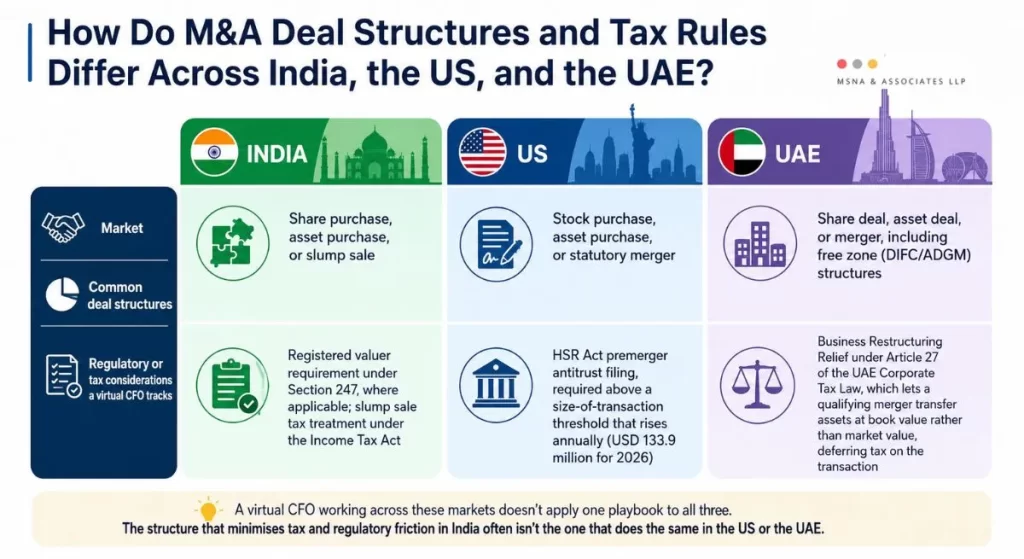
Market | Common deal structures | Regulatory or tax considerations a virtual CFO tracks |
India | Share purchase, asset purchase, or slump sale | Registered valuer requirement under Section 247, where applicable; slump sale tax treatment under the Income Tax Act |
US | Stock purchase, asset purchase, or statutory merger | HSR Act premerger antitrust filing, required above a size-of-transaction threshold that rises annually (USD 133.9 million for 2026) |
UAE | Share deal, asset deal, or merger, including free zone (DIFC/ADGM) structures | Business Restructuring Relief under Article 27 of the UAE Corporate Tax Law, which lets a qualifying merger transfer assets at book value rather than market value, deferring tax on the transaction |
Businesses involved in international transactions often face broader financial challenges beyond M&A. Learn why Every Export Business in India, US, and UAE Needs Virtual CFO to Manage International Finances to understand how strategic financial oversight supports cross-border growth.
What Is Synergy Analysis and Why Does It Matter in Valuation Advisory?
Synergy analysis estimates the extra value expected from combining businesses and forms an important part of valuation advisory before signing. That value usually comes from two places: lower costs once operations combine, and more revenue from cross-selling or reaching new customers together.
This is also where deals most often go wrong. McKinsey’s research on completed mergers found that nearly 70% failed to deliver the revenue synergies the buyer had projected at signing. Cost synergies tend to be more reliable, since they’re largely within the acquirer’s control. Revenue synergies depend on customer behaviour and market response, which is harder to predict and easier to overestimate.
A disciplined synergy review separates:
- Cost synergies that are contractual or structural, and therefore more certain
- Revenue synergies that depend on customer behaviour or market response, and therefore less certain
- Timeline: synergies expected five years out are worth far less today than synergies expected in year one
Testing whether projected synergies are realistic is a key part of risk assessment in M&A, and one of the areas where a Virtual CFO adds the most value.
How Should Purchase Price Allocation Be Handled After the Deal Closes?
Once a deal closes, the purchase price has to be split across what was actually acquired. This is known as Purchase Price Allocation (PPA). It is a mandatory accounting practice under Ind AS 103 (Business Combinations), where the cost needs to be allocated to tangible assets, intangible assets like customer relationships and brand value, and all else becomes part of goodwill.
Getting this allocation right matters, since it affects reported profit and future amortisation. A virtual CFO works with a registered valuer to complete this allocation so it holds up on audit.
The accounting standard behind this changes by market, though the underlying method doesn’t. India follows Ind AS 103, the US follows ASC 805, and UAE entities report under IFRS 3. ASC 805 and IFRS 3 are largely converged. So a virtual CFO working across these markets isn’t learning three separate systems, just applying similar logic under three different rule books.
What Role Does Tax Planning Play in an M&A Transaction?
Tax treatment shapes how a deal gets structured. It shouldn’t be an afterthought once terms are already agreed. A virtual CFO brings tax questions into the deal early, working alongside tax advisors on:
- Deal structure impact: whether a share purchase, asset purchase, or slump sale is more tax-efficient, since each is taxed differently
- Carry-forward of losses: whether the target’s accumulated losses or unabsorbed depreciation can still be used after the acquisition, and under what conditions
- Goodwill and intangible treatment: how the purchase price allocation affects the tax base of what was acquired
- Withholding obligations: whether tax needs to be withheld on the payment itself
- Pending tax disputes: whether the target has open assessments or litigation that should be priced into the deal or covered by an indemnity
Tax planning should never drive the commercial decision, but it should influence how that decision is executed.
How Does a Virtual CFO Support Post-Merger Integration and Risk Assessment?
Post-merger integration is where a large share of deal value is won or lost. It is often under-resourced. Financial integration work includes:
- Combining financial systems and the chart of accounts
- Aligning reporting formats and management information
- Rebuilding cash flow visibility across the combined business
- Tracking actual synergies against what was promised in the deal case
- Keeping integration costs from eating into the value the deal was meant to create
Which Financial Modeling for Acquisitions Approach Works Best?
Model type | Best used for |
Discounted cash flow (DCF) | Estimating intrinsic value based on projected cash flows |
Scenario and sensitivity modeling | Stress-testing the deal against downside assumptions |
Synergy bridge model | Isolating standalone value from synergy-driven value |
Leveraged deal modeling | Transactions involving significant acquisition debt |
Most robust deal teams use more than one model in parallel, then reconcile the outputs rather than relying on a single number.
When Do You Need a Virtual CFO for Mergers and Acquisitions Instead of an In-House Team?
A virtual CFO for M&A tends to make the most sense when:
- The business does not have frequent deal activity to justify a full-time M&A finance hire
- An independent, external view on valuation and risk is needed
- Corporate finance teams need additional bandwidth during a live transaction
- The company is scaling toward its first acquisition and lacks in-house deal experience
Final Word
Financial risk in M&A rarely announces itself. Most often it’s hiding in synergy assumptions that were too optimistic from the start, or in due diligence that didn’t dig deep enough. And it shows up again later, in integration plans nobody built until after the deal had already closed.
A Virtual CFO for Mergers and Acquisitions helps businesses identify financial risks before terms are finalised, protecting deal value through financial due diligence, deal structuring, and post-merger integration. Bringing in dedicated financial oversight before terms are finalised is one of the more effective ways to protect deal value.
Consulting a professional early in the process can help you assess how these risks apply to your specific deal before you’re locked into its terms.
Strengthen Financial Oversight Throughout Your M&A Transaction
Frequently Asked Questions Related To Virtual CFO for Mergers and Acquisitions
Is a virtual CFO involved in the entire deal, or just one phase?
Typically the entire lifecycle, from due diligence through valuation, negotiation, and post-merger integration, though scope can be limited to specific phases depending on the engagement.
How is a virtual CFO different from an investment banker in M&A?
The typical investment banker is mainly concerned with the sourcing and selling side of the deal. The virtual CFO is mainly concerned with risks, financial valuation, and integration, and can work along with the banker but not in place of it.
Does a virtual CFO replace the need for legal and tax advisors?
No. The virtual CFO coordinates the financial stream and works in collaboration with legal and tax advisors to address the aspects within their expertise.
Do M&A deal structures and tax treatment differ between India, the US, and the UAE?
Yes, although the due diligence and valuation process is similar, the differences arise in deal structures, tax-saving options, and pre-closing documentation across markets.
Related
Discover more from MSNA & Associates LLP
Subscribe to get the latest posts sent to your email.