
PMS Disclosure Document Under SEBI Regulations: Structure, Compliance & Certification Guide (2026)
For a Portfolio Manager, the Disclosure Document is not just another compliance formality. It is one of the most important transparency documents in the entire PMS ecosystem.
Before an investor entrusts their capital to a Portfolio Manager, they want answers:
- Who manages the money?
- What investment approach does the PMS follow?
- What risks are involved?
- What fees will be charged?
- Has the PMS faced regulatory action before?
The PMS Disclosure Document answers all these questions in a structured and SEBI-mandated format.
More importantly, it reflects the PMS provider’s commitment to transparency, investor protection, and regulatory compliance.
Under the Securities and Exchange Board of India (Portfolio Managers) Regulations, 2020, every SEBI-registered Portfolio Manager must prepare, maintain, update, and publicly host a Disclosure Document. SEBI strengthened these disclosure requirements further through its revised framework introduced in September 2025.
What is a PMS Disclosure Document?
A PMS Disclosure Document is a mandatory regulatory document that every SEBI-registered Portfolio Manager must maintain under the Portfolio Managers Regulations, 2020.
It gives investors a complete overview of the PMS business, including:
- investment strategies,
- management structure,
- fee model,
- risk factors,
- financial performance,
- litigation history,
- compliance framework,
- and operational policies.
Think of it as the PMS industry’s equivalent of a company’s Memorandum of Association (MOA) or Articles of Association (AOA). It serves as the primary public-facing compliance document through which investors understand how the PMS operates.
SEBI requires Portfolio Managers to:
- maintain this document continuously,
- update it whenever material changes occur,
- and make it available on their website at all times.
The objective is simple: investors should have access to complete, accurate, and updated information before making investment decisions.
Why Does SEBI Mandate a PMS Disclosure Document?
SEBI’s regulatory philosophy has always focused heavily on investor protection and market transparency.
The PMS industry deals with high-value discretionary and non-discretionary investments. Because investors hand over significant capital to professional fund managers, SEBI expects a very high standard of disclosure and accountability.The Disclosure Document forms a key part of PMS Client Onboarding and SEBI Compliance, ensuring investors receive all material information before making investment decisions.
The Disclosure Document supports this objective in three major ways:
1. Improves Investor Awareness
The document gives investors clarity about:
- investment philosophy,
- portfolio risks,
- historical performance,
- expenses,
- and operational structure.
This reduces information asymmetry between the Portfolio Manager and the investor.
2. Enables Better Financial Decision-Making
Investors can compare PMS providers more objectively when disclosures are standardised.
For example:
- one PMS may follow concentrated investing,
- another may follow diversified sector allocation,
- while another may use momentum-based strategies.
Without structured disclosure, investors may struggle to evaluate suitability.
3. Increases Regulatory Accountability
Since the Disclosure Document is publicly accessible and periodically updated, it creates a continuous compliance obligation for the PMS.
This improves:
- governance standards,
- operational discipline,
- and transparency across the industry.
Regulatory Framework Governing PMS Disclosure Documents
The legal requirement for PMS Disclosure Documents comes directly from the Securities and Exchange Board of India (Portfolio Managers) Regulations, 2020.
Regulation 22(3)
Regulation 22(3) states that every Portfolio Manager must provide clients with:
- a Disclosure Document in the format specified by SEBI, and
- a certificate in Form C.
Regulation 22(5)
Regulation 22(5) requires an independent Chartered Accountant to certify the contents of the Disclosure Document.
This ensures that disclosures undergo independent professional verification before circulation.
Regulation 22(6)
Regulation 22(6) mandates that the Portfolio Manager must host the Disclosure Document on its website continuously from the date of registration.
Regulation 22(7)
Regulation 22(7) requires the Portfolio Manager to:
- file the Disclosure Document with SEBI before circulating it to clients,
- and update SEBI whenever any material change occurs.
The updated Disclosure Document must be filed within 7 working days of the material change.
When Should a PMS Disclosure Document Be Updated?
A PMS must update its Disclosure Document whenever a “material change” occurs.
This requirement is important because the PMS industry operates dynamically. Investment strategies, fee structures, management personnel, and operational policies often evolve over time.
SEBI expects investors to receive updated information whenever such changes materially affect the PMS.
What is Considered a Material Change?
SEBI’s Master Circular for Portfolio Managers provides an inclusive definition of material change.
Some common examples include:
- Change in control of the Portfolio Manager
- Change in Principal Officer
- Revision in fee structure
- Change in service-related charges
- Introduction or modification of investment approaches
- Changes affecting client portfolios
- Any other change specified by SEBI
Importantly, this is not an exhaustive definition.
Portfolio Managers must exercise professional judgement while evaluating whether a particular development materially impacts investor decision-making.
This is where experienced compliance professionals and Chartered Accountants play a critical role.
Revised PMS Disclosure Document Structure Introduced by SEBI (2025)
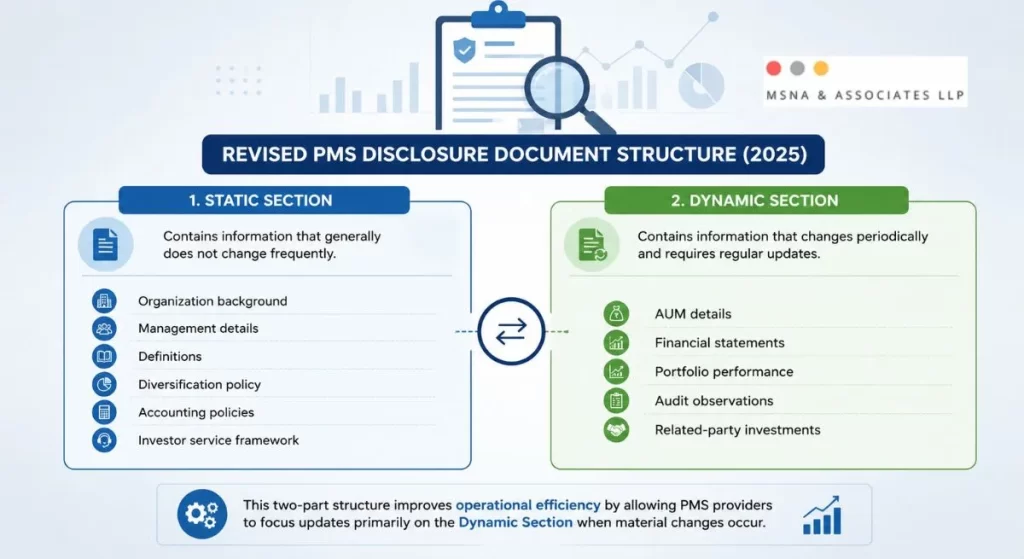
SEBI introduced a revised Disclosure Document structure through circular:
SEBI/HO/IMD/IMD-RAC-3/P/CIR/2025/125 dated 9 September 2025
The revised framework divides the Disclosure Document into two parts:
1. Static Section
The Static Section contains information that generally does not change frequently.
This includes:
- organisation background,
- management details,
- definitions,
- diversification policy,
- accounting policies,
- and investor service framework.
2. Dynamic Section
The Dynamic Section contains information that changes periodically and requires regular updates.
This includes:
- AUM details,
- financial statements,
- portfolio performance,
- audit observations,
- and related-party investments.
This two-part structure significantly improves operational efficiency because PMS providers can focus updates primarily on the Dynamic Section whenever material changes occur.
Key Components of a PMS Disclosure Document
Disclaimer Clause
This section clarifies:
- Investments are subject to market risks,
- past performance does not guarantee future returns,
- and disclosures are informational in nature.
It protects both investors and the PMS from misinterpretation.
Description of the PMS
This section provides:
- business background,
- promoter details,
- management team information,
- group company disclosures,
- and the nature of services offered.
It helps investors understand the credibility and experience of the PMS.
Litigation & Regulatory Proceedings
SEBI requires disclosure of:
- penalties,
- pending litigation,
- regulatory proceedings,
- and disciplinary history.
For investors, this acts as an important governance and integrity checkpoint.
Services Offered & Investment Approaches
The PMS must explain:
- portfolio strategies,
- investment objectives,
- asset allocation philosophy,
- benchmark methodology,
- and associated risks.
This section helps investors determine whether the PMS strategy aligns with their own risk appetite and financial goals.
Risk Factors
This section explains:
- market risk,
- concentration risk,
- liquidity risk,
- sector-specific risks,
- and strategy-specific investment risks.
A strong risk disclosure section improves investor awareness and reduces unrealistic return expectations.
Fees & Expenses
The Disclosure Document must clearly disclose:
- management fees,
- performance fees,
- custodian charges,
- brokerage,
- exit loads,
- and other client expenses.
Transparent fee disclosure allows investors to compare PMS offerings more fairly.
Why the Dynamic Section Matters to Investors?
The Dynamic Section often becomes the most closely reviewed part of the Disclosure Document because it reflects the current health and performance of the PMS.
Client Representation
This section discloses:
- number of clients,
- category-wise client breakup,
- and Assets Under Management (AUM).
According to SEBI data, India’s PMS industry AUM crossed ₹7 lakh crore in 2025, reflecting strong growth in professionally managed investment products.
A growing AUM may indicate:
- investor confidence,
- institutional stability,
- and operational scale.
However, investors should also evaluate consistency, risk management, and investment discipline — not just size.
Financial Performance
The PMS must disclose:
- Balance Sheet,
- Profit & Loss Statement,
- and Cash Flow Statement.
Strong financials indicate operational sustainability and compliance maturity.
Performance Track Record
This section compares PMS strategy performance against benchmarks over 3 years.
For investors, this becomes one of the most critical evaluation parameters.
However, experienced advisors know that:
- short-term outperformance alone is not enough,
- Consistency and risk-adjusted returns matter far more.
Role of an Independent Chartered Accountant in PMS Disclosure Certification

SEBI requires an independent Chartered Accountant to certify the Disclosure Document.
This is not a routine certification assignment.
A CA firm handling PMS Disclosure certification must understand:
- SEBI PMS Regulations,
- SEBI circulars,
- investment operations,
- portfolio reporting,
- fee structures,
- compliance obligations,
- and disclosure standards.
The engagement involves independently verifying:
- completeness,
- accuracy,
- consistency,
- and adequacy of disclosures.
The CA must complete certification within strict timelines, particularly when material changes occur.
What Does the CA Certification Confirm?
The Chartered Accountant issues a certification in Form C confirming that:
The disclosures made in the document are true, fair and adequate to enable investors to make a well-informed decision.”
The certifying CA also signs relevant sections wherever modifications or material changes have been incorporated.
This creates accountability, traceability, and professional assurance.
Common Compliance Challenges Faced by PMS Providers
Many PMS providers face operational challenges while maintaining Disclosure Documents.
Some common issues include:
- identifying material changes correctly,
- maintaining update timelines,
- aligning disclosures with evolving SEBI circulars,
- ensuring consistency across sections,
- coordinating legal, operations, and compliance teams,
- and obtaining timely CA certification.
As SEBI continues tightening disclosure standards, the importance of specialized PMS compliance expertise continues to grow.
Why PMS Disclosure Compliance Matters More Than Ever?
India’s wealth management industry is evolving rapidly.
Today’s investors are:
- more informed,
- more compliance-conscious,
- and more performance-sensitive than ever before.
A well-maintained Disclosure Document does more than satisfy SEBI regulations.
It:
- builds investor trust,
- improves transparency,
- strengthens governance,
- and demonstrates operational maturity.
For serious Portfolio Managers, disclosure quality has become a direct reflection of brand credibility.
Conclusion
The PMS Disclosure Document is far more than a regulatory requirement. It is the foundation of transparency between the Portfolio Manager and the investor.
Maintaining this document requires:
- regulatory understanding,
- operational discipline,
- technical expertise,
- and continuous monitoring of SEBI updates.
Because SEBI regulations evolve regularly, both Portfolio Managers and certifying Chartered Accountants must stay updated at all times.
A professionally prepared and properly certified Disclosure Document not only ensures compliance but also strengthens investor confidence and long-term credibility.
Related
Discover more from MSNA & Associates LLP
Subscribe to get the latest posts sent to your email.