


How Internal Audit Reporting Drives Real Business Action?
Last quarter, a company finished an internal audit. The report was detailed, neatly formatted, and shared with everyone. For a few days, people talked about it. Then it went into emails and folders. And nothing moved. Nothing moved. A few months later, the same issues, costing the company lakhs in leakages, came back.
That is where many audits lose value. The problem is not the audit itself, but the way it is reported. In this blog, we will look at how internal audit reporting can be made clear, practical, and action-focused so teams understand risks and know exactly what to do next.
What is Internal Audit Reporting?
Internal Audit Reporting is simply how audit findings are shared after reviewing a company’s systems and controls. It shows what was checked, what didn’t work, and what needs attention.
But in 2026, it goes beyond documentation. As of January 9, 2025, the new Global Internal Audit Standards became mandatory. This shift means that the auditors need to provide conclusions rather than just observations.
A good report helps management:
- See the real impact of issues
- Understand risks clearly
- Take practical action
This is why risk assessment reporting is now a core part of modern audits, linking findings directly to business risk.
Why Internal Audit Reporting Still Fails in Many Companies?
Many audit reports don’t work because they stop at information. The issues are written down, but the impact is not clearly shown. So, people read it once and move on. The urgency just isn’t felt.
Take a simple case. A report says controls are weak. But what does that really mean for money, operations, or compliance? That link is often missing, and the issue feels less serious than it is.
Common gaps you’ll notice:
- Findings without real business impact
- Vague lines like “improve controls.”
- No one is clearly responsible
- No timeline to fix things
So teams hesitate. Work gets delayed. Over time, the report is ignored. That’s why best practices for effective internal audit reporting now focus on being clear, specific, and action-driven.
Businesses that focus on stronger governance processes often see better audit follow-through and accountability. You can also read how Internal Audit Builds Structured Corporate Governance for Growing Companies to understand how internal audits support long-term operational discipline.
Key Elements of Effective Internal Audit Reporting
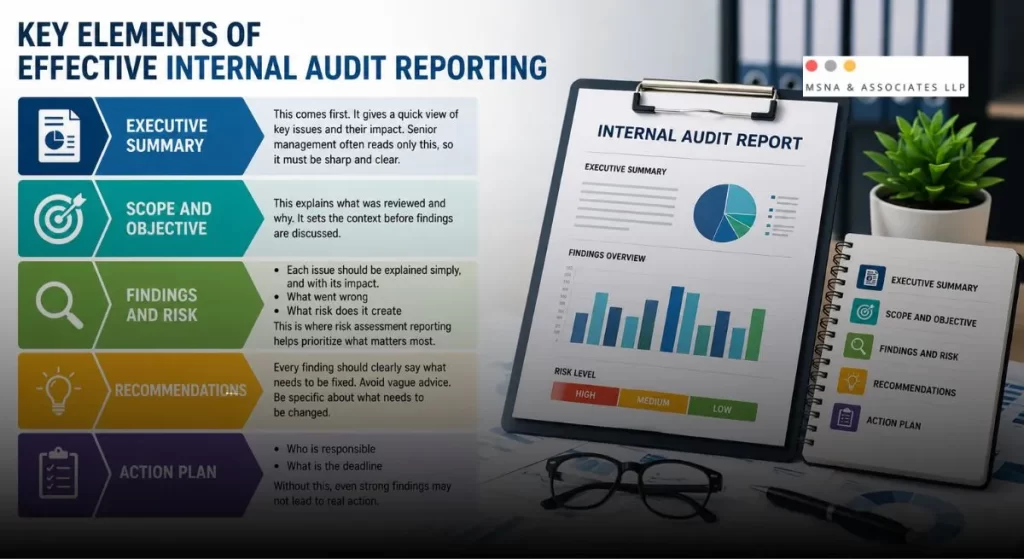
An effective report follows a clear structure. This is often called the internal audit report format, and it helps readers understand issues without confusion.
Executive Summary
This comes first. It gives a quick view of key issues and their impact. Senior management often reads only this, so it must be sharp and clear.
Scope and Objective
This explains what was reviewed and why. It sets the context before findings are discussed.
Findings and Risk
Each issue should be explained, along with its impact.
- What went wrong
- What risk does it create
This is where risk assessment reporting helps prioritise what matters most.
Recommendations
Every finding should clearly say what needs to be fixed. Avoid vague advice. Be specific about what needs to be changed.
Action Plan
This is where things move forward:
- Who is responsible
- What is the deadline
Without this, even strong findings may not lead to real action.
How to Create Actionable Audit Reports?
Creating an actionable report starts with understanding who will read it. Not everyone comes from an audit background, so the language should be simple and direct. If it feels easy to read, it is more likely to be used.
Next, don’t try to cover everything. Audits today are more about what matters most. Instead of listing minor issues, highlight the ones that can actually impact the business.
Clarity plays a big role. Short sentences and clear points help findings land better. When people understand quickly, action is more likely to follow.
Recommendations should be specific and measurable:
- Say what needs to be done
- Define how often or how much
- Avoid vague lines
A strong action plan is also needed:
- Assign a clear owner
- Set a realistic deadline
This builds accountability. Businesses working with an internal audit firm in Bangalore often find it easier to improve tracking, follow-up, and timely closure of audit findings.
Expert Insight: Top-performing audit teams aim to close high-risk findings within 30-60 days. When reports clearly define ownership and deadlines, closure rates improve significantly, and repeat issues are reduced.
Best Practices for Better Internal Audit Reporting
Better audit reporting usually comes down to a few basics done well.
First, keep the report short. If it is too long, most people will stop paying attention. A clean structure helps readers spot the main issues fast.
Second, use plain, simple language. Audit terms may sound correct, but they often make the report harder to follow. Clear writing works better.
What also helps:
- Show how the issue affects the business
- Keep recommendations direct and useful
- Mention what is working well too
That last part matters. A balanced report feels more credible.
Speed is also important. It’s too late if the news is shared too late. A clear, useful, and simple report is one that you can use.
Latest Trends in Internal Audit Reporting (2026)
Industry research from AuditBoard highlights that many audit teams are shifting toward more action-oriented reporting models to improve remediation and accountability.
Key trends you’ll notice:
- AI readiness gap: Most businesses are planning to use more AI in the coming years. But only around 35% are actually using it in reporting and planning.
- Full-population testing: Audits are slowly moving away from sampling to testing entire data sets.
- Real-time dashboards: In India, monthly “flash reports” are being used to spot issues early in high-value transactions.
The “So What?” Test in Internal Audit Reporting
Most audit reports miss one simple question: “So what?”
A finding may be correct, but if its impact isn’t clear, it gets ignored.
Before finalising a report, ask:
- If this continues, what happens?
- Does it affect money, compliance, or operations?
- Would management care right now?
If the answer is unclear, the finding is incomplete.
Take a simple case. “Approvals are missing” sounds minor. But “missing approvals can lead to unauthorised payments” changes how it is seen.
That is why professional firms like MSNA & Associates offer internal audit services in India, so issues are understood and acted on without confusion.
Internal Audit Reporting That Actually Drives Action
At the end of the day, internal audit reporting should do one thing well: help people act. If a report only explains issues but doesn’t move things forward, its job is only half done.
So, clear points, real impact, and simple next steps make all the difference. When that is done right, reports stop sitting in folders and start getting used.
Professional firms like MSNA & Associates take this approach seriously. Their focus on internal audit, risk advisory, and process improvement shows how reporting can go beyond compliance and support real business decisions.
Improve Your Internal Audit Reporting
Related
Discover more from MSNA & Associates LLP
Subscribe to get the latest posts sent to your email.