

PMS Client Onboarding and SEBI Compliance: What Every HNI Investor and Portfolio Manager Should Know
This article explains the complete PMS client onboarding and SEBI compliance process from a practical and regulatory perspective.
It covers KYC requirements, digital onboarding, risk profiling, in-person verification, PMS agreements, AML checks, and the ₹50 lakh investment threshold while highlighting the compliance responsibilities of portfolio managers and the safeguards designed to protect high-net-worth investors.
Understanding PMS Before the Onboarding Begins
What Is a Portfolio Management Service (PMS)?
A Portfolio Management Service is a SEBI-registered investment arrangement where a professional portfolio manager manages investments on behalf of a client according to an agreed mandate.
Unlike mutual funds:
- securities are held in the client’s own name,
- portfolios are customised,
- investment decisions are discretionary or advisory,
- and the relationship is highly personalised.
Under current SEBI regulations, PMS services are available only to investors who can commit a minimum investment of ₹50 lakh.
This threshold exists for a reason. PMS products involve concentrated portfolios, active management, and higher investment complexity. SEBI expects PMS clients to possess both financial sophistication and risk-bearing capacity.
According to SEBI’s Portfolio Managers Report, discretionary PMS continues to dominate the industry, accounting for a substantial share of total assets under management. Equity-focused strategies remain the most preferred category among HNI investors.
From a compliance standpoint, PMS differs fundamentally from pooled investment products because every transaction directly impacts the client’s personal account structure. That increases the importance of:
- identity verification,
- source-of-funds validation,
- suitability assessment,
- and audit-ready documentation.
This is exactly where onboarding becomes critical.
Why PMS Client Onboarding Is a Regulatory Process, Not Just Documentation?
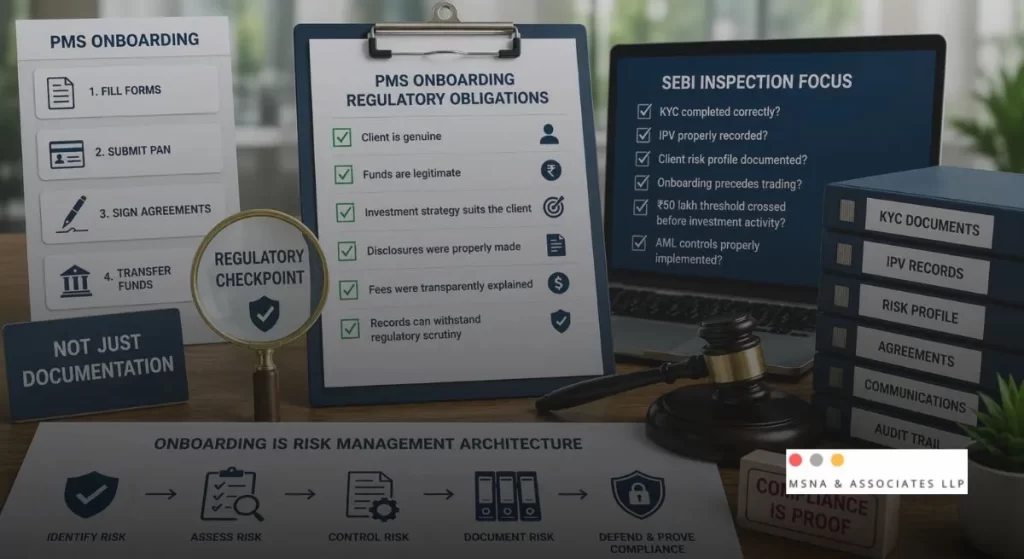
Many investors assume onboarding simply means:
- filling forms,
- submitting PAN,
- signing agreements,
- and transferring funds.
In reality, onboarding is the first regulatory checkpoint in the PMS lifecycle.
The moment Mr Wealth expresses intent to invest, Portfolio Builders Private Limited – our fictional SEBI-registered PMS entity becomes responsible for complying with multiple overlapping regulatory obligations.
A PMS entity must prove:
- The client is genuine,
- The funds are legitimate,
- The investment strategy suits the client,
- disclosures were properly made,
- fees were transparently explained,
- and all records can withstand regulatory scrutiny.
This distinction matters enormously.
SEBI inspections typically do not begin with investment performance. They begin with process validation:
- Was KYC completed correctly?
- Was IPV properly recorded?
- Was the client’s risk profile documented?
- Did onboarding precede trading?
- Was the ₹50 lakh threshold crossed before investment activity started?
- Were AML controls properly implemented?
In several enforcement matters across the financial services sector, regulators have penalised intermediaries not because fraud occurred, but because firms failed to maintain defensible compliance records.
Once onboarding is completed, PMS firms must also ensure that execution and allocation processes remain compliant. Understanding the PMS Pool Trading Process in India can help investors and compliance professionals see how operational controls continue after account activation.
That is why onboarding is best understood as a risk management architecture rather than an operational checklist.
Step 1: PMS KYC Compliance- Establishing Client Identity
Why KYC Is the Foundation of PMS Compliance?
Before Portfolio Builders discusses investment strategy, returns, or portfolio allocation, it must answer one basic question:
Who exactly is Mr Wealth? This requirement falls under the SEBI KYC Master Circular dated 12 October 2023.
The regulation is unambiguous: KYC verification must happen at the beginning of the account-based relationship.
- Not later.
- Not after funds arrive.
- Not after agreement execution.
Immediately. This requirement exists because financial systems globally face increasing threats from:
- money laundering,
- identity theft,
- shell structures,
- tax evasion,
- and terrorist financing.
According to the United Nations Office on Drugs and Crime (UNODC), global money laundering transactions may account for 2% to 5% of global GDP annually. Financial intermediaries therefore operate as frontline gatekeepers in protecting market integrity.
For PMS entities, KYC is not merely a procedural obligation. It is the first line of regulatory defence.
What Are The Documents Required for PMS KYC?
PAN Verification and Aadhaar Linking
PAN remains mandatory for PMS onboarding. However, many investors still misunderstand an important compliance nuance: A PAN that is not linked with Aadhaar may become inoperative under the Income-tax Act. An inoperative PAN cannot support onboarding or transactions.
Portfolio Builders must therefore validate:
- PAN authenticity,
- operational status,
- and Aadhaar linkage compliance.
This applies across:
- individuals,
- HUFs,
- trusts,
- companies,
- partnership firms,
- and joint holders.
The compliance expectation is straightforward:
Verification must be documented and reproducible during audits.
Valid Proof of Identity Documents
Mr Wealth may provide:
- Passport
- Driving Licence
- Aadhaar
- Voter ID
- NREGA Job Card
- NPR Letter
The PMS entity must ensure:
- documents remain valid,
- Details match the onboarding form,
- and records remain retrievable.
Even small inconsistencies can trigger compliance observations during SEBI inspections.
Proof of Address Requirements
One practical challenge often emerges during onboarding: The client’s identity document may display an outdated address.
In such situations, the PMS entity must obtain:
- utility bills,
- bank statements,
- or property tax records,
showing the current residential address.
The Prevention of Money Laundering Rules require intermediaries to maintain accurate and updated client records. This requirement becomes particularly important during:
- Suspicious transaction monitoring,
- AML reviews,
- and law enforcement requests.
Step 2: Digital KYC in PMS – Convenience With Higher Compliance Expectations
How SEBI Has Changed Digital Onboarding?
Digital onboarding has transformed wealth management. Today, many HNI investors complete the entire PMS onboarding process remotely through:
- mobile apps,
- web portals,
- DigiLocker,
- Aadhaar e-sign,
- and video verification systems.
But digital convenience does not reduce compliance expectations. If anything, regulators now expect stronger technological controls because the risk of impersonation and digital fraud has increased sharply.
According to the RBI’s annual report, digital financial fraud cases in India have risen significantly alongside rapid fintech adoption. This explains why regulators increasingly insist on:
- audit logs,
- OTP validation,
- liveliness detection,
- geo-tagging,
- and tamper-proof verification systems.
Critical Digital KYC Controls PMS Entities Must Implement
Before digital onboarding begins, Portfolio Builders must obtain explicit client consent. Consent cannot be implied.
The system must clearly capture:
- acceptance,
- timestamps,
- and user authentication records.
The onboarding platform should also verify:
- mobile numbers through OTP,
- email addresses,
- bank account ownership,
- Aadhaar authentication where voluntarily provided,
- and digital signatures.
One particularly important compliance area involves Aadhaar handling.
Under SEBI rules:
- Aadhaar usage is voluntary,
- data minimisation is mandatory,
- and only masked Aadhaar copies should be retained.
Improper Aadhaar storage can create significant data privacy exposure. This is no longer merely a compliance issue. It is also a reputational risk issue.
Step 3: Risk Profiling and Investor Suitability in PMS
Why Suitability Assessment Matters More Than Ever?
Risk profiling is one of the most underestimated steps in PMS onboarding.
Many firms still treat it as a form-filling exercise. Regulators do not. SEBI increasingly expects investment decisions to align with documented client suitability.
This means Portfolio Builders must assess:
- risk appetite,
- financial capacity,
- liquidity needs,
- investment horizon,
- and wealth objectives.
This assessment directly determines whether:
- aggressive equity strategies,
- concentrated portfolios,
- thematic investments,
- or defensive allocationsThey
are suitable for Mr Wealth.
A conservative client cannot simply be pushed into a high-volatility strategy because markets appear attractive. That creates both:
- suitability risk,
- and litigation risk.
Globally, investor suitability failures have triggered major enforcement actions across wealth management firms. Indian regulators are moving in the same direction.
What Makes Risk Profiling Defensible During Audits?
A proper risk profiling framework should include:
- structured questionnaires,
- documented scoring models,
- client acknowledgements,
- strategy mapping,
- and review mechanisms.
The most important principle is consistency. If Mr. Wealth’s profile suggests moderate risk tolerance, the actual investment strategy must reflect that profile.
A PMS entity cannot later justify unsuitable investments using hindsight arguments.
From an audit perspective, the following are common weaknesses:
- unsigned risk forms,
- missing timestamps,
- inconsistent scoring,
- outdated profiles,
- or strategies that do not align with client categorisation.
Documentation quality ultimately determines whether the process remains defensible.
Step 4: In-Person Verification (IPV) and Video Verification Requirements
Why SEBI Mandates IPV?
Identity fraud has become increasingly sophisticated.
Fake documentation, deepfake technology, and digital impersonation have forced regulators to strengthen identity verification requirements. That is why SEBI mandates In-Person Verification (IPV).
Portfolio Builders must ensure:
- the client exists,
- matches submitted records,
- and participates in a genuine onboarding interaction.
The IPV record must include:
- verifier name,
- designation,
- organisation,
- signature,
- and date.
This creates accountability and traceability
Video IPV and Digital Verification Standards
For remote clients, Video IPV (VIPV) is permitted. However, SEBI expects:
- live interactions,
- spontaneous responses,
- clear visibility,
- timestamped recordings,
- and secure storage systems.
The technology framework should also support:
- geo-location tagging,
- liveliness detection,
- encrypted sessions,
- and anti-spoofing safeguards.
These controls are becoming increasingly important because AI-generated impersonation risks are rising globally. A weak verification process today can easily become tomorrow’s regulatory investigation.
Step 5: PMS Agreement and Mandatory Client Disclosures
Why the PMS Agreement Is Legally Critical?
Under Regulation 22 of the SEBI (Portfolio Managers) Regulations, 2020, Portfolio Builders cannot commence investment activity without executing a formal PMS agreement.
The agreement defines:
- investment mandate,
- fee structure,
- risk disclosures,
- termination rights,
- reporting obligations,
- and dispute resolution mechanisms.
This agreement is not a standard template exercise. It establishes the legal architecture of the entire relationship.
Fee Transparency and Investor Understanding
SEBI now places strong emphasis on fee transparency. The PMS entity must ensure the client genuinely understands:
- management fees,
- performance fees,
- brokerage,
- custodian costs,
- and exit terms.
This requirement reflects broader regulatory trends globally toward investor protection and informed consent. According to Morningstar research, fee transparency significantly influences long-term investor trust and retention in managed investment products.
Portfolio Builders must also provide the MITC (Most Important Terms and Conditions) document summarising critical provisions in simple language. This improves transparency and reduces future disputes.
Step 6: Bank Verification, Demat Setup, and the ₹50 Lakh Threshold
Why Penny Drop Verification Matters in PMS Compliance?
Before accepting funds, Portfolio Builders must validate bank account ownership using Penny Drop verification.
This small transaction confirms:
- account authenticity,
- ownership consistency,
- and operational validity.
From an AML perspective, this is extremely important.
It helps prevent:
- third-party funding,
- benami transactions,
- and suspicious fund routing.
If funds originate from unverified accounts, the PMS entity should reject or return them until verification is completed.
The ₹50 Lakh PMS Minimum Investment Requirement
SEBI regulations mandate a minimum investment threshold of ₹50 lakh for PMS clients. This is not a recommendation. It is a hard regulatory requirement.
If Mr. Wealth transfers funds in instalments:
- Portfolio Builders must wait,
- track cumulative receipts,
- and commence trading only after the threshold is crossed.
Auditors regularly examine:
- funding timelines,
- trade initiation dates,
- and compliance sequencing.
Even operational shortcuts can create regulatory violations.
The Real Compliance Lesson Behind PMS Onboarding
At first glance, PMS onboarding appears procedural.
In reality, it represents something much larger: the integrity of the client relationship itself.
Each compliance step exists to solve a specific risk:
- KYC prevents identity misuse
- AML controls prevent illicit fund flows
- Risk profiling protects suitability
- agreements ensure informed consent
- Verification processes prevent fraud
- Documentation creates accountability
The strongest PMS firms are not necessarily those with the best marketing.
They are the ones whose processes remain consistent, transparent, and defensible under scrutiny.
That is the true meaning of compliance in wealth management.
- Not paperwork.
- Not bureaucracy.
- Trust architecture.
Conclusion
The PMS client onboarding process has evolved far beyond administrative documentation. Today, it sits at the intersection of:
- investor protection,
- regulatory accountability,
- AML governance,
- data security,
- and fiduciary responsibility.
For investors, understanding this framework creates greater confidence in the PMS relationship.
For portfolio managers, the message is even more important: Compliance cannot be reactive. Every onboarding decision creates:
- audit exposure,
- legal implications,
- operational risk,
- and reputational consequences.
A robust onboarding framework ultimately protects:
- the client,
- the PMS entity,
- and the credibility of the financial system itself.
In wealth management, trust is never built through promises alone. It is built through processes that withstand scrutiny. If you need any assistance with PMS, connect with our team of chartered accountants in Bangalore, India, for a discussion.
Related
Discover more from MSNA & Associates LLP
Subscribe to get the latest posts sent to your email.