How Will an Internal Audit Be Conducted: Go-To-Checklist for Founders
Internal audit is more than a formal review of your books – a process to identify risks, prevent compliance missteps, and get clarity on how your money flows.
Whether you’re preparing for funding, a merger, or just want a stronger handle on your finances, knowing how to do an internal audit is essential. In this guide, you’ll get to know how to do an internal audit, when to conduct one, and a founder-friendly checklist for conducting one.
Table of Contents
How to do Internal Audit: Step By Step Internal Audit Process Flow for Startups
Here’s how to do an internal audit to ensure your business remains financially and legally sound:
Step 1: Define Scope and Purpose
Determine why you’re conducting the audit before getting into actual reports. Is it to
Review your financials for the year?
Test internal controls?
Or prepare for a funding round?
Be it of auditing a specific department or the entire organization, setting the scope and objective helps you narrow down your focus. Plus, this guides you in timeline and resource planning.
Step 2: Build a Checklist and Gather Financial Documents
Create an audit checklist that is aligned with your goals. Note that the checklist includes key documents and operational areas that need evaluation.
Typical documents include:
Profit & loss statements
Balance sheets
GST filings & TDS returns
Expense reports and vendor contracts
Payroll records
Internal policies and SOPs
Step 3: Review Financials, Processes, and Policies
This is the step where you need to run three evaluations:
Financial Review: Examine income, expenditure, debts, and assets. Find inconsistencies in misreported revenue, unaccounted costs, and mismatches in tax declarations. Check for revenue leakages if any and also mainly look at misstatement risk.
Policy Review: Ensure internal policies are compliant with statutory requirements and up to professional standards.
Process Review: Asses the operational workflows to see if they are efficient, documented, and implemented properly.
Beyond finding errors, this step is all about understanding how efficiently your business runs.
Step 4: Conduct Interviews and Observe Daily Operations
To get deeper insights into internal control systems, auditors conduct staff interviews and process walk-throughs.
Here’s How Internal Auditors Conduct Interview –
Discuss the expense reimbursement process with HR.
Talk to your accounts team about the steps involved in approving vendor payments.
Watch how the team handles cash flow tracking and data backups.
Do a process interview to understand the revenue recognition process
These insights help to map unaddressed workflows and overlooked issues that could lead to potential risk.
Step 5: Identify Risks and Control Gaps
It is in this step that the value of an internal audit becomes clear. Based on your analysis, flag operational, financial, or compliance risks.
Some examples include of Identifying Risks by Auditors –
Weak expense approval systems.
Delays in statutory filings.
Missing documentation or digital records.
Overdependence on a single individual or financial control.
Types of Internal Audit Risks While Doing Audit
Step 6: Compile Audit Results and Recommend Actionable Steps
Document your findings into a formal audit report that is structured, factual, and solution-oriented. Your report should cover:
After completing your audits, share your report with key decision-makers and build actionable plans. Address areas with high legal and financial risks. Then, delegate tasks, set clear deadlines, and track progress closely.
We recommend scheduling a follow-up review in 3-6 months to track progress.
Bonus tip: Hire a virtual CFO to guide this process, especially when lacking in-house finance capacity.
Internal Audit Checklist for Founders: Vetted by Seasoned Auditors
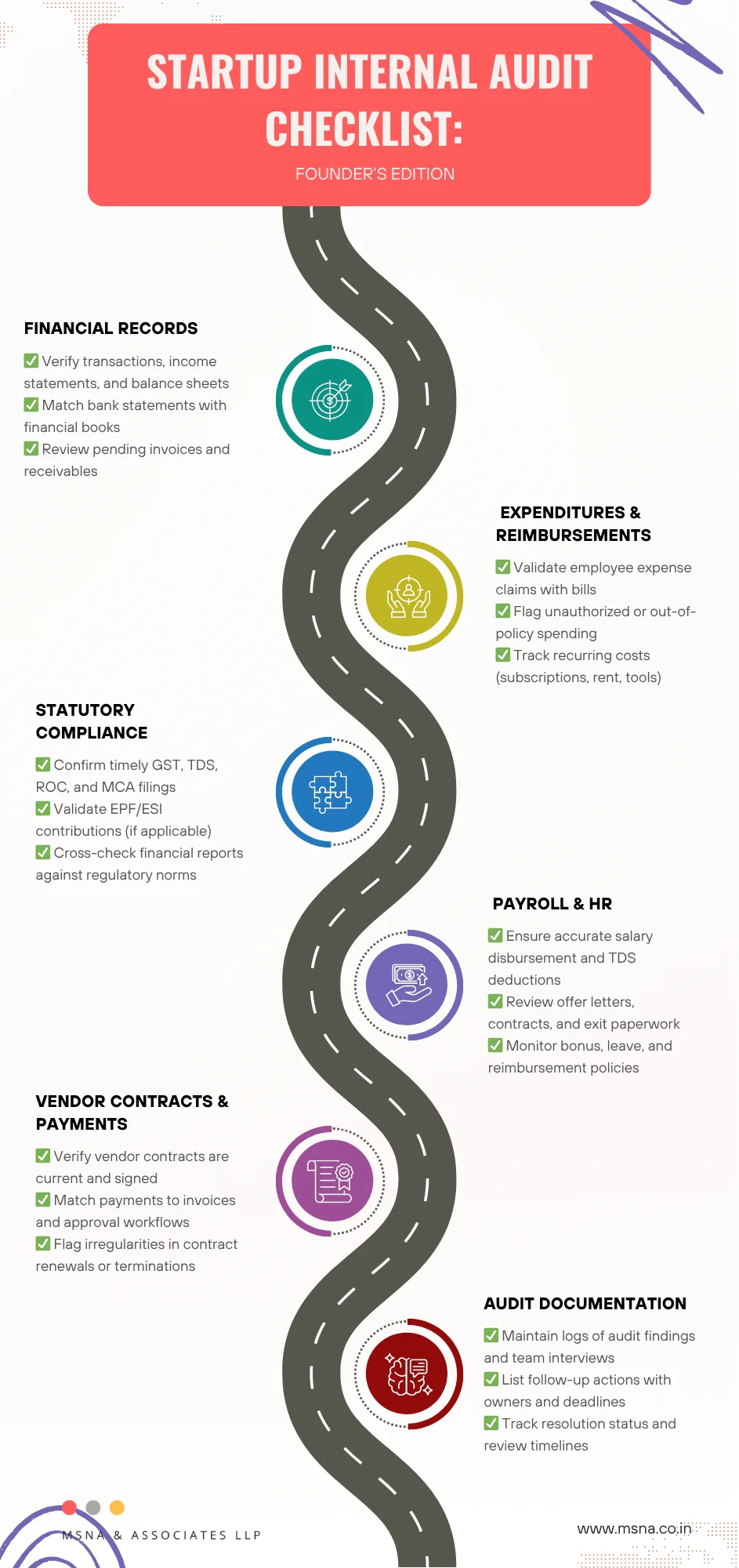
Now that you know how to do internal audit, it’s essential to have the right checklist in hand. Here’s a simple internal audit checklist to help you get started:
Financial Records
Verify transaction, income statements, and balance sheets.
Cross-check your bank statements with financial books.
Find out pending invoices, receivables, and payables.
Track Expenditures & Reimbursement
Validate all employee expense claims with bills.
Check for unauthorized or out-of-policy expenses.
Review recurring payments – software, rent, and subscriptions.
Statutory Compliance & Regulatory Filings
Ensure GST returns are filed on time.
Assess ROC filings and MCA compliance.
Cross-check TDS deductions and filings.
Confirm ESI/EPF is up-to-date (if applicable)
Payroll & HR Processes
Validate salary disbursements, TDS deductions, and payroll compliance.
Check if all leave and bonus obligations are tracked.
Review offer letters, contracts, and exit documents.
Audit Trail Documentation
Keep a log of audit findings.
Document follow-ups with deadlines.
Vendor Contracts & Payments
Review contracts for ongoing vendor services.
Ensure proper documentation and approvals are in place.
Verify payments made vs. invoices received.
Note: This is a very simple checklist. The actual internal audit will provide tailor made checklist.
You don’t necessarily need to be a finance expert to use this checklist. In fact, most startups work with a virtual CFOs or hire experienced Internal auditors quarterly or biannually to go through this list together.
Startup Internal Audit Checklist
When Should You Do an Internal Audit?
There’s nofixed time for doing an internal audit. However, planning an internal audit well in advance can save your business from financial and compliance issues.
Here are the key points to consider before conducting an internal audit:
1. Before or After a Funding Round
Investors often ask for detailed financial reports and due diligence, so run a financial due diligence beforehand or immediately after funding.
2. At the End of the Financial Year
Annual audits allow you to fix errors proactively. It helps your CA or auditor file correct returns and improves year-end reporting.
3. When Expanding Teams and Operations
Test if your systems and controls can handle the growth before hiring more people, launching new products, or expanding to a new location
4. After Noticing Accounting Anomalies
If you spot delayed payments, undocumented expenses, or compliance missteps, do an internal audit to pinpoint the issues and fix them immediately.
5. Biannual or Annual Financial Tests
Doing a routine audit every 6 to 12 months is a good practice for clean bookkeeping, especially for GST, TDS, ROC, and payroll compliance.
Next Steps: How MSNA & Associates assists in an Internal Audit?
Doing an internal audit the right way will prevent future financial surprises and set a strong foundation for growth.
At MSNA & Associates LLP we assist multiple clients with their internal audit activity. From audit planning to compliance review, we manage the full internal audit process, so you can focus on running your business.
Talk To Our Team For Internal Audit Services
Our team of seasoned internal auditors help you with comprehensive audit support. Book A Call with us now!
I am a Chartered Accountant & a Certified Internal Auditor & currently a Partner at M S N A & Associates LLP. I've 9+ years of post qualification experience working in diversified engagements related to assurance, internal audit, risk advisory, SOX compliance, ICFR engagements etc.,
If you need any assistance in Internal Audit, Virtual CFO, Accounting/Bookkeeping for India, US & UAE, Financial Planning & Advisory, connect with our team today!