

If your SaaS company already has paying customers in India, you have a decision to make. Keep billing them from the US and deal with India’s GST rules from a distance, or set up locally and unlock the Indian market properly.
A US SaaS company set up in India touches four things at once: which entity to register, how GST applies to your revenue, how you structure contracts between your US parent and Indian entity, and what tax exposure follows.
This guide walks through each one, under the Companies Act, 2013 and the CGST Act, 2017, so you can plan before you file.
Why Are US SaaS Companies Entering India Now?
India’s SaaS buyer base is growing fast. Mid-market Indian companies now expect local invoicing, local support, and INR pricing. Selling from the US alone limits how big you can get here.
A local entity also opens doors that pure exports don’t, from hiring engineering talent at lower cost to building a support desk in Indian time zones. Most SaaS companies that scale past a few hundred Indian customers eventually need an India entity for tech companies to keep growing without friction.
US SaaS Company Setup in India: What Are Your Entity Options? .
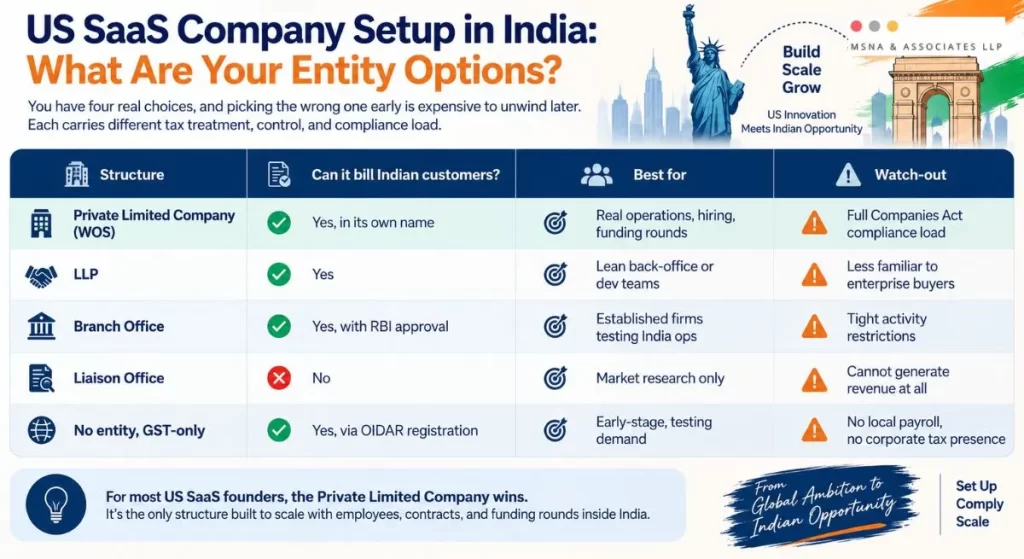
You have four real choices, and picking the wrong one early is expensive to unwind later. Each carries different tax treatment, control, and compliance load.
Structure | Can it bill Indian customers? | Best for | Watch-out |
Yes, in its own name | Real operations, hiring, funding rounds | Full Companies Act compliance load | |
LLP | Yes | Lean back-office or dev teams | Less familiar to enterprise buyers |
Branch Office | Yes, with RBI approval | Established firms testing India ops | Tight activity restrictions |
Liaison Office | No | Market research only | Cannot generate revenue at all |
No entity, GST-only | Yes, via OIDAR registration | Early-stage, testing demand | No local payroll, no corporate tax presence |
For most US SaaS founders, the Private Limited Company wins. It’s the only structure built to scale with employees, contracts, and funding rounds inside India.
How Do You Complete SaaS Entity Registration in India?
Registering a SaaS entity in India runs through the MCA framework in two phases, and the first one is all about getting your company its legal identity.
Phase 1: Incorporation (2-3 weeks)
Every director needs a Digital Signature Certificate and a Director Identification Number. Get these first. Nothing else can move without them.
Next, head to the MCA’s SPICe+ portal to reserve your company name. Once that’s locked in, file your incorporation documents (SPICe+ Part B) along with the Memorandum and Articles of Association.
Approval brings three things at once: your Certificate of Incorporation, PAN, and TAN, all issued in the same filing.
Phase 2: Getting operational
Incorporation alone doesn’t let you invoice anyone. You still need funding in place and a tax registration sorted.
- Open a bank account and route the parent company’s investment through RBI’s FDI reporting mechanism (Form FC-GPR).
- Register for GST before you start billing customers. Most SaaS businesses need this from day one, since the nature of the supply usually triggers registration immediately rather than after crossing a threshold.
Founders who plan this sequence before their first India hire close the loop faster and avoid gaps between incorporation and actual billing.
What Is GST for US SaaS company setup in India ?
GST for SaaS companies in India runs on the OIDAR framework (Online Information and Database Access or Retrieval), defined under Section 2(17) of the IGST Act, 2017, and nearly every SaaS product fits squarely inside that definition.
Rule | What it means for you |
Registration threshold | None. Section 24(xi), CGST Act requires registration from your first Indian customer |
GST rate | 18% flat on domestic SaaS supplies |
B2B place of supply | The recipient’s registered address, under Section 12(2)(b), IGST Act |
B2C place of supply | Determined by billing address, IP address, or payment location |
Exports | Zero-rated under Section 16(1), IGST Act, when export conditions are met |
If you already have an Indian entity, that entity becomes the GST-registered supplier and files under its own GSTIN, generally simpler than the foreign-provider route under Form GST REG-10 and GSTR-5A. GST on SaaS services exported from India stays zero-rated either way, so an entity selling globally doesn’t lose that benefit.
US SaaS Company Setup in India: How to Structure Cross-Border Contracts
Once the entity exists, the contracts between the US parent and the Indian subsidiary need their own structure, not a copy of whatever template your lawyer used for a US vendor deal. Loose or informal intercompany agreements are one of the most common gaps MSNA sees in SaaS entry work and increasingly, the IP licensing clause is where founders get exposure wrong.
A well-built set of cross-border contracts covers:
- Master Service Agreement (MSA), defining exactly what the Indian entity does for the parent, whether that’s development, support, or sales enablement.
- IP licensing clause, clarifying ownership. In most structures, the US parent retains IP and licenses it to the Indian entity for local use.
- Data Processing Agreement (DPA): details the process of transferring customer data from one entity to another. This must comply with data protection laws of India.
- Transfer pricing: the price charged for intercompany transactions should be on an arm’s-length basis. Sections 92 to 92F of the Income Tax Act deal with this aspect.
What the Engineering Analysis Case Means for Your Contracts?
In 2021, India’s Supreme Court settled a long-running argument about software payments and tax. The question was: when an Indian company pays a US company to use software, does that count as “royalty,” which triggers tax withholding, or is it just a regular purchase?
The Court said, if you’re buying the right to use the software, not the underlying copyright, it’s not royalty. No withholding tax required.
Here’s the part that matters for you. That ruling was about software licenses and resale, not subscription access to a hosted SaaS platform. Tax authorities may yet claim that your payments are not for licensing but fees for technical services, which are taxable under a separate set of rules.
So how you word the IP licensing clause between your US parent and Indian entity actually matters. Spell out exactly what’s being licensed and to whom. Don’t just reuse a generic template and hope it holds up.
What Tax Considerations Apply to SaaS Revenue in India?
Tax planning for a SaaS entity in India runs on two separate tracks, and founders tend to only plan for one of them.
Revenue recognition
SaaS revenue recognition in India generally follows Ind AS 115, which recognises subscription revenue over the service period rather than at the point of sale. A 12-month contract paid upfront shows up as revenue spread monthly, not as one lump sum. US parents used to ASC 606 will find the underlying principle familiar, though disclosure requirements differ.
Withholding tax on payments to the US parent
Withholding tax on SaaS payments matters whenever the Indian entity pays the US parent for licenses, royalties, or technical services, and the rate you land on depends on a choice, not a fixed number.
Section 195 of the Income Tax Act requires tax deduction at source on payments to a non-resident. Since the Finance Act, 2023, the domestic rate under Section 115A for royalty and fees for technical services stands at 20%, plus applicable surcharge and cess. Article 12 of the India-US DTAA caps the same payments at 15%, and because that’s now lower than the domestic rate, most US parents claim the treaty rate instead. To claim the treaty rate, you need a valid Tax Residency Certificate and Form 10F on file before payment, not after.
Getting the classification and paperwork right at the contract stage avoids disputes with the tax department later.
Can Remote Staff Trigger a Permanent Establishment Before You Even Register?
Permanent Establishment (PE) risk doesn’t wait for you to incorporate. If your US company has salespeople, contractors, or an early engineer working from India before you form an entity, and that person negotiates deals or manages revenue-generating activity, Indian tax authorities can argue your US company already has a taxable presence here.
The Delhi High Court’s 2019 ruling in GE Energy Parts Inc. v. CIT is the case every US company should know before deciding to “just have someone in India for now.” GE’s US entities ran a liaison office in Delhi that was meant only for coordination. The court found that expatriate staff there were actually negotiating and closing deals on the parent’s behalf, and held that this created both a fixed place PE and a dependent agent PE under Article 5 of the India-US DTAA, for 24 GE group companies at once.
That ruling draws a practical line:
Low risk: back-office, preparatory, or auxiliary work stays outside PE territory.
High risk: someone in India closing enterprise deals or directing core business activity on the parent’s behalf.
Map out what your India-based people actually do before deciding you don’t need an entity yet. A support engineer answering tickets is low risk. A country manager closing deals from a home office is a different conversation, and one worth having with an advisor before it becomes a tax notice.
Common Mistakes to Avoid During US SaaS Company Setup in India
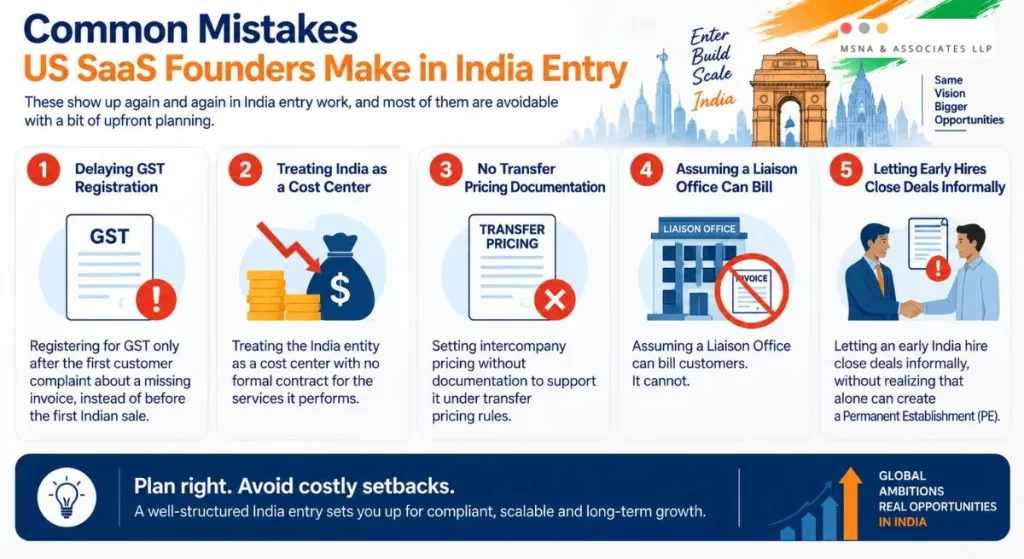
These mistakes show up repeatedly when US SaaS companies enter India, and most are avoidable with the right planning before the first transaction, hire, or customer. Founders planning to Setup New Company in India from the USA should think beyond incorporation and plan the tax, contracts, transfer pricing and operational structure from day one.
- Registering for GST only after the first customer complaint about a missing invoice, instead of before the first Indian sale.
- Treating the India entity as a cost center with no formal contract for the services it performs.
- Setting intercompany pricing without documentation to support it under transfer pricing rules.
- Assuming a Liaison Office can bill customers. It cannot. Letting an early India hire close deals informally, without realizing that alone can create a PE.
Plan Your India Entry With Clarity
Frequently Asked Questions About US SaaS Company Setup In India
Does a US SaaS company need an Indian entity to sell in India?
No. You can register under India’s OIDAR rules and collect GST directly. An entity becomes useful once you want to hire locally, sign India-governed contracts, or build enterprise relationships that expect an Indian GSTIN.
How much time is taken for SaaS Entity Registration in India?
Incorporation by means of the SPICe+ process will take 2-4 weeks from the point that all the documentation is in place, subject to name approval and RBI reporting time for FDI.
Is GST applicable for SaaS service exports from India?
No. The SaaS exports would be exempted as per Section 16(1) of the IGST Act, if it satisfies the provisions of Section 2(6).
Related
Discover more from MSNA & Associates LLP
Subscribe to get the latest posts sent to your email.