


Permanent establishment risk for US companies is the chance that activity in India creates a taxable presence, so part of the US parent’s profit becomes taxable in India. Under Article 5 of the India–US tax treaty and the Income-tax Act, 2025, a PE can arise from a fixed place of business, services through personnel for more than 90 days in any 12 months (other than included services), a dependent agent who habitually concludes contracts, or control exercised from India.
This guide covers each trigger, what changed in 2026, how recent rulings apply and how to test your own exposure.
Key Takeaways
- The treaty decides first. A US company is taxed on business profits in India only if it has a PE under Article 5 of the DTAA.
- Three classic routes: a fixed place PE, a service PE (more than 90 days), and a dependent agent PE.
- A subsidiary is not a shield. Tax officers have tested whether an Indian subsidiary is itself the parent’s PE.
- Remote and visiting staff matter. Extended stays by H-1B holders, founders and engineers are now a live issue.
- The cost can be material. PE profits face a 35% base rate, or 36.40%–38.22% after cess and the applicable surcharge.
- Documentation is one of the strongest defences. Contracts, approvals and day-counts should match what actually happens.
What Is Permanent Establishment Risk for US Companies in India?
A permanent establishment is a threshold. Below it, a US company’s India activity is generally not taxed as business profit. Above it, India can tax the profit attributable to that presence.
The risk is highest where cross-border operations grow informally, a common pattern. A sales lead moves to Bengaluru. A CTO works from Hyderabad. A contractor starts closing deals. None of this feels like “opening an office”, yet each can matter.
Permanent establishment rules India applies: domestic law versus the DTAA
Two layers apply together:
- Domestic law: Section 9 of the Income-tax Act, 2025 deems income to arise in India through a business connection, including dependent agents and significant economic presence (SEP).
- Treaty law: Article 5 of the India–US DTAA defines PE. Where the treaty is more favourable, the taxpayer can rely on it.
Treaty analysis comes first, because a US company is taxed on business profits in India only if it has a PE under Article 5. SEP is a domestic-law concept. A US company covered by the treaty is generally taxed on business profits only if it has an Article 5 PE, so SEP alone may not create one.
What Changed in 2026 for Permanent Establishment Risk for US Companies?
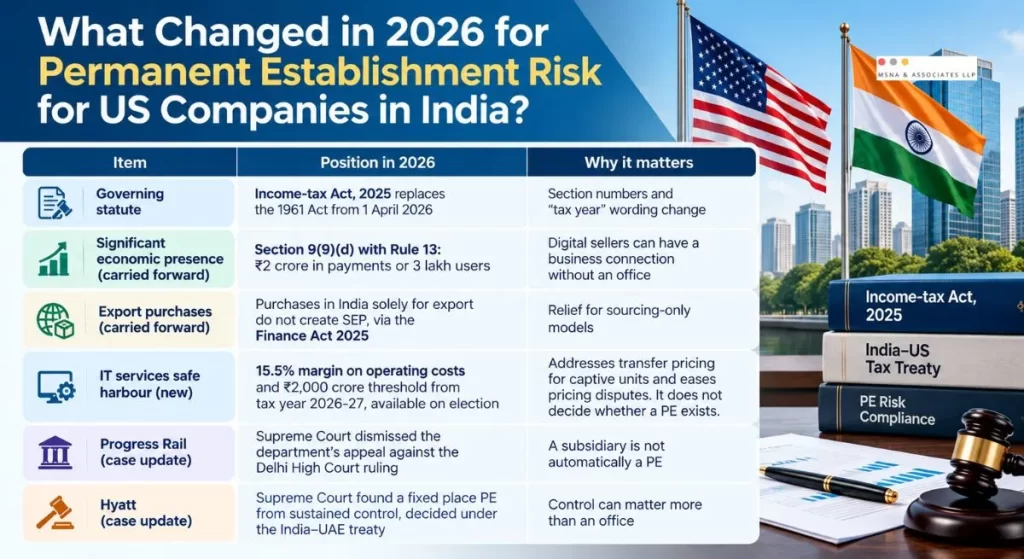
Some 2026 items are new, and others were carried into the new Act from the old rules.
Item | Position in 2026 | Why it matters |
Governing statute | Income-tax Act, 2025 replaces the 1961 Act from 1 April 2026 | Section numbers and “tax year” wording change |
Significant economic presence (carried forward) | Section 9(9)(d) with Rule 13: ₹2 crore in payments or 3 lakh users | Digital sellers can have a business connection without an office |
Export purchases (carried forward) | Purchases in India solely for export do not create SEP, via the Finance Act 2025 | Relief for sourcing-only models |
IT services safe harbour (new) | 15.5% margin on operating costs and ₹2,000 crore threshold from tax year 2026-27, available on election | Addresses transfer pricing for captive units and eases pricing disputes. It does not decide whether a PE exists. |
Progress Rail (case update) | Supreme Court dismissed the department’s appeal against the Delhi High Court ruling | A subsidiary is not automatically a PE |
Hyatt (case update) | Supreme Court found a fixed place PE from sustained control, decided under the India–UAE treaty | Control can matter more than an office |
What Are The Types of PE in India for US Companies?
Permanent establishment risk for US companies in India usually falls into four groups:
PE type | Trigger under the India–US DTAA | Typical example |
Fixed place PE | A fixed place of business at the company’s disposal, used to carry on its business | A dedicated desk or office used for sales or negotiation |
Service PE | Services through employees for more than 90 days in any 12 months (other than included services as defined in Article 12), or services performed within India for a related enterprise | Engineers or consultants working on a connected project |
Dependent agent PE | An agent who habitually exercises authority to conclude contracts, or stocks goods for regular delivery | An India representative who signs or finalises contracts |
Business connection / SEP | Domestic-law test, not a treaty test | Large India-facing digital sales |
Fixed place PE: space, permanence and core business
A fixed place PE needs a place at the company’s disposal and a link to its core business. In Formula One, decided under the India–UK treaty (whose fixed-place wording matches Article 5(1) of the US treaty), the Supreme Court held that a racetrack used for a short period was a fixed place of business (SCC Online report). Back-office and liaison work has fared better, because it is often preparatory or auxiliary.
Service PE: the 90-day test
Article 5(2)(l) of the India–US DTAA has two limbs. The first applies when activities continue for more than 90 days within any 12-month period, and it excludes included services as defined in Article 12. The second applies when services are performed within India for a related enterprise, such as an Indian subsidiary, and it carries no separate day-count (treaty text). In DeGolyer and MacNaughton, the Delhi tribunal counted only unique solar days for the first limb, not combined man-days. Cumulative presence was 181 days, but unique days were 72 (ITAT order).
Dependent agent PE: who really closes the deal
Title and signatures are not the only test. If someone in India negotiates and effectively fixes terms that the US head office rubber-stamps, tax officers may argue that the dependent agent PE test is met. The India–US treaty predates the BEPS project, and the US has not signed the multilateral instrument, so the treaty is unaffected by it. That keeps the older, narrower wording relevant.
Which Activities, Employees, Agents and Contracts Create US Company Tax Exposure in India?
A US company’s tax exposure in India usually comes from what people do, not what the contract says. Use this map as a first screen.
Activity in India | Typical PE risk | Why | Safer approach |
Market research, information gathering | Low | Usually preparatory or auxiliary | Keep it separate from selling |
Support staff on a service agreement | Low to medium | Depends on control and day-count | Subsidiary or EOR with clear scope |
Engineers on a connected project | Medium to high | Service PE after 90 days | Track unique days and roles |
Sales team negotiating prices | High | Fixed place or dependent agent PE | Route sales through a contracting entity |
Local agent signing for the US company | High | Dependent agent PE | Use an independent agent on arm’s-length terms |
CEO or CFO managing from India | High | Place of management and control | Document where decisions are taken |
A professional review can help assess how this map applies to your own structure, travel pattern and contracts.
Employees and remote work
Staff working from India can create a fixed place or service PE if they perform core functions. As per Storyboard18 in January 2026, experts have issued warnings that H-1B employees who are stuck abroad and are working remotely could make the US employer liable to pay taxes from India. According to Parizad Sirwalla from KPMG India, it all depends on the nature of the job.
Agents and contracts
Check three things: who negotiates, who has authority to bind, and who actually approves. A contract that says “approved in Delaware” does not help if emails show terms were settled in Pune.
Management presence
A founder who regularly runs the company from India raises a place-of-management question. Keep board meetings, strategic approvals and signing authority demonstrably outside India.
Business structures compared
Structure | PE exposure | Key consideration |
Lower, but not zero | Must operate independently; transfer pricing applies | |
Employer of record (EOR) | Low if work is non-core | Scope creep can reintroduce risk |
Liaison office | Low if limited to liaison | Cannot earn income; regulatory limits apply |
A PE by nature | Taxed as a foreign company | |
Independent distributor | Low if truly independent | Dependence can recharacterise the role |
Does an Indian Subsidiary Eliminate Permanent Establishment Risk for US Companies?
No. A subsidiary lowers the risk, but it does not remove it. Tax authorities may still argue that the subsidiary is itself the parent’s PE.
That is what happened in Progress Rail Locomotive Inc. The authorities claimed the Indian subsidiary was a fixed place service and dependent agent PE of its US parent. The Delhi High Court overturned the reassessment in 2024. It found the subsidiary’s work was supportive, it lacked authority to conclude contracts, and its management operated independently (Taxmann report).
The Supreme Court later dismissed the department’s appeal, so the High Court ruling stands. Control still matters, though. Hyatt had no office of its own in India, but the Supreme Court still found a fixed place PE. In Hyatt International Southwest Asia (24 July 2025), it held that Hyatt’s day-to-day control of the Indian hotels was enough. The case was decided under the India–UAE treaty.
Vistra’s commentary on the case makes the same practical point: a legal entity does not automatically end PE risk.
The lesson is operational. Reporting lines, approval rights and pricing must match the intercompany agreement. Our guide to setting up a company in India from the USA covers entity choices, and transfer pricing compliance supports the same position.
Can a Founder Working From India Make the US Company Tax Resident in India?
A PE taxes only the profit attributable to India. Residency can reach further. A foreign company whose key management and commercial decisions are in practice taken in India may be treated as resident under the place of effective management (POEM) test. Keep board meetings, strategic approvals and signing authority outside India, and record where each decision is taken. The founder’s own personal tax residency is a separate question.
What India Tax Liability Follows a PE Finding?
Only profit attributable to the PE is taxed, not the whole US group’s income. Even so, a US company’s tax exposure grows quickly once a PE is found.
Item | Tax year 2026-27 position |
Base rate for foreign companies | 35% |
Effective rate, income up to ₹1 crore | 36.40% (35% plus 4% cess, no surcharge) |
Effective rate, ₹1–10 crore | 37.13% |
Effective rate, above ₹10 crore | 38.22% |
Effective rates include 4% cess. A 2% surcharge applies where income exceeds ₹1 crore but not ₹10 crore, and 5% where it exceeds ₹10 crore. Source: Income Tax Department rates for foreign companies. The 35% base rate applies for tax year 2026-27 under the Income-tax Act, 2025.
Beyond tax, a PE usually brings:
- PAN registration and an India tax return
- Books of account and, where applicable, tax audit
- TDS withholding and transfer pricing documentation
- FEMA compliance for money flows
How Do You Count the 90 Days: Solar Days or Man-Days?
Many companies track individual stays but not the combined calendar, and that calendar decides whether the 90-day test is met.
Method | Hypothetical example (three engineers, overlapping stay) | Result |
Man-days (cumulative) | 60 + 60 + 61 days | 181 days, appears to exceed 90 |
Solar days (unique calendar days) | Overlapping dates counted once | 72 days, within 90 |
The totals of 181 and 72 days are taken from DeGolyer and MacNaughton, where the solar-day approach was applied to the 90-day limb. The split across three engineers is hypothetical and is not from the case. It does not help where services are performed in India for a related enterprise, because that limb has no day-count. Outcomes depend on treaty wording and facts, and tax departments may challenge the method. Keep a dated travel and timesheet log for every India visit.
Note: The tribunal’s earlier round in DeGolyer was sent back because of insufficient documentary evidence of the stay, so keep dated, contemporaneous logs for every India visit.
PE Risk Self-Assessment: Score Your Exposure
Give one point for each “yes”. This is an MSNA screening aid, not a legal test.
- Does anyone in India negotiate prices or terms for the US company?
- Does any person in India have, or appear to have, authority to sign?
- Does a US employee or contractor use a fixed desk or office in India?
- Has any team worked in India for more than 90 days in 12 months, or performed services in India for the Indian entity?
- Do H-1B or other US-payroll staff work remotely from India?
- Do senior executives take key decisions while in India?
- Does the Indian entity depend wholly on the US parent for revenue?
- Is the intercompany agreement different from actual practice?
- Do India-facing digital sales exceed ₹2 crore a year?
- Is there no log of India days or decision-making location?
Score | Reading | Suggested step |
0–2 | Lower indicative exposure | Maintain records |
3–5 | Moderate | Review contracts and day-counts |
6–10 | Elevated | Request a structured PE review |
Expert Insight: Where Founders Underestimate PE in India
Three observations on what we commonly see in this area:
- Exposure starts informally. As Naveen CA, founder of MSNA, notes: “Most PE questions begin with an email approving a discount from an Indian city, not with a decision to open an office.”
- Substance beats paper. Authorities look at emails, calendars and reporting lines.
- Growth changes the answer. A structure that worked for three engineers may not suit thirty.
How US Companies Can Reduce PE Risk in India ?
Contracts
- Define the Indian entity’s role as a service provider.
- Reserve contract-signing authority to the US parent, outside India.
- Price intercompany services at arm’s length.
People
- Cap and log visitor days; count unique days.
- Keep core sales and strategic roles outside India, or house them in a properly structured entity.
- Review remote-work approvals for staff in India.
Documentation
- Retain board minutes showing where decisions are made.
- Keep contemporaneous timesheets and visit logs.
- Review structure annually as headcount and revenue grow.
When This May Not Apply?
The permanent establishment rules that apply in India are fact-driven, so exposure may be absent when:
- Activity is truly preparatory or auxiliary
- The US company has no India nexus beyond exporting
- An independent agent acts in the ordinary course of business
- Day-counts and project links fall below treaty thresholds
Next Step On Permanent Establishment Risk for US Companies
If your India team is growing, a structured review of your contracts, travel and decision-making can clarify where you stand. Our international taxation and DTAA advisory page explains how we can help you assess this. Explore our international taxation and DTAA advisory or the GCC setup page, or read the full set up company in India from USA service page.
This article is for general information and is not tax or legal advice. Outcomes depend on the facts of each case and on the treaty and statutory text in force. Consulting a professional can help you assess how this applies to your situation.
Assess Permanent Establishment Risk for US Companies in India
Frequently Asked Questions About Permanent Establishment Risk for US Companies
How many days in India create a PE for a US company?
Under the India–US DTAA, a service PE can arise when activities continue for more than 90 days in any 12-month period. It can also arise when services are performed in India for a related enterprise, with no separate day-count. Fixed place and dependent agent PEs do not depend on days.
Can an employer of record create PE in India?
An EOR does not automatically do so. Risk arises if the personnel perform core functions or the structure lacks real separation. See Wisemonk’s overview.
Is a remote employee in India a PE for the US company?
Not automatically. It depends on the role, tenure, decision-making authority and whether a fixed place is at the company’s disposal.
Does an Indian subsidiary create a PE for the US parent?
Not by itself. The question is whether the subsidiary’s activities and control amount to a PE under Article 5. In Progress Rail, the Delhi High Court found no PE and the Supreme Court dismissed the department’s appeal. In Hyatt, pervasive control produced a PE under a different treaty.
What is the tax rate if a PE exists?
The base rate is 35%, or 36.40%–38.22% with cess and the applicable surcharge, on profits attributable to the PE.
Related
Discover more from MSNA & Associates LLP
Subscribe to get the latest posts sent to your email.