
What if your deal team could read every contract in the data room before the first management meeting? In 2026, that is no longer a thought experiment.
Traditional diligence rewards teams that read fast and miss nothing. Those two goals collide when data rooms are large and bid windows are short. One overlooked indemnity or one mismatched ledger entry can materially change a deal’s value.
AI due diligence is the use of machine learning and language models to read, extract, cross-check and score deal information faster. For Indian deals, this also means testing AI use against the Companies Act, 2013, the DPDP Act, 2023, and CCI notification rules. Final judgement stays with the buyer.
This guide explains how AI due diligence works, where it adds value, where it falls short and how Indian deal teams should govern it.
Key Takeaways
- AI due diligence speeds up document review, but sign-off on every finding stays with a qualified professional.
- The three highest-value use cases today are contract intelligence, financial anomaly detection and fraud detection.
- A governed workflow needs source citations, sample testing and a named owner for each conclusion.
- India’s DPDP framework, phasing in from 2025 with core duties from 13 May 2027, shapes what a tool may do with a target’s personal data.
- Anomaly testing supports quality of earnings work. It does not replace the independent professional judgement.
- Buyers must now examine the AI inside the target as well as the AI in their own workflow.
What Is AI Due Diligence and Why Does It Matter in 2026?
Due diligence has always been a race between the volume of information and the time available to read it. AI due diligence shifts that balance by taking over the reading so people can focus on judgment.
Three forces make 2026 different:
- Deal size: PwC expects global deal value to reach about $4 trillion in 2026, up roughly 13% year on year.
- Document volume: Data rooms now hold contracts, ledgers, emails and compliance files in mixed formats.
- Buyer expectations: PwC’s 2026 M&A outlook notes that AI-enabled data rooms already summarise large document sets and surface risks. In practice, AI-assisted review is now an expected baseline in competitive processes. PwC also expects deal volumes to fall while value concentrates in megadeals.
How does AI due diligence differ from the manual process?
The table compares both approaches across the tasks that consume most of a deal team’s hours.
Task | Manual process | AI-assisted process |
Document review | Sampled, reviewer by reviewer | Broader review coverage with exceptions flagged |
Data extraction | Retyped into spreadsheets | Machine-read into structured fields |
Pattern spotting | Depends on reviewer experience | Machine learning in due diligence flags outliers across datasets |
Consistency | Varies between reviewers | Consistent rules across files |
Final judgement | Human | Human |
How Common Is AI in Mergers and Acquisitions in 2026?
The data shows the question has moved from “should we use it” to “how well do we govern it.”
2026 indicator | Finding | Source |
M&A teams already using AI | 51% (another 31% piloting) | |
Deal teams with 10 people or fewer | 89% | DealRoom and M&A Science |
Generative AI use in due diligence | 58%, the highest of any deal step | McKinsey data via G2 |
Expect high or very high value in diligence | 66% | McKinsey data via G2 |
India M&A in 2025 | 963 deals, about USD 60.2 billion |
The 89% figure deserves attention, with one caveat. It comes from a vendor-co-authored survey, so read it as directional.
McKinsey also reports that only 30% of respondents show moderate-to-high gen-AI engagement. Adoption is broad, but depth of use is uneven, so a buyer should not assume a counterparty’s team is equally equipped.
How Does the AI Due Diligence Process Work?
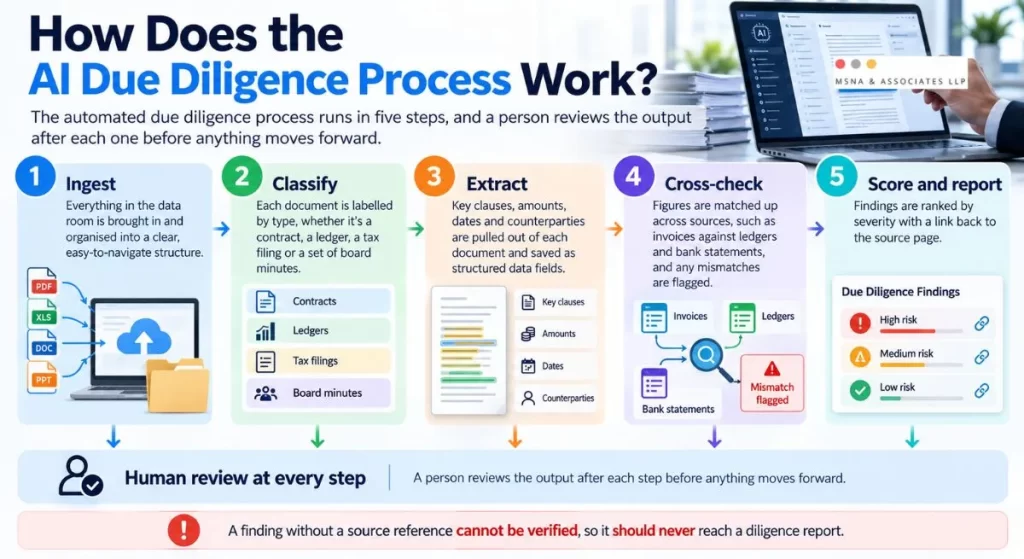
The automated due diligence process runs in five steps, and a person reviews the output after each one before anything moves forward.
- Ingest: Everything in the data room is brought in and organised into a clear, easy-to-navigate structure.
- Classify: Each document is labelled by type, whether it’s a contract, a ledger, a tax filing or a set of board minutes.
- Extract: Key clauses, amounts, dates and counterparties are pulled out of each document and saved as structured data fields.
- Cross-check: Figures are matched up across sources, such as invoices against ledgers and bank statements, and any mismatches are flagged.
- Score and report: Findings are ranked by severity with a link back to the source page.
Step five is where many tools fall short. A finding without a source reference cannot be verified, so it should never reach a diligence report.
Which Due Diligence Tasks Benefit Most from AI?
Five use cases account for most of the practical gains.
1. Automated document analysis and legal document review
Models read thousands of pages and surface change-of-control clauses, termination rights, exclusivity terms and litigation references. Legal document review shifts from page-turning to exception handling.
2. Contract intelligence
Contract intelligence compares clauses across hundreds of agreements. It reveals concentration risk, unusual indemnities and missing consent requirements. This matters for Indian targets with many customer and vendor contracts.
3. AI for financial due diligence
AI for financial due diligence gives quality of earnings work a stronger analytical base. Financial anomaly detection scans ledgers for unusual journal entries, round-sum postings, cut-off breaks and related-party flows. The manual steps behind this work are covered in our guide to financial due diligence in India.
4. Fraud detection and transaction screening
Fraud detection models flag duplicate invoices, ghost vendors and revenue that does not reconcile to cash. Transaction screening checks counterparties and promoters against sanctions and adverse media lists.
5. Predictive risk analytics and deal risk analysis
Predictive risk analytics turns patterns into scores for customer churn, covenant stress and working capital strain. Deal risk analysis then ranks those scores against price and structure
How does AI due diligence combine these signals?
Good risk assessment layers findings instead of treating them alone. A late invoice, a related-party payment and a weak contract clause may each look minor. Together they can change the price.
Red flag | What AI checks | Human follow-up |
Revenue inflation | Invoice-to-cash match, cut-off dates | Management interviews, customer confirmations |
Hidden liabilities | Guarantees, notices, contract clauses | Legal and tax review |
Related-party leakage | Counterparty links across ledgers | Board minutes, Section 188 Companies Act review |
Customer concentration | Revenue split by customer and contract | Customer calls |
Compliance gaps | Filing dates against due dates | Regulatory counsel |
Founders preparing for investor scrutiny can see the other side of this process in how a virtual CFO makes a startup investor-ready.
How Does AI Reconcile Books, GST Returns and Bank Statements?
For Indian targets, the most useful cross-check is a three-way match. AI compares the books of account with GSTR-2B and GSTR-3B filings and with bank statements. A Chartered Accountant then decides what each exception means.
Mismatch | What AI flags | What the CA does |
Sales in books exceed turnover in GSTR-3B | Revenue booked but not reported in GST returns | Checks cut-off, nil-rated supplies and reverse-charge entries, then assesses tax exposure |
Input tax credit in books exceeds GSTR-2B | Credit claimed with no matching supplier filing | Reviews eligibility, supplier compliance and reversal risk |
Sales invoices with no matching bank receipt | Revenue not backed by cash | Seeks customer confirmations and tests receivable quality |
Bank payments with no matching ledger entry | Possible unrecorded payments or liabilities | Traces approvals and asks management to explain |
Which AI Due Diligence Tools Should Deal Teams Consider?
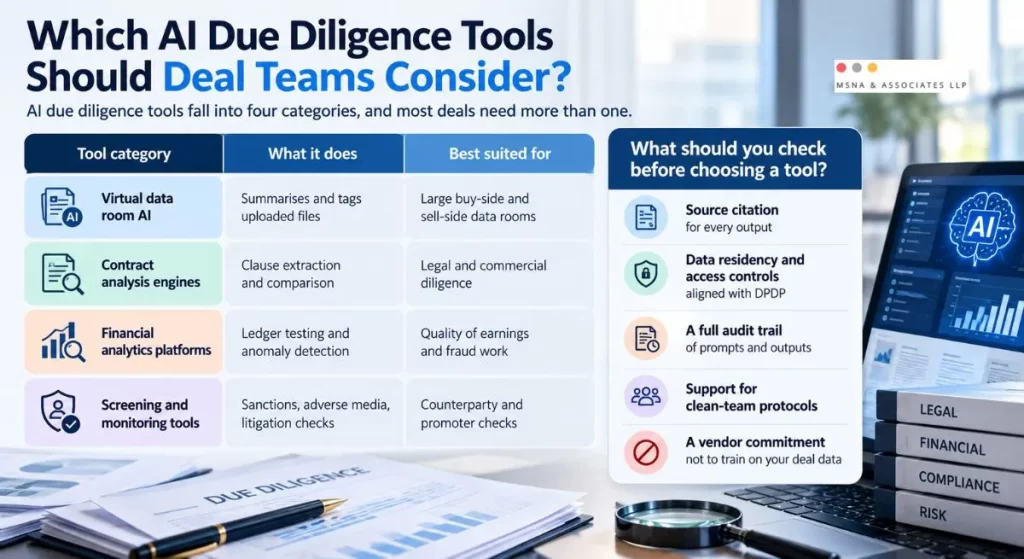
AI due diligence tools fall into four categories, and most deals need more than one.
Tool category | What it does | Best suited for |
Virtual data room AI | Summarises and tags uploaded files | Large buy-side and sell-side data rooms |
Contract analysis engines | Clause extraction and comparison | Legal and commercial diligence |
Financial analytics platforms | Ledger testing and anomaly detection | Quality of earnings and fraud work |
Screening and monitoring tools | Sanctions, adverse media, litigation checks | Counterparty and promoter checks |
What should you check before choosing a tool?
- Source citation for every output
- Data residency and access controls aligned with DPDP
- A full audit trail of prompts and outputs
- Support for clean-team protocols
- A vendor commitment not to train on your deal data
What Are the Risks of AI Due Diligence?
AI-powered due diligence carries four risks that every deal team should price in.
Risk | What goes wrong | Control |
Accuracy | A model states a wrong clause or figure fluently | Verify against the source document |
Privacy | Personal data is processed without a lawful basis | Anonymised data in early rounds |
Explainability | A risk score arrives with no reasoning | Reject scores that cannot be traced |
Over-reliance | Teams skip judgement because the output looks complete | Named human owner for each conclusion |
How does the DPDP Act affect AI in due diligence?
The DPDP Act, 2023 and the DPDP Rules, 2025 are being phased in, with core data-fiduciary duties applying from 13 May 2027. Buyers already treat a target’s personal data as a diligence item, so assess whether identifiable employee or customer data should go into an external AI tool before you upload it. Starting that assessment now means the review will already meet the obligations when they take effect. Details of the framework are available on the MeitY website.
What Can AI Not See in a Deal?
Some of the costliest deal problems sit outside any data room.
- Management integrity and decision-making culture
- Verbal side arrangements with customers or lenders
- Key-person dependency
- Internal discussions and experience-based context
- A transaction above ₹2,000 crore where the target has substantial business operations in India needs prior CCI approval, alongside the asset and turnover tests.
How Should You Run AI Due Diligence on a Target That Uses AI?
Diligence now runs in two directions. Buyers use AI to examine targets, and they must also examine the AI inside the target.
Chambers observes that AI-related IP concerns are beginning to shape diligence and deal documentation. MeitY released the India AI Governance Guidelines on 5 November 2025. They are principles-based, and India has no single horizontal AI statute. A target’s AI practices are therefore tested against existing law on contracts, IP and data protection, plus these guidelines. Buyers should not wait for a dedicated AI law before asking questions.
A practical checklist:
- Provenance and consent for training data
- Ownership of models, outputs and fine-tuned weights
- Third-party model licences and usage limits
- AI governance and compliance policies
- Dependence on a single model provider
For Indian buyers, data and privacy diligence now runs in parallel with financial and legal workstreams.
What Does a Four-Gate AI Governance and Compliance Review Look Like?
We recommend a four-gate review so that machine output never travels unchecked.
Gate | Question | Owner |
1. Scope | What data enters the tool? | Deal lead |
2. Source | Can each finding be traced to a document? | Analyst |
3. Sample | Has a person tested a sample of outputs? | Senior reviewer |
4. Sign-off | Who owns the final conclusion? | Partner or Chartered Accountant |
The same discipline applies to internal controls. Our ICFR audit checklist and CARO 2020 internal audit checklist show the documents a target should keep ready, and having them ready makes any automated review faster.
Illustrative scenario
A model scans a target’s purchase ledger. It flags two invoices from the same vendor, for the same amount, dated three days apart, with different invoice numbers. The analyst traces both to source. One has a delivery challan and a payment record. The other has neither.
The reviewer escalates it to management because an unsupported invoice can point to a control gap or an inflated expense. If both had been supported, the reviewer would clear the flag and record the reason. The model finds the pattern. The reviewer decides what it means.
If you are planning a transaction, a Chartered Accountant can help you decide which workstreams to automate and which to review manually.
Expert Insight On AI Due Diligence
“The teams that benefit most from AI due diligence decide in advance what a machine may conclude and what only a signatory may conclude. A tool can flag a related-party pattern in minutes. Deciding whether it affects price is still a professional call.”
Naveen S N, Chartered Accountant and Co-Founder, MSNA & Associates LLP
Our view is simple. A seller who arrives with reconciled financials, organised contracts and clean customer data gets through any review faster, whether a person or a model runs it. Capital planning decisions follow the same logic, as our note on Virtual CFO support for capex planning explains.
Conclusion On AI Due Diligence
AI due diligence is no longer an experiment. A governed review reads faster and flags risks earlier. That leaves more time for the decisions that matter. The approach works best when every finding is traceable and a named professional signs off.
If you are planning a transaction and want a clear view of risk before you commit, you can speak with MSNA’s M&A and due diligence advisors about a structured review.
This article is for general information and does not constitute professional advice.
Planning an M&A Transaction?
FAQs About AI Due Diligence
Can AI replace human due diligence?
No. AI handles volume and pattern spotting. People judge management quality, valuation, structure and negotiation.
How accurate is AI in due diligence?
Accuracy depends on document quality and the task. Every output should be tested against source documents before it enters a report.
Is AI for financial due diligence reliable for Indian companies?
It works well for ledger testing and reconciliation. Indian filings, Ind AS treatments and tax positions still need a Chartered Accountant’s review.
Is it safe to upload a target's data to AI tools?
Only with controls. Check data residency, access rights, DPDP obligations and the vendor’s training policy first.
Which deals benefit most from AI in mergers and acquisitions?
Document-heavy deals gain the most, such as targets with many contracts or operations across several jurisdictions.
Do small deal teams need AI due diligence tools?
Lean teams often gain the most, since 89% of deal teams surveyed by DealRoom and M&A Science have 10 people or fewer. The survey is vendor-co-authored, so read the figure as directional.
Related
Discover more from MSNA & Associates LLP
Subscribe to get the latest posts sent to your email.